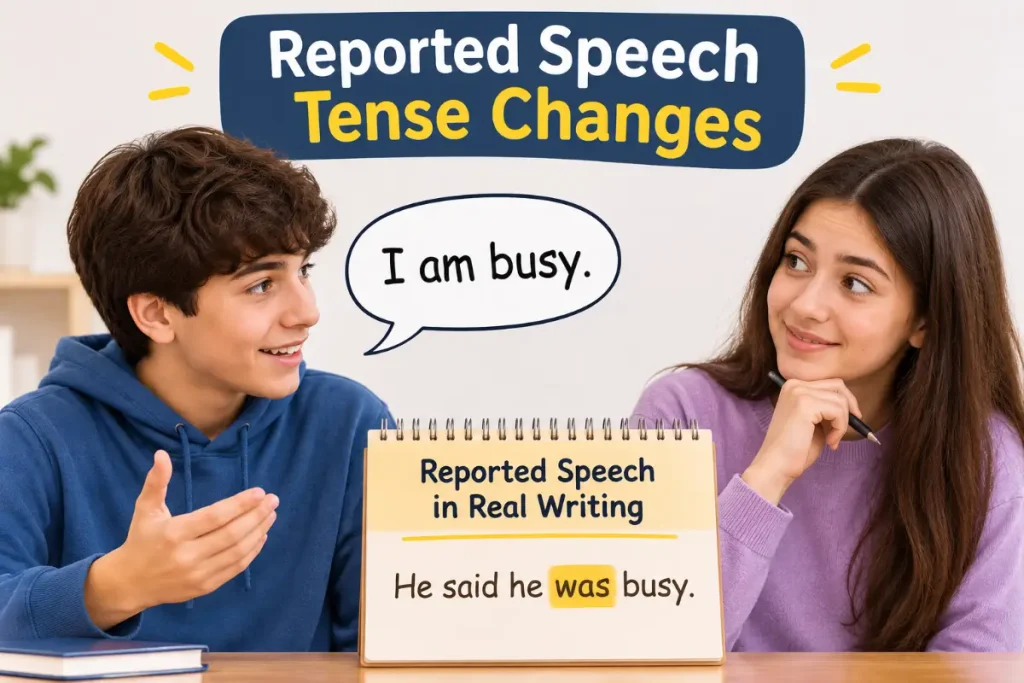
Reported speech tense changes are the verb shifts that happen when you retell what someone said instead of quoting their exact words. “I am tired,” she said becomes She said she was tired, and that small step from “am” to “was” is what grammar books call backshift. It looks like a minor adjustment, yet it’s one of the most searched grammar topics because the rules involve far more than the verb alone.
This guide covers the full backshift chart, the extra words that change alongside tense (pronouns, time words, and place words), the situations where you can skip the shift entirely, and how questions and commands are reported. You’ll also see how reported speech works in news writing, business emails, and fiction, followed by 20 practice sentences with answers so you can test what you’ve learned.
You may also find 7 Present Continuous Tense Rules (2026 Guide) helpful if you want to explore this topic further.
Why the Tense Changes at All
Direct speech captures words exactly as they were spoken, from the speaker’s own point in time. Reported speech, also called indirect speech, retells those words later, from a new point in time. Because the retelling happens after the original moment, English moves the verb back one step to signal that distance.
Picture a timeline. On Monday, Maria says, “I’m leaving.” On Friday, you tell a friend about it. If you say Maria said she is leaving, your friend may assume she’s leaving right now, in the present. If you say Maria said she was leaving, the past tense places her statement firmly behind you, in Monday’s conversation.
The British Council’s LearnEnglish page on reported speech describes the same pattern: when the reporting verb is in the past, the verb in the reported clause usually moves one step further back in time. Think of backshift as a tool that keeps your timeline honest, not as an arbitrary rule to memorize.
The Backshift Chart
| Direct Speech | Reported Speech | Example |
|---|---|---|
| present simple | past simple | “I work late” → He said he worked late. |
| present continuous | past continuous | “I’m working” → He said he was working. |
| present perfect | past perfect | “I’ve finished” → He said he had finished. |
| present perfect continuous | past perfect continuous | “I’ve been waiting” → He said he had been waiting. |
| past simple | past perfect | “I finished” → He said he had finished. |
| past continuous | past perfect continuous | “I was working” → He said he had been working. |
| will | would | “I’ll call” → He said he would call. |
| am/is/are going to | was/were going to | “I’m going to quit” → He said he was going to quit. |
| can | could | “I can help” → He said he could help. |
| may | might | “I may leave” → He said he might leave. |
| must | had to (or must) | “I must go” → He said he had to go. |
Notice that the past simple and the present perfect both turn into the past perfect. That’s the one spot where two different direct forms merge, so the reported version can’t always tell you which one the speaker originally used. Context usually fills the gap.

A Five-Step Method You Can Use Every Time
Instead of memorizing everything at once, work through these steps in order.
- Check the reporting verb. If it’s in the past (said, told, asked), backshift is the default.
- Change the pronouns so they match the new point of view.
- Backshift the verb using the chart above.
- Adjust the time and place words (now becomes then, tomorrow becomes the next day).
- Clean up the punctuation. Remove the quotation marks, and add “that” if you like (it’s optional).
Worked example one.
- Direct: “I’ll meet you here tomorrow,” Sam told me.
- Pronouns: “I” becomes “he,” “you” becomes “me.”
- Backshift: “will” becomes “would.”
- Time and place: “here” becomes “there,” “tomorrow” becomes “the next day.”
- Result: Sam told me he would meet me there the next day.
Worked example two.
- Direct: “We’ve already sent the invoice, and we’re waiting for payment,” the accountant said.
- Backshift: “have sent” becomes “had sent,” “are waiting” becomes “were waiting.”
- Result: The accountant said they had already sent the invoice and were waiting for payment.
Running through the steps slowly a few times builds the habit until it happens automatically.
Verbs That Don’t Change
Some forms already sit far enough back in time, so they stay as they are.
- Past perfect stays past perfect: “I had eaten” → She said she had eaten. English has no tense further back, so nothing shifts.
- Would, could, should, might, and ought to stay the same: “You should rest” → He said I should rest.
- Used to stays the same: “I used to smoke” → He said he used to smoke.
- Unreal conditionals often keep their form: “If I were you, I’d apologize” → She said that if she were me, she’d apologize.
If you want to understand why “were” appears in that last example, our guide to subjunctive mood examples explains it in detail.
Pronouns Follow the Viewpoint
When you retell someone’s words, pronouns usually change because the speaker and listener are no longer the same people. There’s no fixed table, because the correct pronoun depends on who is reporting to whom.
- “I love my job,” Priya said. → Priya said she loved her job.
- “You should call me,” he told her. → He told her she should call him.
- “We’re proud of you,” they said to us. → They told us they were proud of us.
When you report your own words, “I” stays “I”: “I’ll help,” I said. → I said I would help. Always ask who is speaking, who is listening, and who is retelling.
Time and Place Words
| Direct | Reported |
|---|---|
| now | then |
| today | that day |
| tonight | that night |
| yesterday | the day before / the previous day |
| tomorrow | the next day / the following day |
| last week | the week before / the previous week |
| next month | the following month |
| ago | before |
| here | there |
| this / these | that / those |
These changes happen because “tomorrow” is anchored to the day someone spoke, not the day you’re retelling it. If Maria says “I’ll call tomorrow” on Monday and you report it on Friday, “tomorrow” would point to Saturday, which is wrong. “The next day” correctly means Tuesday.
If you’re reporting on the same day, or the time word still works from your point of view, you can leave it alone: She said this morning that she was tired needs no adjustment.
When Backshift Is Optional
Backshift is the default, but not a mandatory law. You can skip it in these situations.
The reporting verb is in the present or future. She says she’s busy. He’ll tell you he’s fine. There’s no past distance to mark, so the verb stays as it was.
The statement is still true or still relevant. “The meeting is at three,” he said. → He said the meeting is at three (if it hasn’t happened yet). Backshifting (was at three) is also acceptable but can suggest that the plan has changed.
The statement is a general truth. “Water freezes at 0°C,” the teacher said. → The teacher said water freezes at 0°C.
You’re reporting something said moments ago. “I’m hungry,” she said just now. → She said she’s hungry.
A small warning: keeping the present tense makes a claim that the statement is still true as you speak. He said he lives in Denver implies he still does. He said he lived in Denver leaves that open. Choose the version that matches what you actually mean.
Reporting Verbs Beyond “Said”
“Said” is the neutral workhorse, but other reporting verbs add meaning and often change the grammar pattern that follows.
| Verb | Pattern | Example |
|---|---|---|
| say | said (that) + clause | She said she was ready. |
| tell | told + person + (that) + clause | She told me she was ready. |
| explain | explained (that) + clause | He explained that the system had crashed. |
| admit | admitted (that) + clause, or admitted + -ing | He admitted breaking the vase. |
| promise | promised (that) + would, or promised + to + verb | She promised to call. |
| warn | warned + person + (not) to + verb | He warned us not to touch it. |
| suggest | suggested (that) + clause, or suggested + -ing | She suggested leaving early. |
| deny | denied + -ing | He denied taking the money. |
| insist | insisted (that) + clause | They insisted that it was safe. |
Note the difference between “said” and “told.” She told me requires a person. She said me is wrong; you need either she said to me or she told me. Choosing a precise reporting verb also lets you drop the quotation’s tone (“shouted,” “whispered”) into one word.
Reporting Questions
Questions change in three ways when reported: the tense backshifts, the word order becomes statement order, and the question mark disappears.
Yes/no questions use if or whether:
- “Are you ready?” he asked. → He asked if I was ready.
- “Did she call?” they wondered. → They wondered whether she had called.
Wh-questions keep the question word but use normal statement order, with no “do/does/did”:
- “Where do you live?” she asked. → She asked where I lived.
- “What time did the meeting start?” he asked. → He asked what time the meeting had started.
The reported question ends with a period, not a question mark, because the whole sentence is a statement about a question: She asked where I lived.
Reporting Commands, Requests, and Advice
Commands and requests use a reporting verb plus a person plus a to-infinitive. Negative commands use not to.
- “Close the door,” she said. → She told me to close the door.
- “Please sit down,” he said. → He asked us to sit down.
- “Don’t touch that!” she shouted. → She told him not to touch that.
- “You should see a doctor,” I said. → I advised her to see a doctor.
“Let’s” suggestions can be reported with suggested plus -ing or a that clause: “Let’s leave early,” she said. → She suggested leaving early.
Reported Speech in Real Writing
News writing leans heavily on “said,” usually in the past tense, because it’s neutral and unobtrusive. Headlines often switch to the present: Mayor says budget will pass.
Business emails often report decisions and conversations: Maria said the budget had been approved, and she asked us to send the revised schedule by Friday. Clear backshift helps readers see the order of events.
Academic writing uses reporting verbs like argued, noted, and suggested. Depending on the style guide, writers may report published research in the present (Smith argues that…) or the past (Smith found that…), so check the rules for your field.
For another useful perspective, check out Zero Conditional Sentences Examples: 2026 Grammar Guide.
Fiction blends direct dialogue with reported speech to control pacing. Summarizing a long conversation in a sentence of reported speech keeps the story moving. For the formatting side of direct quotes, see our guide on how to punctuate dialogue.
Common Mistakes People Make
Mistake 1: Skipping backshift when the speech is clearly in the past. She said she is tired sounds odd if the tiredness is old news. Use was tired.
Mistake 2: Keeping the original time words. She said she was leaving tomorrow can mislead. In retold speech, use the next day.
Mistake 3: Keeping question word order. She asked where did I live is wrong. Use statement order: where I lived.
Mistake 4: Using quotation marks with reported speech. Reported speech never uses quotation marks.
Mistake 5: Shifting a past perfect further back. “I had eaten” stays She said she had eaten. There is nothing earlier to move to.
Mistake 6: Writing “said me.” Use told me or said to me.
Mistake 7: Mixing tenses inside the reported clause. He said he was working and will finish soon breaks the pattern. Keep it consistent: was working and would finish soon.
Practice Exercise
Convert each sentence to reported speech. Answers follow.
- “I am tired,” she said.
- “We live in Denver,” they told me.
- “I have finished,” he said.
- “I went to the store,” she said.
- “I will call you tomorrow,” he said.
- “I can help,” she said.
- “I’m working on it,” he said.
- “We must leave now,” they said.
- “I may be late,” she said.
- “It rained yesterday,” he said.
- “I haven’t seen him,” she said.
- “Water boils at 100°C,” the teacher said. (still true)
- “I was waiting for hours,” he said.
- “We’re leaving today,” they said.
- “I love this place,” she said. (still true)
- “I should go,” he said.
- “I’ll be here,” she said.
- “I’m busy,” he says.
- “I don’t know,” she said.
- “We had already eaten,” they said.
Answer Key
- She said (that) she was tired.
- They told me (that) they lived in Denver.
- He said he had finished.
- She said she had gone to the store.
- He said he would call me the next day.
- She said she could help.
- He said he was working on it.
- They said they had to leave then.
- She said she might be late.
- He said it had rained the day before.
- She said she hadn’t seen him.
- The teacher said water boils (or boiled) at 100°C.
- He said he had been waiting for hours.
- They said they were leaving that day.
- She said she loves (or loved) this place.
- He said he should go.
- She said she would be there.
- He says he is busy.
- She said she didn’t know.
- They said they had already eaten.
Frequently Asked Questions
Do I always have to backshift in reported speech?
No. Backshift is the default when the reporting verb is in the past, but you can keep the original tense when the reporting verb is present, when the statement is a general truth, or when it’s still true and you want to stress that.
Does “that” have to appear after “said”?
No. “She said that she was tired” and “She said she was tired” mean exactly the same thing. “That” is optional, though it can make long or formal sentences easier to follow.
What’s the difference between “said” and “told”?
“Told” needs a person right after it: She told me she was tired. “Said” doesn’t take that direct object: She said she was tired. If you want to include the listener with “said,” you need “to”: She said to me that she was tired.
What happens to “must” in reported speech?
For obligation, “must” usually becomes “had to”: “I must go” → He said he had to go. It can also stay “must,” especially for strong deductions or when the obligation still applies.
How do I report a statement that’s still true?
You can keep the present tense, which signals that it’s still true, or you can backshift. Both are correct, so choose the one that reflects what you want to say. She said she lives in Denver tells the listener she probably still does.
Can reported speech include “and” for several statements?
Yes. You can join several reported statements with conjunctions, as long as each verb follows the same backshift pattern. For guidance on joining clauses cleanly, see our guide to using conjunctions correctly.
Before moving on, you may also want to read Past Participle Examples: 50 Easy Examples to Master Grammar (2026) for more helpful grammar tips.
Wrapping Up
The simplest way to master reported speech tense changes is to remember that backshift exists to show time distance. Move the verb one step back, adjust pronouns and time words for the new point of view, convert questions to statement order, and skip the shift when the statement is still true or the reporting verb is in the present.
Practice with real conversations: retell something a friend said yesterday, then check each verb against the chart. Because reported speech depends on consistent time logic, it pairs naturally with our sequence of tenses rules, and the earlier-time forms it relies on are covered in our past perfect continuous tense rules.