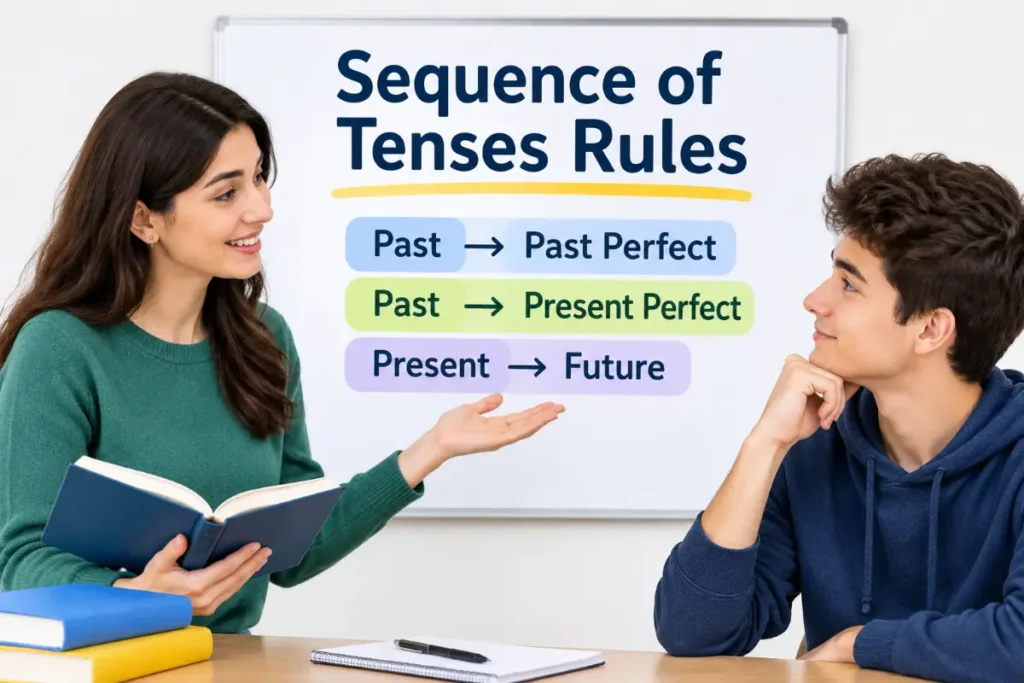
The sequence of tenses rules explain how the verbs in a sentence coordinate with each other so the whole thing tells a story that makes sense in time. When a sentence contains more than one clause, the tense of the first verb often decides which tense the next one needs. Get that coordination wrong and the sentence feels like it jumps between timelines, even if every individual verb is formed correctly.
This guide walks through every major pattern: what happens after a past main verb, how to show which of two past events came first, why English uses the present tense in time clauses about the future, and when facts that stay true can break the usual pattern. You’ll also see how the same logic applies to whole paragraphs, followed by 20 practice items with answers.
You may also find 7 Present Continuous Tense Rules (2026 Guide) helpful if you want to explore this topic further.
The Core Idea: The Main Verb Sets the Anchor
Every complex sentence has a main clause and at least one subordinate clause. The main verb works like an anchor in time, and the subordinate verb has to relate sensibly to it.
- I think that she is right. (present anchor, present verb)
- I thought that she was right. (past anchor, past verb)
- I will think about whether she is right. (future anchor, present verb in the clause)
Notice that the thing being judged, her being right, is the same in all three sentences. What changes is the anchor point from which you describe it. When the anchor moves into the past, the dependent verb usually follows. This is the same logic that drives reported speech tense changes, but it applies to far more than quoting what someone said.
Rule 1: Past Main Verb, Past Dependent Verb
When the main clause is in the past, a dependent clause that refers to the same time frame usually uses a past form too. This is especially common after verbs of speaking, thinking, knowing, and feeling: said, told, thought, knew, realized, believed, hoped, wondered, and discovered.
- He said he would arrive soon. (not will arrive)
- I knew he was lying. (not is lying)
- She told me she could speak Italian.
- We hoped that the weather would improve.
- They discovered that the door had been locked all along.
The “would” in these sentences does a special job: it’s the past version of “will,” often called the future in the past. It lets you talk about something that was still in the future from a past point of view. She knew she would win describes a moment in the past when winning was still ahead.
Rule 2: Use the Past Perfect for the Earlier of Two Past Events
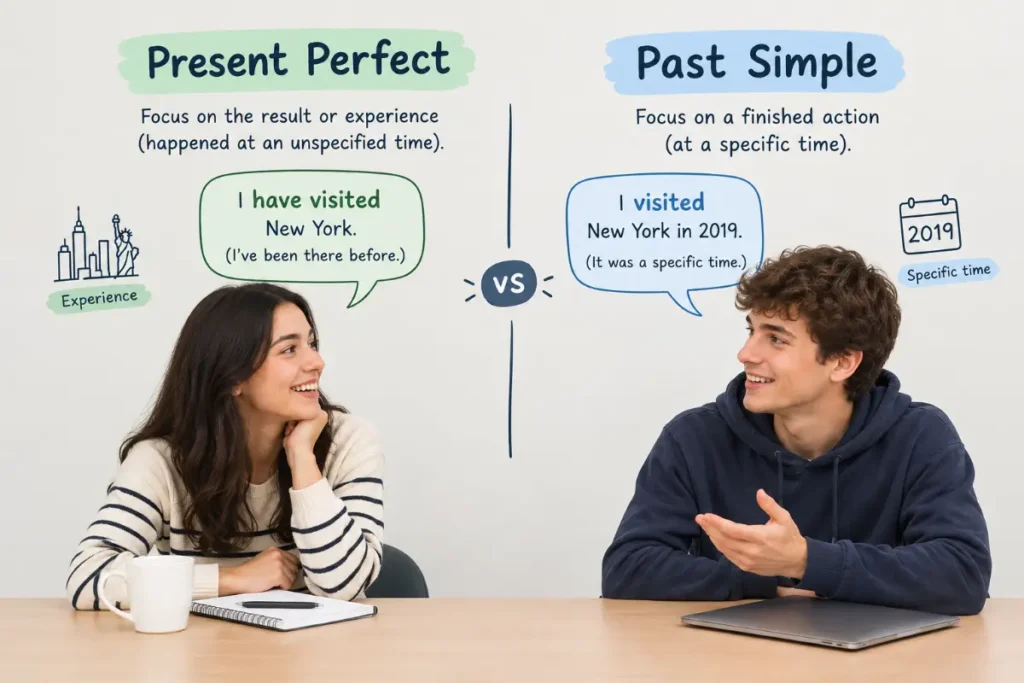
When two past events happened in sequence, the past perfect marks the earlier one. The British Council’s LearnEnglish page on the past perfect describes this tense as the one for something that happened before another point in the past.
- When I arrived, the movie had already started. (the movie started first)
- By the time we called, he had left. (he left first)
- She realized she had left her keys at home. (leaving the keys came first)
- They had finished dinner before the guests arrived.
Compare When I arrived, the movie started, which suggests it began at the moment you walked in, with When I arrived, the movie had started, which says it was already underway. One small verb change reverses the order of events.
Notice, too, that words like before and after already show the order. With them, many writers use the simple past for both events, and the sentence remains clear: She went home after she finished the report. The past perfect becomes essential when nothing else in the sentence signals the order, as in the “when” examples above.
Rule 3: Present or Future Main Verb, Free Choice in the Dependent Clause
If the main verb is present or future, the dependent clause isn’t locked to one tense. Pick whichever fits the meaning.
- I know that she lived in Paris. (past fact, present knowledge)
- I know that she lives in Paris. (present fact)
- He says he will come tomorrow.
- We’ll find out what happened.
- They believe the plan has worked.
This flexibility is why present-tense main verbs rarely cause trouble. The pressure only appears when the main verb moves into the past.

Rule 4: Time Clauses Use the Present for Future Meaning
This is the rule that surprises learners most. After time words such as when, after, before, until, as soon as, once, by the time, and the moment, English uses the present simple to refer to the future, not “will.”
- ✔ I’ll call you when I arrive.
- ✘ I’ll call you when I will arrive.
- ✔ Until the rain stops, we’ll stay inside.
- ✔ As soon as she gets home, she’ll text you.
- ✔ Once you finish the form, send it to me.
The same pattern applies to “if” clauses in first conditional sentences: If it rains tomorrow, we’ll cancel. The “will” lives in the main clause only. For a deeper look at how future forms compete, see our guide on how to use will vs going to.
Rule 5: General Truths and Lasting Facts Can Stay in the Present
If a statement is a general truth or remains true, you don’t have to shift to the past even after a past main verb.
- The teacher explained that the Earth revolves around the sun.
- She said that water freezes at 0°C.
- Galileo argued that the Earth moves.
Using the past in the first two (revolved, froze) is also acceptable, but the present reminds the reader that the fact is still true. Many careful writers prefer the present for scientific facts for exactly that reason.
Rule 6: Comparisons Follow the Meaning, Not the Main Verb
Clauses after than and as don’t automatically copy the main verb’s tense. They follow the time you actually mean.
- He was taller than I am. (I’m still shorter now)
- He was taller than I was. (both at that time)
- She works harder than she did last year.
This is one of the places where the “match the tense” instinct can mislead, so always ask what time each part of the comparison refers to.
Rule 7: Hypothetical and Unreal Situations
Unreal situations use their own pattern, which is separate from simple backshift. After wish and in unreal conditionals, the verb moves back one step to show unreality.
- I wish I had more time. (present wish, past form)
- I wish I had studied harder. (regret about the past, past perfect)
- If she knew, she would tell us. (unreal present)
These patterns are covered in our guides to subjunctive mood examples and the conditional posts in this series. The key point for sequence of tenses is that the tense signals unreality, not necessarily past time.
Rule 8: Relative Clauses Are Independent of the Main Verb
A relative clause (one starting with who, which, or that) describes a noun and follows its own timeline.
- The man who lives next door was a firefighter. (he lives there now; the firefighter job was past)
- The report that she wrote last week impressed everyone.
- I met a woman who works at NASA.
Don’t force the relative clause to match the main verb if the facts differ. Describe each part according to when it’s true.
Keeping a Whole Paragraph Consistent
Sequence of tenses isn’t only a sentence-level skill. Narrative writing needs a stable timeline, too. Pick a frame (past for a story, present for a description or analysis) and stay in it unless the time genuinely changes.
- ✘ She opened the door and sees a stranger standing there. He asked for directions.
- ✔ She opened the door and saw a stranger standing there. He asked for directions.
Legitimate shifts exist. A flashback uses the past perfect for background and the simple past for the main story: He had grown up in Ohio, so the Texas heat shocked him. A writer may also switch to the present for a general truth: She learned that persistence pays off. Fiction sometimes uses the historical present for vividness, and that’s a deliberate stylistic choice, not an error.
The most common accidental shifts happen in long paragraphs, summaries of books or films (where the present is standard), and emails that mix reporting with current updates. Rereading with only the verbs in mind is the fastest way to find them.
Sequence of Tenses in Everyday Professional Writing
Status updates: We finished the first phase last week, and we are now testing the results. Once testing ends, we will send the report. Notice the past for completed work, present for current work, and a present-tense time clause (ends) for the future.
Meeting summaries: Maria said the budget had been approved. She added that the team would receive the revised schedule on Friday. The past perfect marks the earlier approval, and “would” handles the future from a past perspective.
Academic prose: The author argued that earlier studies had overlooked the sample size problem. The past perfect again marks the earlier work.
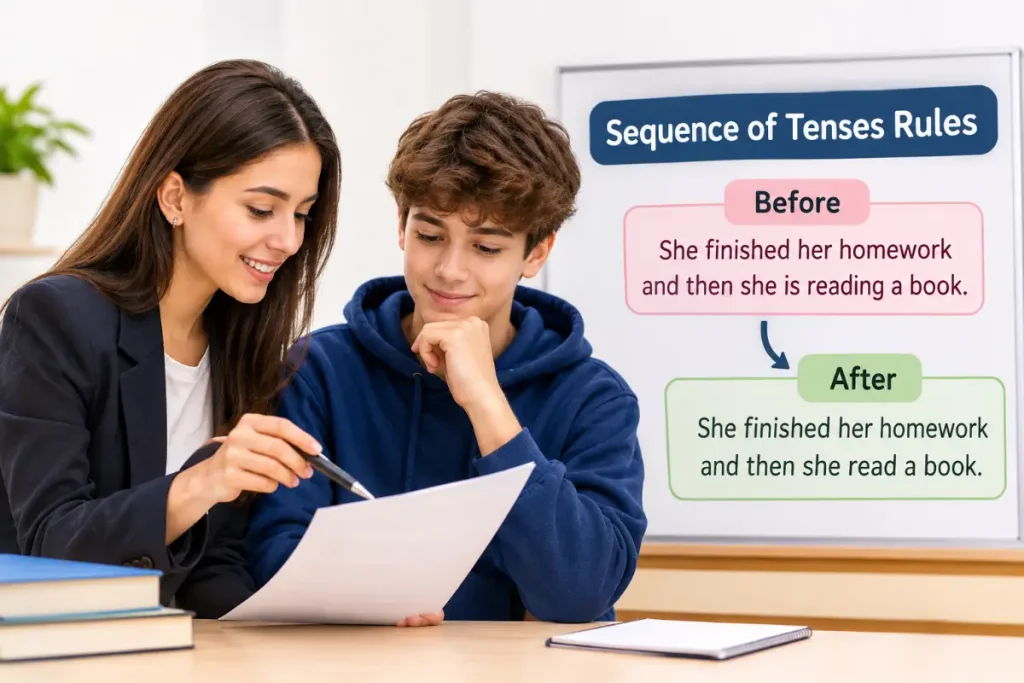
Worked Example: Repairing a Tangled Paragraph
Here’s a short paragraph with several sequence problems, followed by a step-by-step repair.
Last week I went to a meeting where the manager says that the project will be late. She explained that the delay happens because the supplier didn’t send the parts yet. When I will get back to my desk, I wrote an email to the team.
Step 1: Find the anchor. The story is about last week, so the narrative frame is the past. Every verb should relate to that frame.
Step 2: Fix the main verbs. “Says” is the wrong anchor for a past scene. Change it to said.
Step 3: Fix the dependent clauses. After a past main verb, “will be late” becomes would be late. “Happens” becomes was happening or had happened, depending on meaning. “Didn’t send the parts yet” needs the past perfect because the sending (or not sending) came before the explanation: hadn’t sent the parts yet.
Step 4: Fix the time clause. “When I will get back” breaks the time-clause rule, and the verb of the main clause also doesn’t match. Since the whole event is in the past, the clause should read When I got back to my desk.
Repaired version:
Last week I went to a meeting where the manager said that the project would be late. She explained that the delay was happening because the supplier hadn’t sent the parts yet. When I got back to my desk, I wrote an email to the team.
Notice that nothing about the content changed. Only the verbs moved so that each one agreed with the time frame established at the start. This is the real skill behind the rules: you aren’t memorizing patterns, you’re keeping a consistent map of when everything happened.
Quick Reference
| Situation | Pattern | Example |
|---|---|---|
| Past main verb | Past (or past perfect for earlier action) | He said he was tired. |
| Present or future main verb | Any tense that fits the meaning | I think she left already. |
| Time clause with future meaning | Present simple | I’ll call when I arrive. |
| Past main verb + lasting fact | Present allowed | She said Earth revolves around the sun. |
| Earlier of two past events | Past perfect | The show had started when we arrived. |
| Future seen from the past | would | He knew he would succeed. |
Common Mistakes People Make
Mistake 1: Keeping “will” after a past main verb. He said he will come. In past contexts, use would.
Mistake 2: Using “will” in a time clause. I’ll call you when I will arrive. Use when I arrive.
For another useful perspective, check out Use Will vs Going To: Simple Guide (2026).
Mistake 3: Skipping the past perfect when the order matters. When I got there, the show started already. Use had already started.
Mistake 4: Jumping tenses mid-story. He walked in and says hello. Keep one timeline: walked in and said hello.
Mistake 5: Forcing the present after a past verb when the fact is no longer true. She said she lives in Boston misleads if she has moved. Use the past when it’s no longer true.
Mistake 6: Overusing the past perfect. If before or after already makes the order clear, the simple past is usually enough and reads more smoothly.
Mistake 7: Mixing tenses inside one clause chain without a reason. He said he was tired and will go home breaks the pattern. Keep it consistent: would go home.
Practice Exercise
Choose the correct verb. Answers follow.
- I think that she (is/was) right.
- I thought that she (is/was) right.
- He said he (will/would) arrive soon.
- We know that the Earth (revolved/revolves) around the sun.
- The teacher explained that the Earth (revolves/revolved) around the sun.
- I’ll call you when I (arrive/will arrive).
- By the time we got there, the movie (started/had started).
- She said she (has been/had been) waiting for an hour.
- He realized he (left/had left) his keys at home.
- If it rains tomorrow, we (will/would) cancel the trip.
- He asked me whether I (am/was) ready.
- I hope you (have/had) a great trip.
- She told me she (can/could) speak Italian.
- Until the rain (stops/will stop), we’ll stay inside.
- When I arrived, they (already left/had already left).
- I knew he (is/was) lying.
- He says he (will/would) come tomorrow.
- She said she (will/would) be late.
- As soon as she (gets/will get) home, she’ll call.
- I didn’t know that you (are/were) coming.
Answer Key
- is
- was
- would
- revolves
- revolves (revolved is also acceptable)
- arrive
- had started
- had been
- had left
- will
- was
- have
- could (can is acceptable if still true)
- stops
- had already left
- was
- will
- would
- gets
- were
Frequently Asked Questions
Is “sequence of tenses” the same thing as reported speech?
They overlap, but sequence of tenses is broader. Reported speech is one important application. The same coordination also applies to any sentence where one verb sets a time frame for another clause, such as after verbs of thinking, knowing, and hoping.
Why can’t I say “when I will arrive”?
English uses the present simple in time clauses to refer to the future. “Will” belongs in the main clause: I’ll call when I arrive. The same rule applies to after, before, until, as soon as, and once.
Do I always have to shift to the past after a past main verb?
No. When the statement is a general truth or remains true, the present is allowed. She said the Earth revolves around the sun is perfectly correct, and it reminds the reader that the fact still holds.
How do I show that one past event happened before another?
Use the past perfect for the earlier event: When I arrived, the movie had already started. If words like before or after already make the order clear, the simple past often works fine.
What does “would” mean in a sentence like “She knew she would win”?
It’s the future in the past. It describes something that was still in the future from a past point of view. It’s the past counterpart of “will.”
How can I find tense errors in a long document?
Reread it and look only at the verbs. Highlight each one, note the time it refers to, and check whether each shift is deliberate. Shifts that happen mid-sentence or mid-paragraph with no change in time are the usual culprits. For agreement issues you’ll often find in the same pass, see our guide to subject verb agreement rules.
Before moving on, you may also want to read When to Use Past Perfect Tense Practical Guide (2026) for more helpful grammar tips.
Wrapping Up
The sequence of tenses rules come down to a handful of habits: let the main verb set the time frame, use the past perfect for the earlier of two past events, use the present in time clauses for future meaning, and let lasting facts stay in the present. With those four habits, most tense errors disappear, and the remaining ones are usually deliberate stylistic choices.
Because consistency matters across whole paragraphs, make a final reading pass focused only on verbs before you publish anything important. Over time, this check becomes automatic. To keep your clauses properly joined once the tenses line up, our guide to using conjunctions correctly covers the connecting words that carry so many of these time relationships.