Knowing when to use past perfect tense comes down to one situation: you’re telling a story in the past, and one event happened before another. The earlier event gets had plus a past participle, and the later one stays in the simple past. In “When I arrived, the train had left,” the train left first, and my arrival came second.
That’s the whole idea, but the details are where learners and writers slip. When is the past perfect required, and when is it optional? Why does “When I arrived, the train left” mean something different from “When I arrived, the train had left”? And what about reported speech, regrets, and unreal conditions, where the past perfect shows up in places that don’t look like a simple “before and after” story? This guide covers each of these, with examples for every situation.
You may also find 20 Conditional Sentences Examples (2026 Guide) helpful if you want to explore this topic further.
The Core Idea: The Earlier Past
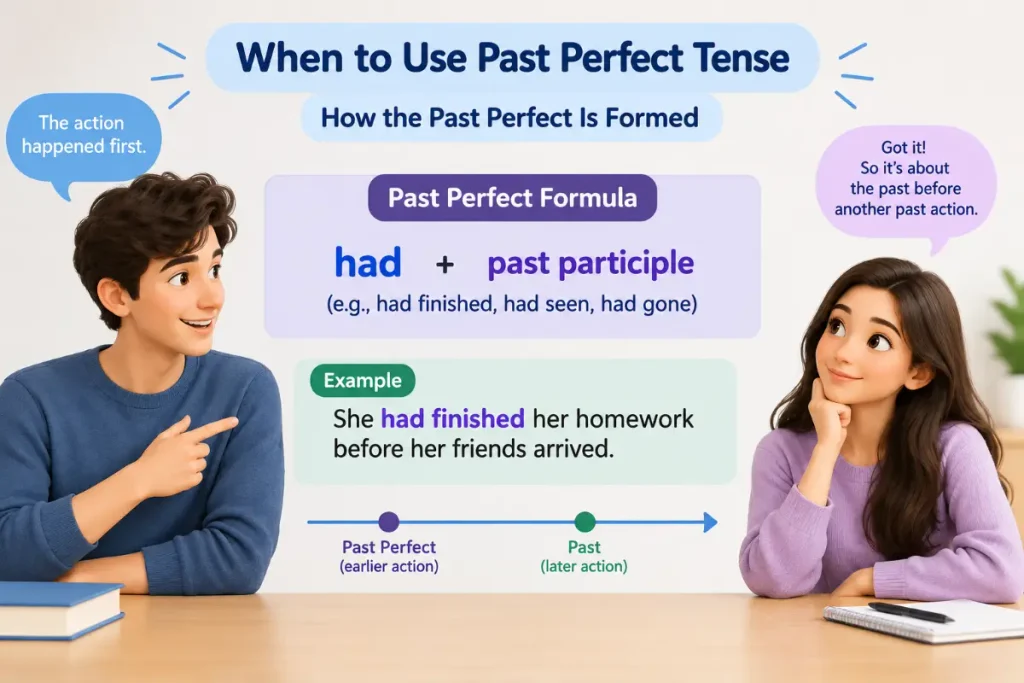
The Athabasca University Write Site defines the past perfect as describing an action that ended before another action or time in the past. Its pattern is had plus the past form of the main verb, which grammar books call the past participle.
- By the time we got to the theater, the show had started.
- She had finished her homework before she watched TV.
Think of it as a “past of the past.” The simple past tells the story, and the past perfect steps back to something that happened earlier than the point you’re describing.
| Earlier event | Later event |
|---|---|
| the show had started (past perfect) | we got to the theater (simple past) |
| she had finished her homework (past perfect) | she watched TV (simple past) |
How the Past Perfect Is Formed
The form doesn’t change with the subject: had + past participle.
- I had left.
- She had finished.
- They had eaten.
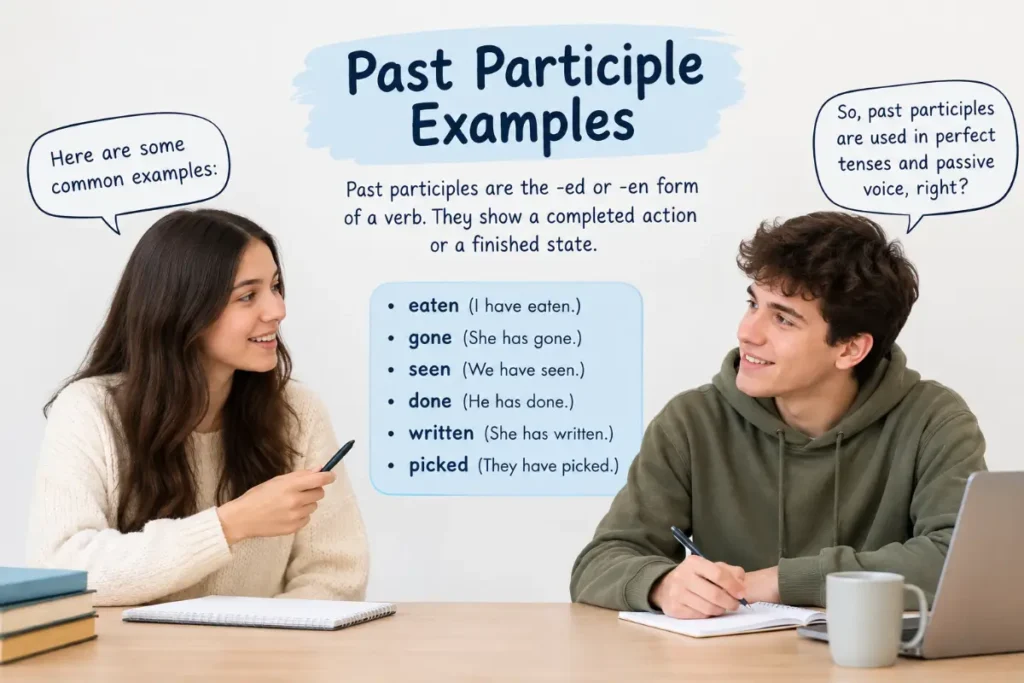
The contraction is ‘d (I’d left, she’d finished), the negative is hadn’t or had not, and questions invert the subject: Had you finished? Irregular verbs need their special participles, so write “had gone,” not “had went,” and “had written,” not “had wrote.” Our list of irregular verbs covers them, and our guide to past participle examples shows how the participle works across tenses.
Seven Situations That Call for the Past Perfect
1. The Earlier of Two Past Events
This is the classic use. When two past events are in the same sentence and the order matters, the earlier one takes the past perfect.
- I didn’t recognize him because he had cut his hair.
- She realized she had left her wallet at home.
- When the police arrived, the thief had already escaped.
2. An Action Finished Before a Specific Past Time
When a past time is named, the past perfect shows something already complete by then.
- By 5 p.m. yesterday, the team had completed the project.
- She had already gone to bed by ten o’clock.
3. After Signal Words Like Before, By the Time, Already, and Until Then
The Athabasca chart lists the time clues that go with the past perfect: before, already, by the time, until then, and after. When you see these in a past-tense story, check whether an earlier action needs the past perfect.
- Before she moved to Denver, she had lived in four states.
- By the time I got home, everyone had gone to bed.
- We had already eaten when they arrived.
4. Reported Speech
When you report what someone said earlier, the original past tense “backshifts” into the past perfect.
- Direct: “I finished the report.”
- Reported: She said she had finished the report.
- Direct: “We lost the keys.”
- Reported: They told me they had lost the keys.
5. Unreal Past Situations (the Third Conditional)
The past perfect appears in the if-clause when you talk about something that didn’t happen in the past.
- If I had known, I would have helped.
- If she had studied, she would have passed.
The result clause uses would have plus a past participle. This is the pattern behind regret and “what if” statements about the past.
6. Wishes and Regrets About the Past
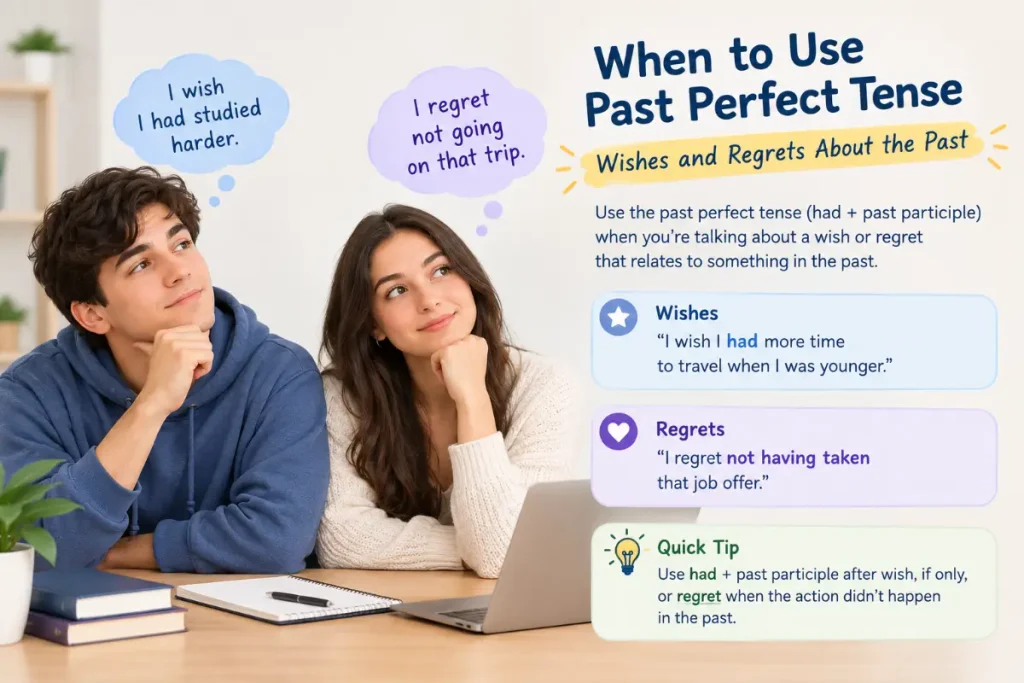
After wish, the past perfect expresses regret about something that didn’t happen.
- I wish I had studied harder.
- She wishes she had taken the job.
7. “The First Time” and Similar Constructions
When you describe an experience in the past that you’d never had before, the past perfect often follows.
- It was the first time I had seen snow.
- She had never visited Paris before last summer.
Formal Patterns: Hardly… When and No Sooner… Than
In formal or literary writing, the past perfect appears after inverted negative openings.
- Hardly had she sat down when the phone rang.
- No sooner had we left than it started to rain.
Notice the inversion: had comes before the subject. These patterns are rare in everyday speech but common in fiction and formal writing.
The Difference It Makes: Simple Past vs. Past Perfect
Sometimes both tenses are grammatically correct but tell different stories. Compare:
- When I arrived, the train left. (the train left after I arrived, probably because I saw it go)
- When I arrived, the train had left. (it was already gone before I got there)
- When she called, he left. (the call came first, and then he left)
- When she called, he had left. (he was gone before she called)
The past perfect changes the order of events. That’s why it matters: leaving it out can reverse the meaning of the sentence.
When You Don’t Need the Past Perfect
The past perfect is not a mandatory marker for every earlier event. It isn’t needed when the order is already clear.
- After she left, we ate dinner. (after already shows the order)
- She left, and then we ate dinner. (a story told in chronological order)
When a story is told in the order events happened, the simple past is enough. Using the past perfect everywhere can make writing feel heavy.
It’s also wrong when there’s no earlier event to anchor it:
- Incorrect: I had gone to the store yesterday.
- Correct: I went to the store yesterday.
A single past event with a finished time like “yesterday” takes the simple past.
Past Perfect vs. Present Perfect
Both use a form of have plus a past participle, but they relate to different moments. The present perfect connects an earlier action to now, while the past perfect connects it to an earlier past moment.
| Present Perfect | Past Perfect |
|---|---|
| I have lost my keys. (they’re still missing) | I had lost my keys, but I found them. (the problem was earlier) |
| She has finished. (she’s done now) | She had finished before we arrived. (done before a past moment) |
Our guide to present perfect vs past simple covers the present perfect in depth.
Where Adverbs Go
Adverbs like already, just, never, and ever sit between had and the participle.
- She had already eaten.
- They had never met.
- He had just left.
The Past Perfect Continuous
When the earlier action was ongoing, use had been plus an -ing verb. The Athabasca chart describes this as an action that happened over time, in the past, before another time or action in the past.
- He had been cooking for a long time before he took lessons.
- She had been waiting for an hour when the bus finally came.
Time words like for and since often appear with it. Use it when the duration matters, and use the plain past perfect when the completion matters.
Quick Reference Table
| Situation | Example |
|---|---|
| Earlier of two past events | He had left before I called. |
| Finished by a past time | By noon, she had finished. |
| After before, by the time, already | We had already eaten. |
| Reported speech | She said she had finished. |
| Unreal past (third conditional) | If I had known, I would have helped. |
| Wish or regret | I wish I had studied. |
| First-time experience | It was the first time I had seen snow. |
| Ongoing earlier action | She had been waiting for an hour. |

Common Mistakes People Make
Mistake 1: Using the past perfect for a single past event, as in “I had gone to the store yesterday.”
Mistake 2: Using the simple past when the order of events matters, which can reverse the meaning: “When I arrived, the train left.”
Mistake 3: Using the base form or the simple past after had, as in “had go” or “had went.”
Mistake 4: Using would have in the if-clause, as in “If I would have known,” instead of “If I had known.”
Mistake 5: Overusing the past perfect in a story that’s already in chronological order.
For another useful perspective, check out Sequence of Tenses Rules: 8 Key Rules To Master It in 2026.
Mistake 6: Mixing the past perfect with a present-time word, as in “I had seen him today,” when the sentence needs the present perfect or simple past.
Practice Exercise
Choose the correct form or follow the instruction. Answers are listed right after, so try each one before checking.
- By the time we arrived, the movie (started/had started).
- She (finished/had finished) her homework before she watched TV.
- When I called, he (left/had left) already.
- I didn’t recognize him because he (cut/had cut) his hair.
- She said she (finished/had finished) the report.
- If I (knew/had known), I would have helped.
- I wish I (studied/had studied) harder.
- It was the first time I (saw/had seen) snow.
- They (never visited/had never visited) Paris before last summer.
- He was tired because he (worked/had worked) all night.
- Yesterday, I (went/had gone) to the store.
- Fix: She had finished yesterday.
- Hardly (she had sat/had she sat) down when the phone rang.
- By 5 p.m. yesterday, the team (completed/had completed) the project.
- When we got to the theater, the show (started/had started). It began before we arrived.
- Which means the train left first? (a) When I arrived, the train left. (b) When I arrived, the train had left.
- She realized she (left/had left) her wallet at home.
- He (studied/had been studying) for hours when the power went out.
- We (didn’t see/hadn’t seen) each other for years before we met at the reunion.
- Fix: She said that she has finished the report an hour earlier.
Answer Key
- had started
- had finished
- had left
- had cut
- had finished (reported speech)
- had known (third conditional)
- had studied (regret)
- had seen (“first time”)
- had never visited
- had worked (the earlier cause)
- went (a single past event, finished time)
- She finished yesterday. (no earlier event to anchor the past perfect)
- had she sat (inversion after “hardly”)
- had completed (finished before a specific past time)
- had started
- (b)
- had left
- had been studying (an ongoing earlier action)
- hadn’t seen
- She said that she had finished the report an hour earlier. (backshift in reported speech)
Frequently Asked Questions
Do I always need the past perfect when one past event happens before another?
No. If the order is clear from words like before or after, or from telling events in chronological order, the simple past is enough. Use the past perfect when the order would otherwise be unclear or when you want to emphasize that one action was complete first.
What’s the difference between “had gone” and “went”?
“Went” is the simple past, used for a finished action in a story. “Had gone” shows that the going happened before another past event or time: “When I arrived, she had gone.”
Is “If I would have known” correct?
It’s common in speech, but standard written English uses the past perfect in the if-clause: “If I had known.” The would have belongs in the result clause.
Can I use the past perfect with a specific past time like “yesterday”?
Only when it’s the earlier of two past events or marks completion by that time, as in “By noon yesterday, she had finished.” A single event on “yesterday” takes the simple past.
How is the past perfect different from the present perfect?
The present perfect links a past action to now, while the past perfect links it to an earlier moment in the past. The auxiliary shows which: have/has for the present perfect, had for the past perfect.
Before moving on, you may also want to read Present Perfect Continuous Tense Examples: 30+ Real-Life Uses for more helpful grammar tips.
Final Thoughts
The answer to when to use past perfect tense is simpler than its many uses suggest: use it for the earlier of two past events, or for something already complete by a past moment. Reported speech, wishes, and the third conditional all apply the same idea, stepping back one tense from the story’s main timeline.
Keep two habits in mind. First, check whether the order of events could be misread, because the past perfect can reverse a sentence’s meaning. Second, don’t overuse it, since a story told in chronological order usually needs only the simple past. Used sparingly and precisely, the past perfect is what makes timelines in writing clear.