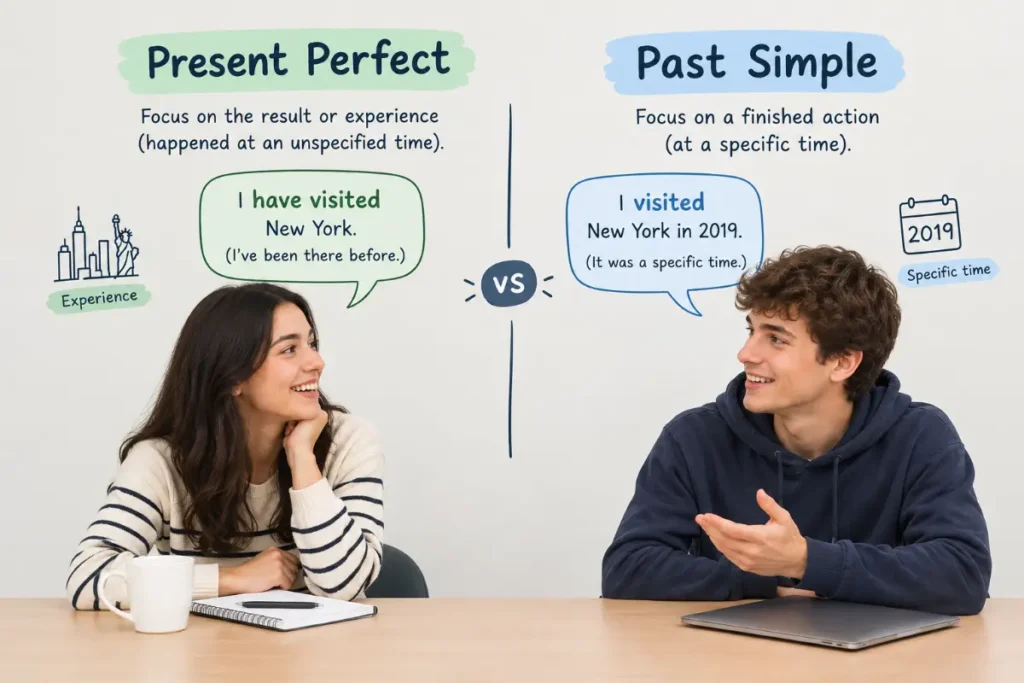
The difference between present perfect vs past simple comes down to one question: does the action still connect to now? “I lost my keys” is a simple past statement about something that happened. “I have lost my keys” tells the listener the keys are still missing, so the past action matters to the present moment.
Both tenses describe things that have already happened, which is exactly why they get confused. Writers pick one by feel and often choose wrong, especially when a time word like “yesterday” or “since” is in the sentence. This guide covers how each tense is formed, the five situations that call for the present perfect, the situations that demand the simple past, and the time expressions that decide the choice almost every time.
You may also find Clear Guide: Simple Past vs Past Continuous (2026) helpful if you want to explore this topic further.
Present Perfect vs Past Simple: Everyday Examples
The easiest way to understand present perfect vs past simple is to compare how people use these tenses in everyday conversations. Both talk about past actions, but the meaning can change depending on whether the action connects to the present or happened at a finished time.
| Present Perfect | Simple Past |
|---|---|
| I have lost my phone. (I still can’t find it.) | I lost my phone yesterday. (The time is clear.) |
| She has finished her homework. (It’s ready now.) | She finished her homework last night. |
| We have visited New York. (It’s part of our experience.) | We visited New York in 2024. |
| He has worked here for five years. (He still works here.) | He worked here for five years. (He doesn’t work here anymore.) |
| Have you eaten yet? | Did you eat yesterday? |
Notice how the time or meaning changes the tense. If you mention a finished time, such as yesterday or in 2024, use the simple past. If you talk about an experience, an unfinished period, or a result that matters now, the present perfect is often the better choice.
Here is another everyday example:
- Present perfect: “I’ve cleaned the kitchen.” This tells someone the kitchen is clean now.
- Simple past: “I cleaned the kitchen this morning.” This tells someone when the action happened.
In casual conversation, the surrounding context also helps people understand which tense sounds right. When in doubt, check whether you’re focusing on a finished past event or its connection to the present.
Common Time Words Used With Each Tense
Time expressions can help you choose between the present perfect and the simple past. Some words point to a finished time, while others suggest a period that continues or a connection to the present.

Time Words for the Present Perfect
Use these words and phrases when talking about experiences, recent events, or actions connected to now.
- Ever: Have you ever tried Korean food?
- Never: I’ve never ridden a horse.
- Already: She has already sent the email.
- Yet: Have you finished your homework yet?
- Just: He has just arrived.
- So far: We’ve completed four tasks so far.
- Since: I’ve known her since 2020.
- For: They have lived here for three years.
- This week: I’ve read two books this week. (The week is still in progress.)
Time Words for the Simple Past
Use the simple past with expressions that refer to a finished time.
- Yesterday: I called my friend yesterday.
- Last night: We watched a movie last night.
- Last year: She moved to Texas last year.
- Ago: He left two hours ago.
- In 2020: They bought their house in 2020.
- On Monday: I met my teacher on Monday.
- When I was young: I played outside every day when I was young.
One common mistake is using the present perfect with a finished-time expression.
- Incorrect: I have visited London last year.
- Correct: I visited London last year.
However, words such as today, this morning, and this week can work with either tense. The right choice depends on whether the time period is still open and how you view the event.
For example, you might say, “I’ve had two cups of coffee this morning” while it is still morning. If it is now evening, “I had two cups of coffee this morning” is more natural.
Quick tip: Don’t memorize time words alone. Ask yourself whether the time period has ended and whether the action connects to the present. These two questions will help you choose the correct tense more reliably.
Which Tense Is More Common in American English?
Both the present perfect and the simple past are common in American English. The main difference is that Americans often use the simple past in casual conversation where British English speakers may prefer the present perfect.
For example, an American might say:
- “Did you eat yet?”
- “I just finished my homework.”
- “She already left.”
British English speakers are more likely to say:
- “Have you eaten yet?”
- “I’ve just finished my homework.”
- “She’s already left.”
Both forms are widely understood, and the simple past versions are normal in everyday American speech. The choice often depends on the speaker, the situation, and the level of formality.
In formal writing, academic work, and English tests, the present perfect is generally the safer choice when discussing experiences without a specific past time or actions that continue into the present. Use the simple past when you identify a finished time, such as yesterday, last week, or in 2022.
For example:
- Casual American English: “I just saw that movie.”
- Present perfect: “I’ve seen that movie before.”
- Specific past time: “I saw that movie last weekend.”
The most important thing is to focus on the meaning rather than assuming one tense is always better than the other. Once you understand the connection between time and the present, choosing between these two tenses becomes much easier.
The Core Difference in One Table
| Simple Past | Present Perfect | |
|---|---|---|
| Form | verb + -ed, or an irregular past form | have or has + past participle |
| Time frame | finished, over, closed | unfinished, or connected to now |
| Time words | yesterday, last year, in 2019, ago | already, yet, ever, never, since, for, so far |
| Example | I lived in Paris. (not anymore) | I have lived in Paris. (still true, or relevant now) |
If you remember only one rule, remember this one: the simple past looks at a finished period of time, and the present perfect looks at a period that includes now.
How Each Tense Is Formed
Simple Past
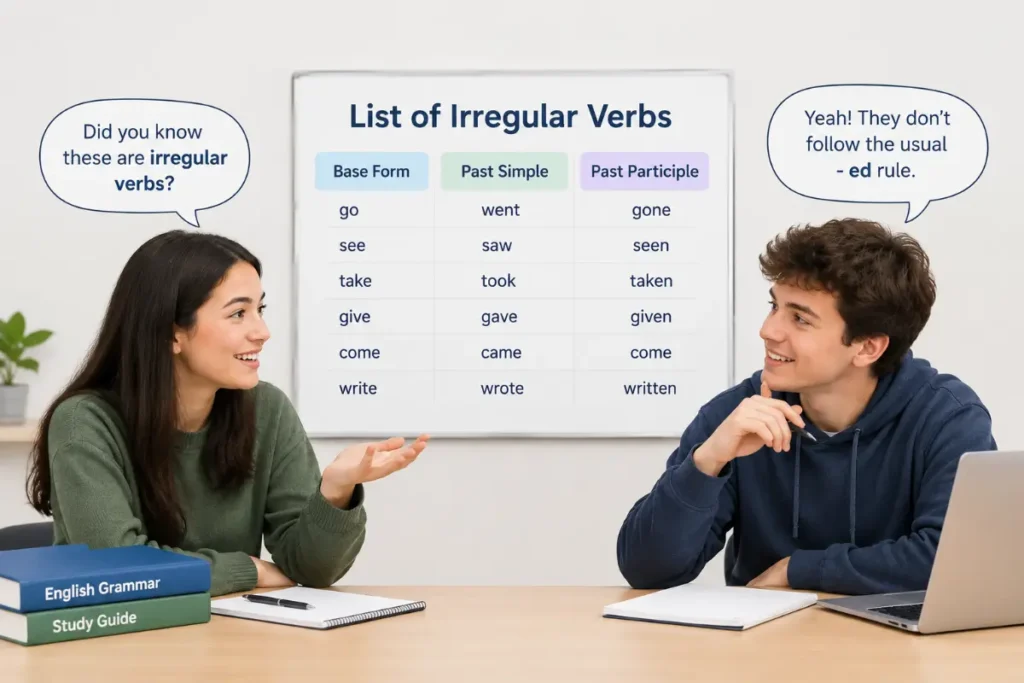
Regular verbs add -ed: walked, played, thanked. Irregular verbs have their own forms: went, saw, wrote, took. Our list of irregular verbs covers the most common ones.
Purdue OWL describes the simple past as the tense for action that was completed in the past without possible continuation or repetition in the present or future. That’s the key idea: the action is finished and sealed off.
- She called yesterday.
- We watched the game last night.
Negatives and questions use did plus the base verb: She didn’t call. Did you watch the game?
Present Perfect
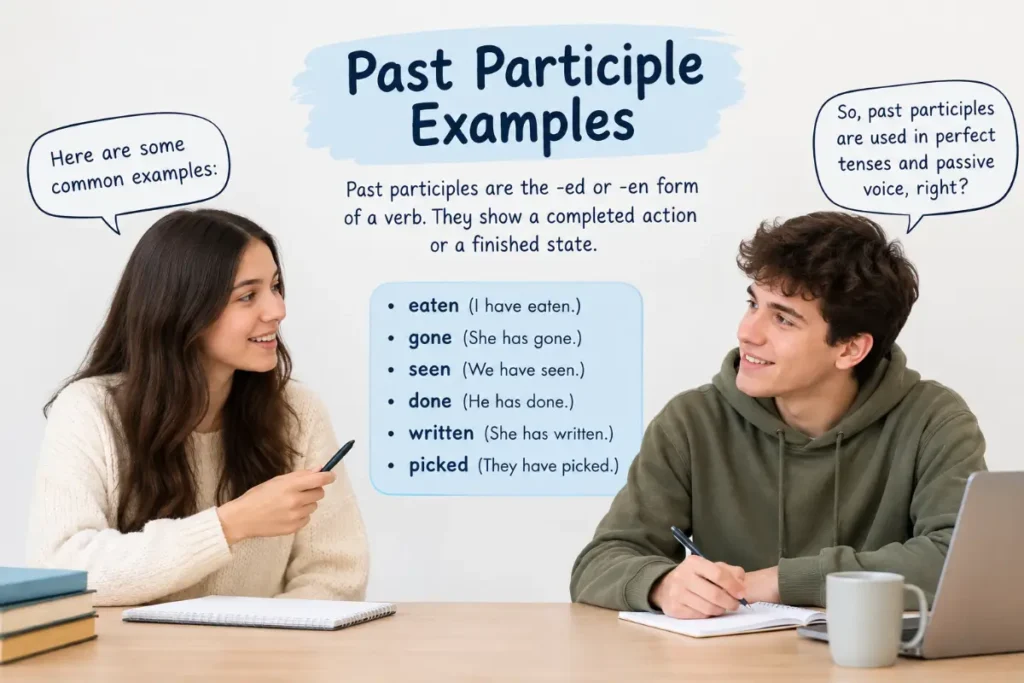
The present perfect uses have or has plus the past participle. Purdue OWL gives the pattern as has or have + past participle, and it’s the tense that connects an earlier action to a present-tense time frame.
- She has called three times.
- We have watched every episode.
For regular verbs, the past participle looks identical to the simple past (walked, played). For irregular verbs the two forms often differ: went versus gone, wrote versus written, ate versus eaten. That difference is the source of mistakes like “I have went” and “she has wrote.”
Negatives and questions put not after the auxiliary or invert it: She hasn’t called. Have you watched it?
The auxiliary has to agree with the subject: I have, you have, we have, they have, but he has, she has, it has. This is the same agreement logic covered in our guide to subject verb agreement rules.
Five Situations That Call for the Present Perfect
1. Unfinished Time Periods
When the time period you’re talking about hasn’t ended, use the present perfect.
- I have answered twelve emails today. (today isn’t over)
- The team has completed five projects this week. (this week isn’t over)
- She has published two books this year.
Once the period ends, the simple past takes over: She published two books last year.
2. Past Actions With a Present Result
Use the present perfect when something that happened earlier still has an effect now.
- I have lost my wallet. (it’s still missing, so I can’t pay)
- He has broken his arm. (it’s still in a cast)
- They have moved. (they live somewhere new now)
Compare He broke his arm in 2019, a historical fact with no present connection.
3. Life Experience, With No Specific Time
When you mention an experience without saying when it happened, the present perfect is the natural choice.
- I have visited Japan.
- She has never eaten sushi.
- Have you ever seen a meteor shower?
Notice that the moment you name a specific time, the tense switches: I visited Japan in 2018.
4. Actions That Started in the Past and Continue
With for and since, the present perfect shows something that began earlier and is still true.
- I have lived here for six years. (I still live here)
- She has worked at the hospital since 2020.
Use for with a length of time (for six years, for two hours) and since with a starting point (since 2020, since Monday).
5. Recent Events and News
The present perfect often introduces recent news, along with words like just, already, and yet.
- The company has just announced layoffs.
- Have you finished yet?
- I’ve already eaten.
When Only the Simple Past Works
Finished Time Expressions
If a sentence includes a time expression that points to a finished time, the simple past is required.
- I saw her yesterday.
- They moved here in 2015.
- He called two hours ago.
- We met when I was in college.
Narrative Sequences
When you tell a story, the events follow each other in the simple past.
- She opened the door, looked inside, and screamed.
Questions About a Specific Time
Questions with when, what time, or how long ago take the simple past, because they ask about a specific finished moment.
- When did you arrive? (never “when have you arrived”)
- What time did the meeting start?
The Time-Expression Rule That Prevents Most Errors
Matching the time word to the tense fixes the majority of mistakes.
Signals for the present perfect: ever, never, already, yet, just, so far, recently, lately, since, for, today, this week, this year
Signals for the simple past: yesterday, last night, last week, in 2019, two years ago, when I was young, at 5 p.m., on Monday
For another useful perspective, check out Modal Verbs List: What Each One Means and When to Use It.
The classic error is combining the present perfect with a finished-time word.
- Incorrect: I have seen him yesterday.
- Correct: I saw him yesterday.
- Incorrect: She has moved here in 2015.
- Correct: She moved here in 2015.
A sentence can only have one of these relationships to time, so the finished-time word wins.
Same Words, Different Meaning
Sometimes both tenses work grammatically, but they say different things.
- I lived in Paris for five years. (I no longer live there)
- I have lived in Paris for five years. (I still live there)
- She has read that book. (a fact about her experience, perhaps relevant now)
- She read that book last summer. (a specific past event)
- He has lost his keys. (still missing)
- He lost his keys, but he found them. (the problem is over)
Choosing the tense lets you decide whether the action still matters now, which is useful in everything from emails to storytelling.
“Has Gone” vs. “Has Been”
This pair shows how much meaning the tense carries.
- She has gone to Paris. (she’s there now, or on her way)
- She has been to Paris. (she visited at some point and came back)
The first points to a current location, and the second reports past experience.
This Morning, This Week, This Year
Time words with “this” depend on whether the period is still going.
- I have had three coffees this morning. (it’s still morning)
- I had three coffees this morning. (it’s now afternoon or evening)
The same logic works with this week, this month, and this year. The tense follows the real-world time.

American and British Usage
British English tends to use the present perfect with already, just, and yet: Have you eaten yet? I’ve just finished. American English is more relaxed, especially in speech, and often uses the simple past there: Did you eat yet? I just finished. Both are acceptable in everyday usage, though the present perfect is the safer choice in formal writing and for most test or exam contexts.
Keeping Tenses Consistent
Purdue OWL reminds writers to keep a clear primary time frame. When the main narration is in the simple present, an earlier action is usually described in the present perfect, and when the main narration is in the simple past, an earlier action moves to the past perfect (had + past participle). The simple past, by contrast, handles finished actions without that extra connection.
- After everyone has finished the main course, we offer dessert. (present narration, present perfect for the earlier step)
- After everyone had finished the main course, we offered dessert. (past narration, past perfect for the earlier step)
Quick Reference Table
| Situation | Tense | Example |
|---|---|---|
| Finished time (yesterday, in 2019) | Simple past | I saw it yesterday. |
| Unfinished time (today, this week) | Present perfect | I’ve seen it this week. |
| Present result of a past action | Present perfect | I’ve lost my keys. |
| Life experience, no time given | Present perfect | I’ve visited Japan. |
| Started earlier, continues now | Present perfect with for/since | I’ve lived here since 2020. |
| Specific past time | Simple past | I visited Japan in 2018. |
| Question with “when” | Simple past | When did you arrive? |
Common Mistakes People Make
Mistake 1: Pairing the present perfect with a finished time word, as in “I have seen him yesterday.”
Mistake 2: Using the simple past when the situation continues, as in “I lived here for six years” when you still live there.
Mistake 3: Using the wrong past participle, as in “I have went,” “she has wrote,” or “they have ate.”
Mistake 4: Asking “When have you arrived?” instead of “When did you arrive?”
Mistake 5: Mixing up for and since: since takes a starting point, and for takes a length of time.
Mistake 6: Using have with a third-person singular subject, as in “she have finished” instead of “she has finished.”
Practice Exercise
Choose the correct verb form for each sentence. Answers are listed right after, so try each one before checking.
- I (lived/have lived) in Chicago since 2018.
- She (visited/has visited) Rome last summer.
- We (finished/have finished) the report, so you can read it now.
- He (broke/has broken) his arm in 2019.
- (Did you see/Have you seen) my keys? I can’t find them.
- They (moved/have moved) here ten years ago.
- I (never ate/have never eaten) sushi.
- The meeting (started/has started) at nine.
- She (has worked/worked) here for six years, and she still loves it.
- Yesterday I (saw/have seen) a great movie.
- How many emails (did you send/have you sent) so far today?
- We (met/have met) at a conference in 2020.
- He (just left/has just left).
- I (didn’t see/haven’t seen) her since Monday.
- She (wrote/has written) three novels so far.
- When (did you arrive/have you arrived)?
- They (lived/have lived) in Spain for two years, but they moved back in 2022.
- This week, the team (completed/has completed) five projects.
- Shakespeare (wrote/has written) many plays.
- I (lost/have lost) my wallet, so I can’t pay.
Answer Key
- have lived (started in 2018, continues)
- visited (“last summer” is finished time)
- have finished (present result: you can read it now)
- broke (“in 2019” is finished time)
- Have you seen (present relevance: I can’t find them)
- moved (“ten years ago” is finished time)
- have never eaten (life experience)
- started (specific time)
- has worked (continues now)
- saw (“yesterday”)
- have you sent (“today” isn’t over)
- met (“in 2020”)
- has just left (recent news; “just left” is also common in American English)
- haven’t seen (“since Monday” continues to now)
- has written (“so far”)
- did you arrive (question about a specific time)
- lived (a finished period, since they moved back)
- has completed (“this week” isn’t over)
- wrote (Shakespeare’s life is a finished period)
- have lost (present result)
Frequently Asked Questions
Can I use the present perfect with a specific past time?
No. Once you name a finished time, such as “yesterday,” “in 2019,” or “two years ago,” the simple past is required. The present perfect only works when the time is unspecified, unfinished, or the action’s result still matters now.
What’s the difference between “I have lived here for five years” and “I lived here for five years”?
The first says you still live here, since the period continues to now. The second says you lived here for five years but no longer do, since the period is finished.
Why do native speakers sometimes use the simple past where the present perfect is expected?
Mostly in American English and in casual speech, with words like already, just, and yet. “Did you eat yet?” is common in speech, though the present perfect remains the standard choice in formal writing.
How do I know which past participle to use?
Regular verbs use the same form as the simple past (-ed). Irregular verbs have their own participles, so it’s worth keeping a reference list handy for verbs like go/gone, write/written, and eat/eaten.
What’s the fastest way to choose between these two tenses?
Look for a time word. A finished time (yesterday, last year, in 2019, ago) means simple past. An unfinished period or a link to now (since, for, so far, already, yet, ever) means present perfect.
Before moving on, you may also want to read Past Perfect Continuous Tense Rules: Easy Guide 2026 for more helpful grammar tips.
Final Thoughts
Understanding present perfect vs past simple means deciding whether you’re talking about a closed chapter or one that’s still open. The simple past seals an action in a finished time, while the present perfect keeps it connected to now, through an unfinished period, a present result, a life experience, or a situation that continues. Time expressions are the fastest tiebreaker.
The mistakes that matter most are the predictable ones: pairing the present perfect with “yesterday,” using the wrong past participle, and mixing up for and since. Fix those three, and most of your tense choices will land correctly on the first try.