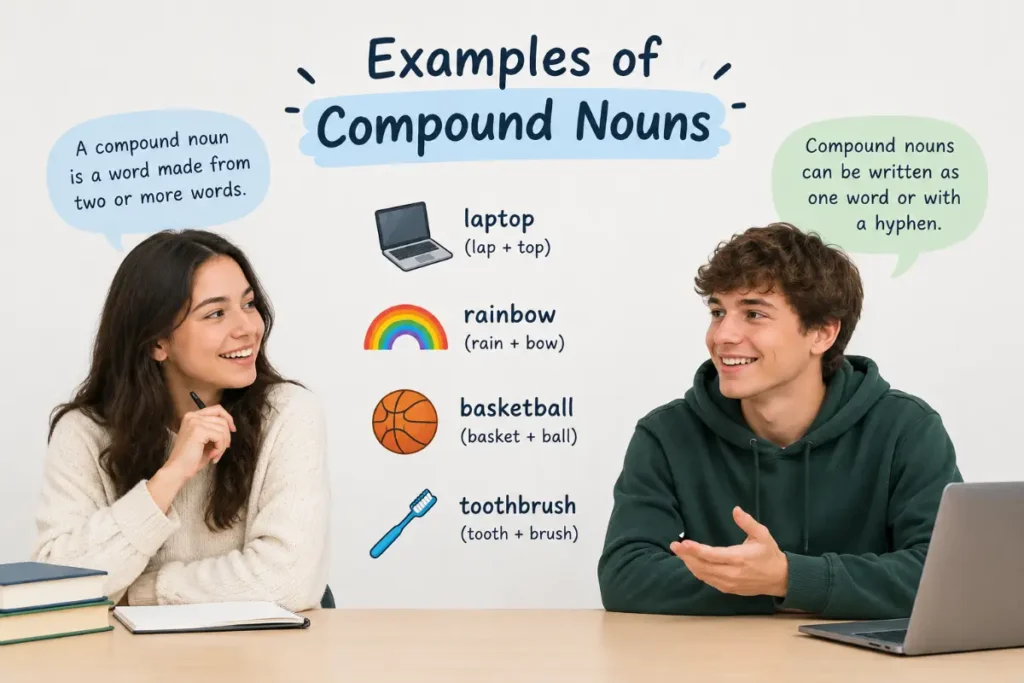
These 30 examples of compound nouns show how English builds new nouns by joining words together: toothbrush, ice cream, mother-in-law. Each one names a single thing, even though it’s made of two or more parts, and each one is spelled one of three ways: as one word, as separate words, or with hyphens.
That spelling choice is where most mistakes happen. Is it “homework” or “home work”? “Cold cuts” or “coldcuts”? And once you’ve got the spelling right, where does the plural -s go in “mother-in-law” or “post office”? This guide sorts the examples into the three forms, shows how compound nouns are built, and gives the plural rules that settle most of the confusion.
You may also find Complete List of Relative Pronouns (2026 Guide) helpful if you want to explore this topic further.
What Counts as a Compound Noun
A compound noun is two or more words that work together as a single noun. Daily Writing Tips sorts them into three kinds (open, closed, and hyphenated) and adds an honest warning: not all authorities agree on which is which, or where the plural goes. Keep that in mind as you read the lists below, because dictionaries sometimes disagree.
- Closed: written as one word (toothbrush)
- Open: written as separate words (ice cream)
- Hyphenated: joined with hyphens (mother-in-law)
10 Closed Compound Nouns
These are written as a single word, with no space or hyphen.
- toothbrush — She replaced her toothbrush.
- bookshelf — The bookshelf is full.
- bedroom — Our bedroom faces the garden.
- haircut — He got a haircut on Friday.
- blackboard — The teacher wrote on the blackboard.
- grasshopper — A grasshopper jumped onto the porch.
- football — They watched football all afternoon.
- toothpaste — We ran out of toothpaste.
- campfire — We sat around the campfire.
- cheesecake — She baked a cheesecake for the party.
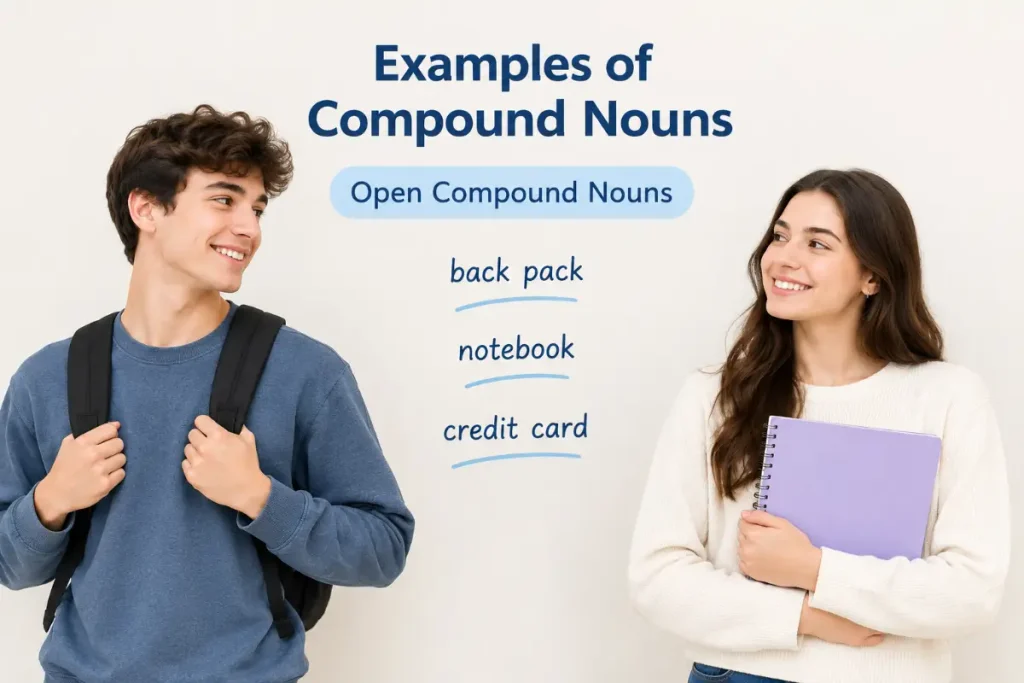
10 Open Compound Nouns
These keep a space between the words but still act as one noun.
- ice cream — The ice cream melted quickly.
- post office — The post office closes at five.
- high school — He teaches at a high school.
- swimming pool — The swimming pool opens in May.
- hot dog — She ordered a hot dog.
- dining room — The dining room seats twelve.
- moon landing — The moon landing happened in 1969.
- dish soap — We need more dish soap.
- bus stop — Meet me at the bus stop.
- cold cuts — The deli sells fresh cold cuts.
10 Hyphenated Compound Nouns
These join their parts with hyphens.
- mother-in-law — My mother-in-law visits often.
- daughter-in-law — Her daughter-in-law lives nearby.
- merry-go-round — The children rode the merry-go-round.
- forget-me-not — A forget-me-not bloomed by the fence.
- stand-in — The understudy was a perfect stand-in.
- free-for-all — The sale turned into a free-for-all.
- ten-year-old — The ten-year-old won the spelling bee.
- check-in — Check-in starts at three.
- go-between — He acted as a go-between for the two companies.
- man-of-war — The man-of-war sailed into the harbor.
Some of these, like check-in, are written as hyphenated or closed depending on the dictionary, which brings us to the core problem.
How Compound Nouns Are Built
Compound nouns come from several word combinations. Here are the common patterns, with examples:
| Pattern | Examples |
|---|---|
| noun + noun | toothpaste, fish tank |
| adjective + noun | bluebird, redhead, high school |
| verb + noun | chopstick, swimsuit |
| noun + verb | haircut, snowfall |
| verb + preposition | check-in, touchdown |
| preposition + noun | bystander, afterlife |
The pattern doesn’t tell you the spelling. Both “toothpaste” (closed) and “fish tank” (open) are noun + noun.
Open, Closed, or Hyphenated? There’s No Fixed Rule
No single rule says which form a compound noun should take, and the safest move is to check a current dictionary. Two facts help explain why.
Forms change over time. Scribbr notes that open compounds tend to become hyphenated or closed as they become more widely used. “Website” and “email” are familiar examples of compounds that settled into closed forms.
Dictionaries disagree. Daily Writing Tips points out that some compounds are hyphenated in the Oxford English Dictionary and written as one word in Merriam-Webster. If a style guide or publisher names a preferred dictionary, follow that one.
One pattern is worth knowing: compound nouns are often hyphenated or closed when they come before another noun and work like an adjective. Many style guides prefer “she attends high school” but “a high-school student.” For more on joining words with hyphens, see our guide to hyphen vs en dash vs em dash.
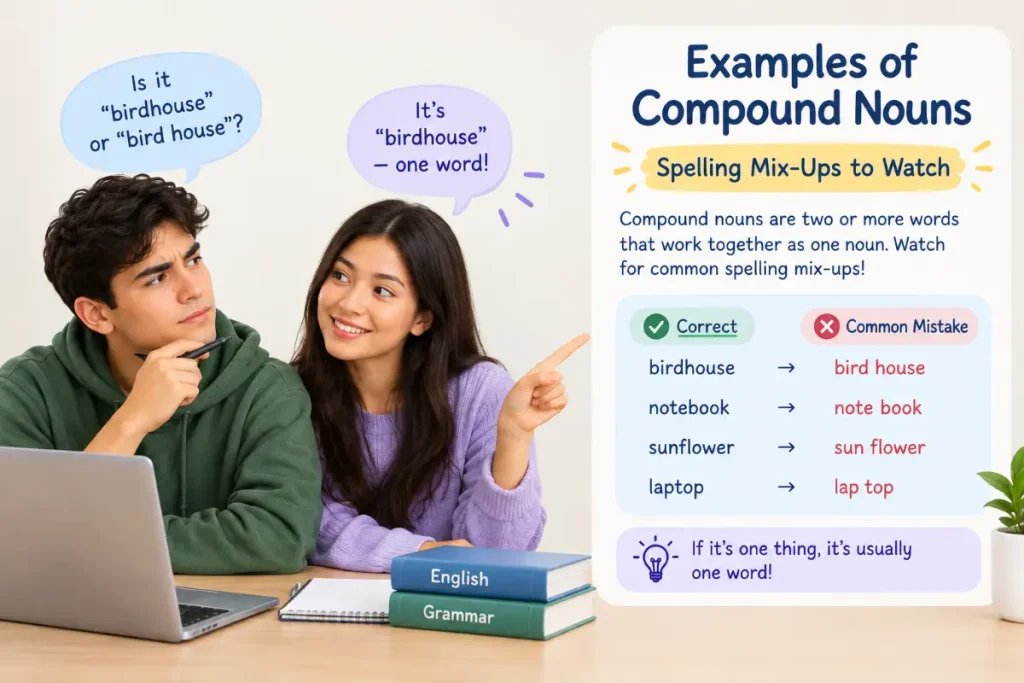
Spelling Mix-Ups to Watch
- homework, not “home work”
- suitcase, not “suit case”
- cold cuts, not “coldcuts”
- never mind, not “nevermind”
These errors run in both directions: some writers close up compounds that should stay open, and others leave a space inside compounds that have become single words.
Compound Noun or Adjective Plus Noun?
Sometimes the closed compound and the two-word phrase mean different things.
- A greenhouse is a building for growing plants. (compound noun)
- A green house is a house painted green. (adjective + noun)
If the combination names one specific thing, it’s a compound noun. If the first word simply describes the second, it’s an ordinary adjective + noun. Our guide to types of adjectives with examples covers the descriptive side, including compound adjectives like “well-known.”
Making Compound Nouns Plural
Daily Writing Tips lays out the pattern clearly.
Closed compounds: add the plural at the end of the word.
- toothbrush → toothbrushes
- bedroom → bedrooms
- haircut → haircuts
Exception: passerby → passersby, where the plural goes on the first part.
Open compounds: pluralize the principal word, which is the main noun.
- post office → post offices
- free lunch → free lunches
- court martial → courts martial (this one is still debated; the source notes that Merriam-Webster also accepts “court martials”)
- inspector general → inspectors general
Hyphenated compounds: pluralize the principal noun.
- mother-in-law → mothers-in-law
- man-of-war → men-of-war
Hyphenated compounds with no principal word: add the plural to the end.
- merry-go-round → merry-go-rounds
- forget-me-not → forget-me-nots
- stand-in → stand-ins
The common thread is to find the main noun and pluralize that. When there isn’t one, the end of the compound takes the -s. Possessives follow the usual apostrophe patterns, such as “my mother-in-law’s car,” covered in our guide to apostrophe rules for plurals.
30 Examples of Compound Nouns in Sentences
Compound nouns join two or more words to name one person, place, thing, or idea. Some are written as one word, some have a space, and others use a hyphen.
Here are 30 examples of compound nouns in sentences. Each example shows how the noun works in everyday English.
For another useful perspective, check out A Conjunction? The 2026 Guide to Types & Uses.
- Toothbrush: I use my toothbrush every morning.
- Bookshelf: My books are on the bookshelf.
- Bedroom: My bedroom is clean and bright.
- Haircut: He got a new haircut.
- Blackboard: The teacher wrote on the blackboard.
- Grasshopper: A grasshopper jumped into the grass.
- Football: We played football after school.
- Toothpaste: I need more toothpaste.
- Campfire: We sat around the campfire.
- Cheesecake: Mom made a cheesecake.
- Ice cream: I ate ice cream after dinner.
- Post office: Dad went to the post office.
- High school: My sister goes to high school.
- Swimming pool: The swimming pool is open today.
- Hot dog: I ate a hot dog for lunch.
- Dining room: We eat dinner in the dining room.
- Moon landing: We learned about the moon landing in class.
- Dish soap: Please buy some dish soap.
- Bus stop: I waited at the bus stop.
- Cold cuts: We made sandwiches with cold cuts.
- Mother-in-law: My mother-in-law came to visit.
- Daughter-in-law: His daughter-in-law lives nearby.
- Merry-go-round: The children rode the merry-go-round.
- Forget-me-not: A forget-me-not grew in the garden.
- Stand-in: The actor had a stand-in.
- Free-for-all: The game turned into a free-for-all.
- Ten-year-old: The ten-year-old won the race.
- Check-in: Check-in starts at three o’clock.
- Go-between: She acted as a go-between for the two friends.
- Man-of-war: The man-of-war sailed across the sea.
Quick tip: A compound noun names one thing, even when it has more than one word. Learning these examples can help you read, write, and spell compound nouns correctly.
Examples of Compound Nouns for Everyday Use
You use compound nouns every day without even thinking about them. They name common things at home, at school, and in other places.
Here are some easy examples of compound nouns you may already know.
| Compound noun | Meaning or example |
|---|---|
| Classroom | A room where students learn |
| Raincoat | A coat that keeps you dry in the rain |
| Bedroom | A room where you sleep |
| Toothbrush | A brush used to clean your teeth |
| Living room | A room where people sit and relax |
| Dining table | A table used for meals |
| Washing machine | A machine that washes clothes |
| Basketball | A ball game played by two teams |
| Birthday cake | A cake made for someone’s birthday |
| Bus stop | A place where people wait for a bus |
| Playground | A place where children play |
| Mailbox | A box where you receive mail |
Compound nouns can have different forms. For example, raincoat is written as one word, living room has a space, and mother-in-law uses hyphens.
The spelling is not always easy to guess. When you are unsure, check a trusted dictionary. This simple habit can help you avoid spelling mistakes in schoolwork, emails, and other writing.
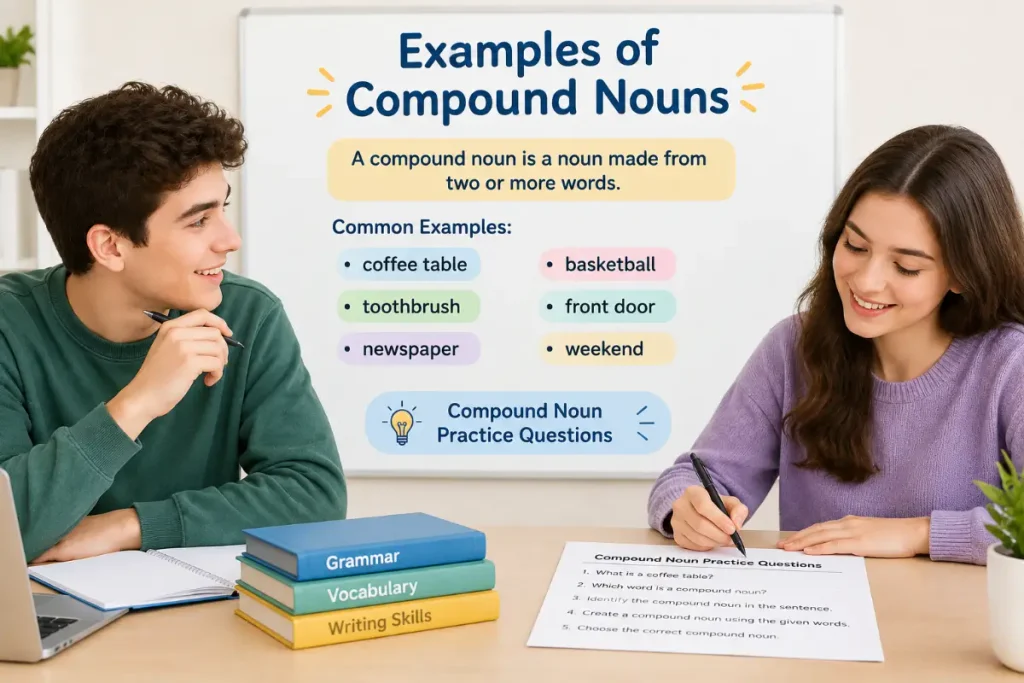
20 Compound Noun Practice Questions With Answers
Want to check what you have learned about compound nouns? Try these 20 practice questions. They cover compound noun types, plural forms, and correct spelling.
Practice Questions
Choose the correct answer or write the correct form.
- Is toothbrush an open, closed, or hyphenated compound noun?
- Is ice cream an open, closed, or hyphenated compound noun?
- Is mother-in-law an open, closed, or hyphenated compound noun?
- Which is correct: homework or home work?
- Which is correct: suitcase or suit case?
- Which is correct: cold cuts or coldcuts?
- What is the plural of toothbrush?
- What is the plural of bedroom?
- What is the plural of post office?
- What is the plural of mother-in-law?
- What is the plural of passerby?
- What is the plural of merry-go-round?
- What is the plural of stand-in?
- Find the compound noun: “I left my bag in the classroom.”
- Find the two compound nouns: “We ate ice cream after the football game.”
- Which is a compound noun: greenhouse or green house when you mean a building for growing plants?
- Complete the phrase: “We waited at the ______.” (bus stop / busstop)
- Which is correct: toothpaste or tooth paste?
- What are the three main types of compound nouns?
- What should you do if you are unsure how to spell a compound noun?
Answer Key
- Closed
- Open
- Hyphenated
- Homework
- Suitcase
- Cold cuts
- Toothbrushes
- Bedrooms
- Post offices
- Mothers-in-law
- Passersby
- Merry-go-rounds
- Stand-ins
- Classroom
- Ice cream and football game
- Greenhouse
- Bus stop
- Toothpaste
- Closed, open, and hyphenated
- Check a trusted, up-to-date dictionary.
Remember: Compound nouns can be written as one word, two separate words, or words joined by hyphens. Learn to spot these forms, and use a dictionary when you need help with spelling or plurals.
Quick Reference Table
| Form | Examples | Plural Pattern |
|---|---|---|
| Closed | toothbrush, bedroom, haircut | add -s at the end |
| Open | post office, ice cream, high school | pluralize the main noun |
| Hyphenated | mother-in-law, man-of-war | pluralize the main noun |
| Hyphenated, no main noun | merry-go-round, stand-in | add -s at the end |
Common Mistakes People Make
- Mistake 1: Pluralizing the wrong part, as in “mother-in-laws” instead of “mothers-in-law.”
- Mistake 2: Writing an open compound as one word, such as “coldcuts” or “nevermind.”
- Mistake 3: Putting a space in a closed compound, such as “home work” or “suit case.”
- Mistake 4: Treating a closed compound as if it were an adjective + noun, mixing up “greenhouse” and “green house.”
- Mistake 5: Assuming one spelling is universal when dictionaries disagree, instead of picking one and applying it consistently.
Practice Exercise
For items 1 to 8, name the form (open, closed, or hyphenated). Write the plural for items 9 to 16. For items 17 to 19, choose the standard spelling. For item 20, find the compound nouns. Answers are listed right after, so try each one before checking.
- toothbrush
- ice cream
- mother-in-law
- swimming pool
- bookshelf
- merry-go-round
- post office
- haircut
- toothbrush
- post office
- mother-in-law
- passerby
- merry-go-round
- inspector general
- bedroom
- stand-in
- homework or home work?
- cold cuts or coldcuts?
- suitcase or suit case?
- We stopped at the post office after the football game.
Answer Key
- closed
- open
- hyphenated
- open
- closed
- hyphenated
- open
- closed
- toothbrushes
- post offices
- mothers-in-law
- passersby
- merry-go-rounds
- inspectors general
- bedrooms
- stand-ins
- homework
- cold cuts
- suitcase
- post office, football game (football is itself a closed compound)
Frequently Asked Questions
What are the three types of compound nouns?
Closed compounds are written as one word (toothbrush), open compounds keep a space (ice cream), and hyphenated compounds use hyphens (mother-in-law).
How do I know whether a compound noun is open, closed, or hyphenated?
There’s no fixed rule, so check a current dictionary. Spellings change over time, and dictionaries sometimes disagree, so follow the one your style guide or publisher names.
Which part of a compound noun gets the plural?
Usually the main noun. That’s the last part of closed compounds (toothbrushes), the principal noun in open and hyphenated ones (post offices, mothers-in-law), and the end of the word when a hyphenated compound has no main noun (merry-go-rounds).
Is “ice cream” one word or two?
It’s an open compound noun, written as two words. Many style guides hyphenate it only when it comes before another noun, as in “an ice-cream cone.”
What’s the fastest way to check a compound noun’s spelling?
Look it up in a current dictionary, then use the form it lists consistently throughout your writing.
Before moving on, you may also want to read Examples of Intransitive Verbs: 20+ Easy Examples (2026 Guide) for more helpful grammar tips.
The Short Version
Keep these examples of compound nouns in mind as a reference for the three spellings: closed (toothbrush, bedroom), open (ice cream, post office), and hyphenated (mother-in-law, merry-go-round). The spelling can’t be predicted from the pattern, so a dictionary is your best tool, and forms keep shifting as words become more common.
The plural rule is easier to remember: find the main noun and pluralize it, or add the -s at the end when there isn’t one. With those two habits, from “mothers-in-law” to “post offices” to “stand-ins,” the plural usually falls into place.