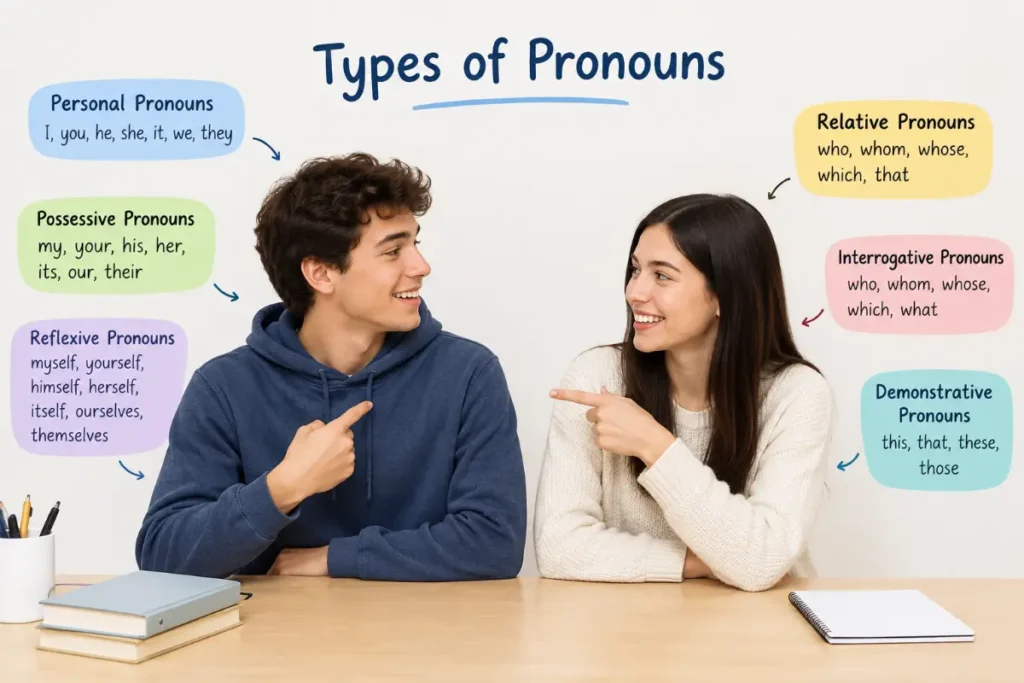
English has nine recognized types of pronouns, and most writers can name two or three without thinking, then draw a blank on the rest. Personal pronouns like “she” and “they” get all the attention, but English also relies on possessive, reflexive, relative, demonstrative, indefinite, interrogative, intensive, and reciprocal pronouns to do jobs that nouns alone can’t handle efficiently.
This guide walks through all nine categories with clear examples for each, plus the case distinction (subject, object, possessive) that cuts across several of them and explains errors like “whom” versus “who” or “its” versus “it’s.”
You may also find A Linking Verb? Easy Guide And 15+ Examples (2026) helpful if you want to explore this topic further.
What Are Pronouns?
Pronouns are words that take the place of nouns or noun phrases, helping writers avoid unnecessary repetition. Instead of saying Maria told Maria’s manager that Maria would finish Maria’s report, you can write, Maria told her manager that she would finish her report. The words her and she are pronouns because they refer back to a person already identified.
Pronouns can refer to people, things, places, or ideas, and their form or function can change depending on how they are used in a sentence. That is why learning the types of pronouns is more useful than memorizing a long list of individual words. Once you know what a pronoun is doing—showing ownership, asking a question, pointing something out, referring to an unspecified person, or connecting a clause—you can usually identify its category.
How to Identify the Type of Pronoun in a Sentence
To identify a pronoun, first find the word that stands in for or refers to a person, thing, or idea. Then ask what job it performs in the sentence. Its function usually tells you which category it belongs to.
- Does it refer to a specific person or thing? It may be a personal pronoun: She called me.
- Does it show ownership? It is possessive: The blue car is theirs.
- Does it refer back to the subject? It is reflexive: He blamed himself.
- Does it simply add emphasis? It is intensive: She herself made the decision.
- Does it introduce a descriptive clause? It is relative: The person who called left a message.
- Does it point to something? It is demonstrative: Those are expensive.
- Does it refer to someone or something without naming exactly who or what? It is indefinite: Everyone agreed.
- Does it introduce a question? It is interrogative: Who called?
- Does it show a mutual action or relationship? It is reciprocal: They helped each other.
A useful shortcut is to focus on function rather than the word itself. The same word can belong to different categories depending on how it is used. For example, that is demonstrative in That is mine but relative in The book that I bought was expensive.
Pronoun vs. Noun: What’s the Difference?
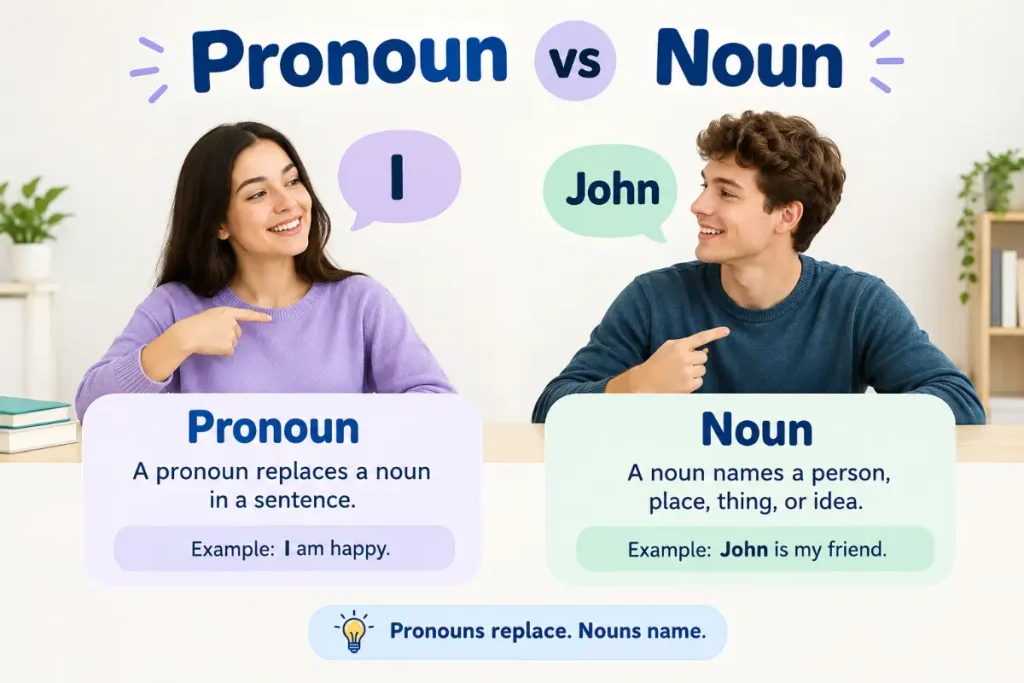
A noun names a person, place, thing, or idea, while a pronoun generally stands in for a noun or noun phrase. Compare Sarah finished Sarah’s homework with Sarah finished her homework. The noun Sarah identifies the person, while her refers back to Sarah without repeating her name.
| Noun | Pronoun |
|---|---|
| Maria | she |
| the students | they |
| the car | it |
| James’s book | his |
| the children | they |
Pronouns make sentences less repetitive and often make everyday writing sound more natural. However, the pronoun must have a clear reference so readers can tell what it represents.
Subject, Object, and Possessive Pronouns
Pronouns can change form depending on their grammatical role. The three major cases are subjective, objective, and possessive.
- Subject pronouns: I, you, he, she, it, we, they
They finished the project. - Object pronouns: me, you, him, her, it, us, them
The teacher called them. - Possessive pronouns: mine, yours, his, hers, ours, theirs
The seats are ours.
The distinction becomes especially important when two pronouns appear together. In She and I went shopping, both pronouns are subjects. In The teacher spoke to her and me, both are objects.
Removing the other person can make the correct form easier to identify: I went, not me went; the teacher spoke to me, not the teacher spoke to I.
Pronoun-Antecedent Agreement
A pronoun should generally agree with its antecedent—the noun or noun phrase it refers to—in number and, when relevant, person and gender.
- The student forgot her notebook.
- The students forgot their notebooks.
- The dog wagged its tail.
Singular and plural agreement is particularly important. A plural noun normally requires a plural pronoun, while a singular noun normally takes a singular pronoun.
Modern American English also commonly uses singular they when the person’s gender is unknown, irrelevant, or when the person uses they as a pronoun: Every student should bring their laptop. This usage avoids awkward repetition and is widely established in contemporary English.
Common Pronoun Errors to Avoid
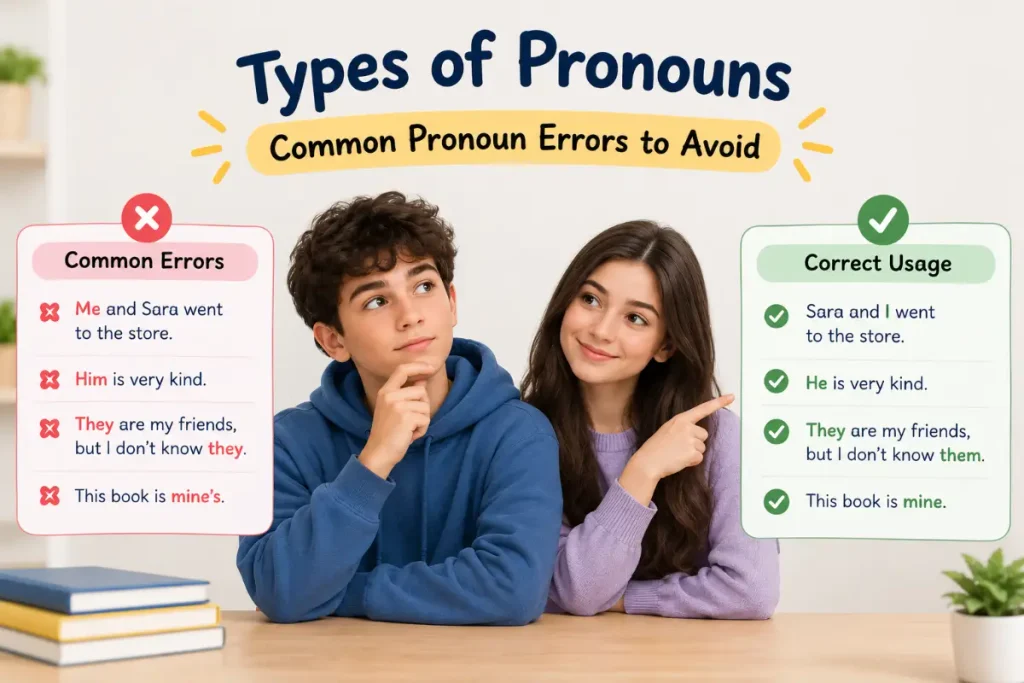
Pronoun errors usually happen when writers choose a form based on how it sounds rather than on the pronoun’s grammatical role. Some of the most common problems include:
- Using “myself” instead of “me” — Please contact me is correct when there is no reflexive relationship.
- Confusing “its” and “it’s” — its shows possession, while it’s means it is or it has.
- Using “who” and “whom” incorrectly — check whether the pronoun is the subject or object of its clause.
- Writing possessives with apostrophes — hers, ours, and theirs do not use apostrophes.
- Creating an unclear pronoun reference — readers should be able to tell what it, this, they, or which refers to.
- Forgetting pronoun-antecedent agreement — singular and plural forms should normally match.
- Using “them” as a subject in formal writing — They went to the store is standard; Them went to the store is not.
The best way to avoid these errors is to identify what the pronoun refers to and what grammatical job it performs.
How to Use Pronouns Correctly
Using pronouns correctly comes down to three basic checks: reference, agreement, and function.
First, make sure the pronoun has a clear antecedent. A reader should not have to guess what this, they, or it means. Second, check that the pronoun agrees with what it represents in number and, where applicable, person. Finally, make sure the pronoun has the correct grammatical form for its position in the sentence.
For another useful perspective, check out List of Prepositions: 100+ Words You Need to Know (2026).
For example:
- When Sarah spoke to Emily, she was upset.
The sentence is grammatically possible but unclear because she could refer to either Sarah or Emily. A clearer version would be:
- Sarah was upset when she spoke to Emily.
Clear pronoun use is not only about following grammar rules. It is also about making your writing easy to understand.
1. Personal Pronouns
These stand in for specific people or things and change form based on whether they’re acting as a subject or an object. Purdue OWL lays out this subject/object distinction clearly: “I, you, he, she, it, we, they” work as subjects, while “me, you, him, her, it, us, them” work as objects.
- She called me yesterday. (“she” is the subject, “me” is the object)
- They invited us to the party.
2. Possessive Pronouns
These show ownership and come in two related forms: possessive pronouns that stand alone, and possessive determiners that sit directly before a noun.
- This book is mine. (possessive pronoun, standing alone)
- This is my book. (possessive determiner, before the noun)
The full set: my/mine, your/yours, his, her/hers, its, our/ours, their/theirs. None of these ever take an apostrophe, which is exactly why “its” (possessive) and “it’s” (a contraction) are so often confused — our its vs it’s guide covers that specific mix-up in depth.
3. Reflexive Pronouns
These end in “-self” or “-selves” and refer back to the subject of the sentence, used when the subject and object are the same person or thing.
- She taught herself to play guitar.
- They blamed themselves for the delay.
A reflexive pronoun is required when the action genuinely loops back to the subject; it can’t simply replace a regular object pronoun (“give it to myself” only works if you are, in fact, the one receiving it).
4. Intensive Pronouns
These look identical to reflexive pronouns but do a different job: they add emphasis to a noun or pronoun already in the sentence, rather than acting as the object of the verb.
- I baked this cake myself. (emphasizes that no one else baked it; “myself” isn’t the object of any verb here)
- The director herself approved the changes.
The test for telling intensive and reflexive pronouns apart: remove the “-self” word. If the sentence still makes complete sense, it was intensive. If removing it leaves the sentence incomplete or changes its meaning, it was reflexive.
5. Relative Pronouns
These introduce a clause that describes or identifies a noun earlier in the sentence. The common ones are who, whom, whose, which, and that.
- The man who called earlier left a message.
- The book that you recommended was excellent.
- My neighbor, whose dog barks constantly, apologized.
Choosing correctly between “who” and “whom” depends on whether the pronoun is acting as a subject or object within its own clause, which our who vs whom guide covers through the he/him substitution test. Choosing between “which” and “that” depends on whether the clause is essential to the sentence’s meaning, covered in our guide to what is a non-restrictive clause.
6. Demonstrative Pronouns
These point to specific things, distinguishing near from far and singular from plural: this, that, these, those.
- This is my favorite song.
- Those belong to my sister.
Note that these same four words can also function as determiners when placed directly before a noun (“this song,” “those shoes”), in which case they’re not technically standing in for a noun but modifying one instead.
7. Indefinite Pronouns
These refer to people or things without specifying exactly who or what, and they’re grammatically either singular, plural, or variable depending on context.
- Always singular: anyone, everyone, someone, no one, nobody, everybody, each, either, neither
- Always plural: both, few, many, several
- Variable, depending on what follows: all, any, more, most, none, some
- Everyone has submitted their form. (singular subject, though paired with “their” under the singular they convention)
- Several were left behind.
- All of the cake is gone. (singular, since “cake” is uncountable) versus All of the cookies are gone. (plural, since “cookies” is countable)
8. Interrogative Pronouns
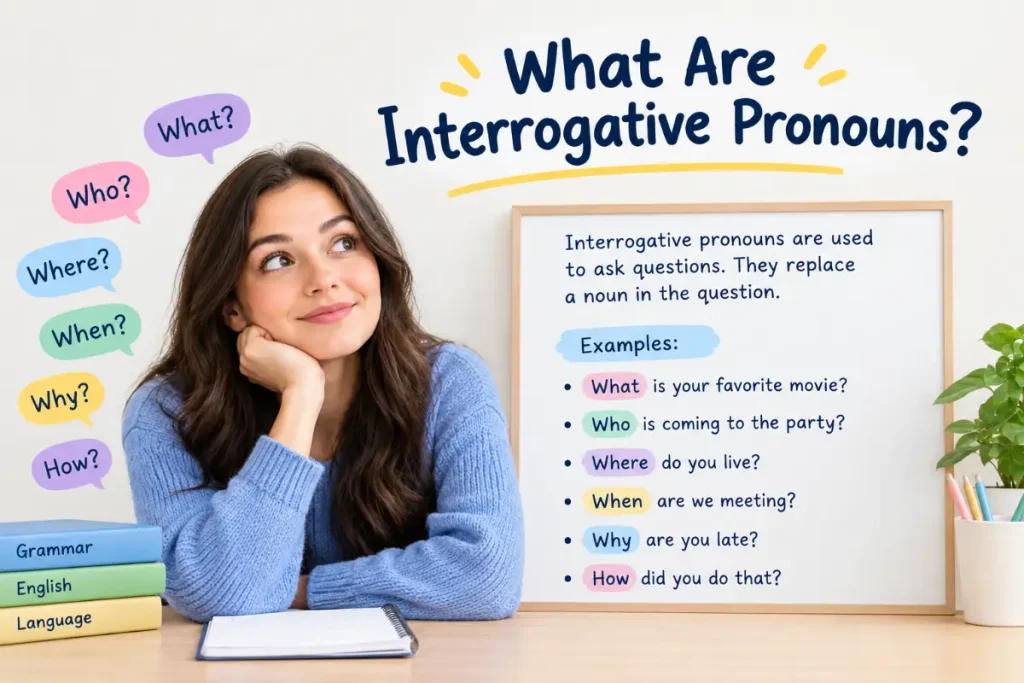
These introduce questions: who, whom, whose, which, and what.
- Who left this here?
- Which do you prefer?
- What happened last night?
Notice that several of these words overlap with the relative pronoun list — the difference is purely functional. In a question, they’re interrogative; introducing a descriptive clause, they’re relative.
9. Reciprocal Pronouns
These express a mutual action or relationship between two or more people: each other and one another.
- They helped each other move.
- The neighbors look out for one another.
Traditionally, some style guides distinguished “each other” (for exactly two) from “one another” (for more than two), though this distinction has largely faded in modern usage, and both are now generally treated as interchangeable.
Pronoun Case: The Thread Running Through Several Categories
Purdue OWL summarizes pronoun case in three simple categories that apply across personal, relative, and interrogative pronouns alike: subjective case (used as the subject), objective case (used as the object of a verb or preposition), and possessive case (showing ownership).
- He gave it to her. (“he” subjective, “her” objective)
- Whom did you call? (“whom” objective, since it’s the object of “call”)
Quick Reference Table
| Type | Examples | Function |
|---|---|---|
| Personal | I, you, he, she, it, we, they | Stands in for a specific person or thing |
| Possessive | mine, yours, his, hers, ours, theirs | Shows ownership |
| Reflexive | myself, yourself, themselves | Refers back to the subject |
| Intensive | myself, yourself, themselves | Adds emphasis |
| Relative | who, whom, whose, which, that | Introduces a descriptive clause |
| Demonstrative | this, that, these, those | Points to something specific |
| Indefinite | someone, everyone, few, all | Refers to a nonspecific person or thing |
| Interrogative | who, whom, which, what | Introduces a question |
| Reciprocal | each other, one another | Shows a mutual relationship |
Common Mistakes People Make
- Mistake 1: Using “myself” as a plain substitute for “me,” as in “give the report to myself,” when there’s no reflexive relationship to justify it.
- Mistake 2: Adding an apostrophe to a possessive pronoun, writing “her’s” or “their’s” instead of “hers” and “theirs.”
- Mistake 3: Treating all indefinite pronouns as uniformly singular, when words like “both,” “few,” and “several” are always plural.
- Mistake 4: Confusing “who” and “whom” by checking the wrong part of the sentence rather than the pronoun’s role in its own clause.
- Mistake 5: Using “which” for a restrictive clause where “that” is the more standard American English choice.
Practice Exercise
Identify the type of pronoun used in each sentence. Answers are listed right after, so try each one before checking.
- She finished the project herself.
- Everyone is welcome to join.
- This is exactly what I needed.
- The woman who called is my aunt.
- They support each other through everything.
- Whose jacket is this?
- I baked the bread myself.
- Few were willing to volunteer.
- He gave the keys to her.
- That belongs to my brother.
- Which one do you want?
- The book that I read was excellent.
- Nobody answered the phone.
- The students helped one another study.
- My sister hurt herself at practice.
- All of the milk is gone.
- Those are my favorite shoes.
- Whom did you invite?
- The car, which is brand new, broke down already.
- Several of the guests left early.
Answer Key
- Reflexive
- Indefinite
- Demonstrative
- Relative
- Reciprocal
- Interrogative
- Intensive
- Indefinite
- Personal
- Demonstrative
- Interrogative
- Relative
- Indefinite
- Reciprocal
- Reflexive
- Indefinite
- Demonstrative
- Interrogative
- Relative
- Indefinite
Frequently Asked Questions
How many types of pronouns are there in English?
Most grammar references count nine: personal, possessive, reflexive, intensive, relative, demonstrative, indefinite, interrogative, and reciprocal.
What’s the difference between a reflexive and an intensive pronoun if they look identical?
A reflexive pronoun is the actual object of the verb, needed for the sentence’s meaning, as in “she hurt herself.” An intensive pronoun simply adds emphasis to a noun already present and can be removed without changing the sentence’s core meaning, as in “she did it herself.”
Can the same word belong to more than one pronoun category?
Yes. “Which,” “who,” and “that” can be relative pronouns when introducing a descriptive clause, or interrogative pronouns when introducing a question. “This,” “that,” “these,” and “those” can be demonstrative pronouns or demonstrative determiners depending on whether a noun follows them.
Are indefinite pronouns always grammatically singular?
No. Some, like “everyone” and “nobody,” are always singular. Others, like “few” and “several,” are always plural. A third group, including “all,” “some,” and “none,” changes based on whether the noun they refer to is countable or uncountable.
What’s the fastest way to identify which type of pronoun a word is?
Look at its job in the sentence: does it stand alone as a subject or object (personal), show ownership (possessive), reflect back on the subject (reflexive), add emphasis (intensive), introduce a clause (relative) or a question (interrogative), point to something specific (demonstrative), refer to something nonspecific (indefinite), or show mutual action (reciprocal)?
Before moving on, you may also want to read An Adverb? 25 Easy Examples to Understand It (2026) for more helpful grammar tips.
Wrapping Up
Learning the nine types of pronouns gives you a map for understanding errors that otherwise seem unrelated: who/whom confusion, its/it’s mix-ups, and misused reflexives all trace back to which category a pronoun belongs to and what job it’s doing in a specific sentence.
Once the categories are clear, most pronoun questions become a matter of checking function rather than memorizing exceptions, since each type follows its own consistent internal logic once you know what to look for.