The short answer to what is a proper noun comes straight from the dictionary: Merriam-Webster defines it as a noun “that is the name of a particular person, place, or thing and usually begins with a capital letter.” Washington, Tuesday, the Grand Canyon, and Microsoft are all proper nouns, because each one names one specific, unique thing rather than a general category.
The word “usually” in that definition is doing real work, though, and it’s exactly where most capitalization questions actually live. The Blue Book of Grammar advises that experienced writers stay stingy with capital letters, using them only when a rule clearly calls for one, which is a good general instinct to pair with the categories below. This guide covers the core categories of proper nouns, the related rule for proper adjectives, and the specific cases, like seasons, family relationships, and general subjects, where the capital-letter instinct leads people astray.
You may also find Examples of Intransitive Verbs: 20+ Easy Examples (2026 Guide) helpful if you want to explore this topic further.
What Is a Proper Noun? Definition and Examples
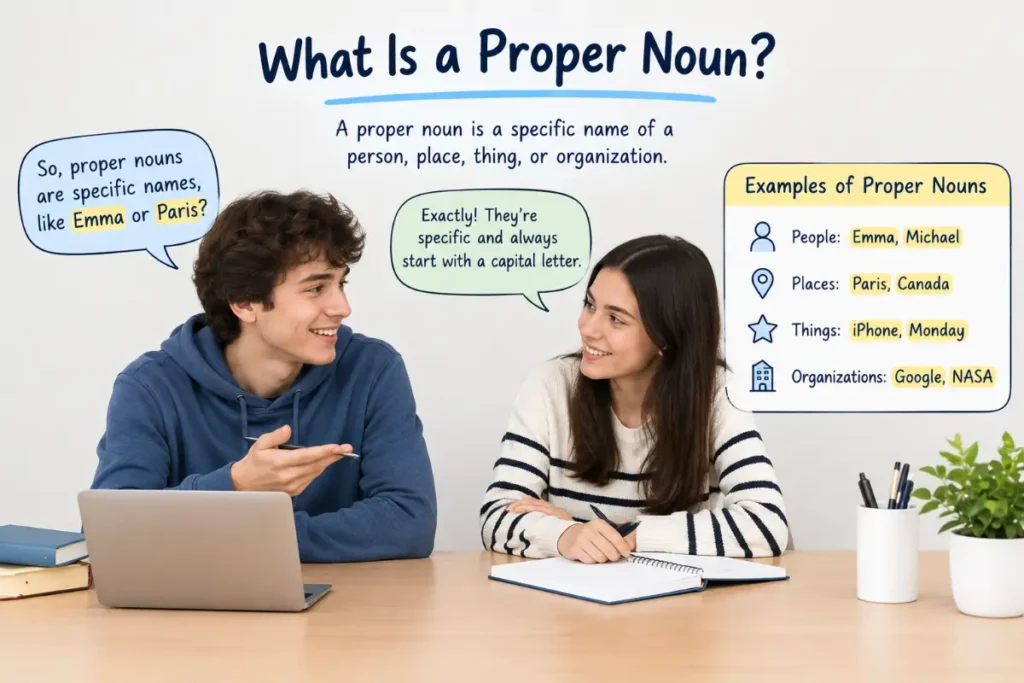
A proper noun is the specific name of a person, place, organization, event, brand, or other unique thing. Unlike a common noun, which refers to a general category, a proper noun identifies one particular entity. In standard English, proper nouns are capitalized wherever they appear in a sentence.
For example, city is a common noun because it can refer to any city, while Chicago is a proper noun because it names one specific city. Similarly, teacher is a common noun, but Dr. Alvarez is a proper noun.
Here are a few simple examples:
- Person: Maria, Michael Jackson, Dr. Patel
- Place: New York, the Grand Canyon, France
- Organization: Microsoft, Harvard University, the United Nations
- Holiday: Thanksgiving, Christmas, Halloween
- Day or month: Monday, October
- Historical event: World War II, the Renaissance
- Brand: Coca-Cola, Nike, iPhone
A useful way to remember the difference is this: common nouns name types; proper nouns name specific examples. So, river is common, while the Mississippi River is proper. Company is common, while Google is proper.
Not every capitalized word is automatically a proper noun, though. A word may be capitalized because it begins a sentence or appears in a title. The key question is whether it is actually naming a specific person, place, thing, organization, or other unique entity.
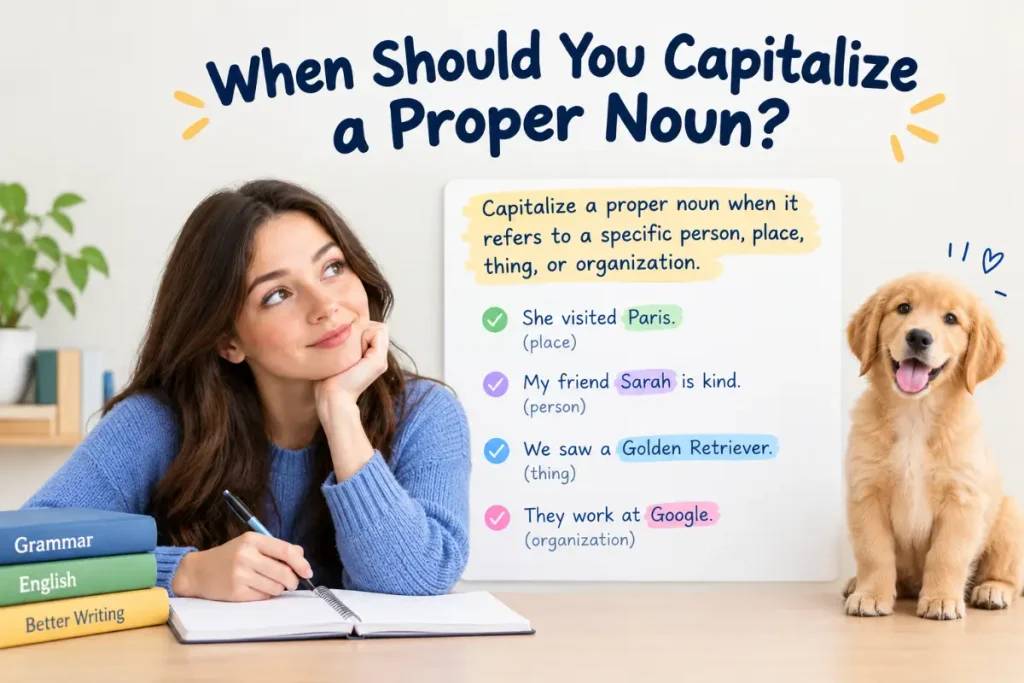
When Should You Capitalize a Proper Noun?
The basic rule is straightforward: capitalize a proper noun when it names a specific person, place, organization, event, or other officially named entity.
Compare these examples:
- country → general category
- Canada → specific country
- river → general category
- Mississippi River → specific river
- university → general institution
- Harvard University → specific institution
- holiday → general category
- Thanksgiving → specific holiday
The tricky part is that some words can be either common or proper nouns depending on how they’re used. Consider president. In “The president gave a speech,” the word is a general title and stays lowercase. But in “President Lincoln gave a speech,” the title appears directly before a person’s name and is capitalized.
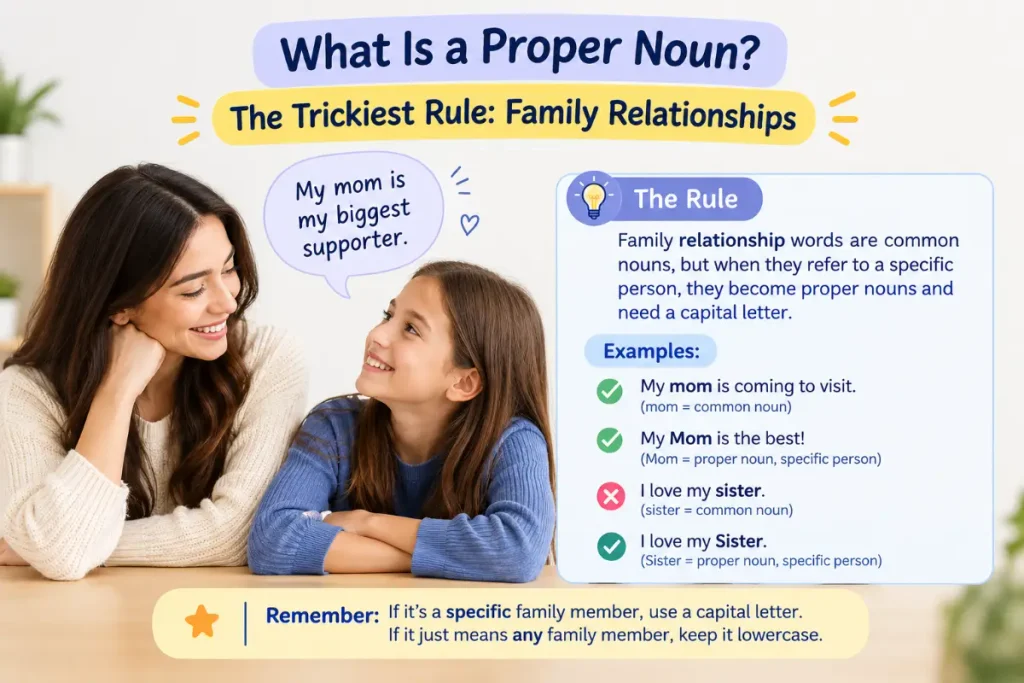
Family terms work in a similar way. In “I called my mom,” mom is a common noun because it describes a family relationship. In “I called Mom,” it can function as a substitute for the person’s name, so it is capitalized.
The same principle explains why summer is normally lowercase but Monday is capitalized. Seasons are general recurring periods, while days of the week are treated as specific named divisions of the calendar.
When you’re unsure, don’t rely on how important or special the word feels. Ask whether it is being used as an actual name. That simple check solves many proper noun capitalization questions.
Proper Noun vs. Common Noun: How to Tell the Difference
The easiest way to understand a proper noun is to compare it with a common noun. Both can name people, places, things, or ideas, but they work at different levels of specificity.
A common noun identifies a general type or category. A proper noun identifies a particular member of that category.
| Common Noun | Proper Noun |
|---|---|
| person | Maria |
| city | Chicago |
| country | France |
| river | Mississippi River |
| company | Microsoft |
| university | Harvard University |
| holiday | Thanksgiving |
| month | October |
| language | Spanish |
For example, you might say, “We visited a museum.” The word museum doesn’t tell us which one. If you say, “We visited the Louvre Museum,” the name identifies a particular museum, so it is a proper noun.
The distinction can also change within the same sentence or conversation. You might first write, “We visited Central Park.” Later, you could say, “The park was crowded.” Once park is being used as a general reference rather than as part of the official name, it becomes a common noun and stays lowercase.
This is why proper noun capitalization isn’t simply about memorizing lists of words. Context matters. The same word can sometimes be capitalized in one sentence and lowercase in another depending on whether it is being used as a specific name or a general description.
A quick test is to ask: “Am I naming one specific thing, or am I talking about a general type?” If you’re naming one specific entity, you’re likely dealing with a proper noun.
For another useful perspective, check out Types of Pronouns: 9 Essential Types With Easy Examples (2026).
Proper Noun vs. Common Noun: The Core Distinction
A common noun names a general category or type of thing. A proper noun names one specific, unique example within that category, and it gets a capital letter every time it appears, regardless of its position in the sentence.
| Common Noun | Proper Noun |
|---|---|
| a country | France |
| a company | Microsoft |
| a river | the Mississippi River |
| a holiday | Thanksgiving |
| a language | Spanish |
Seven Categories That Cover Most Everyday Proper Nouns
Names of people. John, Maria, Dr. Alvarez. This includes full names and any title used directly before them, a rule covered in more depth in our guide to when to capitalize job titles.
Specific places. Chicago, the Grand Canyon, Yellowstone Park. Note the distinction grammar references consistently point out: “Yellowstone Park” is capitalized, but a later reference to simply “the park” is not, since “park” alone is now functioning as a common noun.
Organizations and companies. Google, the United Nations, Harvard University.
Days, months, and holidays. Monday, October, Halloween, Hanukkah. These are treated as proper nouns because they name specific, named points on the calendar rather than general categories.
Nationalities, languages, and religions. American, French, Buddhism, Christianity. Words derived from these, called proper adjectives, are capitalized too: a French pastry, a Buddhist temple.
Specific historical periods and events. World War II, the Renaissance, the Great Depression.
Brand names and trademarked products. Kleenex, Coca-Cola, iPhone. These stay capitalized even when used informally, which is why style guides often note that a specific brand name functioning as a stand-in for a general product category is still technically a proper noun.
The Trickiest Rule: Family Relationships
This single rule accounts for an enormous share of everyday capitalization questions. A family term is a proper noun, and gets capitalized, only when it’s functioning as the person’s actual name, typically without a possessive pronoun in front of it.
- I asked Uncle Bob to help. (functioning as his name — capitalized)
- I asked my uncle to help. (describing a general relationship — lowercase)
- Did you see Mom’s new car? (standing in for her name — capitalized)
- Did you see my mom’s new car? (describing a relationship, with “my” in front — lowercase)
The presence of a possessive pronoun like “my,” “his,” or “our” right before the family word is usually the clearest signal that it should stay lowercase, since the word is now functioning as a description rather than a substitute name.
Seasons: Common, Not Proper
Despite feeling like they deserve the same treatment as months, the four seasons are common nouns and stay lowercase, even at the start of a sentence context or in casual writing.
- What a beautiful summer day!
- I love the colors of fall.
The only exception is when a season becomes part of an actual proper noun, such as a named academic term or event: “Fall 2024 Semester.”
General Subjects vs. Named Courses and Languages
A general academic subject is a common noun and stays lowercase, but a specific, officially titled course name is capitalized, and language-based subjects are always capitalized because the language itself is a proper noun.
- I am taking geography this semester. (general subject — lowercase)
- I am taking History of Pathology this semester. (a specific, titled course — capitalized)
- I am taking Spanish this semester. (the subject is a language, always capitalized regardless of context)
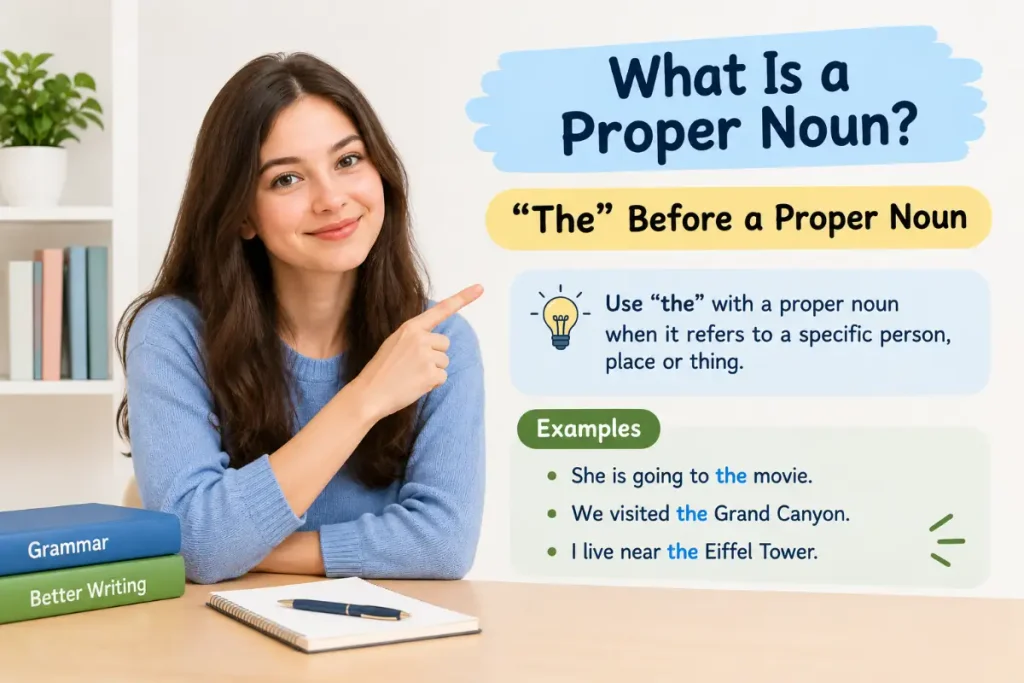
“The” Before a Proper Noun
As a general rule, the word “the” immediately preceding a proper noun stays lowercase, since it’s functioning as a regular article rather than part of the name itself.
- the Golden Gate Bridge
- the United States
- the Mississippi River
Quick Reference Table
| Category | Capitalized Example | Lowercase Common Noun |
|---|---|---|
| Place | Yellowstone Park | the park |
| Family | Uncle Bob | my uncle |
| Season | (no proper noun form) | summer, fall, winter |
| Subject | Spanish, History of Pathology | geography, math |
| Title + name | President Lincoln | the president |
| Holiday | Thanksgiving | a holiday |
Common Mistakes People Make
- Mistake 1: Capitalizing a season, as in “I love Autumn,” when seasons are common nouns in standard usage.
- Mistake 2: Capitalizing a family term that’s preceded by a possessive pronoun, as in “I called my Mom,” which should be lowercase: “I called my mom.”
- Mistake 3: Failing to capitalize a proper adjective derived from a proper noun, as in “a french pastry” instead of “a French pastry.”
- Mistake 4: Capitalizing a general academic subject that isn’t a language or an official course title, as in “I’m studying Biology this semester” when it should be lowercase unless referring to the exact course name.
- Mistake 5: Treating a shortened, generic reference to something as though it still carries the original proper noun’s capitalization, as in capitalizing “the Bridge” in later references after first naming “the Golden Gate Bridge.”
Practice Exercise
Decide whether the underlined word or phrase should be capitalized. Answers are listed right after, so try each one before checking.
- We visited yellowstone park last summer.
- I asked my uncle for advice.
- I asked uncle Bob for advice.
- She speaks spanish fluently.
- He’s studying biology this semester.
- They celebrate thanksgiving every year.
- We drove across the golden gate bridge.
- My mom is a nurse.
- Did you see mom today?
- He bought a new iphone.
- The renaissance was a period of great art.
- I’ll see you next monday.
- She has a french accent.
- The park closes at dusk. (after first mentioning “Central Park”)
- We’re taking history of pathology next term.
- My favorite season is winter.
- He works for google.
- Her grandmother immigrated from france.
- I love my grandmother‘s cooking.
- They’re Buddhist, so they visit the temple during buddhist holidays.
Answer Key
- Yellowstone Park (capitalized); summer stays lowercase
- uncle (lowercase, preceded by “my”)
- Uncle (capitalized, functioning as a name)
- Spanish (capitalized, a language)
- biology (lowercase, general subject)
- Thanksgiving (capitalized, a holiday)
- Golden Gate Bridge (capitalized)
- mom (lowercase, preceded by “my”)
- Mom (capitalized, functioning as a name)
- iPhone (capitalized, brand name)
- Renaissance (capitalized, specific historical period)
- Monday (capitalized, day of the week)
- French (capitalized, proper adjective)
- park (lowercase, generic reference after the proper noun was already introduced)
- History of Pathology (capitalized, specific course title)
- winter (lowercase, a season)
- Google (capitalized, company name)
- France (capitalized, country)
- grandmother (lowercase, preceded by “my”)
- Buddhist (capitalized, proper adjective)
Frequently Asked Questions
Are brand names always capitalized, even when used casually?
Yes, in standard usage. Even when a brand name is used loosely to refer to a general product category, like calling any tissue a “Kleenex,” the word itself remains a proper noun and stays capitalized.
Why aren’t the seasons capitalized if months and days of the week are?
Months and days of the week are treated as specific, named points on a calendar system, similar to proper names, while the four seasons are considered general, recurring natural phenomena rather than unique named entities, which is why grammar references consistently classify them as common nouns.
Is “mom” or “dad” ever capitalized without a name attached?
Yes, when the word is being used as a direct substitute for the person’s actual name, typically without a possessive pronoun like “my” or “his” in front of it, as in “I’ll ask Dad” versus “I’ll ask my dad.”
What’s a proper adjective, and how does it relate to proper nouns?
A proper adjective is an adjective formed from a proper noun, such as “American,” “Victorian,” or “Shakespearean,” and it keeps the capital letter of its source noun even though it’s now functioning as a descriptive word rather than a name.
What’s the fastest way to check whether a word should be capitalized as a proper noun?
Ask whether the word is naming one specific, unique person, place, or thing, or whether it’s describing a general category. If a possessive pronoun like “my” or “our” sits directly in front of it, that’s often a strong signal it’s functioning as a common noun instead.
Before moving on, you may also want to read A Predicate in a Sentence? A Simple 2026 Guide for more helpful grammar tips.
Wrapping Up
Understanding what is a proper noun goes beyond the basic definition of “a name that gets capitalized,” since the real skill is recognizing the specific situations, family terms with possessive pronouns, seasons, general subjects, where the instinct to capitalize actually leads to an error.
The underlying test stays consistent throughout: a proper noun names one particular, unique thing, while a common noun names a general category, and whenever a word shifts between functioning as an actual name and functioning as a description, its capitalization needs to shift right along with it.