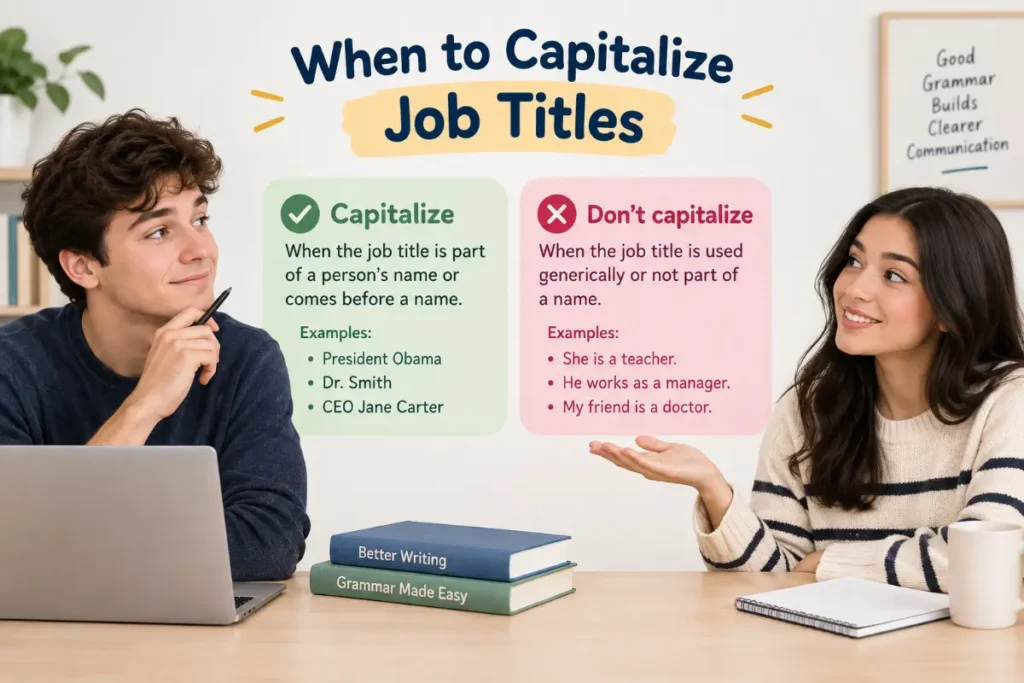
Wondering when to capitalize job titles? The answer depends on how the title is used in a sentence. Learn the simple rules for capitalization, with clear examples that show when a job title should be uppercase and when it should stay lowercase.
Job title capitalization causes more everyday confusion than almost any other capitalization question, especially in resumes, business emails, and company bios. The good news: Purdue OWL’s summary of AP style boils the whole thing down to one clear principle — “generally, capitalize formal titles when they appear before a person’s name, but lowercase titles if they are informal, appear without a person’s name, follow a person’s name, or are set off before a name by commas.”
You may also find Punctuate Abbreviations: The 2026 Easy Guide helpful if you want to explore this topic further.
The Quick Answer
- Capitalize when the title comes directly before someone’s name, acting like part of the name itself:
- Marketing Director Jane Smith arrived early.
- Lowercase when the title comes after the name, stands alone, or is set off by commas:
- Jane Smith, marketing director, arrived early.
- The marketing director arrived early.
The test: does the title sit immediately before the name with no comma separating them, functioning almost like a first name? Capitalize it. Does it appear anywhere else — after the name, standing alone, or set off by commas? Lowercase it.
Rule 1: Directly Before a Name (No Comma) — Capitalize
When a title sits immediately in front of someone’s name, with nothing separating them, it’s treated like part of the proper name and gets capitalized.
Examples:
- President Maria Gonzalez opened the conference.
- We welcomed Chief Financial Officer David Chen to the board.
- Senator Elizabeth Warren spoke at the event.
- Executive Vice President John Reyes announced the merger.
Notice these all read almost like a first name is standing in for the title — “President Gonzalez” functions grammatically the same way “Mr. Gonzalez” would.
Rule 2: After a Name, or Standing Alone — Lowercase
Once the title moves after the name, or appears without a name attached at all, it’s functioning as a regular descriptive noun rather than part of a proper name, so it drops the capital.
Examples:
- Maria Gonzalez, the president, opened the conference.
- The chief financial officer joined the board last year.
- We spoke with the senator about the upcoming vote.
- John Reyes, executive vice president, announced the merger.
Notice the comma pattern in the first and last examples — whenever a title is set off by commas around a name (called an appositive), it’s lowercase, even though the exact same words would be capitalized if moved directly in front of the name with no comma.
Rule 3: Formal Titles Used as Direct Address — Capitalize
When you use a job title directly to address someone instead of using their name, capitalize it when the title is being used as a name substitute.
Examples:
- Thank you, Professor, for your guidance.
- Good morning, Doctor. How are you today?
- Could you review this, Director?
- What do you think, Senator?
The key is that the title is functioning almost like the person’s name. However, if you’re simply describing someone’s role, use lowercase: The professor reviewed my paper.
Rule 4: Job Titles With Possessive Pronouns — Lowercase
When a job title follows words such as my, your, his, her, or their, it usually stays lowercase because it is being used as a common noun.
Examples:
- My manager approved the request.
- Her director scheduled the meeting.
- Their president announced the changes.
- Your supervisor will contact you tomorrow.
Even though these are important positions, the titles aren’t functioning as part of a person’s proper name.
Rule 5: Titles in Signatures and Formal Documents — Capitalize
In professional signatures, letterheads, business cards, and similar formal contexts, job titles are often capitalized as part of the person’s official identification.
Examples:
- Maria Gonzalez
Chief Executive Officer - David Chen
Director of Marketing - John Reyes
Executive Vice President
This style is common in professional materials, but it doesn’t mean every reference to the same position must be capitalized in ordinary sentences.
Rule 6: Long or Descriptive Job Titles — Usually Lowercase
A job title that simply describes what someone does should generally remain lowercase, even if the position sounds formal or impressive.
Examples:
- She works as a senior marketing manager.
- He became the company’s regional sales director.
- We hired a new human resources specialist.
- The university is looking for an assistant research coordinator.
The title’s length or importance doesn’t determine capitalization. What matters is how the title functions in the sentence.
Rule 7: Titles in Headings, Resumes, and Lists — Follow the Style
Job titles in headings, resumes, organizational charts, and lists may be capitalized as labels or headings, even when they would normally be lowercase in a sentence.
Examples:
- Senior Marketing Manager
- Director of Human Resources
- Customer Success Specialist
- Vice President of Operations
This is often a matter of formatting and style rather than standard sentence capitalization. In running prose, however, follow the normal capitalization rules: She was promoted to vice president of operations.

The Comma Test: The Detail That Resolves Almost Every Edge Case
This is worth its own section, since it’s genuinely the fastest way to check yourself. If there’s a comma between the title and the name, lowercase the title — full stop. If there’s no comma and the title sits immediately before the name, capitalize it.
- Director of Marketing Sarah Kim (no comma, capitalized)
- Sarah Kim, director of marketing, (comma, lowercase)
This single check resolves the vast majority of cases that otherwise feel ambiguous, including longer, multi-word titles like “chief financial officer” or “executive vice president.”
Job Titles vs. Job Descriptions: A Distinction Worth Knowing
AP style specifically distinguishes between formal titles (which follow the capitalization rule above) and generic job descriptions, which stay lowercase even directly before a name, since they’re not treated as formal titles at all.
- director Steven Spielberg (lowercase — “director” here functions as a job description, not a formal title)
- coach Biff Sykes (lowercase — same reasoning)
- teacher Maria Lopez (lowercase)
This distinction is genuinely debated and inconsistently applied even among professional editors — where exactly the line falls between a “formal title” (like President, Senator, or CEO) and a “job description” (like director, coach, or teacher) isn’t always crisp. When in doubt, many writers and organizations default to lowercase for anything that isn’t clearly an official, formal position title.
What About Resumes and LinkedIn Profiles?
This is one of the most commonly searched practical questions about this topic, and it has a genuinely different answer than standard prose writing. On a resume, when a job title functions as a heading (for example, listed above a company name and dates), it’s standard and widely accepted to capitalize it regardless of its position relative to a name:
- Marketing Director — Acme Corporation, 2020–2023
But within the body text of a resume or cover letter — describing your responsibilities in sentence form — standard AP-style lowercase rules generally apply:
- As marketing director, I led a team of six people.
This distinction between headings and body text is worth knowing specifically because resume formatting conventions genuinely diverge from standard prose capitalization rules, and both are considered correct in their respective contexts.

Special Cases Worth Knowing
Titles used as direct address are capitalized, regardless of whether a name follows:
- Thank you, Doctor, for seeing me on short notice.
- Will that be all, Captain?
Very high-ranking titles are sometimes capitalized even without a name, following certain style guides’ specific exceptions — this is more common with titles like “President” (referring to a head of state) in some formal or governmental writing, though AP style generally still lowercases even these without a name attached in standard usage.
“The” before a title signals lowercase. If the word “the” appears directly before a title, that’s a strong signal the title should be lowercase, since “the” wouldn’t naturally precede a capitalized proper name: the chairperson, not the Chairperson.
The Fastest Way to Check Yourself
Step 1: Is the title sitting immediately before a name, with no comma? Capitalize it.
Step 2: Is there a comma between the title and the name, or does the title stand alone? Lowercase it.
Step 3: Is this a resume heading rather than body text? Capitalization conventions loosen in that specific formatting context.
Step 4: Is “the” sitting in front of the title? That’s a strong signal to lowercase.
Job Title Capitalization: Quick Reference
| Situation | Capitalize? | Example |
|---|---|---|
| Directly before name, no comma | Yes | President Maria Gonzalez |
| After name, set off by comma | No | Maria Gonzalez, president, |
| Standing alone, no name | No | the president announced |
| Direct address | Yes | Thank you, Doctor |
| Resume heading | Yes (by convention) | Marketing Director — Acme Corp |
| Preceded by “the” | No | the chief financial officer |
| Generic job description before name | No | director Steven Spielberg |
Common Mistakes People Make
Mistake 1: “John Smith, our new Marketing Director, starts Monday.” Should be lowercase: “John Smith, our new marketing director, starts Monday” — the comma before the title signals it should be lowercase.
Mistake 2: “She was promoted to Senior Vice President last year,” used mid-sentence without a name. This should be lowercase in standard prose: “she was promoted to senior vice president,” since there’s no name directly attached to the title in this construction.
Mistake 3: “the President of the company spoke at the meeting.” Should be lowercase: “the president of the company spoke,” since “the” precedes the title and no specific name follows it directly.
For another useful perspective, check out When to Use a Comma After an Introductory Phrase: 7 Easy Rules (2026).
Mistake 4: Capitalizing every job title in a document out of a sense that titles deserve respect. This is a common instinct in business writing — capitalizing titles like “Manager” or “Director” throughout a document regardless of position, out of politeness or formality. Under standard AP and most style guide conventions, this over-capitalization isn’t correct; position relative to the name is what matters, not perceived importance.
Mistake 5: Inconsistency within the same document. Capitalizing a title in one paragraph and lowercasing the identical title elsewhere, without a structural reason (like the comma test) for the difference, reads as inconsistent and unpolished.

More Examples to Lock It In
- Chief Executive Officer Lisa Park announced the layoffs; Lisa Park, the CEO, later addressed employee concerns directly.
- We invited Professor James Liu, who has taught economics for over twenty years, to speak at the ceremony.
- The senator, Angela Brooks, is up for reelection; Senator Brooks has served the district for a decade.
- As project manager, I coordinated with Director of Operations Wendy Tran on the timeline.
- Thank you for your time, Doctor — the doctor on call will follow up shortly.
Frequently Asked Questions
Does this rule apply the same way to email signatures and business cards?
Not exactly — email signatures and business cards commonly capitalize job titles regardless of position, similar to resume headings, since they function more like formal labels than as part of a flowing sentence. This is a widely accepted convention distinct from standard prose capitalization rules.
Is “CEO” treated differently from “chief executive officer” when it comes to capitalization?
No — the same before/after-name rule applies whether the title is spelled out or abbreviated: “CEO Lisa Park” (capitalized, no comma, before name) versus “Lisa Park, the CEO,” (lowercase, comma, after name).
What’s the difference between a formal title and a job description, and why does it matter?
Formal titles (President, Senator, Chief Financial Officer) denote a scope of authority or an official position and follow the capitalization rule outlined here. Job descriptions (director, coach, teacher, when used more generically) are typically lowercase even before a name, since AP style treats them as descriptive rather than as formal titles — though this distinction is genuinely one of the more debated, inconsistently applied areas of the overall rule.
Do other style guides (Chicago, APA, MLA) handle this differently from AP?
The core before/after-name logic is broadly consistent across AP, Chicago, and APA, though each has its own specific edge-case guidance and slightly different thresholds for what counts as a “formal” title versus a general description. AP tends to be the strictest and most widely referenced for this specific rule, especially in journalism and business writing.
What’s the fastest way to catch this error before publishing something?
For every job title in your document, check what comes immediately before and after it: no comma and directly before a name means capitalize; a comma, standing alone, or coming after the name means lowercase.
Practice Exercise
Decide whether each title should be capitalized or lowercase. Answers are listed right after — try each one before checking.
- ______ Director Angela Kim will present the quarterly report.
- Angela Kim, ______ director, will present the quarterly report.
- The ______ president announced new office hours.
- Thank you, ______, for your quick response. (title used in direct address)
- We met with ______ Senator Cruz yesterday.
- Senator Cruz, the ______ senior senator from Texas, spoke at length.
- ______ Chief Technology Officer Raj Patel joined the panel.
- Raj Patel, the ______ chief technology officer, joined the panel.
- As ______ manager, she oversees twelve employees.
- The company named ______ Vice President Lopez to the new role.
Answer Key
- Capitalize — “Director” (directly before name, no comma)
- Lowercase — “director” (comma before name)
- Lowercase — “president” (preceded by “the,” no name follows)
- Capitalize — “Doctor” or equivalent (direct address)
- Capitalize — “Senator” (directly before name)
- Lowercase — “senior senator” (appositive set off by “the” and commas)
- Capitalize — “Chief Technology Officer” (directly before name)
- Lowercase — “chief technology officer” (comma before name, preceded by “the”)
- Lowercase — “manager” (standing alone, no name attached)
- Capitalize — “Vice President” (directly before name)
If you got eight or more correct, the comma test has already become second nature. For any you missed, check: is there a comma between the title and the name, and does the title sit directly before or after it?
Before moving on, you may also want to read Quotation Marks Inside Quotation Marks Rules: 7 Mistakes to Avoid for more helpful grammar tips.
The Bottom Line
Capitalize a job title when it sits immediately before someone’s name with no comma; lowercase it everywhere else — after the name, standing alone, set off by commas, or preceded by “the.” The comma test is your fastest, most reliable check, and it resolves the vast majority of real-world cases.
For more on how commas interact with names and appositives in general, see our guide on the comma before “and” rule — and if capitalization details like this one make you want a refresher on apostrophes in names too, our guide to apostrophe rules for plurals covers that closely related ground.
For a clearer understanding of When to capitalize job titles, it’s also helpful to review how capitalization works with names, formal titles, and other proper nouns. Knowing when a title should be capitalized can make your writing look more polished, consistent, and professional.