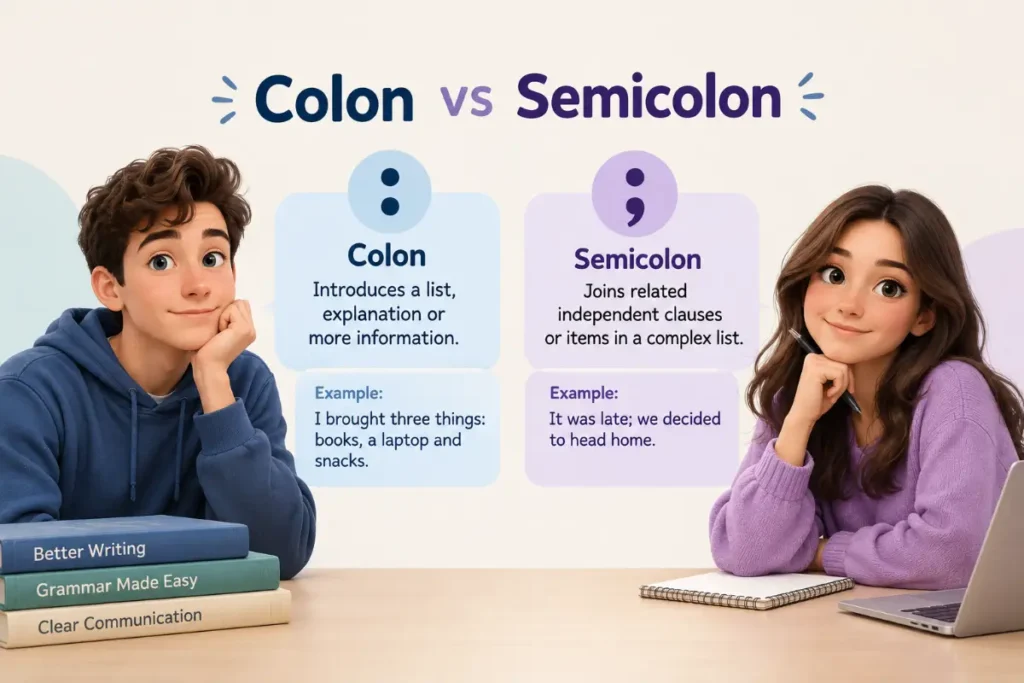
Confused about Colon vs Semicolon? Both punctuation marks can connect related ideas, but they serve different purposes. Learn when to use each one with simple rules and clear examples that make punctuation easier to understand.
These two marks get confused constantly, partly because their names sound so similar and partly because both can technically join two independent clauses. But Merriam-Webster draws the real distinction clearly: a colon “points forward” to what follows — introducing, explaining, or emphasizing it — while a semicolon links two ideas sideways, treating them as equally weighted and closely related.
You may also find When to Capitalize Job Titles: 7 Rules You Need to Know (2026) helpful if you want to explore this topic further.
The Quick Answer
- Colon (:) = introduces, explains, or emphasizes what follows
- She had one goal: winning.
- Semicolon (;) = links two closely related, independent ideas of equal weight
- She trained for months; her effort paid off.
The test: does what comes after the punctuation mark explain, restate, or list something pointed to by what came before? Use a colon. Are you joining two complete, equally important thoughts without one explaining the other? Use a semicolon.
Try it: “He had only one excuse ___ traffic.” Does “traffic” explain the excuse being pointed to? Yes — so it’s a colon: “He had only one excuse: traffic.”
Now try: “The meeting ran long ___ everyone still left in good spirits.” Are these two separate, equally weighted, related ideas? Yes — so it’s a semicolon: “The meeting ran long; everyone still left in good spirits.”
The Core Distinction: Pointing Forward vs. Linking Sideways
Think of a colon as an arrow — everything before it sets up an expectation, and everything after it fulfills that expectation, whether through a list, an explanation, or a dramatic reveal. A semicolon, by contrast, works more like a soft wall between two complete rooms that happen to share a connecting doorway — each side stands on its own, but the semicolon signals they’re worth reading together.
Merriam-Webster puts it precisely: colons “introduce clauses or phrases that serve to describe, amplify, or restate what precedes them,” while semicolons are “mostly used to separate two independent sentence parts that are related in meaning” without one explaining the other.
When to Use a Colon
Introducing a list:
- We need three things: flour, sugar, and eggs.
- The team includes four members: a designer, a developer, a writer, and a manager.
Introducing an explanation or elaboration:
- The reason was simple: nobody had checked the schedule.
- There’s one problem with this plan: it’s already too late.
Introducing a quotation:
- She said it best: “Nothing worth having comes easy.”
Creating emphasis or a dramatic pause before a key word or phrase:
- After months of preparation, she finally had it: the winning idea.
A useful check for colons introducing a list or explanation: the part of the sentence before the colon should be able to stand alone as a complete sentence. “We need three things” works fine on its own — that’s your signal a colon is appropriate. If the part before the colon can’t stand alone (“We need: flour, sugar, and eggs” — “we need” isn’t complete), a colon doesn’t belong there at all; the sentence should be rewritten without one.
When to Use a Semicolon
Joining two closely related independent clauses without a conjunction:
- The store closed early; we still made it in time.
- He trained for months; his effort showed on race day.
Joining clauses with a conjunctive adverb (however, therefore, moreover):
- The report was late; consequently, the launch was delayed.
- She disagreed with the plan; nevertheless, she went along with it.
Separating items in a list that already contains commas:
- We visited Paris, France; Rome, Italy; and Vienna, Austria.
Notice the difference in relationship: in every semicolon example, both halves are equally important, complete statements — neither one is explaining or introducing the other, they’re simply closely connected. That’s fundamentally different from a colon, where one part always sets up and the other part always delivers.
Can They Ever Be Interchangeable?
Occasionally, yes, in one specific overlapping case: when joining two independent clauses where the second one explains the first, both a colon and a semicolon can technically work, though they create a slightly different emphasis.
- The trip was a disaster: everything that could go wrong did. (colon — strongly signals “here’s the explanation”)
- The trip was a disaster; everything that could go wrong did. (semicolon — presents both as connected but more equally weighted statements)
The colon version reads as more direct and emphatic, almost like a spotlight on the explanation. The semicolon version reads slightly more measured and even-keeled. Neither is wrong in this specific overlapping case — it’s a matter of the tone and emphasis you want.
The Fastest Way to Check Yourself
Step 1: Does what follows explain, list, or emphasize what came before? If yes, and the part before could stand alone as a complete sentence, use a colon.
Step 2: Are you joining two complete, independent ideas that are related but where neither explains the other? Use a semicolon.
Step 3: If you have a complex list where items already contain commas, always use semicolons to separate them — never colons for this specific job.
A simple visual trick: think of the colon (:) as two dots stacked vertically, like a spotlight shining straight down onto what follows — it’s a direct, forward-pointing mark. Think of the semicolon (;) as a comma with a period sitting on top of it — literally a blend of a light pause (comma) and a fuller stop (period), which mirrors its actual function as something stronger than a comma but softer than a full stop.
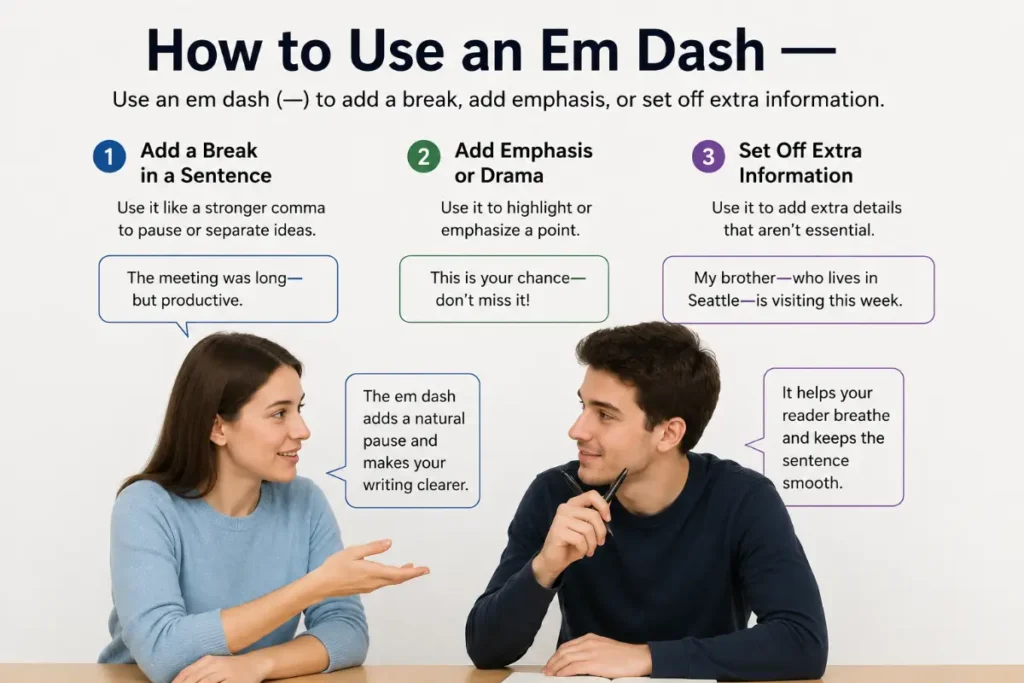
This same instinct — checking what job a mark is actually doing rather than guessing from habit — is exactly what resolves the confusion around the em dash too, since it can stand in for a colon, a comma, or even a semicolon depending on the sentence.
For another useful perspective, check out Apostrophe Rules for Plurals: 9 Simple Rules to Get It Right (2026).
Colon vs. Semicolon: Side-by-Side Comparison
| Colon | Semicolon | |
|---|---|---|
| Function | Introduces, explains, emphasizes | Links two equal, related independent clauses |
| Relationship | Forward-pointing, unequal | Sideways, equal weight |
| Before a list | Yes, standard use | Only for complex lists with internal commas |
| With conjunctive adverbs (however) | No | Yes |
| First part must stand alone? | Yes | Yes (on both sides) |
| Visual metaphor | An arrow, or a spotlight | A comma plus a period |
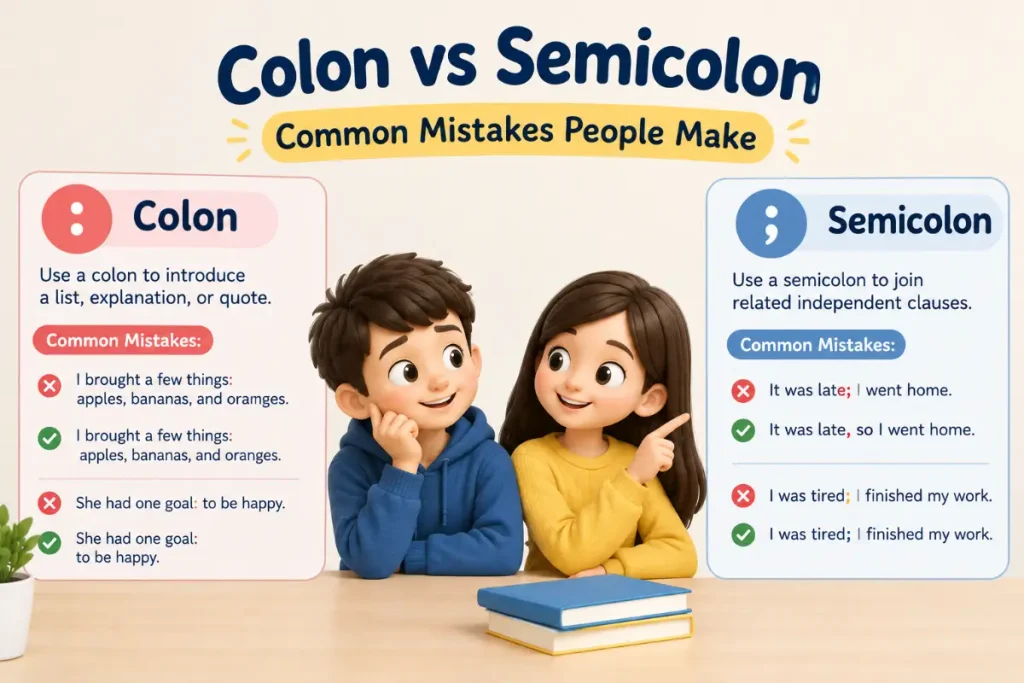
Common Mistakes People Make
Mistake 1: “My favorite foods are: pizza, tacos, and sushi.” The colon is misplaced — “my favorite foods are” isn’t a complete sentence on its own, so no colon is needed here at all: “My favorite foods are pizza, tacos, and sushi.” A colon would only work if rephrased as “I have three favorite foods: pizza, tacos, and sushi.”
Mistake 2: “The plan failed; because nobody communicated clearly.” This should use a comma, not a semicolon — “because nobody communicated clearly” is a dependent clause, not an independent one, so it can’t be joined with a semicolon.
Mistake 3: “She had one goal; win the championship.” Should be a colon, not a semicolon — this is introducing and explaining the goal, which is a colon’s job, not two equally weighted independent clauses.
Mistake 4: “He arrived late, however, he still finished on time.” This is a comma splice — “however” needs a semicolon before it when joining two independent clauses: “He arrived late; however, he still finished on time.”
Mistake 5: Using a colon to separate a complex list with internal commas. “We visited Paris, France: Rome, Italy: and Vienna, Austria” is incorrect — this specific job belongs to semicolons, not colons: “We visited Paris, France; Rome, Italy; and Vienna, Austria.”
More Examples to Lock It In
- The recipe requires one key step: letting the dough rest overnight; skipping it ruins the texture completely.
- There was only one explanation: he’d forgotten the meeting entirely; nobody else on the team had made that mistake before.
- She had a clear plan: save aggressively for two years; her sacrifice eventually paid off.
- The report covered three regions: North America, Latin America, and Europe; each showed different growth patterns.
- His advice was simple: work smarter, not harder; he’d learned that lesson the hard way.
Frequently Asked Questions
Can a colon ever join two independent clauses the way a semicolon does?
Yes, specifically when the second clause explains or elaborates on the first — “The trip was a disaster: everything went wrong” works as a colon because the second half explains the first. This is the one area where colon and semicolon usage genuinely overlaps, though the colon creates more emphasis than the semicolon would in the same spot.
Should the word after a colon be capitalized?
It depends on what follows. If it’s a single word, phrase, or dependent clause, keep it lowercase (unless it’s a proper noun). If it’s a complete independent sentence, some style guides capitalize it and others don’t — Chicago Manual of Style allows either as long as you’re consistent, while AP style generally capitalizes the first word after a colon when a full sentence follows.
Is it wrong to use a colon before a list if the introduction isn’t a complete sentence?
Yes — this is one of the most common colon errors. If the words before the colon can’t stand alone as a complete sentence (“My favorite colors are:”), a colon doesn’t belong there. Either remove the colon entirely or rephrase so the introduction is complete on its own.
Why do colons and semicolons get confused so often, given how different their jobs are?
Likely because they look visually similar (both are “taller” punctuation marks compared to a plain comma or period) and their names sound alike, even though their actual grammatical functions — forward-pointing introduction versus sideways linking of equals — are genuinely quite different once you look closely.
What’s the fastest way to catch colon and semicolon errors before publishing something?
For each colon, check that what comes before it could stand alone as a complete sentence, and that what follows explains, lists, or emphasizes it. For each semicolon, check that both sides are independent clauses of roughly equal weight, with neither one explaining the other.
Practice Exercise
Decide whether each sentence needs a colon or a semicolon in the blank. Answers are listed right after — try each one before checking.
- She had one rule___ never negotiate on price.
- The meeting ran long___ everyone still got their questions answered.
- We need the following supplies___ paper, pens, and folders.
- He missed the deadline___ consequently, the client was upset.
- There’s only one explanation___ he forgot completely.
- The trip included Lyon, France___ Turin, Italy___ and Bern, Switzerland.
- Her advice was simple___ start small and stay consistent.
- The store closed early___ we still made it in time.
- He had a single goal___ finish the marathon.
- The report was thorough___ nevertheless, questions remained.
Answer Key
- colon
- semicolon
- colon
- semicolon
- colon
- semicolon (x2 — complex list)
- colon
- semicolon
- colon
- semicolon
If you got eight or more correct, the forward-pointing-versus-sideways-linking distinction has already become instinct. For any you missed, ask: does this introduce or explain (colon), or link two equal, related ideas (semicolon)?
Before moving on, you may also want to read Punctuate Dialogue: Master 4 Rules Like a Pro (2026) for more helpful grammar tips.
The Bottom Line
A colon points forward, introducing, explaining, or emphasizing what follows — and the words before it must be able to stand alone as a complete sentence. A semicolon links two independent, equally weighted ideas sideways, without one explaining the other. Once you separate “pointing forward” from “linking sideways,” these two marks stop being confusing twins and become two genuinely different tools.
For the fuller breakdown of everything a semicolon can do on its own, including how it works with conjunctive adverbs and complex lists, see our complete guide to semicolons — and if you’re also unsure when a comma belongs before “and” in similar list and clause situations, our comma before and guide covers that related ground in full.