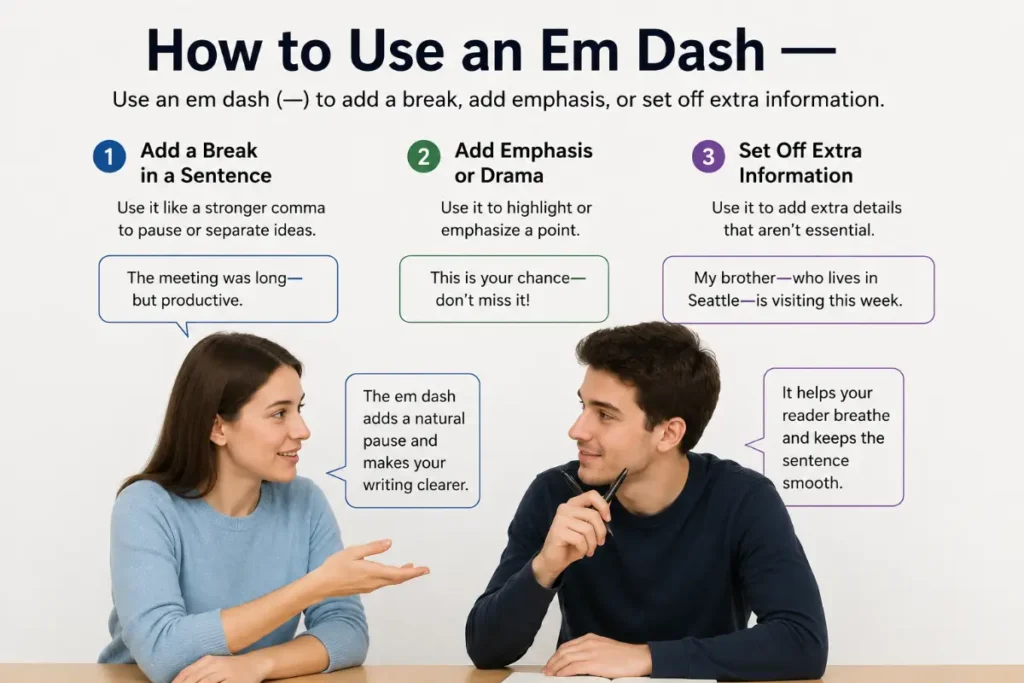
The em dash has a reputation problem — some writers avoid it entirely, worried they’ll use it wrong, while others (or certain AI writing tools) overuse it to the point of exhaustion. Here’s the reassuring truth: Merriam-Webster sums up its whole job in one elegant sentence — “the em dash (—) can function like a comma, a colon, or parenthesis.” Once you know which of those three jobs it’s doing in a given sentence, using it correctly becomes genuinely simple.
You may also find Hyphen vs En Dash vs Em Dash: The Ultimate 2026 Usage Guide helpful if you want to explore this topic further.
The Quick Answer
An em dash (—) is used to:
- Set off extra information, the way commas or parentheses do
- The bakery — which had just opened — was already packed.
- Introduce an explanation or expansion, the way a colon does
- She had one goal — winning.
- Mark an abrupt break or shift in a sentence’s structure
- He was about to leave — actually, he’d already left.
- Show interrupted speech or hesitation in dialogue
- “I just think that — well, never mind.”
If you’re doing one of these four things, an em dash is a valid choice. If you’re not, you probably want a comma, colon, semicolon, or hyphen instead.
What Exactly Is an Em Dash?
An em dash gets its name from its width — it’s roughly as wide as the capital letter M, which is where “em” comes from (as opposed to the shorter en dash, roughly the width of a capital N, used mainly in number ranges like “pages 10–15”). Visually, it’s a long, unbroken horizontal line: —. It’s distinct from a hyphen (-), which is much shorter and used to join words or parts of words, like “well-known” or “self-esteem.”
Getting the right mark matters: a hyphen used where an em dash belongs looks like a typo, and vice versa. Most word processors will auto-convert two hyphens (–) into an em dash automatically, which is the easiest way to insert one without hunting for a special character.
Job 1: Setting Off Extra Information (Like a Comma or Parenthesis)
This is the em dash’s most common job — inserting a phrase that adds detail or context without which the sentence would still be grammatically complete.
Examples:
- The museum’s newest exhibit — a collection of ancient pottery — draws crowds every weekend.
- My neighbor’s dog — a golden retriever named Biscuit — barks at literally everything.
- The proposal — despite months of preparation — was rejected in five minutes.
Merriam-Webster notes that em dashes used this way work “like commas and parentheses” to set off extra information, such as examples, explanatory phrases, or supplemental facts. The key difference in feel: commas are neutral and quiet, parentheses whisper the extra information almost as an aside, and em dashes announce it with more emphasis and energy. Choosing between the three often comes down to how much you want that inserted detail to stand out.
Job 2: Introducing an Explanation (Like a Colon)
An em dash can introduce a clause that explains, expands on, or delivers a punchy conclusion to what came before it — doing essentially the same job as a colon, but with a slightly more conversational, dramatic feel.
Examples:
- She had one rule — never negotiate on price.
- The team had a single mission — get the product out before the holidays.
- There was only one explanation — he’d forgotten completely.
This use is especially common when a writer wants to build anticipation before delivering the key piece of information, giving the sentence more punch than a colon typically provides.
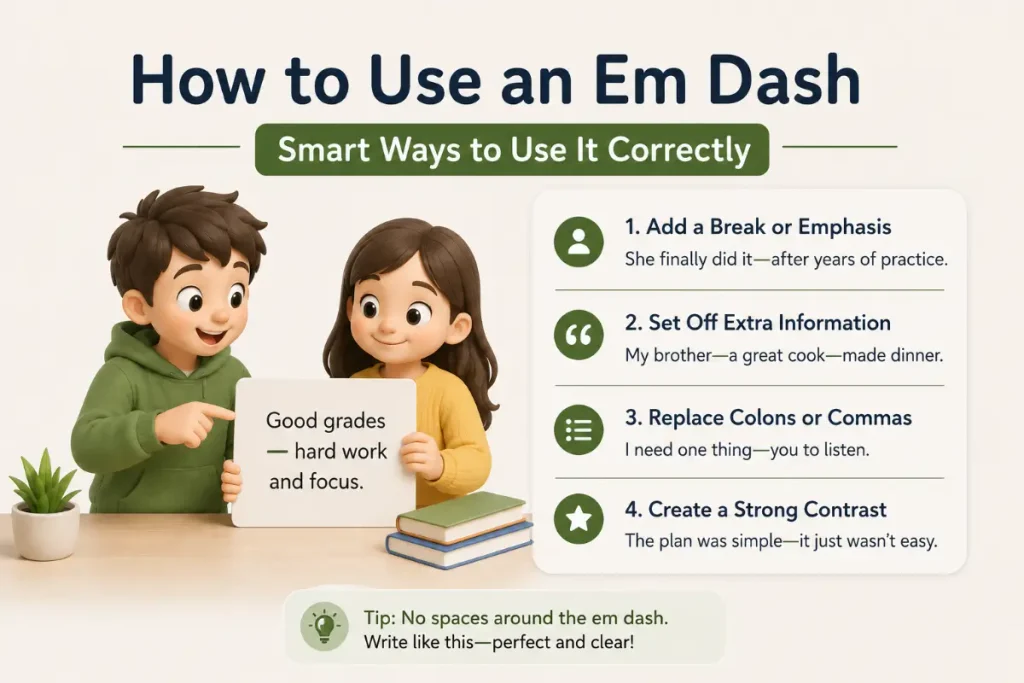
Job 3: Marking an Abrupt Break or Shift
An em dash can signal a sudden change in thought, direction, or tone within a sentence — something a comma is too gentle to capture.
Examples:
- He was fully prepared to apologize — until he saw the mess she’d made of his kitchen.
- Everyone agreed the plan was solid — everyone except the one person whose vote actually mattered.
- She reached for the door — and stopped cold.
Merriam-Webster’s own example captures this well: “Mabel the Cat was delighted with the assortment of pastries the new bakery featured, but Harry the Dog — he felt otherwise…” — the dash here marks a genuine pivot in the sentence’s direction, something no other punctuation mark handles quite as naturally.
Job 4: Showing Interrupted Speech or Hesitation
In dialogue and narrative writing, em dashes are the standard way to represent a speaker being cut off, trailing into hesitation, or stumbling mid-thought.
Examples:
- “I was going to say—” she started, before he cut her off.
- “Of course you have a point,” Mabel murmured. “That is — I suppose it is concerning.”
- “Wait, I don’t think that’s—” “It’s fine,” he interrupted.
This is one of the em dash’s most distinctive jobs, since no other punctuation mark captures interruption quite as cleanly — an ellipsis (…) suggests a trailing off or pause, while an em dash suggests a sharper, more sudden cutoff.
Spacing: The One Genuinely Debated Detail
This is worth addressing directly, since it’s the most common formatting question about em dashes. Most style guides, including Chicago Manual of Style (widely used in U.S. book publishing), recommend no spaces on either side of the em dash: “the idea worked—somehow.” Other style guides and many newspapers use a single space on each side instead: “the idea worked — somehow.” Neither approach is objectively wrong; it’s a matter of house style. The one firm rule: whichever you choose, stay consistent throughout the same piece of writing.
The Fastest Way to Check Yourself
Step 1: Could you replace the em dash with a comma, colon, or parenthesis without losing the meaning? If yes, an em dash is a stylistically valid, often more dynamic choice.
Step 2: Is there a genuine break, pivot, or interruption in the sentence? If yes, an em dash is likely your best (and sometimes only) option.
Step 3: Are you joining two words or parts of a compound word? If yes, you want a hyphen, not an em dash — these are not interchangeable.
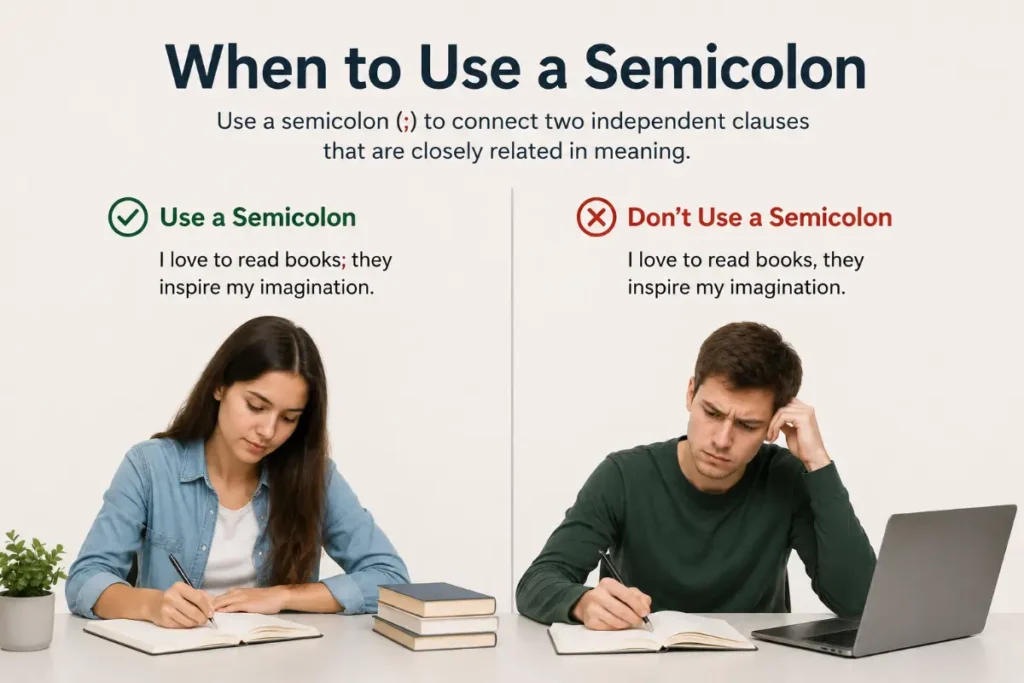
For the other punctuation mark that trips up almost as many writers as this one, see our guide on when to use a semicolon — the two marks overlap in one specific job (joining related independent clauses), which is exactly where writers often wonder which one to reach for.
Em Dash vs. Comma vs. Colon vs. Parentheses: Quick Comparison
| Em Dash | Comma | Colon | Parentheses | |
|---|---|---|---|---|
| Sets off extra info | Yes, with emphasis | Yes, neutral | Rarely | Yes, understated |
| Introduces an explanation | Yes, dramatic | No | Yes, formal | Rarely |
| Marks abrupt shifts | Yes | No | No | No |
| Shows interrupted speech | Yes | No | No | No |
| Tone | Bold, emphatic | Neutral | Formal | Quiet, aside-like |
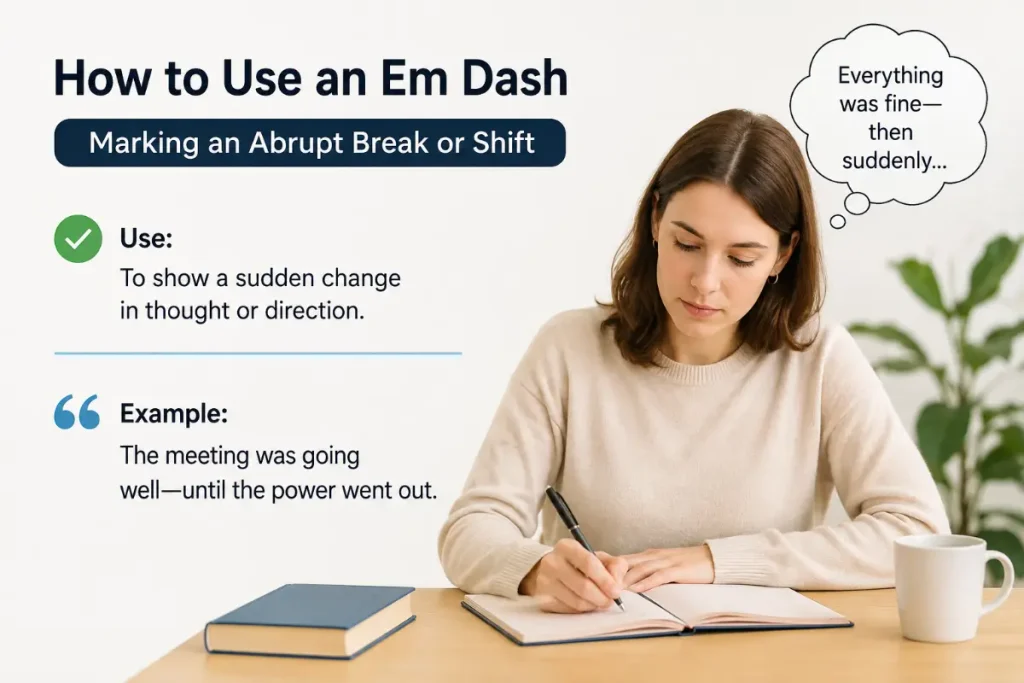
7 Smart Ways to Use It Correctly
Learning How to Use an Em Dash becomes much easier when you focus on the job the punctuation mark is doing. An em dash can add emphasis, introduce an explanation, separate extra information, or signal a sudden change in thought. Here are seven practical ways to use it correctly.
1. Set Off Extra Information
Use an em dash to surround information that adds detail but isn’t essential to the basic sentence.
Example:
The new restaurant — which opened last week — is already fully booked.
You can usually replace the dashes with commas or parentheses, but em dashes make the added information stand out more.
2. Introduce an Explanation
An em dash can introduce an explanation, example, or conclusion that expands on what came before it.
Example:
She had one priority — finishing the project on time.
This works similarly to a colon, but the em dash often gives the sentence a more conversational or emphatic feel.
3. Create an Abrupt Shift
Use an em dash when a sentence suddenly changes direction, reveals an unexpected detail, or interrupts the expected flow.
Example:
I was ready to leave — until I heard the news.
The dash creates a noticeable pause and highlights the shift in thought.
4. Emphasize a Key Point
An em dash can draw attention to an important word, phrase, or idea at the end of a sentence.
Example:
There was only one thing left to do — apologize.
The pause created by the dash builds anticipation before the main point.
5. Show an Interruption in Dialogue
In fiction and conversational writing, an em dash can show that someone is interrupted before finishing a thought.
Example:
“I was just about to tell you—”
“Don’t bother,” she replied.
The em dash signals a sudden cutoff rather than a gradual pause.
6. Show Hesitation or a Broken Thought
An em dash can also show that a speaker changes direction, hesitates, or breaks off mid-sentence.
Example:
“I thought you were — actually, never mind.”
This gives the dialogue a natural, interrupted quality and can convey uncertainty or reluctance.
7. Highlight a Strong Contrast
Use an em dash to place two contrasting ideas next to each other when you want the contrast to feel especially sharp.
Example:
Everyone supported the proposal — except the person who had to approve it.
The em dash creates a stronger contrast than a simple comma would and gives the second idea extra weight.
The key to How to Use an Em Dash is to use it purposefully. If you’re adding emphasis, introducing an explanation, setting off extra information, or showing a genuine break in thought, an em dash may be the perfect choice. Just avoid using it in every sentence, or its impact quickly wears off.
For another useful perspective, check out Use an Ellipsis Correctly: 20 Simple Examples (2026).
Common Mistakes People Make
Mistake 1: “Well-known-author wrote the book.” Using hyphens where an em dash is needed (or vice versa) creates confusion — this should likely be “The well-known author wrote the book,” with the hyphen correctly joining “well” and “known” into a compound adjective, not standing in for a dash at all.
Mistake 2: Overusing em dashes throughout a piece. Because em dashes are so versatile, it’s tempting to reach for them constantly instead of varying sentence structure with commas, periods, and other punctuation. Overuse can make writing feel breathless or erratic rather than confident and varied.
Mistake 3: Mixing spacing styles within the same document. Using “word—word” in one paragraph and “word — word” in another looks inconsistent and unpolished. Pick one spacing convention and apply it throughout.
Mistake 4: Using a single em dash when a pair is needed. When an em dash sets off information in the middle of a sentence (not at the end), it typically needs a matching dash on both sides: “The results — though preliminary — were promising,” not “The results — though preliminary, were promising.”
Mistake 5: Confusing en dashes and em dashes. The shorter en dash (–) is used for ranges (“pages 10–15,” “the 2020–2021 season”), not for the jobs covered in this guide. Using an en dash where an em dash belongs is a subtle but noticeable formatting error in professional and published writing.
More Examples to Lock It In
- The recipe — passed down from her grandmother — called for one secret ingredient: patience.
- He had exactly one excuse — traffic — and it wasn’t going to work this time.
- The company’s growth was steady — until, suddenly, it wasn’t.
- “I really think we should—” “Don’t,” she said firmly, before he could finish.
- Every plan had a flaw — every single one — except for the last one they tried.
Frequently Asked Questions
Can I use an em dash instead of a semicolon?
In many cases, yes — both can join two closely related ideas, but an em dash tends to feel more casual and emphatic, while a semicolon feels more formal and measured. In academic or highly formal writing, a semicolon is usually the safer, more expected choice.
How do I type an em dash on my keyboard?
Most word processors (Word, Google Docs) automatically convert two hyphens typed in a row (–) into an em dash. On a Mac, you can also type Shift+Option+Hyphen; on Windows, Alt+0151 using the numeric keypad.
Is it ever wrong to use an em dash?
It’s rarely grammatically “wrong” given how flexible the mark is, but it can be a poor stylistic choice if overused, or if a more precise mark (like a colon for a formal list, or a semicolon for a formal academic tone) would better suit the writing’s register.
Do em dashes work differently in fiction versus nonfiction writing?
The core rules stay the same, but em dashes appear especially often in fiction dialogue to show interruption, and in narrative prose to create dramatic pacing — uses that are less common, though not incorrect, in more formal nonfiction and business writing.
What’s the fastest way to catch em dash errors before publishing something?
Check that every mid-sentence em dash has a matching pair, confirm you haven’t mixed spaced and unspaced styles in the same document, and make sure you haven’t used a hyphen where the sentence actually needed the longer em dash mark.
Practice Exercise
Decide whether each sentence needs an em dash, comma, colon, or hyphen in the blank. Answers are listed right after — try each one before checking.
- The plan___though risky___was ultimately approved.
- She has one goal___to finish the marathon.
- My best___friend moved away last year.
- The weather was perfect___sunny, warm, and calm.
- “I was about to say___” he stopped mid-sentence.
- The report___all forty pages of it___was due Monday.
- He’s a well___known chef in the city.
- There’s only one solution___patience.
- The trip included stops in Rome, Paris, and Madrid.
- Everyone loved the idea___everyone except the client.
Answer Key
- em dash (x2)
- em dash or colon
- hyphen
- colon
- em dash
- em dash (x2)
- hyphen
- em dash or colon
- comma
- em dash
If you got eight or more correct, you’ve got a solid handle on when the em dash earns its place. For any you missed, ask again: extra info, explanation, abrupt shift, or interrupted speech?
Em Dashes in Different Writing Contexts
In journalism and news writing, em dashes are used sparingly, typically reserved for genuinely abrupt shifts or essential clarifying details, since news style favors shorter, punchier sentences overall.
In academic writing, em dashes appear less frequently than commas, colons, or semicolons, since formal academic tone tends to favor those more measured, traditional marks — though a well-placed em dash for emphasis is still acceptable in most academic style guides.
In fiction and creative writing, em dashes are everywhere — marking interrupted dialogue, sudden narrative pivots, and dramatic pauses. This is the genre where the mark’s full range gets used most naturally and most often.
In business and marketing copy, em dashes are popular for their punchy, confident tone — introducing a bold claim or key benefit with more energy than a comma or colon would provide. This popularity is also part of why the mark has recently become associated with AI-generated writing, since language models tend to reach for it especially often; using it thoughtfully and sparingly, rather than in every other sentence, helps writing read as more deliberately human.
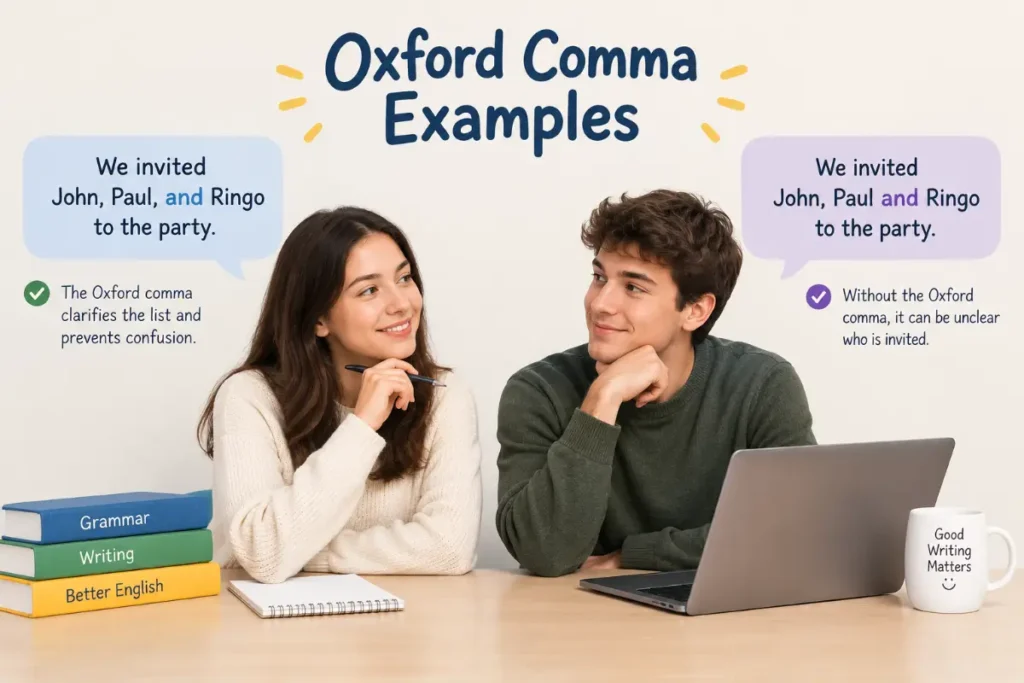
Before moving on, you may also want to read Oxford Comma Examples: 21 Ways to Use It Correctly (2026) for more helpful grammar tips.
The Bottom Line
An em dash can do the work of a comma, colon, or parenthesis — plus mark abrupt breaks and interrupted speech, jobs no other punctuation mark handles as naturally. The key is matching its bold, emphatic tone to what your sentence actually needs, staying consistent with spacing, and not reaching for it so often that its impact wears off.