Learning How to Use Quotation Marks Correctly can be simple once you know the basic rules. From direct quotes to titles and dialogue, these guidelines help you use quotation marks clearly and confidently.
Purdue OWL sums up the core purpose of quotation marks in one clear sentence: their primary function is “to set off and represent exact language (either spoken or written) that has come from somebody else.” That’s the foundation everything else builds on — but quotation marks come with enough smaller rules around punctuation placement, nested quotes, and special uses that it’s worth walking through all of them in one place.
You may also find When to Capitalize Job Titles: 7 Rules You Need to Know (2026) helpful if you want to explore this topic further.
The Quick Answer
Use quotation marks to:
- Enclose someone’s exact spoken or written words
- She said, “I’ll be there by noon.”
- Mark titles of shorter works (articles, poems, songs, short stories, episodes)
- We read “The Road Not Taken” in class today.
- Indicate irony, skepticism, or a word used in an unusual way
- His “apology” didn’t sound very sincere.
- Show dialogue within another quotation (using single quotes)
- He said, “She told me, ‘I’m not coming back.'”
Rule 1: Enclosing Someone’s Exact Words
This is the most familiar use — putting quotation marks around a direct quotation, whether spoken aloud or copied from a written source.
Examples:
- The teacher said, “Turn in your homework by Friday.”
- “I’m not sure I agree,” she replied.
- According to the report, “sales increased by 12 percent last quarter.”
Purdue OWL specifies that a comma introduces a quotation after a standard dialogue tag, a brief introductory phrase, or a dependent clause: The detective said, “I am sure who performed the murder.” Note this only applies to direct quotations — someone’s exact words. If you’re paraphrasing what someone said rather than quoting them directly, no quotation marks are needed at all: The teacher said the homework was due Friday (no quotes, since this isn’t word-for-word).
Rule 2: Comma and Period Placement (The Detail Everyone Gets Wrong)
This is genuinely the single most common quotation mark error in American English, and it’s worth memorizing as a fixed rule rather than reasoning through it each time: in standard American usage, commas and periods always go inside the closing quotation mark, regardless of whether they’re logically part of the quoted material.
Examples:
- He said, “I’ll call you tomorrow.” (period inside, even though it just ends the whole sentence)
- She called it “a complete disaster,” though others disagreed. (comma inside)
- The article was titled “New Discoveries in Space Exploration.”
This differs from British English, which places commas and periods outside the quotation marks unless they’re genuinely part of the original quoted material. If you’re writing for a U.S. audience or publication, periods and commas inside the closing quotation mark is the standard, expected convention.
Rule 3: Colons and Semicolons Go Outside
Unlike commas and periods, colons and semicolons always go outside the closing quotation mark, with no exceptions.
Examples:
- She called the plan “brilliant”; I had my doubts.
- He described it as “unforgettable”: the trip changed his entire outlook.
Rule 4: Question Marks and Exclamation Points Depend on Meaning
This is the one placement rule that genuinely requires judgment rather than a fixed pattern. Purdue OWL explains it clearly: place the question mark or exclamation point inside the closing quotation marks if it applies to the quoted material itself; place it outside if it applies to the entire surrounding sentence.
Examples where the punctuation belongs inside:
- He asked, “When will you be arriving?” (the question is what he asked)
- She shouted, “Watch out!” (the exclamation is what she shouted)
Examples where the punctuation belongs outside:
- Did she really say, “I quit”? (the question is whether she said it, not part of the quote itself)
- I can’t believe he called it “a masterpiece”! (the exclamation is the speaker’s reaction, not part of the original quote)
Rule 5: Nested Quotes Use Single Quotation Marks
When you need to show a quotation within another quotation, the inner quote uses single quotation marks, while the outer quote uses standard double quotation marks.
Example:
- The reporter told me, “When I interviewed the quarterback, he said they simply ‘played a better game.'”
Notice the pattern: double quotes for the outer, full quotation, single quotes for the quote embedded inside it. This nesting rule is standard across American style guides.
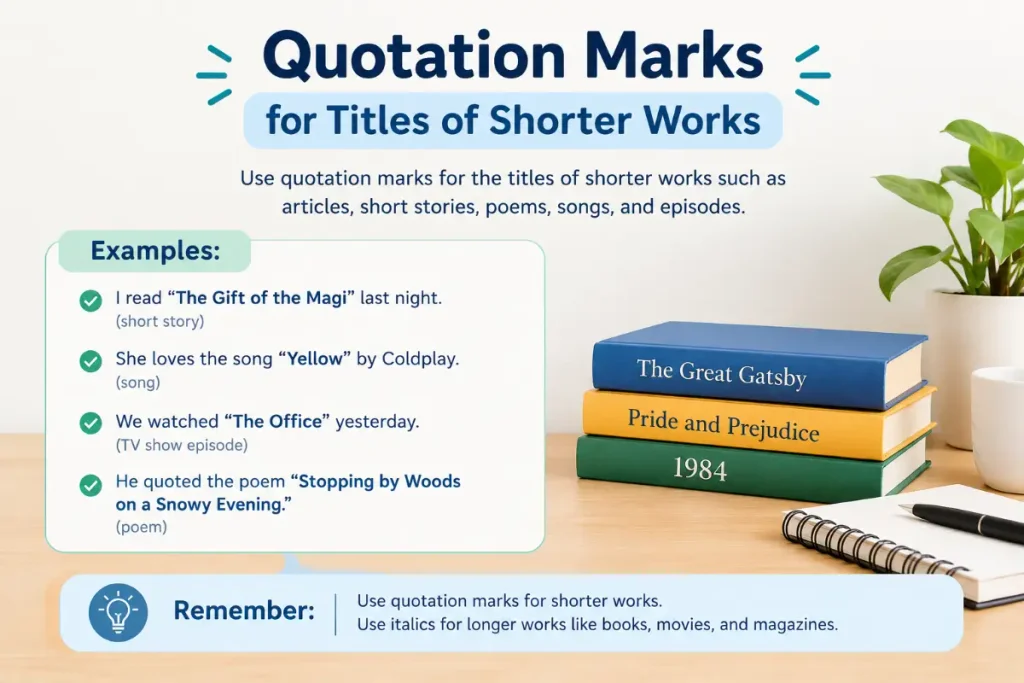
Rule 6: Quotation Marks for Titles of Shorter Works
Quotation marks (rather than italics) are used for the titles of shorter works: articles, short stories, poems, songs, essays, individual episodes of TV or radio shows, and chapter titles.
Examples:
- We analyzed Robert Frost’s poem “Mending Wall” in class.
- Her favorite episode is “The One Where Chandler Can’t Cry.”
- The magazine published an article titled “The Future of Renewable Energy.”
Longer, standalone works — books, movies, TV series as a whole, albums — are italicized instead, not placed in quotation marks. This title/quotation-versus-italics distinction is a common point of confusion, but the underlying logic is simple: shorter works that exist as part of something larger get quotation marks; complete, standalone works get italics.
Rule 7: Marking Irony or Unusual Word Use
Quotation marks can signal that a word is being used sarcastically, skeptically, or with some reservation — sometimes called “scare quotes.”
Examples:
- The great march of “progress” has left millions impoverished.
- His “quick fix” ended up taking three weeks.
- She gave what she called a “brief” explanation that lasted twenty minutes.
Use this sparingly — overusing scare quotes throughout a piece of writing can come across as overly sarcastic or undermine the writing’s credibility if every other sentence casts doubt on a word choice.
What NOT to Use Quotation Marks For
- Don’t use them for words discussed as words themselves — use italics instead: The word love means something different in every language (italics), not “love” in quotation marks for this specific purpose.
- Don’t use them for paraphrased speech — if you’re summarizing what someone said rather than quoting them exactly, skip the quotation marks entirely: She mentioned she’d be running late (no quotes needed, since this isn’t verbatim).
- Don’t use them for emphasis — a word in quotation marks meant simply to be emphasized (“This is a ‘must-have’ item”) actually reads as ironic or skeptical to careful readers, which is rarely the intended effect. Bold or italics are the correct tools for genuine emphasis.
The Fastest Way to Check Yourself
Step 1: Are you quoting someone’s exact words? Use double quotation marks around them.
Step 2: Is there a comma or period right at the end of the quoted material? It goes inside the closing quotation mark.
Step 3: Is there a colon or semicolon? It goes outside.
Step 4: Is there a question mark or exclamation point? Check whether it belongs to the quote itself (inside) or the whole sentence (outside).
Step 5: Is this a quote within a quote? Use single quotation marks for the inner one.
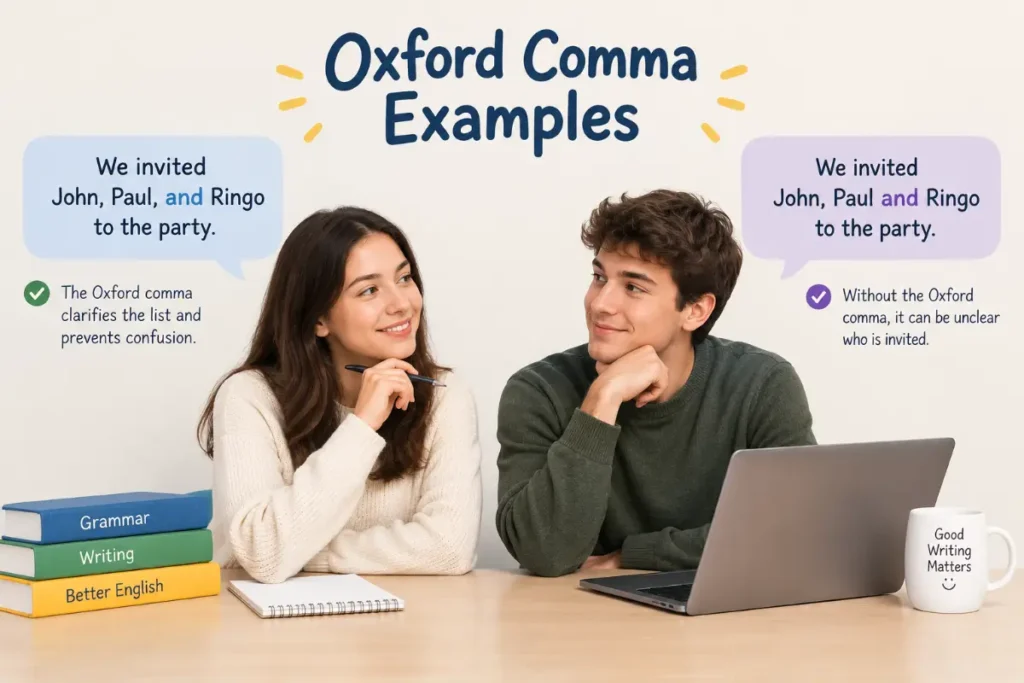
Getting comma placement right around quotes is closely related to the broader comma logic covered in oxford comma examples — in both cases, the comma’s job depends entirely on the structure surrounding it, not on any single fixed position in the sentence.
Quotation Mark Placement: Quick Reference
| Punctuation | Placement | Example |
|---|---|---|
| Comma | Always inside | “Wait,” she said. |
| Period | Always inside | He said, “Stop.” |
| Colon | Always outside | She called it “urgent”: act now. |
| Semicolon | Always outside | He said “maybe”; I doubted it. |
| Question mark | Inside or outside, depends on meaning | She asked, “Why?” / Did he say “yes”? |
| Exclamation point | Inside or outside, depends on meaning | He yelled, “Run!” / She actually said “no”! |
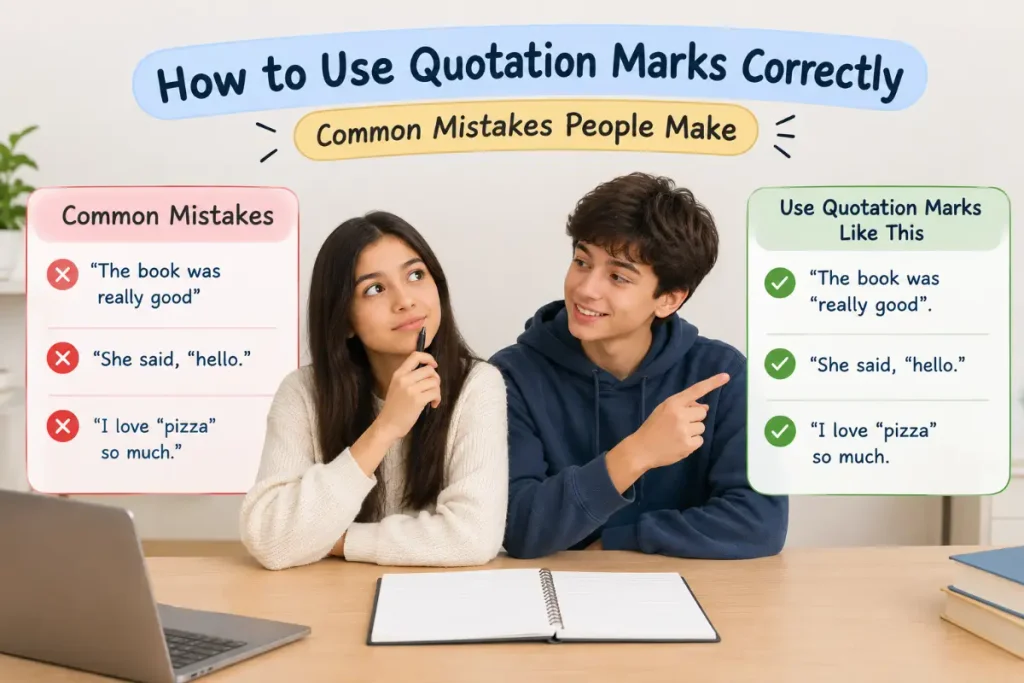
Common Mistakes People Make
Mistake 1: “I’ll be there soon”, she said. In American English, this should be “I’ll be there soon,” she said — the comma belongs inside the closing quotation mark.
Mistake 2: He described the trip as “amazing”. Should be “amazing.” — the period goes inside the closing quotation mark in standard American usage.
Mistake 3: Using quotation marks for a paraphrase. “She said that she ‘would try her best'” when the writer is actually paraphrasing, not quoting exactly, misleadingly implies those specific words were spoken verbatim. If it’s not an exact quote, drop the quotation marks.
For another useful perspective, check out Hyphen vs En Dash vs Em Dash: The Ultimate 2026 Usage Guide.
Mistake 4: Using double quotes for a quote within a quote. “He said, “I’m leaving now”” should use single quotes for the inner quotation: “He said, ‘I’m leaving now.'”
Mistake 5: Using quotation marks for emphasis. Writing “our ‘famous’ pizza” to mean genuinely famous pizza backfires, since scare quotes signal doubt or irony — this sentence unintentionally suggests the pizza isn’t actually famous at all.
More Examples to Lock It In
- “Are you coming to the party?” she asked, glancing at her watch.
- He called the deal “the opportunity of a lifetime,” though his tone suggested otherwise.
- The chapter titled “New Beginnings” set up the rest of the novel.
- Did she seriously just call that plan “flawless”?
- “I told him,” Maria explained, “‘don’t wait for me’ — but he waited anyway.”
Frequently Asked Questions
Do commas and periods really always go inside quotation marks, even if it seems illogical?
Yes, in standard American English — this is a fixed typographic convention, not a logic-based rule, and it applies even when the comma or period isn’t technically part of the quoted material. British English follows a different, more “logical” convention, placing them outside unless they belong to the original quote.
When should I use single quotation marks instead of double?
Single quotation marks are used specifically for a quotation nested inside another quotation. Outside of that nesting situation, American English uses double quotation marks for all standard quoting purposes.
Should song titles and book titles both use quotation marks?
No — song titles typically use quotation marks (since they’re shorter individual works), while entire albums, like full books, are italicized. The same logic applies to a single episode of a show (quotation marks) versus the show as a whole (italics).
Is it ever acceptable to put a comma outside a closing quotation mark in American writing?
Only in rare, specialized cases — such as when the quoted material is immediately followed by a citation in parentheses, where the period moves after the citation rather than staying inside the quote. For standard prose without citations, the comma-and-period-inside rule applies consistently.
What’s the fastest way to catch quotation mark errors before publishing something?
Check every closing quotation mark against the punctuation immediately next to it: commas and periods go inside, colons and semicolons go outside, and question marks or exclamation points depend on whether they belong to the quoted material or the whole sentence.
Practice Exercise
Add the correct punctuation placement to each sentence. Answers are listed right after — try each one before checking.
- She said “I’m almost done”
- He called it “the best decision I’ve ever made”
- Did she really say “I don’t care”
- The article was titled “Climate Change and the Future”
- He shouted “Get down”
- I loved the poem “Fire and Ice”
- She described the food as “incredible” though I disagreed
- He asked “What time is it”
- My favorite episode is “The Final Chapter”
- She whispered “Don’t tell anyone” and walked away
Answer Key
- She said, “I’m almost done.”
- He called it “the best decision I’ve ever made.”
- Did she really say “I don’t care”?
- The article was titled “Climate Change and the Future.”
- He shouted, “Get down!”
- I loved the poem “Fire and Ice.”
- She described the food as “incredible,” though I disagreed.
- He asked, “What time is it?”
- My favorite episode is “The Final Chapter.”
- She whispered, “Don’t tell anyone,” and walked away.
If you got eight or more correct, the placement rules have already become second nature. For any you missed, check: comma or period (inside), colon or semicolon (outside), or question/exclamation mark (depends on meaning)?
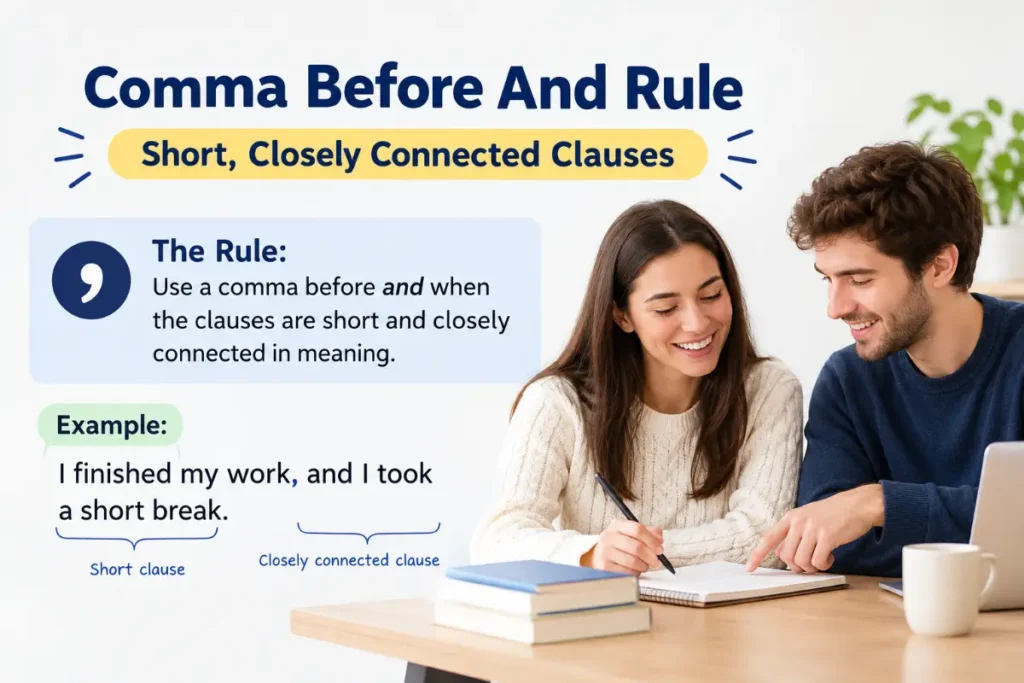
Before moving on, you may also want to read Comma Before And Rule: 5 Easy Rules You Need to Know (2026) for more helpful grammar tips.
The Bottom Line
Quotation marks enclose exact words, mark titles of shorter works, and can signal irony when used sparingly. The placement rules are largely fixed in American English — commas and periods always inside, colons and semicolons always outside — with question marks and exclamation points as the one case that depends on whether the punctuation belongs to the quote itself or the whole sentence.
In short, How to Use Quotation Marks Correctly comes down to knowing when to quote exact words, how to punctuate them, and when quotation marks add meaning. Follow these simple rules, and your writing will stay clear, polished, and easy to understand.