Here’s the thing most people never quite get straight about this rule: whether you need a comma before “and” doesn’t depend on the word “and” itself — it depends entirely on what comes after it. Once you separate this into its two genuinely different situations, the whole question stops being confusing.
The comma before and rule becomes much easier once you know what kind of sentence you’re dealing with. Whether you’re joining two complete thoughts, listing items, or simply connecting related words, the structure of the sentence tells you whether that comma belongs there—not the word “and” alone.
You may also find Use an Em Dash: 7 Smart Ways to Use It Correctly (2026) helpful if you want to explore this topic further.
The Quick Answer
You need a comma before “and” in exactly two situations:
- When “and” joins two independent clauses (each side could be its own complete sentence)
- She finished the report, and she sent it to the client immediately.
- When “and” comes before the final item in a list of three or more (the serial/Oxford comma — technically optional, but recommended)
- We packed sandwiches, chips, and drinks.
You do NOT need a comma before “and” when it simply joins two words, phrases, or a compound predicate (two actions by the same subject) that aren’t full independent clauses.
- She writes and edits for the magazine. (no comma — same subject, two verbs)
- I like tea and coffee. (no comma — just two items)
Situation 1: Joining Two Independent Clauses
An independent clause is a group of words with its own subject and verb that could stand alone as a complete sentence. When “and” connects two of these, a comma goes before it.
Examples:
- The concert was sold out, and fans still lined up outside hoping for tickets.
- He studied all night, and his effort showed on the exam.
- The meeting ran late, and everyone missed their lunch break.
The test: read each half separately. “The concert was sold out.” “Fans still lined up outside hoping for tickets.” Both are complete sentences on their own — that’s your signal a comma belongs before “and.”
Compare that to a sentence where “and” is simply joining two verbs with the same subject, not two full clauses:
- He cooked dinner and cleaned the kitchen. (no comma — one subject, “he,” doing two things)
This second sentence has one subject performing two actions — it’s not two independent clauses, so no comma is needed. This distinction is genuinely the single biggest source of confusion in this entire rule.
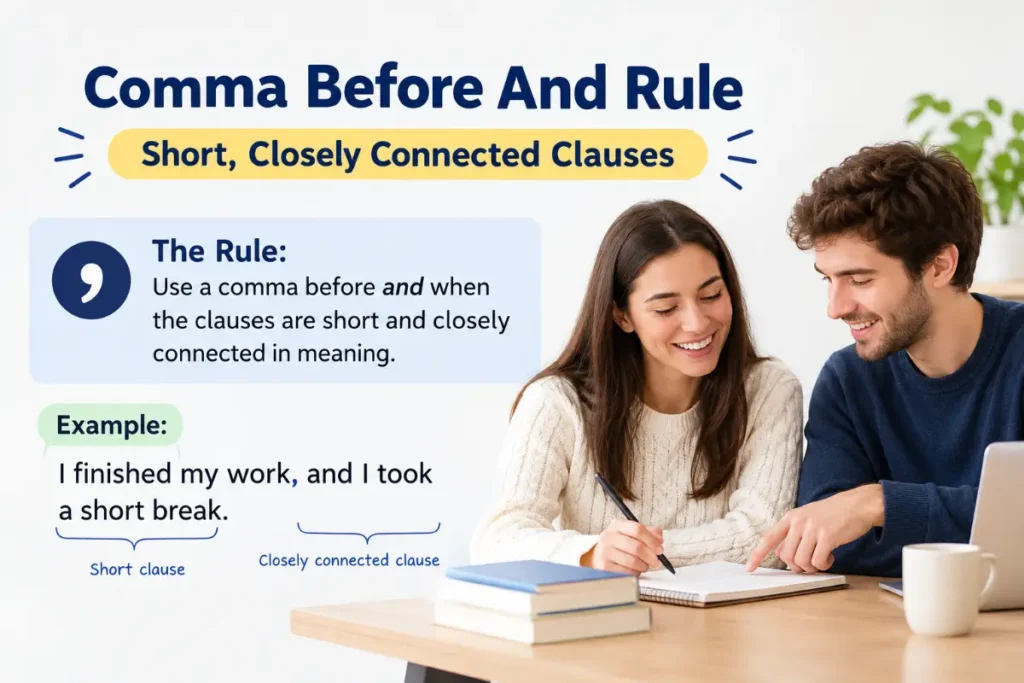
The Exception: Short, Closely Connected Clauses
Even when “and” technically joins two independent clauses, most style guides agree the comma becomes optional if both clauses are short and closely related in meaning.
- Carlos danced and Felipe sang.
- She smiled and he waved.
Both of these could take a comma (“Carlos danced, and Felipe sang”), and it wouldn’t be wrong — but with short, tightly connected clauses like these, many writers and editors prefer to skip it, since inserting a comma can make a brisk, simple sentence feel unnecessarily choppy.
Situation 2: The Serial (Oxford) Comma
This is the comma before “and” (or “or”) that comes right before the last item in a list of three or more things. It’s one of the most famously debated points in all of English punctuation.
Examples with the serial comma:
- We packed sandwiches, chips, and drinks.
- The team includes a designer, a developer, and a project manager.
- She studied biology, chemistry, and physics in college.
Examples without it (also grammatically acceptable):
- We packed sandwiches, chips and drinks.
- The team includes a designer, a developer and a project manager.
Merriam-Webster’s own video guide confirms directly: “the serial comma is optional.” There’s no single, universally “correct” answer — it comes down to which style guide you’re following. The Chicago Manual of Style and MLA both strongly recommend using it consistently. The AP Stylebook, followed by most U.S. newspapers, generally omits it to save space, except in cases where leaving it out would create genuine confusion.
When the Serial Comma Genuinely Matters (Not Just Style)
Even style guides that generally skip the serial comma make an exception when its absence creates real ambiguity. Merriam-Webster’s own example is the classic illustration: “I would like to thank my parents, Ayn Rand and God” — without a comma before “and,” this reads as if your parents are literally named Ayn Rand and God, rather than being a separate item in the list. Add the serial comma — “I would like to thank my parents, Ayn Rand, and God” — and the ambiguity disappears.
A real published example makes the same point: a caption describing a documentary listed interviewees as “his two ex-wives, Kris Kristofferson and Robert Duvall” — without a comma before “and,” it briefly reads as though Kris Kristofferson and Robert Duvall were the two ex-wives, rather than three separate names in a list. This is exactly the kind of case where even AP-style publications will typically add the comma anyway, precision winning out over house style.
The Fastest Way to Check Yourself
Step 1: Could both halves of the sentence stand alone as complete sentences? If yes, you’re joining independent clauses, and a comma before “and” is standard (though optional for short, closely connected pairs).
Step 2: Is “and” connecting the last two items in a list of three or more? If yes, the comma is the serial comma — optional stylistically, but worth using whenever skipping it could cause any ambiguity.
Step 3: Is “and” simply joining two words, or two verbs sharing the same subject? If yes, no comma is needed at all.
This same “check what’s actually on each side” instinct is exactly what resolves the semicolon rules too — both marks care less about the connecting word itself and more about the grammatical structure surrounding it.
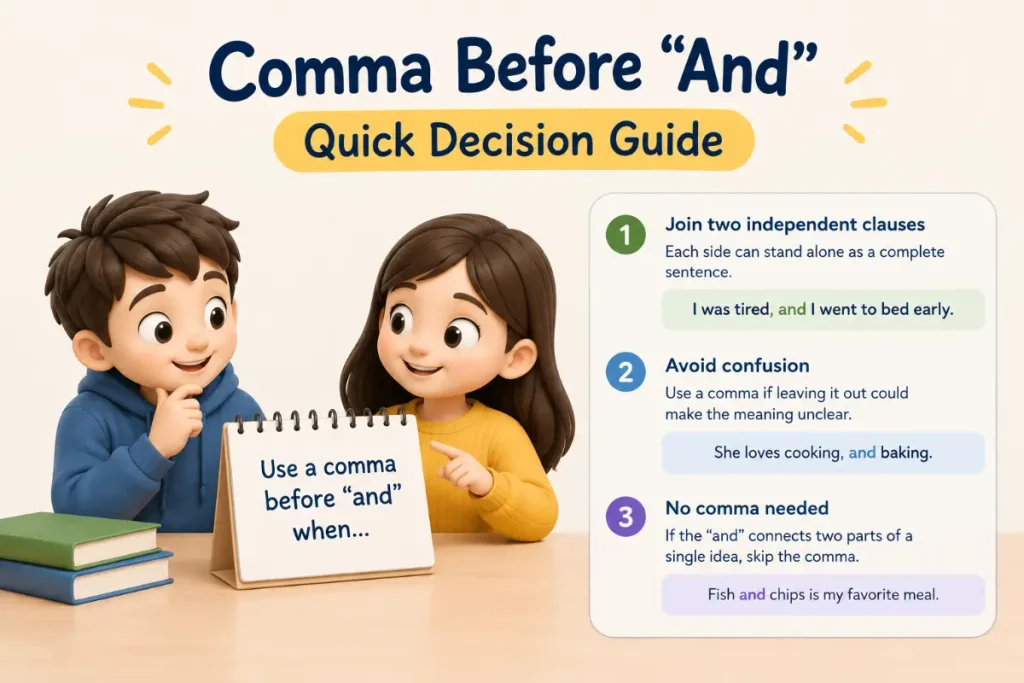
Comma Before “And”: Quick Decision Guide
| Situation | Comma Needed? | Example |
|---|---|---|
| Joining two independent clauses | Yes (standard) | She left, and he stayed. |
| Joining two short, closely related clauses | Optional | She smiled and he waved. |
| Serial comma before last list item | Optional (style-dependent) | Red, white, and blue. |
| Serial comma needed to avoid ambiguity | Yes, strongly recommended | My parents, Ayn Rand, and God. |
| Joining two verbs, same subject | No | She cooked and cleaned. |
| Joining just two items (not a list of 3+) | No | I like tea and coffee. |
Common Mistakes People Make
Mistake 1: “She finished her homework, and went to bed.” No comma needed here — “went to bed” isn’t an independent clause (there’s no subject; it’s just a second verb attached to “she”). This should be “She finished her homework and went to bed.”
Mistake 2: “I bought apples, oranges and, bananas.” The comma is misplaced — it should come before “and,” not after it: “I bought apples, oranges, and bananas.”
Mistake 3: “He left early and she arrived late” (as two clearly separate, unrelated events). While short closely-related clauses can skip the comma, genuinely separate ideas usually read more clearly with one: “He left early, and she arrived late.”
For another useful perspective, check out When to Capitalize Job Titles: 7 Rules You Need to Know (2026).
Mistake 4: Treating the serial comma as a hard grammar rule rather than a style choice. Both “red, white, and blue” and “red, white and blue” are grammatically acceptable — this is genuinely a style preference, not a right-versus-wrong grammar issue, except in the specific cases where omitting it creates real ambiguity.
Mistake 5: Inconsistent serial comma use within the same document. Using it in one list and skipping it in another, within the same piece of writing, looks inconsistent. Pick a style (with or without) and apply it throughout.
More Examples to Lock It In
- The store was closing, and the manager was rushing to lock up, count the register, and turn off the lights.
- He wanted to travel and see the world, and eventually, he did.
- We ordered pasta, salad, and garlic bread, and the waiter brought everything out together.
- She sings and dances, and she’s remarkably good at both.
- The board approved the budget, and the new hires start Monday.
Practice Exercise
Decide whether each sentence needs a comma before “and.” Answers are listed right after — try each one before checking.
- She packed her bags and left for the airport.
- He finished the race and his coach cheered loudly.
- We need milk, eggs and butter for the recipe.
- The dog barked and the cat hissed.
- I called my sister and asked about the trip.
- The team practiced hard and their coach was proud.
- She likes hiking and camping.
- He opened the door and stepped inside.
- The company hired a designer, a writer and an editor.
- The rain stopped and the sun came out.
Answer Key
- No comma (same subject, two verbs)
- Comma (two independent clauses)
- Optional serial comma before “and” (style choice)
- Comma (two independent clauses, though optional if treated as short/closely related)
- No comma (same subject, two verbs)
- Comma (two independent clauses)
- No comma (just two items)
- No comma (same subject, two verbs)
- Optional serial comma before “and” (style choice)
- Comma (two independent clauses, though optional if treated as short/closely related)
If you got eight or more correct, the independent-clauses-versus-shared-verb distinction has already become instinct. For any you missed, check: does each side of “and” have its own subject and verb?
What the Style Guides Say
Merriam-Webster states plainly that the serial comma is optional, framing it as a house-style choice rather than a fixed grammar rule. The Chicago Manual of Style and MLA Handbook both recommend using it consistently across all writing for maximum clarity. The AP Stylebook, built around the space constraints of print journalism, generally omits it — except in the specific cases where a sentence would otherwise be ambiguous, at which point even AP-style publications typically add it back in.
The rule for joining independent clauses with a comma before “and,” by contrast, is far more settled across every major style guide — there’s no real disagreement there, unlike the serial comma question, which remains one of the most famously debated points in English punctuation.
Comma Usage in Different Writing Contexts
- In journalism, following AP style typically means skipping the serial comma except where ambiguity would result — this is one of the more visible differences between newspaper writing and book or academic publishing.
- In academic and book publishing, the serial comma is close to universal, following Chicago Manual of Style or MLA conventions, since clarity and consistency are prioritized over saving space.
- In business writing, house style varies by company, but consistency within a single document matters more than which specific convention is chosen.
- In legal writing, the stakes for the serial comma can be genuinely high — a well-known 2017 labor dispute in Maine hinged partly on the absence of a serial comma in a state law, which affected how a list of exemptions was interpreted in court.
This real-world case is often cited as the clearest evidence that the “optional” comma can carry real legal and financial consequences depending on context.
Frequently Asked Questions
Is the serial comma required by any official grammar rule?
No — it’s a style choice, not a hard grammar rule. Major style guides genuinely disagree: Chicago Manual of Style and MLA recommend using it consistently, while AP Stylebook generally omits it except when needed to avoid ambiguity. Neither position is objectively “more correct” grammatically.
Why do newspapers tend to skip the serial comma?
Historically, this traces back to saving column space in print — every comma took up room across thousands of copies. AP style still generally follows this convention today, even though the original space-saving rationale matters much less in digital publishing.
Is it ever grammatically wrong to include the serial comma?
No — including it is never grammatically incorrect, even under AP style; AP simply doesn’t require it. If you’re not bound by a specific style guide, using the serial comma consistently is a safe, widely respected default that helps prevent ambiguity.
What’s the easiest way to remember when NOT to use a comma before “and”?
Check whether “and” is connecting a second full clause (with its own subject) or just a second verb attached to the same subject. “She cooked and cleaned” has one subject doing two things — no comma. “She cooked, and he cleaned” has two different subjects, each with their own action — comma needed.
What’s the fastest way to catch this error before publishing something?
For every “and” in your document, check what’s on each side: two complete sentences (comma, standard), the last item in a list of three or more (optional serial comma, but recommended for clarity), or just two words or a shared-subject verb pair (no comma).
Before moving on, you may also want to read When to Use a Dash Instead of a Comma (2026 Guide) for more helpful grammar tips.
The Bottom Line
A comma belongs before “and” when it joins two independent clauses, and it’s a stylistic (but recommended) choice before the last item in a list of three or more. No comma is needed when “and” simply connects two words or two verbs sharing the same subject. The real test isn’t the word “and” itself — it’s what’s standing on either side of it.
Understanding the comma before and rule becomes much easier when you focus on what comes before and after “and.” Use a comma when “and” joins two independent clauses, and consider it before the final item in a list of three or more. No comma is needed when “and” connects two words or verbs that share the same subject.