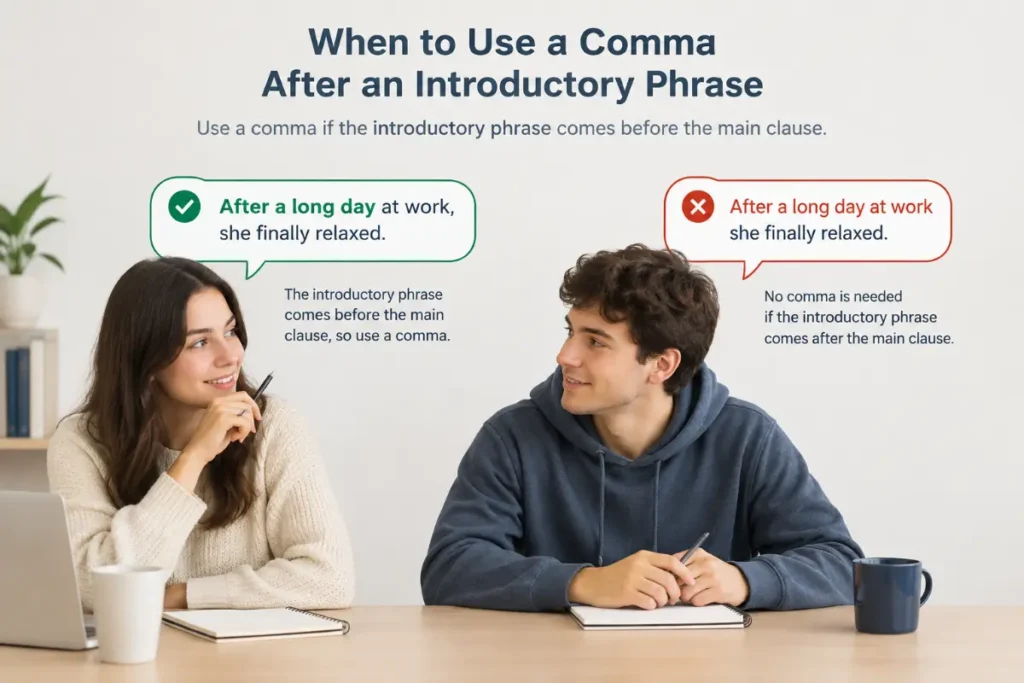
Wondering When to Use a Comma After an Introductory Phrase? This small punctuation rule can make a big difference in clarity, helping readers quickly see where the opening phrase ends and the main sentence begins.
Knowing using comma after an introductory phrase is one of the more genuinely useful punctuation skills to master, since introductory elements show up in nearly every paragraph you write. Purdue OWL lays out the core principle clearly: introductory clauses, phrases, and words that “set the stage” for the main part of a sentence are generally followed by a comma, separating that setup from the independent clause that follows.
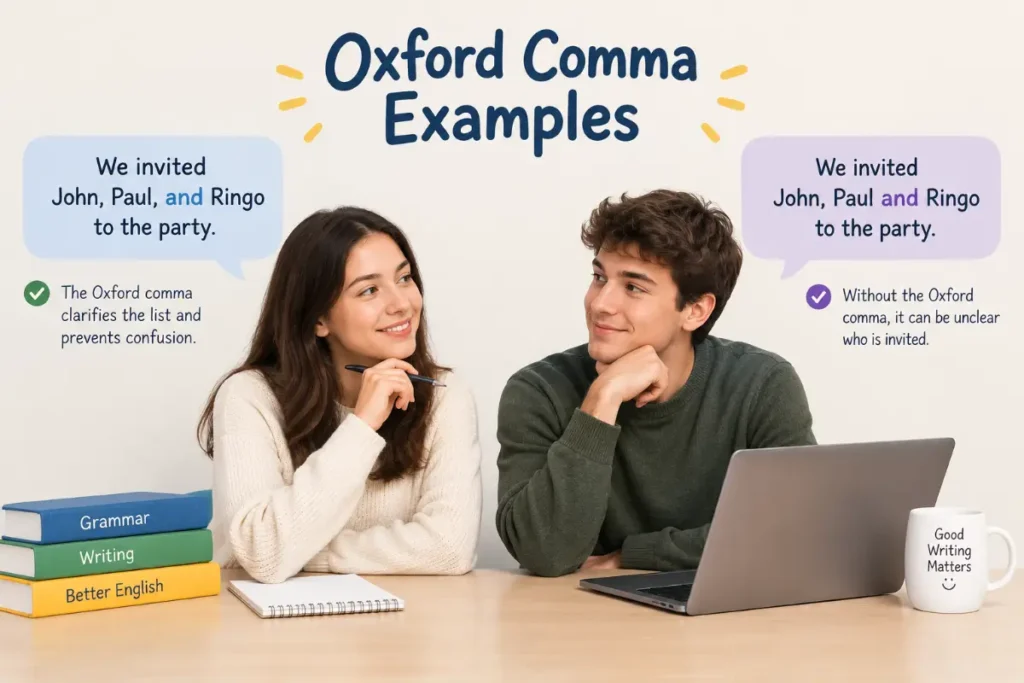
You may also find Oxford Comma Examples: 21 Ways to Use It Correctly (2026) helpful if you want to explore this topic further.
The Quick Answer
Use a comma after an introductory element in these common cases:
- Introductory clauses (starting with words like after, although, because, if, since, when, while)
- When the snow stops falling, we’ll shovel the driveway.
- Introductory phrases of a certain length or type (infinitive, participial, absolute, or longer prepositional phrases)
- To stay in shape for competition, athletes must exercise every day.
- Introductory words (transitional words like however, meanwhile, yes, well)
- However, the results told a different story.
Shorter, simple introductory elements — especially brief prepositional phrases of fewer than five words — often don’t strictly need a comma, though including one is never wrong.
Rule 1: Introductory Clauses Always Take a Comma
An introductory clause is a dependent clause — it has its own subject and verb but can’t stand alone as a complete sentence — that comes before the main, independent clause. Purdue OWL lists the common starter words for these clauses: after, although, as, because, before, if, since, though, until, when, and while.
- If you are ill, you ought to see a doctor.
- Because her alarm clock was broken, she was late for class.
- While I was eating, the cat scratched at the door.
- Although she’d never been abroad, she felt ready for the trip.
This is one of the more consistently enforced comma rules, and it’s worth noting that the same rule doesn’t apply in reverse: when the dependent clause follows the main clause instead of introducing it, no comma is typically needed. “The cat scratched at the door while I was eating” doesn’t need a comma, even though the identical clause required one when it came first.
Rule 2: Longer Introductory Phrases Take a Comma
Several types of phrases — not full clauses, since they lack a separate subject and verb — also call for a comma when they open a sentence.
Infinitive phrases:
- To get a good seat, you’ll need to arrive early.
Participial phrases:
- Barking insistently, the dog got us to throw his ball.
- Having finished the test, he left the room.
Absolute phrases (a noun plus a participle, modifying the whole sentence):
- The wind blowing violently, the townspeople began to seek shelter.
Longer prepositional phrases, or more than one prepositional phrase in a row:
- In the early hours of the morning, before anyone else had woken up, she went for a run.
Rule 3: Introductory Words Take a Comma
Single transitional or introductory words — however, meanwhile, well, yes, no, first, finally — are followed by a comma when they open a sentence.
- However, not everyone agreed with the decision.
- Finally, we reached the summit.
- Well, that’s certainly one way to look at it.
Rule 4: Short Introductory Phrases May Not Need a Comma
Not every short introductory phrase requires a comma. Very brief phrases—especially simple time, place, or manner phrases—can often flow naturally into the main sentence without punctuation.
- Yesterday we went to the museum.
- Today I have a lot of work.
- In the morning we usually exercise.
- At home she feels more relaxed.
Adding a comma isn’t necessarily wrong in many of these cases:
- Yesterday, we went to the museum.
- In the morning, we usually exercise.
The choice often depends on clarity, emphasis, and rhythm. If the opening phrase is short and the sentence is easy to understand without a pause, leaving out the comma is usually acceptable.
Rule 5: Use a Comma After Introductory Participial Phrases
When a sentence begins with a participial phrase that describes the subject of the main clause, separate the phrase from the main clause with a comma.
- Walking through the park, I found a $20 bill.
- Exhausted after the long journey, they went straight to bed.
- Having finished dinner, we watched a movie.
- Smiling warmly, the receptionist welcomed the guests.
The comma makes it clear that the introductory action or description belongs to the subject that follows. Avoid creating a dangling modifier, where the introductory phrase appears to modify the wrong noun.
Incorrect: Walking through the park, the trees looked beautiful.
Here, the trees aren’t walking through the park. A clearer version is: Walking through the park, I thought the trees looked beautiful.
Rule 6: Introductory Transitional Words and Phrases Need a Comma
Words and phrases that signal a transition, contrast, result, or connection are generally followed by a comma when they introduce a sentence.
Common examples include however, therefore, meanwhile, in fact, for example, in addition, instead, and as a result.
- However, we decided to continue.
- In fact, she had already finished the project.
- For example, you could start with the easiest question.
- As a result, the meeting ended early.
- Meanwhile, the children waited outside.
The comma helps separate the transitional element from the main thought, making the relationship between ideas easier to follow.
Rule 7: Use a Comma When the Introductory Element Could Cause Confusion
Even when a comma isn’t strictly required, use one when it helps readers immediately understand where the introductory element ends and the main clause begins.
- Before eating, wash your hands.
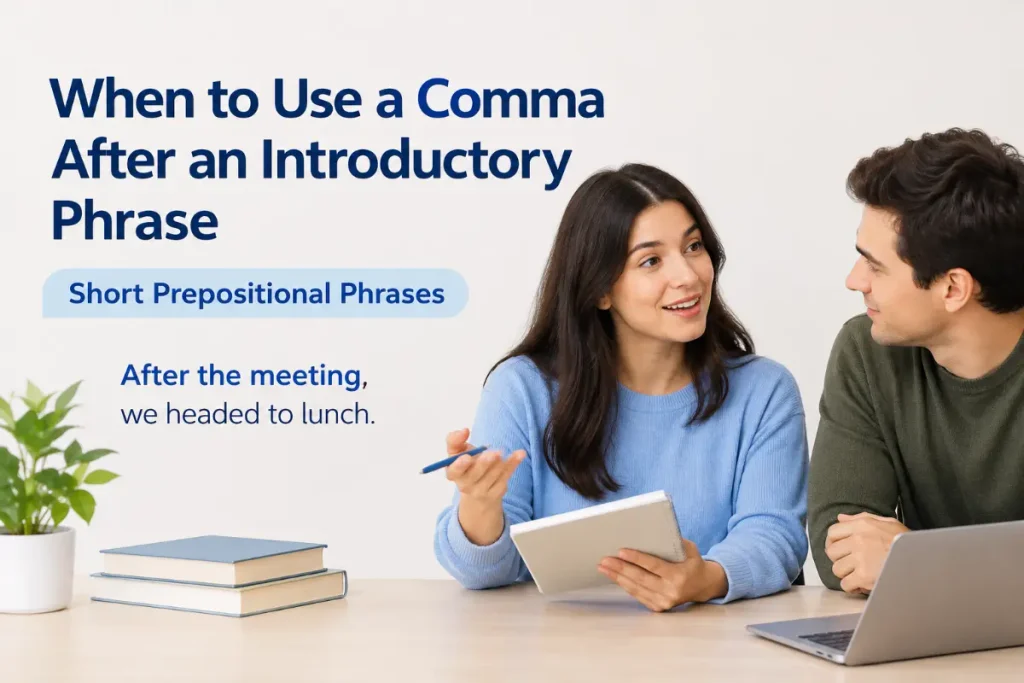
- After the meeting, we discussed the proposal.
- Without a doubt, this was the best option.
- In the middle of the night, the alarm suddenly went off.
This is especially useful when the opening phrase is long, contains several words, or could momentarily be read as part of the main clause. The goal isn’t simply to insert commas mechanically—it’s to make the sentence clear and easy to read.
The Genuinely Debated Case: Short Prepositional Phrases
This is where when to use a comma after an introductory phrase gets less absolute and more a matter of style and clarity. Purdue OWL specifically notes that a short introductory prepositional phrase — generally fewer than five words — doesn’t strictly require a comma.
- In 1995 the company was founded. (comma optional, short phrase)
- In 1995, the company was founded. (also correct, comma included)
Both versions are grammatically acceptable. Many style guides simply recommend picking one convention and staying consistent throughout a document, rather than treating this as a strict rule with only one right answer.
When You Genuinely Need the Comma, Even With a Short Phrase
There’s one situation where a comma becomes necessary regardless of length: when leaving it out would cause a momentary misreading.
- Before eating, the family said grace. (without the comma: “Before eating the family” briefly misreads as one unit)
- After all, the plan worked out fine. (without a comma, this could briefly seem to mean “after everything” was consumed, rather than functioning as the transitional phrase “after all”)
Purdue OWL specifically flags “to avoid confusion” as one of its standalone reasons for using a comma after an introductory element, even in cases that wouldn’t otherwise strictly require one.
The Fastest Way to Check Yourself
Step 1: Is there a dependent clause (with its own subject and verb) opening the sentence? Use a comma.
Step 2: Is there an infinitive, participial, or absolute phrase opening the sentence? Use a comma.
Step 3: Is there a short prepositional phrase (under five words)? A comma is optional, though including one is never incorrect.
Step 4: Would skipping the comma cause even a momentary misreading? If yes, include it regardless of length.
When to Use a Comma After an Introductory Phrase: Quick Reference
| Introductory Element | Comma Needed? | Example |
|---|---|---|
| Dependent clause (because, although, if, when) | Yes | Because it rained, we left early. |
| Infinitive phrase | Yes | To win, you must practice. |
| Participial phrase | Yes | Running late, she skipped breakfast. |
| Long prepositional phrase | Yes | In the middle of the busy afternoon, she called. |
| Short prepositional phrase (under 5 words) | Optional | In 1995 the company launched. |
| Transitional word | Yes | However, things changed quickly. |
| Would cause misreading without it | Yes, regardless of length | Before eating, they said grace. |
Common Mistakes People Make
Mistake 1: “Because it was raining we stayed inside.” Missing the comma after a full introductory clause — this should be “Because it was raining, we stayed inside.”
Mistake 2: “The cat scratched at the door, while I was eating.” This reverses the rule incorrectly — since the dependent clause now follows the main clause rather than introducing it, the comma generally isn’t needed here: “The cat scratched at the door while I was eating.”
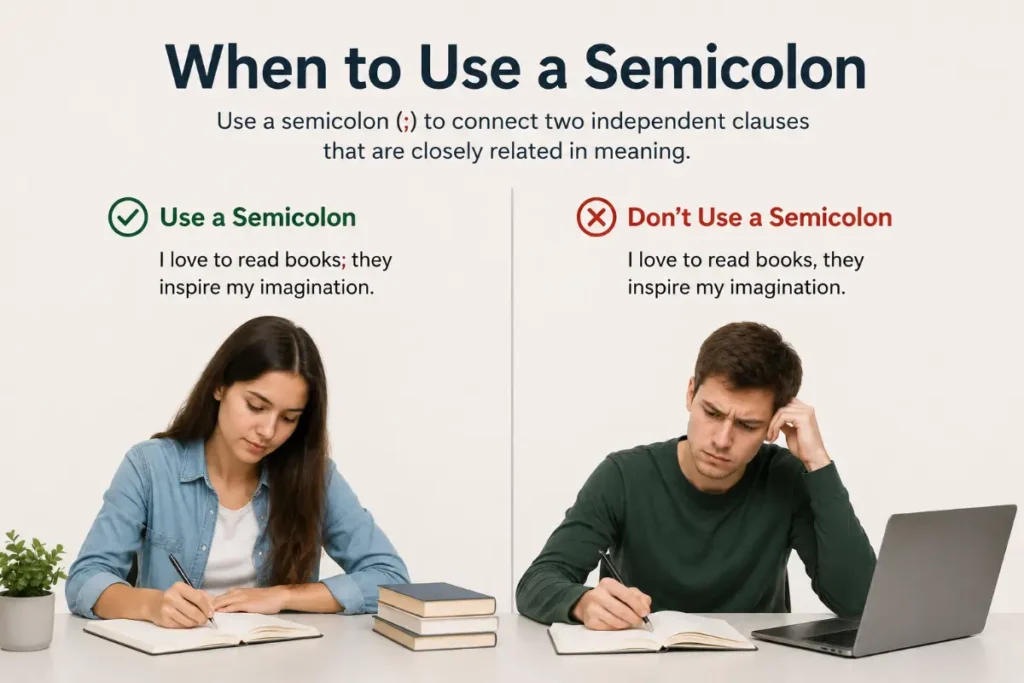
For another useful perspective, check out When to Use a Semicolon: 9 Easy Rules & Examples (2026).
Mistake 3: Treating the short-phrase comma as mandatory in every case. “In 2020, the company launched” and “In 2020 the company launched” are both correct — insisting one is wrong misunderstands that this specific case is a style choice, not a fixed rule.
Mistake 4: Skipping the comma even when it causes confusion. “After eating the dog went outside” briefly misreads as the dog eating something specific — “After eating, the dog went outside” resolves the ambiguity immediately.
Mistake 5: Adding a comma after a subject that only looks like an introductory element. “Running is my favorite hobby” doesn’t need a comma after “running,” since “running” is actually the subject of the sentence, not an introductory phrase modifying a separate main clause.
More Examples to Lock It In
- After the meeting ended, everyone went their separate ways.
- To succeed in this field, you need patience and persistence.
- Exhausted from the long flight, she went straight to bed.
- In the early days of the company, resources were scarce.
- Well, I suppose we’ll find out soon enough.
- Before you leave, make sure the lights are off.
Frequently Asked Questions
Is it ever wrong to add a comma after a short introductory phrase, even though it’s optional?
No — including the comma is never incorrect, even for short phrases where it’s not strictly required. The optional cases simply mean you have flexibility, not that adding the comma would be a mistake.
Does this rule change based on which style guide I’m following?
The core distinction between clauses/longer phrases (comma required) and short prepositional phrases (comma optional) is broadly consistent across AP, Chicago, and MLA. Specific style guides may have slightly different thresholds for what counts as “short,” but the underlying logic is the same everywhere.
What’s the difference between an introductory phrase and a sentence’s subject?
An introductory phrase sets up a separate main clause that follows it; a subject is the actual noun performing the sentence’s main action. “Walking to school, she saw a rainbow” has an introductory phrase (walking to school) followed by the subject (she). “Walking to school is good exercise” has no introductory phrase at all — “walking to school” is the subject itself, so no comma is needed.
Can more than one introductory clause or phrase appear before the same main clause?
Yes — when multiple introductory elements stack up, the comma still goes after the final one, right before the main clause begins: “After the storm passed, once the roads had cleared, they finally left for the airport.”
What’s the fastest way to catch this error before publishing something?
For every sentence that opens with a clause or phrase before its main subject and verb, check whether that opening element is a dependent clause, a longer phrase, or a short prepositional phrase — and apply the comma accordingly, watching especially for cases where skipping it could cause a misreading.
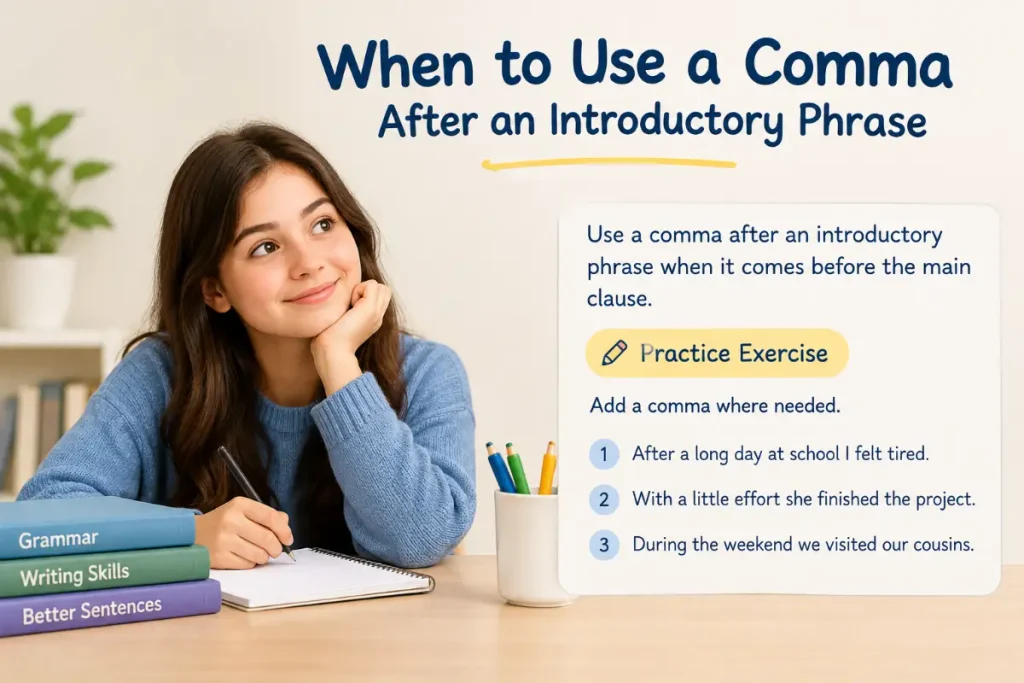
Practice Exercise
Decide whether each sentence needs a comma after its introductory element. Answers are listed right after — try each one before checking.
- After the meeting we went out for lunch.
- Because it was raining we stayed inside.
- In the afternoon the children usually play outside.
- Feeling nervous before the interview she took a deep breath.
- To avoid traffic you should leave early.
- Last weekend we visited our grandparents.
- Without any warning the lights suddenly went out.
- When the movie ended everyone applauded.
- Surprisingly nobody complained about the delay.
- Before making a decision think about the consequences.
- Having finished his homework he went to bed.
- At the end of the day we were completely exhausted.
- If you need help just give me a call.
- Fortunately the package arrived on time.
- Running late for work James skipped breakfast.
- During the summer months the store stays open later.
- Well I suppose you’re right.
- Although the task looked difficult we finished it quickly.
- In fact I had already heard the news.
- With a little patience you can solve the problem.
Answer Key
- Optional — “After the meeting we went out for lunch” or “After the meeting, we went out for lunch.”
- Comma needed — “Because it was raining, we stayed inside.”
- Optional — “In the afternoon the children usually play outside” or “In the afternoon, the children usually play outside.”
- Comma needed — “Feeling nervous before the interview, she took a deep breath.”
- Comma needed — “To avoid traffic, you should leave early.”
- Optional — “Last weekend we visited our grandparents” or “Last weekend, we visited our grandparents.”
- Comma needed — “Without any warning, the lights suddenly went out.”
- Comma needed — “When the movie ended, everyone applauded.”
- Comma needed — “Surprisingly, nobody complained about the delay.”
- Comma needed — “Before making a decision, think about the consequences.”
- Comma needed — “Having finished his homework, he went to bed.”
- Optional — “At the end of the day we were completely exhausted” or “At the end of the day, we were completely exhausted.”
- Comma needed — “If you need help, just give me a call.”
- Comma needed — “Fortunately, the package arrived on time.”
- Comma needed — “Running late for work, James skipped breakfast.”
- Optional — “During the summer months the store stays open later” or “During the summer months, the store stays open later.”
- Comma needed — “Well, I suppose you’re right.”
- Comma needed — “Although the task looked difficult, we finished it quickly.”
- Comma needed — “In fact, I had already heard the news.”
- Comma needed — “With a little patience, you can solve the problem.”
This set gives you a mix of required, optional, and conversational introductory commas, so you can practice the rule without treating every opening phrase as an automatic comma case.
Before moving on, you may also want to read When to Capitalize Job Titles: 7 Rules You Need to Know (2026) for more helpful grammar tips.
The Bottom Line
Understanding when to use a comma after an introductory phrase comes down to recognizing the type of element opening your sentence: dependent clauses, infinitive and participial phrases, and longer prepositional phrases all take a comma, while short prepositional phrases under five words offer more flexibility — though adding the comma is always safe, and necessary whenever skipping it would cause even a momentary misreading.
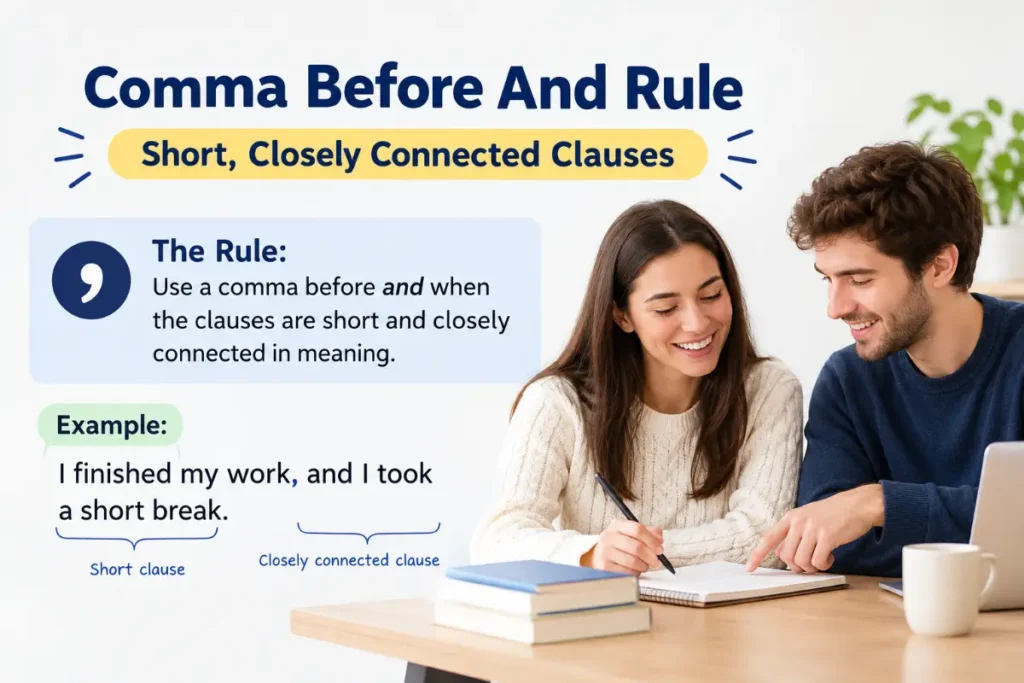
For more on how commas function once you’re past the introductory portion of a sentence, see our guide on the comma before “and” rule — and if you’re also navigating comma splices in your writing, our comma splice examples and fixes guide covers that closely related error in depth.