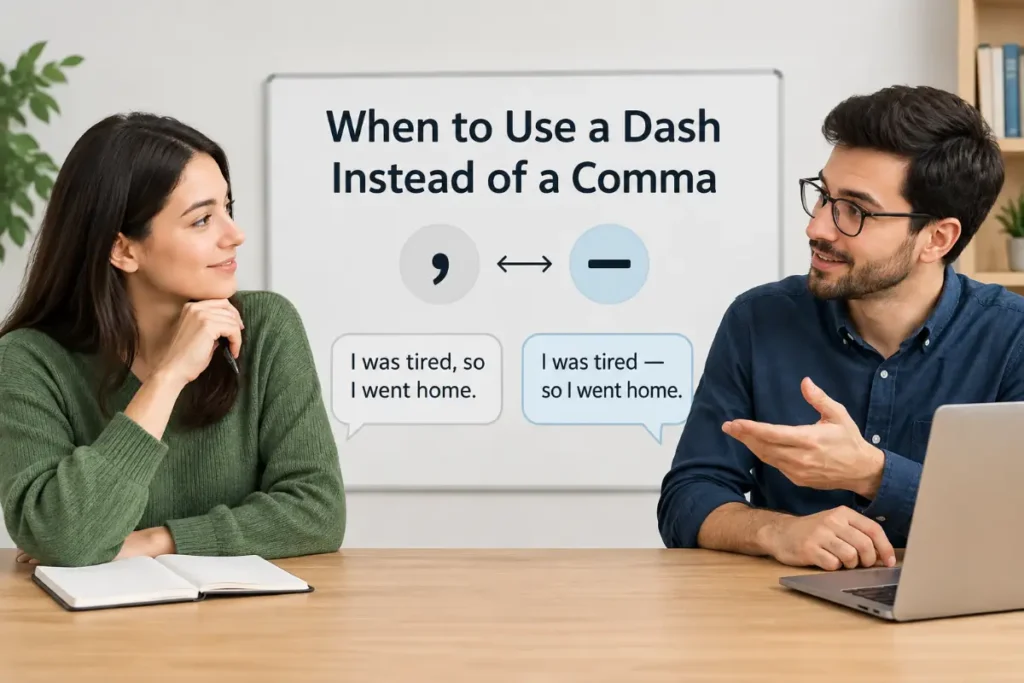
When to use a dash instead of a comma comes down to one question: does the interruption need to feel dramatic, or just informative? A comma folds extra information smoothly into a sentence. A dash makes the reader stop and notice it. Both are grammatically correct in many of the same spots. The choice is about tone and emphasis, not right versus wrong.
That distinction is exactly what trips writers up. Most punctuation guides explain what a dash is without explaining when a comma quietly does the same job better. This guide covers both directions: when the dash earns its keep, when a comma is still the smarter choice, and how to actually type the thing once you’ve decided to use it.
You may also find Punctuate Dialogue: Master 4 Rules Like a Pro (2026) helpful if you want to explore this topic further.
What a Dash Actually Does That a Comma Doesn’t
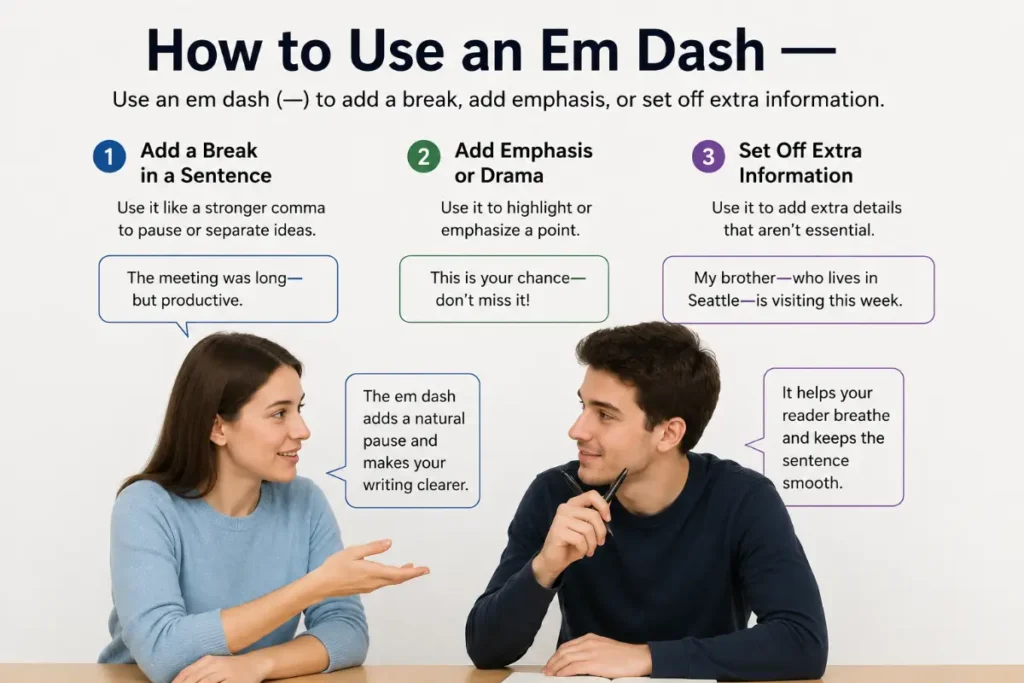
A comma is a soft pause. It keeps the sentence moving without asking the reader to stop and pay attention. An em dash, the long dash most people mean when they say “dash,” is a harder pause. It makes the reader hold for a beat before continuing. University style guides consistently describe the em dash as more forceful than a comma but more flexible than a colon or parentheses, since it can introduce, interrupt, or emphasize depending on where it’s placed.
That extra force is the whole reason to reach for one. If a sentence needs the reader to feel a shift in tone, in direction, or in stakes, a dash signals that shift more clearly than a comma ever will.
- Comma version: The meeting ran long, and everyone left frustrated.
- Dash version: The meeting ran long, everyone left frustrated (there simply wasn’t a good way to end it early).
Even without leaning on the dash itself, notice the difference: the comma version reads as one smooth, connected thought. Adding a hard break of any kind, whether a dash or a parenthetical aside, signals a beat before the consequence lands.
Four Situations Where a Dash Beats a Comma
1. The Parenthetical Already Has Commas in It
This is the single most practical reason to switch. When the information you’re inserting mid-sentence already contains a comma, adding more commas around it buries the sentence in punctuation the reader has to untangle.
- Confusing with commas: My consultant, a senior at the university, who also tutors part-time, was very helpful.
- Clear with a dash pair: My consultant — a senior at the university who also tutors part-time — was very helpful.
The dash pair acts like a visual container, telling the reader “everything between these two marks is one unit,” which a string of commas can’t do as clearly. This is genuinely one of the few cases where reaching for the dash isn’t optional stylistically. It’s the clearest fix available.
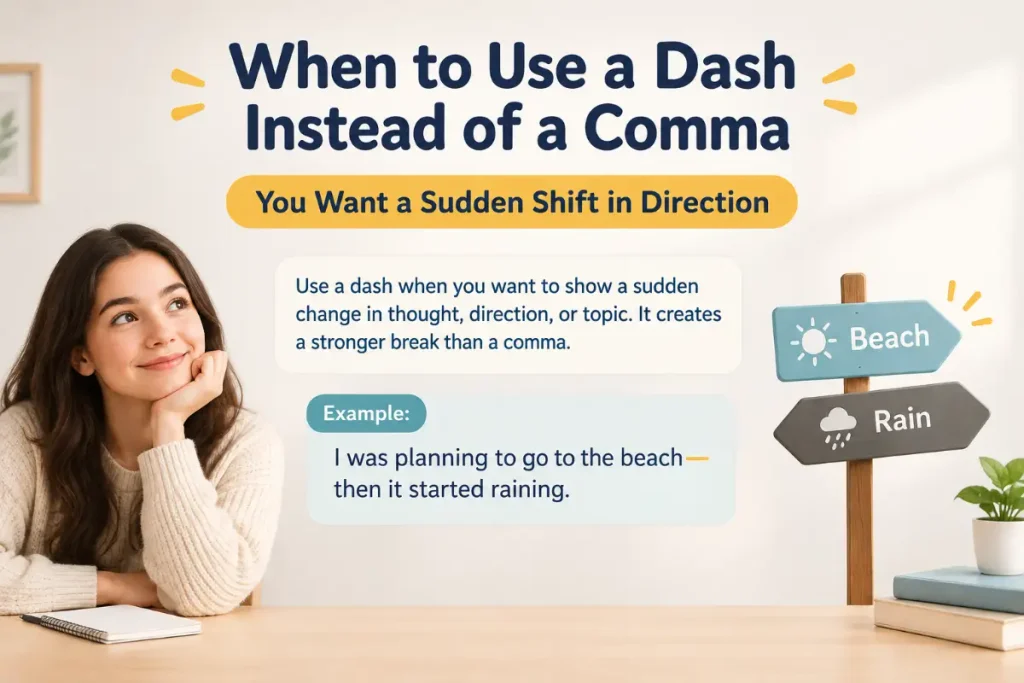
2. You Want a Sudden Shift in Direction
If a sentence pivots, whether through surprise, contradiction, or a change in thought mid-stream, a dash captures that turn better than a comma, which tends to smooth transitions rather than highlight them.
- We expected the flight to be delayed, but it left on time.
- We expected the flight to be delayed. It left on time.
Splitting the sentence into two short statements, or using a single dash if the tone calls for it, makes the contrast feel sharper and more immediate than the softer “but” version.
3. You’re Building to an Emphatic Final Word or Phrase
A dash right before the last part of a sentence works like a spotlight, drawing extra attention to whatever comes after it. This is something a comma, used the same way, won’t do nearly as forcefully.
- After months of rehearsal, the band finally had one thing left to do: perform.
A colon can often do this same emphatic job without reaching for a dash at all, which is worth remembering if you’re trying to keep dash usage light across a piece of writing.
4. You Need to Interrupt Dialogue or a Thought Mid-Sentence
In dialogue or first-person narration, a dash can cut a sentence off entirely, showing that a thought was interrupted rather than simply paused.
- “I thought that was the right thing to—”
- “No, it wasn’t,” she said.
A comma can’t do this at all. Only a dash, or an ellipsis for a trailing-off effect instead of an abrupt cutoff, signals that kind of interruption. This is genuinely a case with no real substitute.
When a Comma Is Actually the Better Choice
Dashes lose their power the moment they show up in every sentence. If a piece of writing leans on them constantly, none of those pauses register as meaningful anymore. They just become visual noise, and readers start skimming past them.
- Routine, non-dramatic asides. A comma is quieter and more appropriate: The recipe, which takes about twenty minutes, serves four.
- Formal or academic writing. Commas and parentheses are the more conventional choice. Dashes read as informal or conversational in most academic style guides, so a research paper or business report generally leans on commas instead.
- Simple lists or straightforward additions. If there’s no real interruption or emphasis happening, a comma does the job without drawing extra attention.
A useful gut check: read the sentence aloud. If the pause feels like a breath, use a comma. If it feels like a beat of silence, that’s when a dash, sparingly, might fit.
Dash vs. Colon vs. Parentheses: Picking Between All Three
Most guides only compare the dash to the comma, but in practice writers are usually choosing between three options for setting off extra information: the dash, the colon, and parentheses. Each sends a slightly different signal to the reader.
A colon works best when what follows explains, defines, or lists something promised by the first part of the sentence. It’s more formal and more expected in structured or explanatory writing.
- She had one goal: finish the marathon.
Parentheses are the quietest option. They tell the reader “this is optional, extra detail, feel free to skim it if you want,” which makes them ideal for asides that genuinely aren’t central to the sentence’s meaning.
- The bridge (built in 1932) closed for repairs last spring.
A dash, by contrast, tells the reader the opposite of what parentheses signal: “pay attention to this, it matters.” It’s the loudest of the three options, which is exactly why it should be used the least often.
A simple way to choose: if the aside is genuinely skippable, use parentheses. If it explains or lists something, use a colon. If it needs real emphasis and neither of the other two fits, that’s when the dash is worth reaching for, but only then.
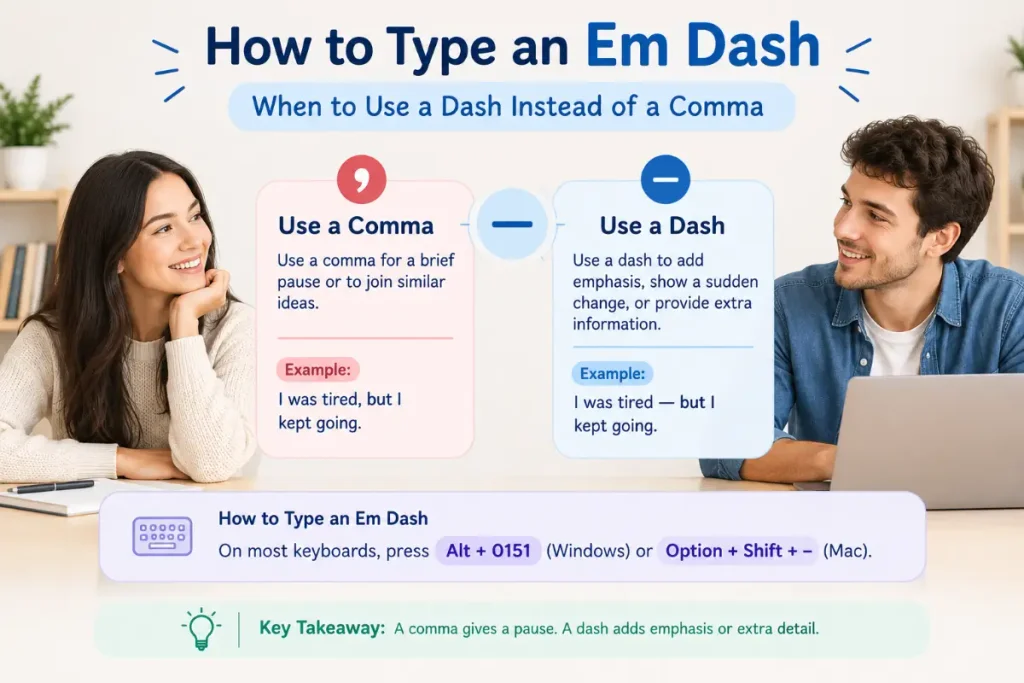
How to Type an Em Dash
One reason writers default to a plain hyphen instead of a proper dash is that most keyboards don’t have a dedicated key for it. Here’s how to actually produce one:
- Windows: Hold Alt and type 0151 on the numeric keypad, or use the shortcut Ctrl + Alt + Minus in Microsoft Word.
- Mac: Press Option + Shift + Hyphen.
- Google Docs and most web editors: Typing two hyphens between words, then continuing to type, will often auto-convert them into a proper em dash.
- Microsoft Word: Typing a word, two hyphens, and the next word without spaces will usually trigger AutoCorrect to convert the double hyphen into an em dash automatically once you keep typing.
Getting this right matters more than it seems. A double hyphen (–) left uncorrected reads as a typo to careful readers and to some spell-checkers, even though the intent behind it is clear.
Spacing and Formatting: The Detail Most Writers Get Wrong
Most style guides used in the United States, including the Chicago Manual of Style and AP Style, call for no spaces on either side of an em dash (word—word, not word — word), though some newspapers and web styles add thin spaces for readability. Whichever convention a site or publication uses, the key is picking one and staying consistent throughout, since mixing spaced and unspaced dashes in the same piece looks like an error even when it technically isn’t.
It’s also worth keeping the em dash separate from the shorter en dash, which is reserved for ranges like pages 10 to 15 or 2020 to 2024, and from the hyphen, which only joins compound words like well-known. Swapping one for another is a common formatting slip that spell-checkers rarely catch.
American vs. British Usage
Writers who read a lot of British publications sometimes pick up the British convention of using a spaced en dash instead of an unspaced em dash for the same emphatic function (word – word instead of word—word). For US-facing writing, sticking with the unspaced em dash is the safer, more expected choice, since it matches both American style guides and what most US readers are used to seeing.
Quick Reference Table
| Situation | Better Choice | Why |
|---|---|---|
| Parenthetical already has commas | Dash pair | Prevents comma pile-up and confusion |
| Sudden shift or contrast | Dash or period | Signals the pivot more sharply |
| Emphasis on a final word or phrase | Dash or colon | Acts like a spotlight |
| Interrupted dialogue or thought | Dash | Only a dash can cut off mid-sentence |
| Routine aside, no real emphasis | Comma | Keeps the sentence smooth and quiet |
| Skippable extra detail | Parentheses | Signals the aside is optional |
| Explaining or listing something | Colon | Formal, expected, and clear |
| Formal or academic writing | Comma or parentheses | More conventional, less conversational |
Common Mistakes People Make
Mistake 1: Using a dash in every other sentence out of habit, which flattens its impact until it stops signaling anything special.
Mistake 2: Mixing spaced and unspaced dashes within the same document, which reads as inconsistent formatting rather than a stylistic choice.
Mistake 3: Using a plain hyphen where an em dash belongs, especially in text typed quickly without autocorrect converting it.
For another useful perspective, check out Oxford Comma Examples: 21 Ways to Use It Correctly (2026).
Mistake 4: Pairing only one dash where two are needed for a mid-sentence interruption, leaving the sentence structurally unbalanced.
Mistake 5: Reaching for a dash in formal writing where a comma, colon, or parentheses would read as more appropriate for the tone.
Practice Exercise
For each sentence, decide whether a comma, dash, colon, or parentheses fits better, and explain why in one sentence. Answers follow. Try each one first.
- The proposal, which took three weeks to write, was rejected in five minutes.
- We had one goal left to accomplish: win.
- My neighbor, a retired teacher, who now volunteers at the library, waters my plants.
- She opened the door and there it was.
- The recipe calls for two eggs, a cup of flour, and a pinch of salt.
- He was certain, almost certain, that he’d locked the car.
- The report covered three regions, the Midwest, the South, and the Northeast.
- I had one thing left to say: thank you.
- The storm hit without warning, and the power went out instantly.
- Her apartment, small but bright, overlooked the park.
- The team had a plan, a good one, until the client changed the deadline.
- He froze because she was standing right behind him.
- The candidate, once a frontrunner, who dropped out in March, endorsed her rival.
- We packed quickly, grabbed the bags, and left.
- There was only one explanation: none at all.
- The bridge, built in 1932, closed for repairs last spring.
- I trusted him completely, until I didn’t.
- The garden had roses, tulips, and daisies, all in bloom.
- She whispered one word: run.
- The meeting, originally scheduled for Monday, moved to Thursday.
Answer Key
- Comma or dash pair both work; a dash pair adds more drama to the contrast between the three weeks of work and the five-minute rejection.
- Colon, since it introduces the single word that answers the sentence’s setup.
- Dash pair, since the parenthetical already contains a comma, so dashes prevent confusion about where the aside starts and ends.
- A period or dash works to mark the sudden reveal; a comma would flatten the surprise.
- Comma, since it’s a routine list with no interruption or emphasis needed.
- Parentheses or a dash pair for the self-correcting aside; commas alone read a bit flat here.
- Comma is fine here since no item contains its own comma; a colon could also work to introduce the list formally.
- Colon, introducing the emphatic final phrase.
- Comma with “and,” since it’s a straightforward cause and effect without needing extra drama.
- Comma, for a routine descriptive aside.
- Dash pair or parentheses, emphasizing the aside about the plan being a good one.
- Comma with “because,” turning it into a clear cause-and-effect sentence.
- Dash pair, since the parenthetical already has an internal clause, so dashes keep it contained.
- Comma, for a straightforward list of actions with no need for emphasis.
- Colon, introducing the dramatic reversal.
- Comma, for a routine factual aside.
- Comma or dash for the sharp contrast; either works depending on how much emphasis is wanted.
- Comma, since it’s a simple list with no internal commas or drama.
- Colon, emphasizing the final word.
- Comma, for a routine factual update with no need for emphasis.
Frequently Asked Questions
Is it ever wrong to use a dash where a comma would also work?
Not grammatically wrong, but it can be a tonal mismatch. Using a dash in a sentence with no real interruption or emphasis can make routine writing feel unnecessarily dramatic.
How many dashes are too many in one piece of writing?
There’s no fixed number, but if a reader notices the dashes themselves rather than what they’re emphasizing, that’s a sign to cut back and let some of those pauses become commas, periods, or parentheses instead.
Should I use one dash or two?
It depends on where the interruption falls. A single dash works when the aside comes at the end of a sentence. Two dashes are needed when the aside sits in the middle, functioning like a pair of parentheses.
Is there a difference between how dashes are used in formal writing versus fiction or blogging?
Yes. Academic and business writing generally favors commas, colons, and parentheses for a more measured tone, while fiction, journalism, and blog writing use dashes more freely for rhythm and emphasis, though even there, restraint tends to read better than overuse.
What’s the fastest way to decide between a comma and a dash while editing?
Read the sentence aloud. If the pause feels like a natural breath, a comma fits. If it feels like a deliberate beat meant to draw attention, and nothing else (a colon, parentheses, or a period) does the job better, a dash is the right call.
Before moving on, you may also want to read Comma Splice Examples and Fixes: 10 Mistakes to Avoid (2026) for more helpful grammar tips.
Wrapping Up
When to use a dash instead of a comma ultimately depends on how much weight a pause needs to carry. A comma keeps a sentence moving smoothly. A dash asks the reader to stop and notice something: a shift in tone, an emphatic final word, or a parenthetical that already has commas of its own tangled inside it. Even then, a colon or a pair of parentheses often does the same job with less visual noise, which is why restraint tends to serve a piece of writing better than reaching for the dash by default.
Neither mark is inherently better than the other. The skill is recognizing which effect a given sentence actually needs, then reaching for the punctuation that delivers it, rather than defaulting to whichever one happens to feel most familiar in the moment.