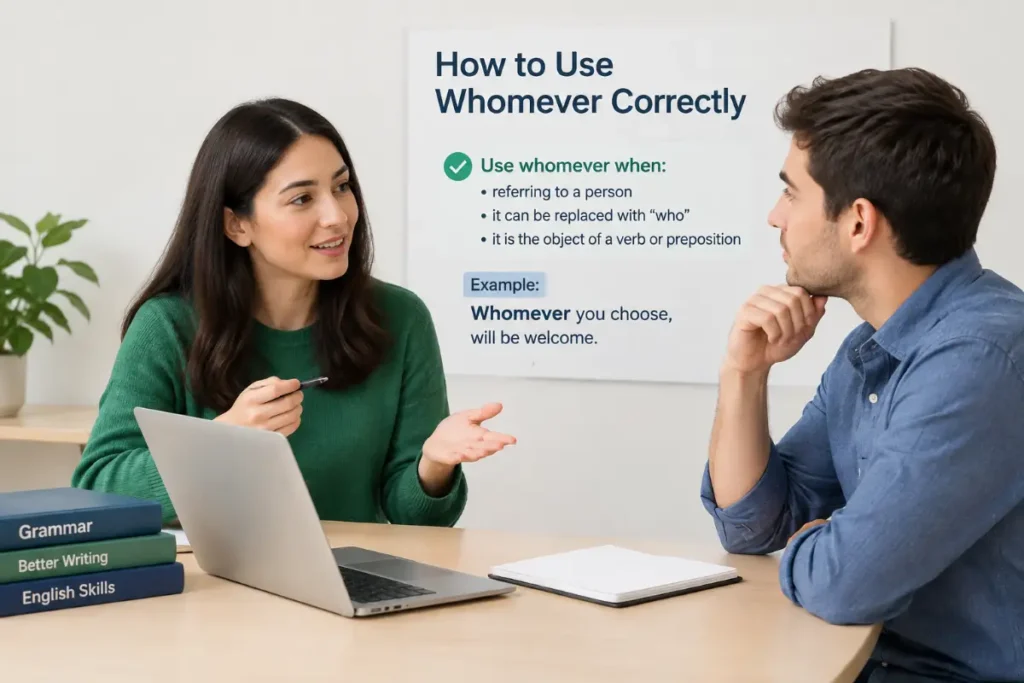
Most people who search for how to use whomever correctly already half-know the basic rule — whoever for subjects, whomever for objects — but still get tripped up constantly, and there’s a specific reason why. The tricky cases almost always involve a whoever/whomever clause tucked inside a larger sentence, where it’s easy to accidentally check agreement against the wrong verb entirely.
This guide covers the basic rule quickly, then spends most of its time on that specific embedded-clause trap, since that’s genuinely where nearly every real-world mistake happens.
You may also find A Non-Restrictive Clause? 5 Simple Rules (2026) helpful if you want to explore this topic further.
The Basic Rule, Quickly
Merriam-Webster confirms both words mean the same thing — “whatever person” — but occupy different grammatical roles. Whoever is a subject pronoun, doing the work of “he,” “she,” or “they.” Whomever is an object pronoun, doing the work of “him,” “her,” or “them.”
- Whoever wants to come is welcome. (“they” want to come — subject)
- Invite whomever you like. (you like “them” — object)
The Trap: When the Whole Clause Is the Sentence’s Subject
Here’s where nearly every real mistake happens. The Blue Book of Grammar lays out the rule precisely: “the presence of whoever or whomever indicates a dependent clause. Use whoever or whomever to agree with the verb in that dependent clause, regardless of the rest of the sentence.”
That last phrase — “regardless of the rest of the sentence” — is the whole key. It doesn’t matter what role the entire clause plays in the bigger sentence; what matters is only the pronoun’s job inside its own smaller clause.
- Whoever is elected will serve a four-year term.
At first glance, you might think “whoever is elected” functions as the object of the sentence overall. But look inside the clause itself: “whoever is elected” — the pronoun is the subject of “is elected.” The entire clause (“whoever is elected”) then becomes the subject of the outer verb “will serve.” Since the pronoun’s job within its own clause is the subject, “whoever” is correct — even though the whole clause is functioning as the sentence’s subject.
Now compare a case that looks almost identical on the surface but resolves differently:
- Whomever you elect will serve a four-year term.
Here, inside the clause, “you elect whomever” — the pronoun is the object of “elect” (you elect him, not he). The clause “whomever you elect” then becomes the subject of “will serve.” Even though this entire clause is also functioning as the sentence’s subject, the pronoun itself is correctly “whomever,” because its job inside its own clause is as an object.
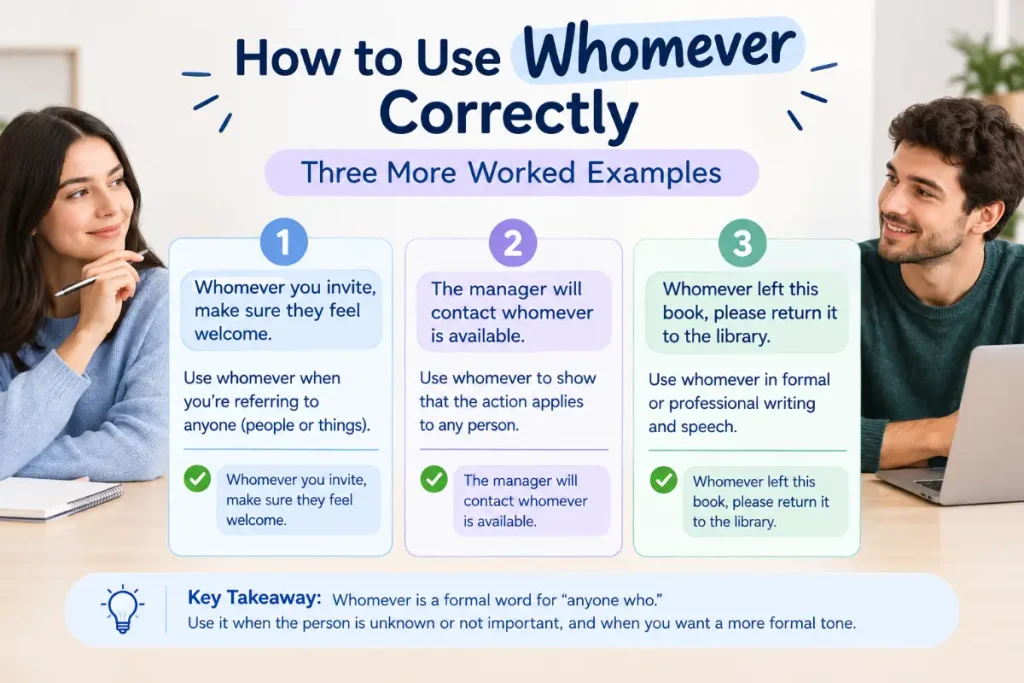
Three More Worked Examples
- Give it to whoever asks for it first. — Strip it down: “he asks for it first.” Subject role inside the clause → whoever.
- We will hire whomever you recommend. — Strip it down: “you recommend him.” Object role inside the clause → whomever.
- We will hire whoever is most qualified. — Strip it down: “he is most qualified.” Subject role inside the clause → whoever.
Notice the pattern across all of these: it never matters what comes before the clause (“give it to,” “we will hire”) — that outer verb or preposition has zero influence on whether you need whoever or whomever. Only the pronoun’s job inside its own clause counts.
The He/Him Substitution Test, Step by Step
- Step 1: Isolate the dependent clause containing whoever/whomever, ignoring everything else in the sentence.
- Step 2: Rearrange that clause into a simple statement, substituting “he” or “him” for the pronoun.
- Step 3: If “he” sounds right, use whoever. If “him” sounds right, use whomever.
- Step 4: Ignore the rest of the sentence entirely — the outer verb, preposition, or clause role has no bearing on this decision.
Does This Distinction Still Matter in Everyday Speech?
Worth knowing honestly: Merriam-Webster notes that “in actual usage, whoever is more common in both positions, and whomever is sometimes used simply to make something sound more formal.” This mirrors the broader who/whom situation — whomever is fading from casual speech, and defaulting to “whoever” in everyday conversation is widely accepted and rarely noticed as an error. Where the distinction still matters is in formal, edited, or professional writing, where getting it right (or knowing when to sidestep the whole question by rephrasing) signals careful attention to grammar.
Quick Reference Table
| Sentence | Clause Analyzed | Correct Form |
|---|---|---|
| ___ wants to come is welcome. | “he wants to come” | Whoever |
| Invite ___ you like. | “you like him” | Whomever |
| ___ is elected will serve. | “he is elected” | Whoever |
| ___ you elect will serve. | “you elect him” | Whomever |
| Give it to ___ arrives first. | “he arrives first” | Whoever |
| Thank ___ sent this gift. | “he sent this gift” | Whoever |
How to Use Whomever Correctly in Complex Sentences
Knowing how to use whomever correctly becomes most useful when the sentence contains multiple clauses and the pronoun’s role is easy to overlook. The key is to focus on what whomever is doing inside its own clause, rather than letting the surrounding sentence determine the choice.
Consider this example:
We will interview whomever you recommend.
The complete sentence may look complicated, but the relevant clause is simply “you recommend whomever.” Replace the pronoun with “him”:
You recommend him.
Because “him” works as the object of “recommend,” whomever is correct.
Now compare:
We will interview whoever is available.
Inside the clause, the structure is “whoever is available.” Replace the pronoun with “he”:
He is available.
Because the pronoun functions as the subject of “is available,” whoever is correct.
Look Inside the Clause, Not Outside It
A common mistake is allowing the main sentence to influence the choice. The verb or preposition outside the whoever/whomever clause does not determine whether the pronoun should be a subject or object.
Compare:
- Give the position to whoever applies first.
→ He applies first. → whoever - Give the position to whomever you choose.
→ You choose him. → whomever
The word “to” appears before both clauses, but it does not automatically make whomever correct. The pronoun’s role inside its own clause is what matters.
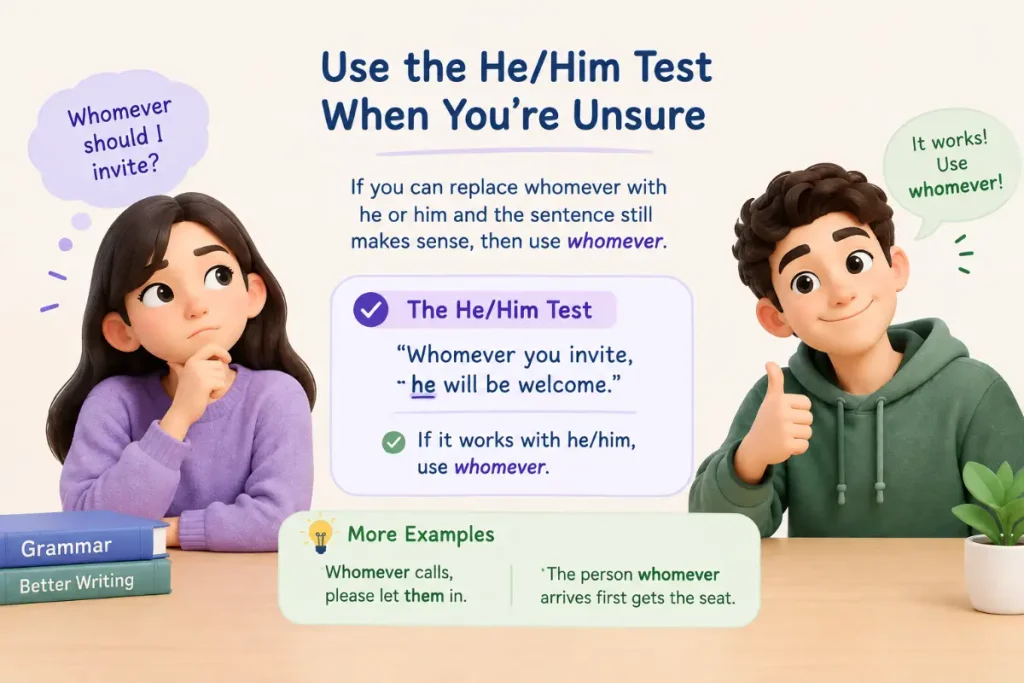
Use the He/Him Test When You’re Unsure
When a sentence feels complicated, temporarily remove everything except the clause containing the pronoun.
Whoever finishes first will receive the award.
→ He finishes first.
→ Whoever
The award will go to whomever the judges select.
→ The judges select him.
→ Whomever
This simple test is often faster and more reliable than trying to analyze the entire sentence at once. If he fits, choose whoever. If him fits, choose whomever.
The same approach works whether the clause appears at the beginning, middle, or end of a sentence. Once you isolate the smaller clause, the grammatical role usually becomes much easier to see.
How to Use Whomever Correctly in Formal Writing
If you’re writing an email, report, application, or other formal document, knowing how to use whomever correctly can help you handle sentences where the pronoun functions as an object. The distinction is most useful when you want your writing to follow traditional subject-and-object grammar.
Compare these examples:
- Contact whoever is available.
→ “Whoever” is the subject of “is available.” - Contact whomever you need to speak with.
→ “You” is the subject, and “whomever” functions as the object. - Choose whoever seems most qualified.
→ “Whoever” performs the action in “seems most qualified.” - Choose whomever the committee recommends.
→ The committee recommends “him,” so whomever is the object.
Don’t Choose Whomever Just Because It Sounds Formal
One common mistake is assuming whomever is automatically the more correct or sophisticated choice. It isn’t. The form still depends on grammatical function.
Incorrect: Give the award to whomever arrives first.
Correct: Give the award to whoever arrives first.
The preposition to does not automatically require whomever because the pronoun is the subject of the embedded clause: whoever arrives first.
For another useful perspective, check out Spotting the Sneaky Ones: How to Identify a Dangling Participle.
A reliable approach is to ignore how formal the sentence sounds and run the he/him test instead. If the hidden sentence takes he, use whoever. If it takes him, use whomever.
This is especially helpful in professional writing, where avoiding unnecessary hypercorrection is just as important as avoiding an obvious grammar error.
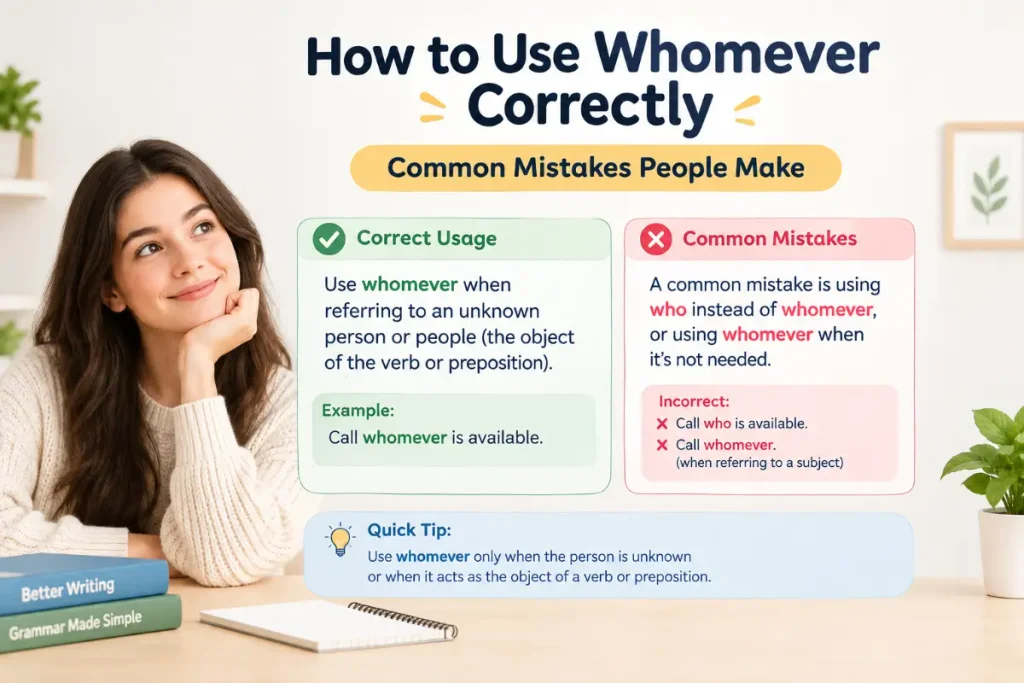
Common Mistakes People Make
Mistake 1: “Give the prize to whomever wins.” Should be “whoever wins” — inside the clause, “he wins,” a subject role, regardless of the preposition “to” sitting in front of it.
Mistake 2: “We’ll hire whoever you recommend.” Should be “whomever you recommend” — inside the clause, “you recommend him,” an object role.
Mistake 3: Judging the pronoun by the outer sentence structure rather than the inner clause. This is the single most common source of errors with this pair, exactly because the outer verb or preposition feels like it should matter, even though it never does.
Mistake 4: Assuming “whomever” always sounds more correct or formal, and inserting it reflexively without running the substitution test — this hypercorrection produces errors just as often as defaulting to “whoever” everywhere.
Mistake 5: Overcomplicating simple cases. If the clause is short and the pronoun’s role is obvious, there’s no need to overanalyze — the substitution test resolves it in seconds.
Practice Exercise
Fill in the blank with “whoever” or “whomever.” Answers are listed right after — try each one before checking.
- ______ finishes first gets a prize.
- Give the assignment to ______ you trust most.
- ______ is chosen will represent the team.
- We should hire ______ the manager recommends.
- Send the invitation to ______ RSVPs first.
- ______ broke the vase should own up to it.
- I’ll speak with ______ answers the phone.
- Thank ______ left this thoughtful note.
- ______ you choose will need to start Monday.
- The award goes to ______ scores the highest.
- Talk to ______ is available.
- We’ll support ______ the board selects.
- ______ wants to volunteer should sign up here.
- Give the leftovers to ______ is still hungry.
- ______ arrives late will miss the introduction.
- I’ll trust ______ you decide to hire.
- ______ finishes the race first wins the trophy.
- Notify ______ needs to know.
- ______ she recommends will get the job.
- Send it to ______ requested it.
Answer Key
- Whoever
- whomever
- Whoever
- whomever
- whoever
- Whoever
- whoever
- whoever
- Whomever
- whoever
- whoever
- whomever
- Whoever
- whoever
- Whoever
- whomever
- Whoever
- whoever
- Whomever
- whoever
If you got sixteen or more correct, the embedded-clause trick has already become second nature. For any you missed, isolate just the dependent clause and run the he/him substitution again, ignoring everything else in the sentence.
Frequently Asked Questions
Does it matter what verb or preposition comes before “whoever” or “whomever”?
No — this is the single most important thing to internalize. Only the pronoun’s grammatical role inside its own clause determines the correct form, regardless of what verb or preposition precedes the entire clause.
Is it ever acceptable to just use “whoever” everywhere, even where “whomever” is technically correct?
In casual speech and most informal writing, yes — this usage is widespread and rarely draws criticism. In formal or professional writing, running the substitution test to confirm the correct form is worth the extra few seconds.
What’s the fastest mental shortcut for this rule?
Isolate the dependent clause, ignore the rest of the sentence, and substitute “he” (whoever) or “him” (whomever) to see which one fits naturally inside that clause alone.
Are “whoever” and “whomever” used the same way as “who” and “whom”?
Yes — they follow identical subject/object logic, just applied to an indefinite “any person” rather than a specific one. If you’ve already mastered who versus whom, the same he/him substitution test transfers directly.
What’s the fastest way to catch whoever/whomever errors before publishing something?
For every instance, mentally extract just the dependent clause containing the pronoun, rearrange it into a simple statement, and substitute “he” or “him” — the rest of the sentence structure is irrelevant to this specific decision.
Before moving on, you may also want to read Use Neither Nor Correctly: The Easy 2026 Guide for more helpful grammar tips.
Wrapping Up
Getting comfortable with how to use whomever correctly really comes down to one habit: isolating the dependent clause and judging the pronoun’s role only within that smaller unit, never by the sentence surrounding it. Once you stop letting the outer verb or preposition influence your decision, cases that once seemed genuinely confusing — like “whoever is elected will serve” — resolve almost instantly.
In practice, though, don’t stress too much about getting this perfect in casual writing. Even Merriam-Webster acknowledges that “whoever” has become the more common default in everyday usage, and reserving the formal distinction for polished, professional writing is a perfectly reasonable approach.