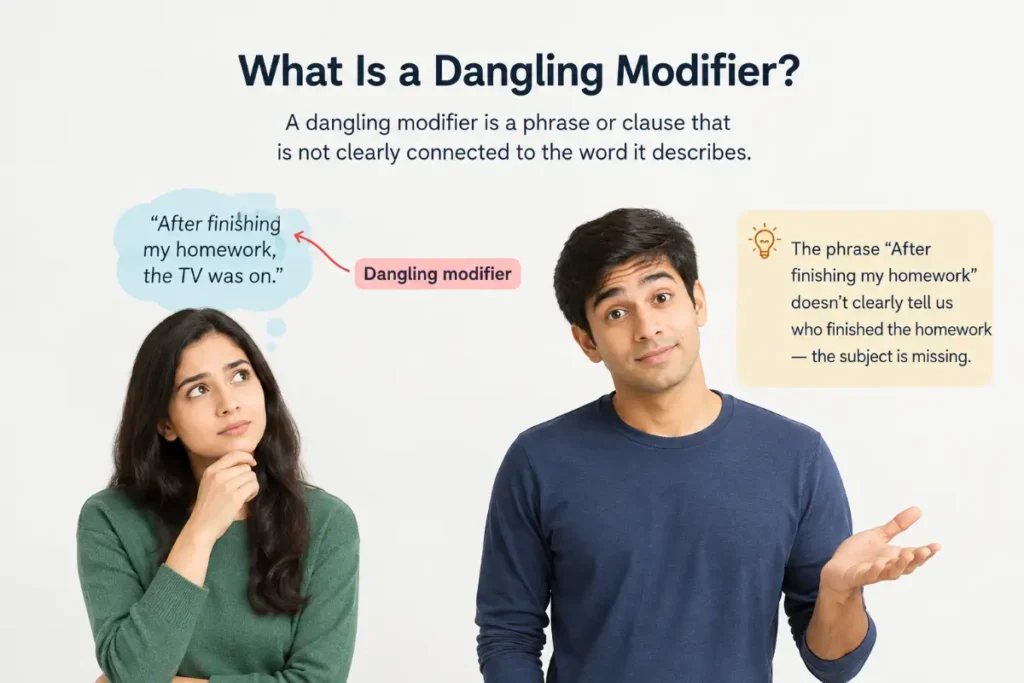
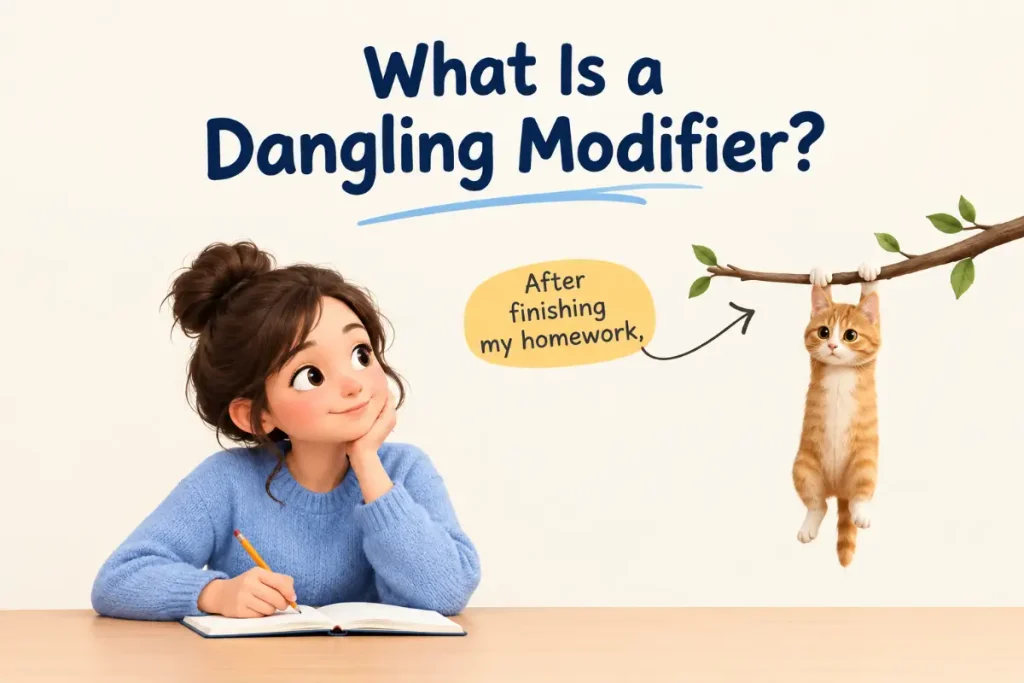
If you’ve ever wondered what is a dangling modifier and why some perfectly normal-looking sentences suddenly sound confusing, you’re not alone. This common grammar mistake happens when a descriptive phrase doesn’t clearly connect to the person, place, or thing it’s meant to describe. The result can range from mildly confusing to unintentionally funny, especially when the sentence seems to suggest that the wrong person or thing is doing the action.
Understanding dangling modifier is one of those grammar lessons that sticks immediately once you see a good example, because the results are often accidentally hilarious. Purdue OWL defines it precisely: “a word or phrase that modifies a word not clearly stated in the sentence.” In plain terms, it’s a descriptive phrase that’s left describing the wrong thing — or nothing at all — because the actual subject it was meant to modify never shows up in the sentence.
You may also find A Misplaced Modifier? 20 Clear Examples (2026) helpful if you want to explore this topic further.
The Quick Answer
A dangling modifier example:
- Having finished the assignment, the TV was turned on. (incorrect — the TV didn’t finish any assignment)
Fixed:
- Having finished the assignment, Jill turned on the TV. (correct — Jill is now clearly the one who finished the assignment)
The core problem: “having finished the assignment” is an introductory phrase describing an action, but the subject that immediately follows it — “the TV” — isn’t capable of finishing an assignment. English grammar assumes the subject right after an introductory modifier is the one performing that modifying action, so when that subject doesn’t logically match, the modifier is left “dangling,” with no proper subject to attach to.
Classic Dangling Modifier Examples
These examples make the pattern obvious, since they create genuinely absurd, unintended meanings.
- Turning the corner, a handsome school building appeared. (the building didn’t turn any corner — the unnamed narrator did)
- At the age of eight, my family finally bought a dog. (this technically says the family was eight years old)
- Having arrived late for the date, a good excuse was needed. (an excuse can’t arrive late — a person does)
- Leaping to the saddle, his horse bolted. (the horse didn’t leap onto itself)
Every one of these follows the same pattern: an introductory phrase describes an action or a state, but the noun immediately following the comma isn’t logically capable of being the one doing it.
Why This Happens: The Missing “Doer”
Purdue OWL explains the underlying mechanic clearly: in English sentences, the “doer” of an introductory modifying phrase must be the subject of the main clause that immediately follows it. When the sentence’s actual subject is genuinely absent — replaced by an unrelated noun, a vague pronoun like “it,” or the passive voice — there’s nothing left for the modifier to properly attach to, and it dangles.
- Without knowing the address, it was difficult to find the house. — “it” isn’t capable of knowing an address; the actual person who didn’t know the address is missing from the sentence entirely.
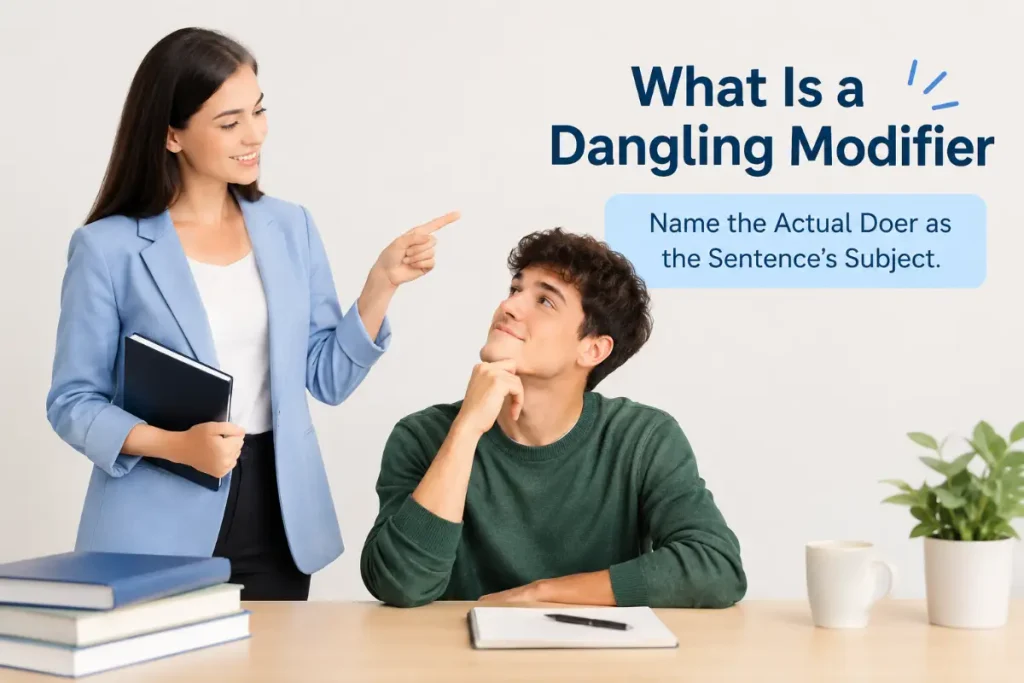
Strategy 1: Name the Actual Doer as the Sentence’s Subject
The most direct fix is to identify who or what should logically be performing the modifying action, and make that the subject of your main clause.
- Dangling: Having arrived late for a date, a good excuse was needed.
- Fixed: Having arrived late for a date, Margo needed a good excuse.
Strategy 2: Turn the Dangling Phrase Into a Complete Introductory Clause
Instead of leaving the phrase as a modifier with an implied but absent subject, expand it into its own full clause with its own explicit subject.
- Dangling: Deciding to join the Navy, the recruiter enthusiastically shook Joe’s hand.
- Fixed: When Joe decided to join the Navy, the recruiter enthusiastically shook his hand.
Notice that this fix explicitly names Joe as the one who made the decision, rather than leaving that role ambiguously implied and then incorrectly attaching it to “the recruiter.”
Strategy 3: Rewrite the Main Clause Entirely
Sometimes the cleanest fix is restructuring the sentence so the logical relationship becomes clear without needing to force the original phrase into a new shape.
- Dangling: Without knowing the address, it was difficult to find the house.
- Fixed: Without knowing the address, we found it difficult to locate the house.
Strategy 4: Add the Missing Subject Directly to the Introductory Phrase
If the introductory phrase clearly describes a particular person or thing, name that subject directly instead of leaving it implied.
- Dangling: After finishing the assignment, the television was turned on.
- Fixed: After I finished the assignment, I turned on the television.
The revised version makes it immediately clear who finished the assignment and who turned on the television.
Strategy 5: Move the Modifier Closer to the Word It Describes
A modifier can sometimes appear to dangle simply because it is positioned too far from the word it should modify. Moving the phrase next to its intended subject can make the relationship clear.
- Dangling: Walking through the park, the beautiful flowers caught Lena’s attention.
- Fixed: Walking through the park, Lena noticed the beautiful flowers.
Here, walking through the park clearly modifies Lena, rather than incorrectly suggesting that the flowers were walking.
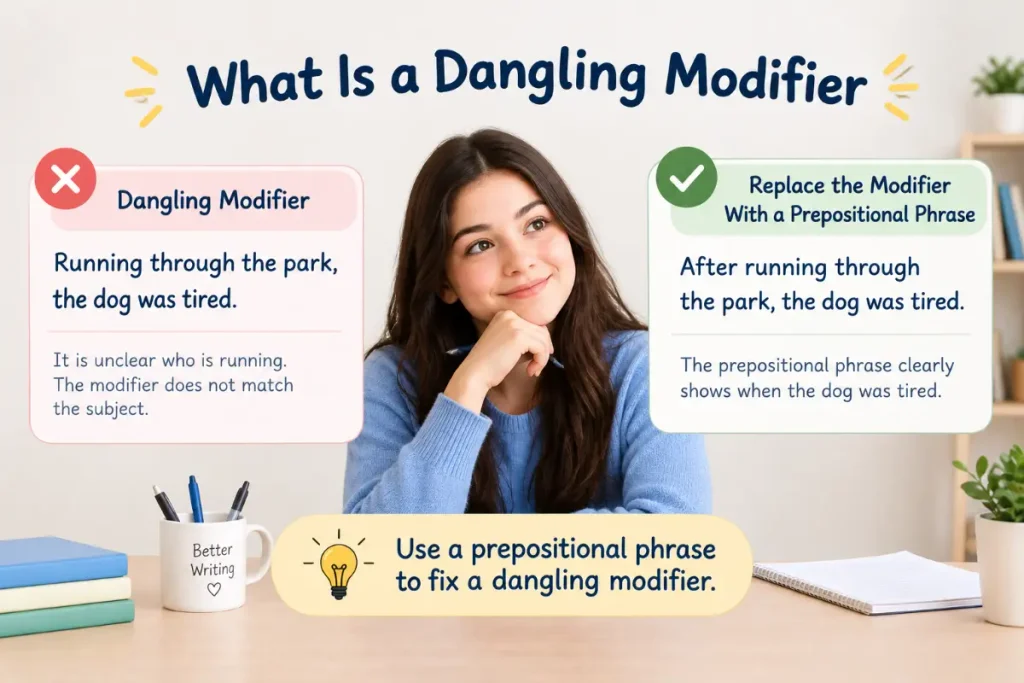
Strategy 6: Replace the Modifier With a Prepositional Phrase
When the original modifier creates an unclear relationship, rewriting it as a prepositional phrase can make the sentence more precise.
- Dangling: After reading the instructions, the correct answer was easy to find.
- Fixed: After reading the instructions, Sam found the correct answer easily.
This revision identifies the person who performed the action instead of leaving the correct answer as the accidental subject of reading.
Strategy 7: Use a Passive Construction Carefully
Changing a sentence to passive voice can sometimes remove a dangling modifier, but only when the resulting sentence still clearly identifies the intended subject.
- Dangling: While driving to work, the traffic seemed unusually heavy.
- Fixed: While I was driving to work, I noticed that the traffic was unusually heavy.
The active construction is clearer here because I is explicitly identified as the person driving.
Strategy 8: Split a Long Sentence Into Two Sentences
When several ideas are packed into one sentence, separating them can make the modifier’s intended subject much easier to identify.
- Dangling: Running to catch the bus, my backpack fell open and scattered my books everywhere.
- Fixed: I was running to catch the bus. My backpack fell open and scattered my books everywhere.
The two-sentence version removes the misleading connection between running and my backpack.
Strategy 9: Read the Sentence From the Modifier’s Point of View
Before finalizing a sentence, mentally ask: Who is actually performing the action described by the modifier? Then check whether that person or thing appears immediately as the grammatical subject of the main clause.
- Dangling: To save money, the expensive restaurant was avoided.
- Fixed: To save money, we avoided the expensive restaurant.
In the corrected version, we are clearly the ones trying to save money and avoiding the restaurant. This quick check can help you catch dangling modifiers before they make it into your final draft.
Dangling Modifiers vs. Squinting Modifiers: A Related but Different Error
Purdue OWL notes a related error worth distinguishing: a squinting modifier occurs when it’s unclear which of two possible words or phrases a modifier is meant to describe, because it sits ambiguously between them.
- Squinting: Students who practice writing often improve quickly. (does “often” describe how frequently they practice, or how often they improve?)
Unlike a dangling modifier, which has no logical subject to attach to at all, a squinting modifier has two possible candidates and no clear way to tell which one is intended. Both errors are typically solved by rearranging the sentence’s existing elements for clarity.
The Fastest Way to Check Yourself
Step 1: Identify any introductory phrase at the start of your sentence, especially ones beginning with an “-ing” verb (a participle) or “to + verb” (an infinitive).
Step 2: Ask what the phrase is actually describing. Who or what is doing that action?
Step 3: Check whether that “doer” is the very next word in your sentence — the subject of your main clause. If it isn’t, or if it’s missing entirely, you have a dangling modifier.
Step 4: Fix it by naming the correct subject, expanding the phrase into a full clause, or rewriting the sentence.
What Is a Dangling Modifier: Quick Reference
| Dangling Version | Fixed Version | Method |
|---|---|---|
| Having finished dinner, the waiter brought dessert. | Having finished dinner, we asked the waiter for dessert. | Named the correct doer as subject |
| Turning the corner, a building appeared. | As I turned the corner, a building appeared. | Expanded into a full clause |
| To improve fitness, exercise is essential. | To improve fitness, you need regular exercise. | Named the correct doer as subject |
Common Mistakes People Make
Mistake 1: “Walking down the street, the trees looked beautiful.” The trees weren’t walking — this should be “Walking down the street, I noticed the trees looked beautiful,” naming the actual person doing the walking.
Mistake 2: “After finishing the race, a cold drink was refreshing.” A drink didn’t finish any race — this should be “After finishing the race, she found a cold drink refreshing.”
Mistake 3: Assuming any introductory phrase followed by a comma is automatically fine. Not every introductory phrase dangles, but every one needs to be checked against the subject that immediately follows it — this is a habit worth building specifically during editing, not something to assume is automatically correct.
For another useful perspective, check out Use Neither Nor Correctly: The Easy 2026 Guide.
Mistake 4: “To succeed in this industry, hard work and dedication are required.” This is technically a dangling infinitive — “hard work and dedication” can’t “succeed” the way a person can; a fix might be “To succeed in this industry, you need hard work and dedication.”
Mistake 5: Fixing the dangling modifier by simply removing the comma, without addressing the underlying logic problem. Removing the comma doesn’t fix a dangling modifier — the sentence still needs its actual subject named clearly, regardless of punctuation.
More Examples to Lock It In
- Dangling: Exhausted after the long flight, the hotel room was a welcome sight. Fixed: Exhausted after the long flight, we were relieved to see the hotel room.
- Dangling: While reading the report, several errors became apparent. Fixed: While reading the report, she noticed several errors.
- Dangling: Covered in mud, the car wash was our next stop. Fixed: Covered in mud, we headed straight for the car wash.
Frequently Asked Questions
Is a dangling modifier always found at the beginning of a sentence?
Most commonly, yes, especially with introductory participial or infinitive phrases, but dangling modifiers can also appear at the end of a sentence, following the same logic: the modifying phrase still needs a clear, logical subject to attach to somewhere in the sentence.
Why do dangling modifiers often create unintentionally funny sentences?
Because the grammatical structure forces an illogical action onto an inanimate object or an unrelated noun — a TV finishing homework, a horse leaping onto itself — creating an absurd literal meaning that readers immediately recognize as unintended, which is exactly what makes these errors so often used as classic grammar humor examples.
Is a dangling modifier the same thing as a misplaced modifier?
They’re related but distinct. A dangling modifier has no logical subject at all in the sentence to attach to. A misplaced modifier does have a logical subject present, but it’s positioned too far away from the modifier, creating ambiguity or an unintended meaning based on word order alone.
Can the passive voice contribute to dangling modifiers?
Yes, frequently — passive voice constructions often remove or obscure the actual “doer” of an action (“a good excuse was needed” instead of “she needed a good excuse”), which is exactly the kind of missing subject that leaves an introductory modifier with nothing logical to attach to.
What’s the fastest way to catch dangling modifiers before publishing something?
For every sentence that opens with an “-ing” or “to + verb” phrase, check whether the very next noun is actually capable of performing that action. If it isn’t — or if the sentence uses a vague “it” or passive construction instead of a clear subject — you’ve likely found a dangling modifier.
Practice Exercise
Identify and fix the dangling modifier in each sentence. Answers are listed right after — try each one before checking.
- Having cleaned the entire house, the afternoon was finally free.
- To master a new language, consistent practice is needed.
- Running late for the meeting, the papers were left behind.
- After waiting an hour, the bus finally arrived and we boarded.
- While walking to school, the rain suddenly started pouring.
- After finishing the report, the computer was turned off.
- Hoping to catch the last train, the station was reached just in time.
- Having studied all night, the exam seemed surprisingly easy.
- To improve her writing, several grammar books were purchased.
- Driving down the highway, the mountains looked beautiful.
- After being left outside all night, we found the bicycle covered in snow.
- Looking through the old photographs, childhood memories came flooding back.
- While preparing dinner, the doorbell was heard ringing.
- Exhausted after the long hike, the hotel looked especially comfortable.
- To avoid missing the flight, an early taxi was booked.
- Having forgotten his umbrella, the heavy rain caught Daniel by surprise.
- After reading the instructions carefully, the machine was easy to operate.
- Walking into the classroom, everyone’s attention was immediately drawn to the new student.
- Hoping to save time, the shortcut was taken by Mia.
- After working for three hours, the finished project gave the team a sense of relief.
Answer Key
Fixes may vary; one valid option is shown for each.
- Having cleaned the entire house, she finally had the afternoon free.
- To master a new language, you need consistent practice.
- Running late for the meeting, he left the papers behind.
- Correct as written — “we” is present and logically the ones waiting.
- While I was walking to school, the rain suddenly started pouring.
- After finishing the report, she turned off the computer.
- Hoping to catch the last train, he reached the station just in time.
- Having studied all night, I found the exam surprisingly easy.
- To improve her writing, she purchased several grammar books.
- Driving down the highway, we admired the beautiful mountains.
- Correct as written — “we” logically refers to the people who found the bicycle.
- While I was looking through the old photographs, childhood memories came flooding back.
- While I was preparing dinner, I heard the doorbell ringing.
- Exhausted after the long hike, we found the hotel especially comfortable.
- To avoid missing the flight, she booked an early taxi.
- Having forgotten his umbrella, Daniel was caught by surprise by the heavy rain.
- After reading the instructions carefully, I found the machine easy to operate.
- Walking into the classroom, the new student immediately drew everyone’s attention.
- Hoping to save time, Mia took the shortcut.
- After working for three hours, the team felt relieved to have finished the project.
Quick tip: For each sentence, first identify the action in the opening phrase. Then ask, “Who actually did this?” If that person or thing doesn’t appear as the subject of the main clause, you may have found a dangling modifier.orrectly, you now understand what is a dangling modifier well enough to catch it reliably in your own writing.
Before moving on, you may also want to read Subject Verb Agreement with Collective Nouns: 7 Easy Rules (2026) for more helpful grammar tips.
The Bottom Line
Now that you know what is a dangling modifier — a descriptive phrase left without a logical subject to attach to — spotting one comes down to a simple habit: check whether the noun immediately following an introductory phrase is actually capable of performing the action described. When it isn’t, name the real doer, expand the phrase into a full clause, or rewrite the sentence, and the dangling modifier disappears.
For a related sentence-clarity issue involving where a phrase sits rather than whether its subject exists at all, our comma splice examples and fixes guide covers a different but equally common structural error worth knowing.