Understanding the difference between active and passive voice becomes much easier when you see how the same idea can be expressed in two different ways. Instead of memorizing grammar rules, comparing active vs passive voice examples helps you quickly spot who performs the action, who receives it, and how changing the sentence structure can affect clarity and emphasis.
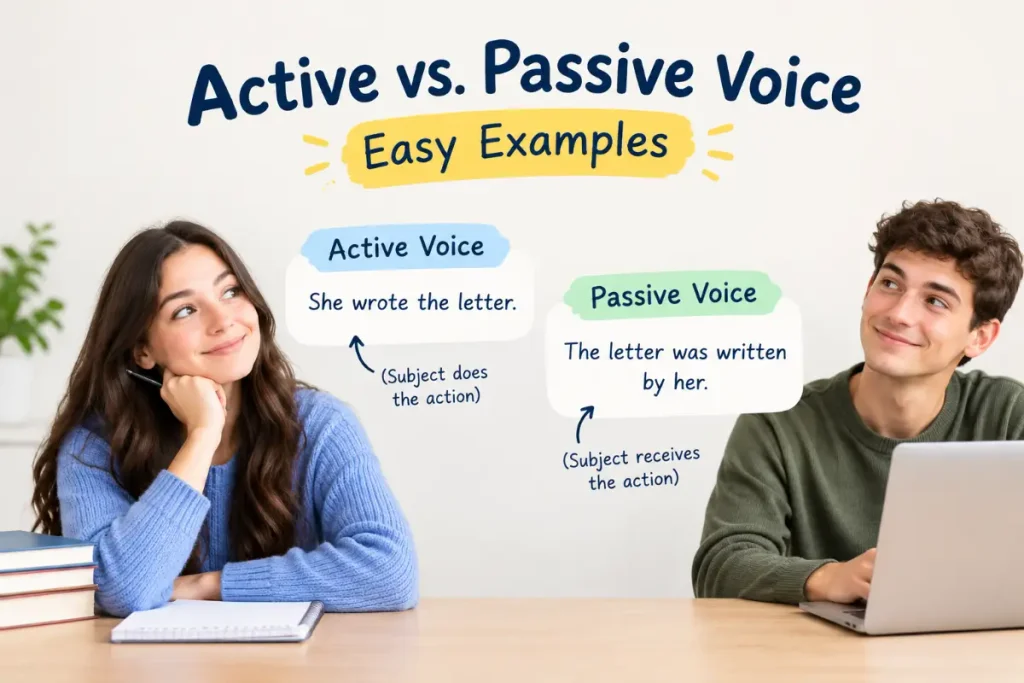
Looking at real active vs passive voice side by side is the fastest way to internalize this distinction, since the difference is really about who’s doing what to whom in a sentence. Purdue OWL defines it precisely: in active voice, “the subject of the sentence performs the action expressed in the verb.” In passive voice, the subject instead receives that action, with the actual doer either mentioned in a “by” phrase or left out entirely.
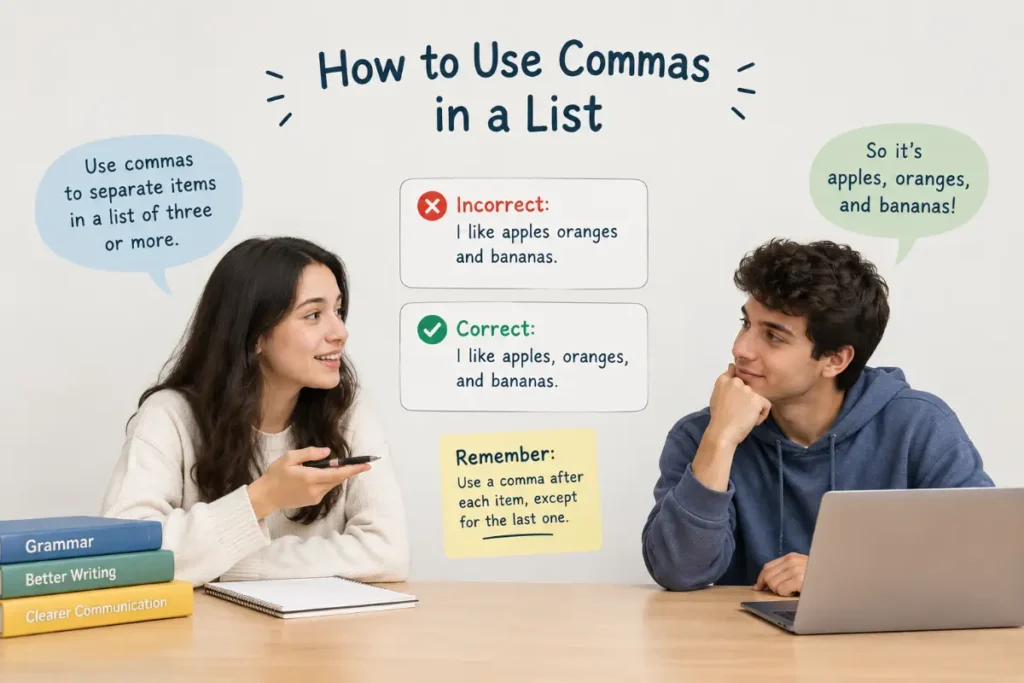
You may also find Use Commas in a List: 7 Easy Rules (2026) helpful if you want to explore this topic further.
The Quick Answer
- Active: The dog bit the boy. (the dog, the subject, performs the biting)
- Passive: The boy was bitten by the dog. (the boy, the subject, receives the action)
- Active: Scientists have conducted experiments to test the hypothesis.
- Passive: Experiments have been conducted to test the hypothesis. (the scientists are omitted entirely)
The test: does the sentence’s subject perform the action, or receive it? If it performs the action, that’s active voice. If it receives the action — and you can spot a form of “be” (is, was, were, has been) paired with a past participle — that’s passive voice.
More Active vs. Passive Voice Examples, Side by Side
- Active: She slammed on the brakes as the car sped downhill.
- Passive: The brakes were slammed on by her as the car sped downhill.
- Active: Over one-third of the applicants failed the entrance exam.
- Passive: The entrance exam was failed by over one-third of the applicants.
- Active: Someone damaged your bicycle.
- Passive: Your bicycle has been damaged. (the agent — whoever did it — is omitted entirely here)
- Active: The chef prepared the meal.
- Passive: The meal was prepared by the chef.
Notice how, in most of these pairs, active voice uses fewer words to communicate the same core idea — Purdue OWL specifically notes that active voice sentences “are also more concise than those in passive voice because fewer words are required to express action.”
How to Spot Passive Voice
Every passive voice sentence includes a form of the verb “be” — is, are, was, were, has been, have been, will be — paired with a past participle (typically a verb ending in -ed, -en, or an irregular past-tense form).
- is written, was built, has been completed, will be announced, were damaged
If you can identify this specific verb pattern, and the noun in front of it isn’t the one actually doing the action, you’ve found passive voice.
When Active Voice Is the Better Choice
Purdue OWL recommends active voice for most non-scientific writing, since it “makes your meaning clear for readers, and keeps the sentences from becoming too complicated or wordy.” Active voice is generally the better default because it’s:
- More direct. The reader immediately knows who did what.
- More concise. Fewer words are needed to convey the same information.
- More engaging. Action-driven sentences tend to feel more energetic and readable.
When Passive Voice Is Actually the Right Choice
This is worth knowing, because passive voice isn’t simply a mistake to eliminate everywhere — it has legitimate, deliberate uses. Purdue OWL identifies several situations where passive voice is the more effective choice:
When the agent performing the action is unknown:
- The window was broken sometime last night. (nobody knows who did it)
When the agent is unimportant or obvious from context:
- The bridge was completed in 1932. (who specifically built it matters less than the fact itself)
When you want to emphasize the action or the object, rather than who performed it:
- The suspect was arrested at 3 a.m. (the arrest matters more than naming the specific officer)
In scientific and technical writing, where the convention favors describing what was done rather than who did it, creating a sense of objective, fact-based reporting:
- The samples were heated to 200 degrees Celsius.
Purdue OWL explains this scientific convention specifically helps “create the appearance of an objective, fact-based discourse,” since it allows researchers to present findings without centering themselves as the ones performing the action.

Why Passive Voice Sometimes Gets a Bad Reputation
The problem isn’t passive voice itself — it’s overuse. Purdue OWL notes that “overuse of passive voice throughout an essay can cause your prose to seem flat and uninteresting,” and even in scientific writing, “too much use of passive voice can cloud the meaning of your sentences.” The real goal isn’t eliminating passive voice entirely; it’s using it intentionally, in the specific situations where it genuinely serves the sentence better than active voice would.
The Fastest Way to Check Yourself
Step 1: Identify who or what is performing the action described by the verb. Is that the sentence’s subject?
Step 2: Look for a form of “be” paired with a past participle. That combination signals passive voice.
Step 3: Ask whether the “doer” of the action matters for this sentence. If it does, and rewriting to active voice makes the sentence clearer or more concise, switch to active voice. If the doer is unknown, unimportant, or deliberately being de-emphasized, passive voice may be the better choice.
Active vs. Passive Voice Examples: Quick Reference
| Active Voice | Passive Voice | |
|---|---|---|
| Subject role | Performs the action | Receives the action |
| Verb pattern | Standard verb form | “Be” + past participle |
| Example | She wrote the report. | The report was written by her. |
| Word count | Usually shorter | Usually longer |
| Best for | Most writing; clarity and directness | Unknown/unimportant agent, scientific convention, emphasis on the action |
Common Mistakes People Make
Mistake 1: Assuming passive voice is always wrong. Passive voice has legitimate, deliberate uses — the goal is intentional use, not total avoidance.
Mistake 2: “Mistakes were made.” This is a classic example of passive voice used to deliberately avoid naming responsibility — while grammatically fine, it’s worth recognizing this rhetorical effect and using it consciously rather than by accident.
Mistake 3: Overusing passive voice throughout a long document, creating flat, repetitive sentence structures. Even in scientific writing where passive voice is conventional, variety matters for readability — an entire paper written exclusively in passive voice tends to feel monotonous.
Mistake 4: Converting every passive sentence to active without checking if it actually improves the sentence. Sometimes the passive version genuinely reads better, especially when the “doer” is unknown or irrelevant — “the package was delivered this morning” is perfectly natural, since naming a specific unknown delivery person would be awkward and unnecessary.
For another useful perspective, check out A Non-Restrictive Clause? 5 Simple Rules (2026).
Mistake 5: Missing passive voice that doesn’t include an obvious “by” phrase. “The decision has been made” is passive voice with the agent omitted entirely — it’s easy to miss this pattern since there’s no “by someone” phrase to flag it visually.
15 Easy Examples
| No. | Active Voice | Passive Voice |
|---|---|---|
| 1 | The boy kicked the ball. | The ball was kicked by the boy. |
| 2 | She reads a book. | A book is read by her. |
| 3 | Tom opened the door. | The door was opened by Tom. |
| 4 | The cat chased the mouse. | The mouse was chased by the cat. |
| 5 | He wrote a letter. | A letter was written by him. |
| 6 | The teacher praised the student. | The student was praised by the teacher. |
| 7 | They cleaned the room. | The room was cleaned by them. |
| 8 | Mom cooked dinner. | Dinner was cooked by Mom. |
| 9 | The dog broke the vase. | The vase was broken by the dog. |
| 10 | We planted a tree. | A tree was planted by us. |
| 11 | Sarah washed the dishes. | The dishes were washed by Sarah. |
| 12 | The farmer grows vegetables. | Vegetables are grown by the farmer. |
| 13 | The children drew pictures. | Pictures were drawn by the children. |
| 14 | He fixed the bicycle. | The bicycle was fixed by him. |
| 15 | The chef prepared the meal. | The meal was prepared by the chef. |
More Examples to Lock It In
- Active: The committee approved the proposal. Passive: The proposal was approved by the committee.
- Active: Researchers discovered a new species. Passive: A new species was discovered. (agent omitted — common and appropriate in scientific writing)
- Active: The storm damaged several homes. Passive: Several homes were damaged by the storm.
Frequently Asked Questions
Is passive voice grammatically incorrect?
No — passive voice is entirely grammatical and has legitimate uses, particularly in scientific writing, when the agent is unknown, or when the writer deliberately wants to emphasize the action or object over who performed it.
Why do writing tools often flag passive voice as an error?
Most grammar-checking tools flag passive voice as a stylistic suggestion, not a genuine error, since active voice is generally clearer and more concise for most everyday and professional writing — but the flag doesn’t mean the sentence is wrong.
How can I quickly identify passive voice in my own writing?
Look for a form of “be” (is, was, were, has been, will be) immediately followed by a past participle, and check whether the sentence’s subject is receiving the action rather than performing it.
Is passive voice more common in certain fields than others?
Yes — scientific and academic writing conventionally uses passive voice more often than most other genres, specifically to create a sense of objective, fact-based reporting that doesn’t center the researcher as the active agent.
What’s the fastest way to catch overused passive voice before publishing something?
Scan your document for the “be verb + past participle” pattern, and for each instance, ask whether naming the actual “doer” as the subject would make the sentence clearer, more direct, or more concise — if so, consider switching to active voice.
Practice Exercise
Identify whether each sentence is active or passive, then rewrite it in the opposite voice. Try each one before checking the answer key.
- The teacher explained the lesson clearly.
- The windows were cleaned by the janitor.
- Sarah mailed the package yesterday.
- The final decision was made by the committee.
- Someone left the lights on all night.
- The invitations were sent to all the guests.
- The chef prepared a delicious meal.
- The missing documents were found by the assistant.
- The company launched a new product last month.
- The road was repaired after the storm.
- The police arrested the suspect early this morning.
- The winning design was selected by the judges.
- The mechanic fixed my car in an hour.
- The results were announced by the principal.
- Someone broke the kitchen window.
- The students completed the assignment before lunch.
- The new software was installed by the IT team.
- The author wrote the novel in three months.
- The old building was demolished last year.
- The volunteers organized the charity event.
Answer Key
- Active → Passive: “The lesson was explained clearly by the teacher.”
- Passive → Active: “The janitor cleaned the windows.”
- Active → Passive: “The package was mailed by Sarah yesterday.”
- Passive → Active: “The committee made the final decision.”
- Active → Passive: “The lights were left on all night.”
- Passive → Active: “Someone sent the invitations to all the guests.”
- Active → Passive: “A delicious meal was prepared by the chef.”
- Passive → Active: “The assistant found the missing documents.”
- Active → Passive: “A new product was launched by the company last month.”
- Passive → Active: “The workers repaired the road after the storm.”
- Active → Passive: “The suspect was arrested by the police early this morning.”
- Passive → Active: “The judges selected the winning design.”
- Active → Passive: “My car was fixed by the mechanic in an hour.”
- Passive → Active: “The principal announced the results.”
- Active → Passive: “The kitchen window was broken.”
- Active → Passive: “The assignment was completed by the students before lunch.”
- Passive → Active: “The IT team installed the new software.”
- Active → Passive: “The novel was written by the author in three months.”
- Passive → Active: “Workers demolished the old building last year.”
- Active → Passive: “The charity event was organized by the volunteers.”
If you can correctly identify and rewrite most of these sentences, you’re getting comfortable with both directions of active vs passive voice. Keep practicing with different sentence structures, and the distinction will become much easier to spot in your own writing.
Active and Passive Voice in Different Writing Contexts
- In journalism, active voice dominates, since news writing prioritizes clarity, directness, and identifying who did what as quickly as possible.
- In legal and policy writing, passive voice appears more often than in most genres, sometimes deliberately, to describe requirements or outcomes without assigning a specific actor (“the form must be submitted by the deadline”).
- In business writing, a mix is common — active voice for clear instructions and calls to action, passive voice when softening a message or avoiding direct blame (“the deadline was missed” rather than naming who missed it).
- In creative writing, active voice generally drives narrative momentum, while passive voice is used sparingly for specific effects, such as emphasizing a character’s lack of control over events happening to them.
Before moving on, you may also want to read Avoid Passive Voice in Writing: 7 Easy Rules (2026) for more helpful grammar tips.
The Bottom Line
Working through real active vs passive voice examples makes the underlying pattern clear: active voice has the subject performing the action, while passive voice has the subject receiving it, typically marked by a “be” verb plus a past participle. Active voice is the better default for most writing because it’s more direct and concise, but passive voice earns its place when the agent is unknown, unimportant, or deliberately de-emphasized — the goal is choosing intentionally, not avoiding passive voice altogether.
Once you’ve worked through these examples, the difference becomes much easier to recognize and apply. Active voice puts the doer of the action front and center, while passive voice shifts attention to the person or thing affected by it. In most everyday writing, active voice is a useful default because it tends to be clearer and more concise. Still, passive voice isn’t something to avoid completely—it can be the right choice when the doer is unknown, irrelevant, or intentionally left in the background. The key is to choose the voice that best fits what you want the sentence to emphasize.