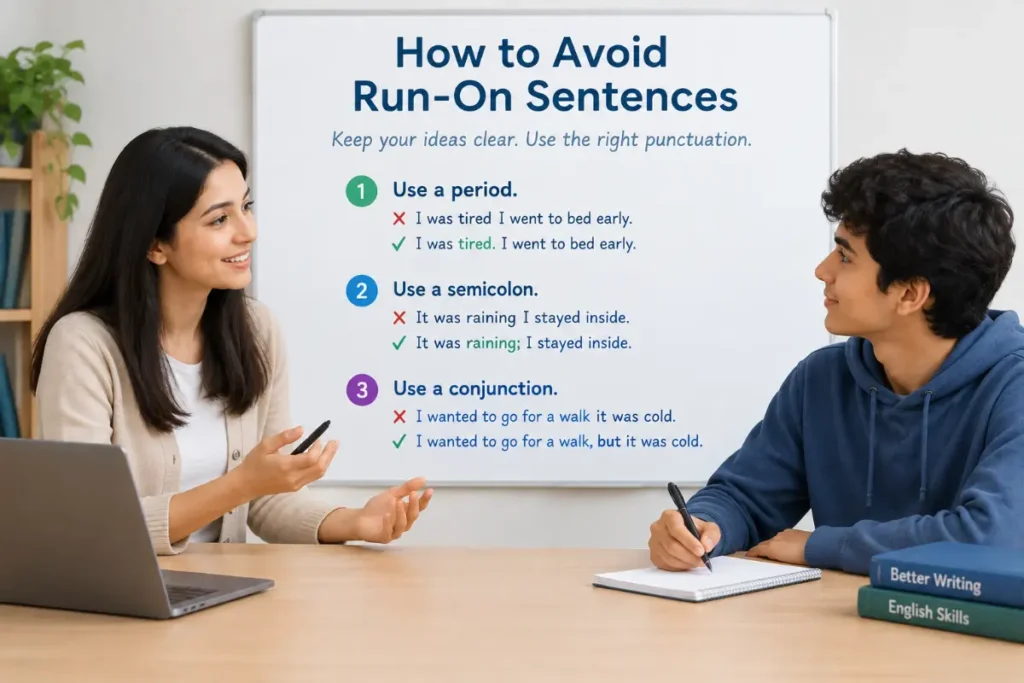
Run-on sentences can make even good writing feel rushed, confusing, or harder to follow than it needs to be. The tricky part is that they often look perfectly fine at first glance—especially when you’re trying to connect related ideas in a single sentence. The good news is that avoiding them doesn’t require complicated grammar rules. Once you know what to look for and how to separate complete thoughts clearly, you can spot run-ons quickly and keep your writing clean, natural, and easy to read.
If you’ve already read our guide on comma splice examples and fixes, you know one major cause of run-on sentences. This guide covers the other major cause — fused sentences, where independent clauses are jammed together with no punctuation at all — plus the broader habits that help you catch and avoid run-ons before they ever make it into a final draft.
You may also find Fix a Comma Splice: 11 Easy Ways to Fix (2026) helpful if you want to explore this topic further.
The Quick Answer
Purdue OWL defines run-ons, comma splices, and fused sentences as all describing the same underlying problem: independent clauses joined incorrectly. A fused sentence specifically has no punctuation at all between the two clauses.
- I didn’t know which job I wanted I was too confused to decide. (fused — incorrect)
Fixed four ways:
- Split into two sentences: I didn’t know which job I wanted. I was too confused to decide.
- Add a comma plus coordinating conjunction: I didn’t know which job I wanted, and I was too confused to decide.
- Use a semicolon: I didn’t know which job I wanted; I was too confused to decide.
- Make one clause dependent: Because I didn’t know which job I wanted, I was too confused to decide.
What Makes a Fused Sentence Different From a Comma Splice
Both errors stem from the same root problem — two independent clauses that need a proper connector and don’t have one. The difference is simply whether a comma is present. A comma splice has a comma doing a job it’s too weak to do alone; a fused sentence has nothing there at all.
- They weren’t dangerous criminals they were detectives in disguise. (fused — no punctuation whatsoever)
- They weren’t dangerous criminals, they were detectives in disguise. (comma splice — a comma alone, still not strong enough)
Both need the same set of fixes, and Purdue OWL recommends the identical two core strategies for both: join with a coordinating conjunction plus a comma, or separate the clauses with a semicolon.
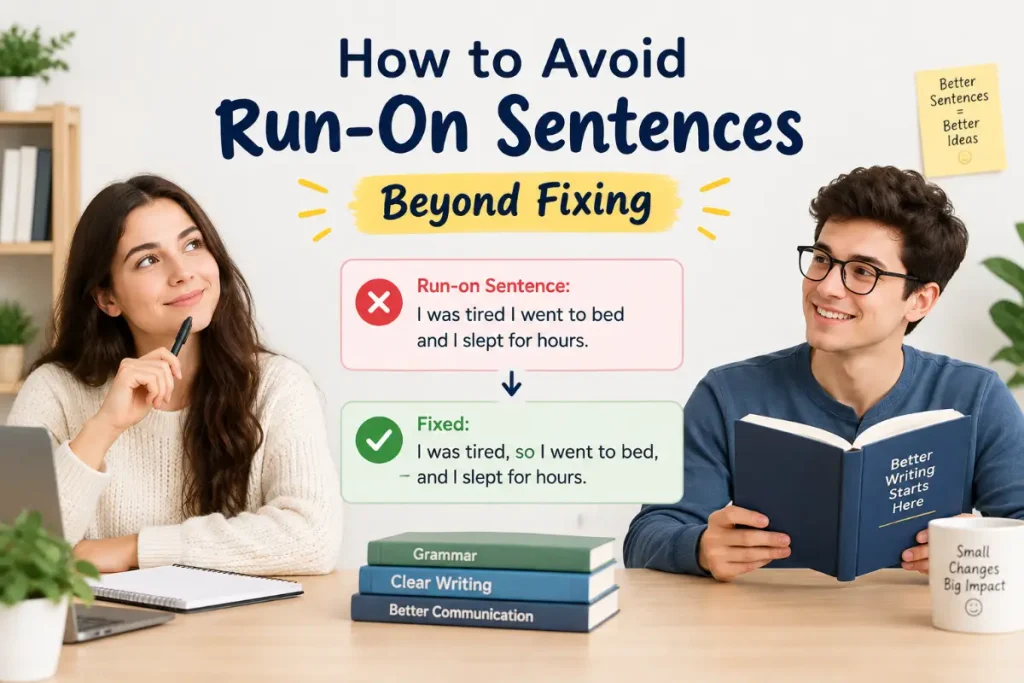
Beyond Fixing: Building Habits That Prevent Run-Ons in the First Place
Fixing individual sentences is useful, but the more durable skill is catching the pattern in your own writing before it becomes a habit. A few strategies genuinely help:
Read your writing aloud. Run-on sentences almost always reveal themselves the moment you try to read them naturally — you’ll find yourself needing to take a breath or pause somewhere the punctuation doesn’t actually support, which is usually the exact spot where a period, comma-plus-conjunction, or semicolon belongs.
Watch for sentences with more than one complete subject-verb pairing. If you can identify two distinct “who did what” statements packed into a single sentence, check carefully how they’re connected before moving on.
Be suspicious of long sentences that keep adding “and it,” “and then,” “and so.” This is a common pattern where writers keep bolting new complete thoughts onto an existing sentence rather than starting fresh ones — each “and” here is a signal to double-check whether you’re joining two independent clauses correctly or just running them together.
Slow down during editing passes specifically for sentence boundaries. A dedicated read-through focused only on where each sentence starts and ends — ignoring content and focusing purely on structure — catches run-ons that a normal read-through, focused on meaning, tends to miss.
The Two Core Fixing Strategies, in More Depth
Strategy 1: Coordinating conjunction plus comma. This works well when the two ideas are closely related and roughly equal in weight, and you want to preserve a sense of connection between them.
- He enjoys walking through the country, and he often goes backpacking on his vacations.
Strategy 2: Semicolon. This works well when the two ideas are closely related but you don’t need a specific connecting word — or when you want to use a conjunctive adverb like “however” or “therefore,” which requires a semicolon before it rather than just a comma.
- He often watched TV when there were only reruns; she preferred to read instead.
- He often watched TV when there were only reruns; however, she preferred to read instead.
For the complete range of jobs a semicolon can do beyond fixing run-ons, see our full semicolon guide.
When Run-Ons Happen for a Different Reason: Simply Overloaded Sentences
Not every “run-on” complaint is technically a grammatical run-on sentence — sometimes a sentence is grammatically correct but simply too long and overloaded with clauses, making it hard to follow even without any punctuation error. In this case, the fix isn’t about inserting the right punctuation mark; it’s about breaking the sentence into smaller, clearer pieces for the reader’s sake, even if the original version was technically grammatical.
- Overloaded but grammatically correct: “The company, which was founded in 1998 by two college roommates who had met during their sophomore year and bonded over a shared interest in software, eventually grew into one of the largest firms in its industry, employing thousands of people across multiple countries.”
- Broken up for clarity: “The company was founded in 1998 by two college roommates who met during their sophomore year and bonded over a shared interest in software. It eventually grew into one of the largest firms in its industry, employing thousands of people across multiple countries.”
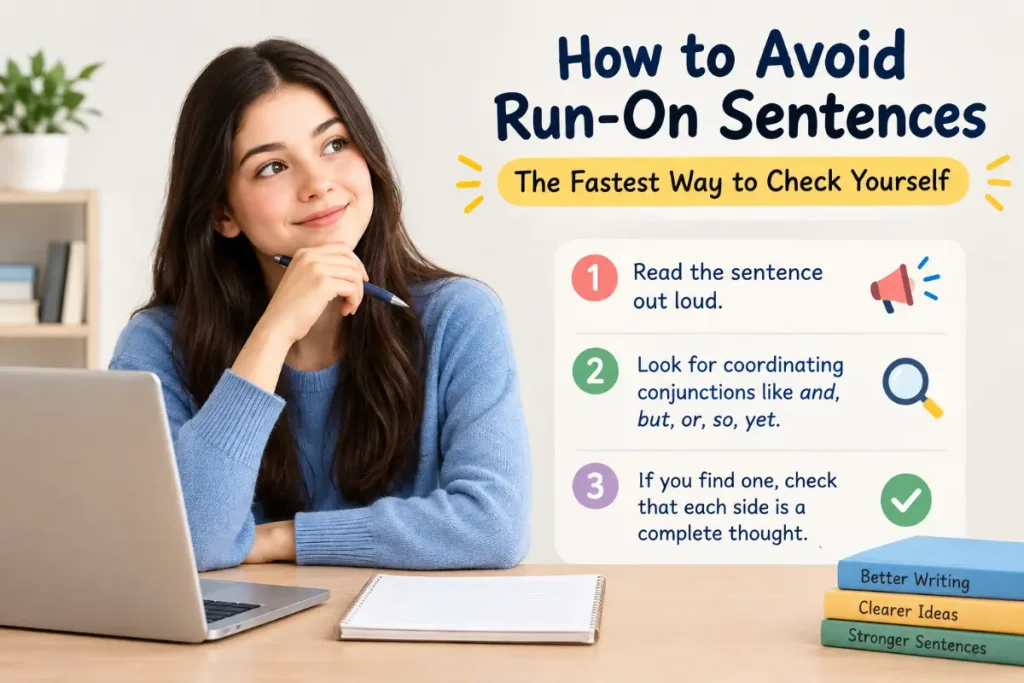
The Fastest Way to Check Yourself
Step 1: Read the sentence aloud and notice where you naturally want to pause or stop. That’s often exactly where a missing period, comma-plus-conjunction, or semicolon belongs.
Step 2: Identify every independent clause in the sentence. Could each one stand alone as a complete sentence?
Step 3: Check what’s connecting them. Nothing at all means a fused sentence; a lone comma means a comma splice; either needs one of the four standard fixes.
Step 4: If the sentence is grammatically fine but simply feels heavy or hard to follow, consider breaking it up for readability, even without a technical error present.
Run-On Sentences: Quick Reference
| Type | What’s Between the Clauses | Fix |
|---|---|---|
| Fused sentence | Nothing at all | Period, comma+conjunction, semicolon, or dependent clause |
| Comma splice | A comma alone | Same four fixes |
| Overloaded sentence | Technically correct punctuation | Break into shorter sentences for readability |
Common Mistakes People Make
Mistake 1: “The store closed early we had to shop somewhere else.” A fused sentence with no punctuation between two independent clauses. Fix it with a period, semicolon, comma + coordinating conjunction, or another appropriate joining structure: “The store closed early, so we had to shop somewhere else.”
Mistake 2: Assuming a long sentence is automatically a run-on. Sentence length has nothing to do with whether a sentence is a run-on. A long sentence can be grammatically correct if its clauses are joined properly, while a short sentence can still be a run-on if two independent clauses are incorrectly fused together.
Mistake 3: Fixing every run-on the same way. Turning every run-on into two short sentences can make your writing feel choppy, while using semicolons everywhere can become repetitive. Choose the fix that best reflects the relationship between the ideas.
Mistake 4: Adding “and” without the necessary comma. “He finished his homework and he watched television” contains two independent clauses joined by a coordinating conjunction. In formal writing, add a comma before “and”: “He finished his homework, and he watched television.”
Mistake 5: Skipping the read-aloud test. Some run-ons are much easier to hear than to spot on the page. Reading your draft aloud can help you notice places where one complete thought runs directly into another without a clear pause or boundary.
For another useful perspective, check out Subject Verb Agreement with Collective Nouns: 7 Easy Rules (2026).
Mistake 6: Using a comma alone to join two independent clauses. “I wanted to go for a walk, it started raining” is a comma splice, not a correct sentence. Use a period, semicolon, or coordinating conjunction instead: “I wanted to go for a walk, but it started raining.”
Mistake 7: Thinking a semicolon can join any two sentences. A semicolon works only when both sides can stand alone as independent clauses and the ideas are closely related. You can’t use one to connect an independent clause to a fragment.
Mistake 8: Forgetting that dependent clauses don’t need the same treatment. Not every clause needs to stand alone. In “Because it was raining, we stayed home,” the first part is dependent, so it doesn’t create a run-on when joined to the independent clause with a comma.
Mistake 9: Adding punctuation without checking the sentence structure. Simply dropping a comma, dash, or other punctuation into the middle of a sentence doesn’t automatically fix a run-on. Make sure the punctuation you’re using can actually connect the structures on both sides.
Mistake 10: Breaking sentences apart so aggressively that the writing becomes choppy. Once writers learn to spot run-ons, they sometimes turn every long sentence into two or three short ones. The goal isn’t to make every sentence short—it’s to make every sentence clear and correctly structured.
Mistake 11: Relying completely on grammar checkers. Automated tools can catch many sentence-boundary problems, but they may miss context-dependent errors or suggest changes that aren’t necessary. Use grammar software as an editing aid, not as a substitute for understanding how independent clauses work.
Mistake 12: Editing for punctuation without checking the meaning. A technically correct fix can still make a sentence awkward if it changes the relationship between the ideas. Before choosing a period, semicolon, or conjunction, ask how the two thoughts are connected and whether they actually belong together.
More Examples to Lock It In
- She loves to travel she’s visited twelve countries. → She loves to travel; she’s visited twelve countries.
- He finished the report it was due at noon. → He finished the report, and it was due at noon.
- The team practiced hard they still lost the game. → The team practiced hard, but they still lost the game.
- I called twice nobody answered. → I called twice. Nobody answered.
Frequently Asked Questions
Is a fused sentence a more serious error than a comma splice?
Both are considered genuine grammatical errors in formal and professional writing, though a fused sentence (no punctuation at all) is sometimes seen as slightly more disruptive to read, since there’s no visual signal at all marking where one thought ends and the next begins.
Can a run-on sentence ever be a deliberate stylistic choice?
In literary and creative writing, some authors deliberately use run-on structures for pacing or stream-of-consciousness effect. This is a conscious choice by writers who understand the convention they’re breaking, not a general exception for everyday or professional writing.
Does sentence length determine whether something is a run-on?
No — a run-on is defined by how independent clauses are connected, not by word count. A short sentence can be a run-on if two complete thoughts are fused together; a long sentence can be perfectly correct if its clauses are properly joined throughout.
What’s the difference between a run-on sentence and an overloaded sentence?
A run-on is a genuine grammatical error involving improperly joined independent clauses. An overloaded sentence may be entirely correct grammatically but still difficult to read because it packs in too many ideas, clauses, or details — the fix there is about readability, not correcting an error.
What’s the fastest way to catch run-on sentences before publishing something?
Read your writing aloud, watching for any spot where you need to pause but the punctuation doesn’t support it. For every sentence containing more than one complete subject-verb pairing, check exactly what’s connecting the clauses and confirm it’s one of the four accepted methods.
Practice Exercise
Identify and fix the run-on in each sentence using any appropriate method. Answers are listed right after — try each one before checking.
- The rain stopped everyone went back outside.
- She finished her degree she started her own business.
- He didn’t call he didn’t text either.
- The flight was delayed passengers waited for hours.
- I wanted to buy the jacket it was too expensive.
- The alarm went off nobody got out of bed.
- We arrived early the doors were still locked.
- Maya loves cooking she makes dinner almost every night.
- The movie was nearly three hours long we still enjoyed it.
- I forgot my umbrella I got completely soaked.
- The dog started barking the baby woke up.
- He studied all night he still didn’t pass the exam.
- The restaurant was crowded we found a table outside.
- Sarah sent the email she didn’t receive a reply.
- The road was closed we had to take another route.
- I called the hotel they had no rooms available.
- The sun came out everyone started taking pictures.
- We can leave now we can wait for another hour.
- Tom wanted to join us he had too much work to finish.
- The meeting ended everyone returned to their desks.
Answer Key
Fixes may vary; one valid option is shown for each.
- The rain stopped, and everyone went back outside.
- She finished her degree; she started her own business.
- He didn’t call, and he didn’t text either.
- The flight was delayed. Passengers waited for hours.
- I wanted to buy the jacket, but it was too expensive.
- The alarm went off, but nobody got out of bed.
- We arrived early, but the doors were still locked.
- Maya loves cooking, and she makes dinner almost every night.
- The movie was nearly three hours long, but we still enjoyed it.
- I forgot my umbrella, so I got completely soaked.
- The dog started barking, and the baby woke up.
- He studied all night, but he still didn’t pass the exam.
- The restaurant was crowded, so we found a table outside.
- Sarah sent the email, but she didn’t receive a reply.
- The road was closed, so we had to take another route.
- I called the hotel, but they had no rooms available.
- The sun came out, and everyone started taking pictures.
- We can leave now, or we can wait for another hour.
- Tom wanted to join us, but he had too much work to finish.
- The meeting ended. Everyone returned to their desks.
If you fixed 17 or more correctly, you have a strong grasp of how to identify and fix run-on sentences. If you got 13–16, you’re on the right track—review the different ways to join independent clauses. And if you got 12 or fewer, revisit the rules and try the exercise again before moving on. on both fused sentences and the broader habits that help catch them early.
Before moving on, you may also want to read Active vs Passive Voice Examples: 15 Easy Examples (2026) for more helpful grammar tips.
The Bottom Line
Knowing how to avoid run-on sentences means recognizing both major causes — fused sentences with no punctuation at all, and comma splices with a comma too weak to do the job — and applying one of four reliable fixes: a period, a comma plus coordinating conjunction, a semicolon, or a dependent clause. Reading your work aloud remains the single most effective habit for catching these errors before they reach a reader.
Once you start spotting where one complete thought ends and another begins, run-on sentences become much easier to prevent. During your final edit, look for places where independent clauses are crowded together, check that your punctuation matches the relationship between the ideas, and read tricky sentences aloud. With a little practice, these checks become second nature—and your writing will sound clearer, smoother, and more confident as a result.