The singular they grammar rule sounds like a modern invention, but the pronoun has been doing this job in English for centuries. If you’ve ever written “everyone should bring their lunch” without a second thought, you’ve already used it, and you were in very good company.
This guide covers where the usage came from, why an 18th-century objection briefly pushed it out of “proper” writing, and how to use it correctly today, including the verb agreement question that trips up the most writers. Because it touches pronoun agreement throughout, it pairs naturally with our guides on subject verb agreement rules and subject verb agreement with collective nouns.
You may also find Subject Verb Agreement with Collective Nouns: 7 Easy Rules (2026) helpful if you want to explore this topic further.
What Singular They Actually Is
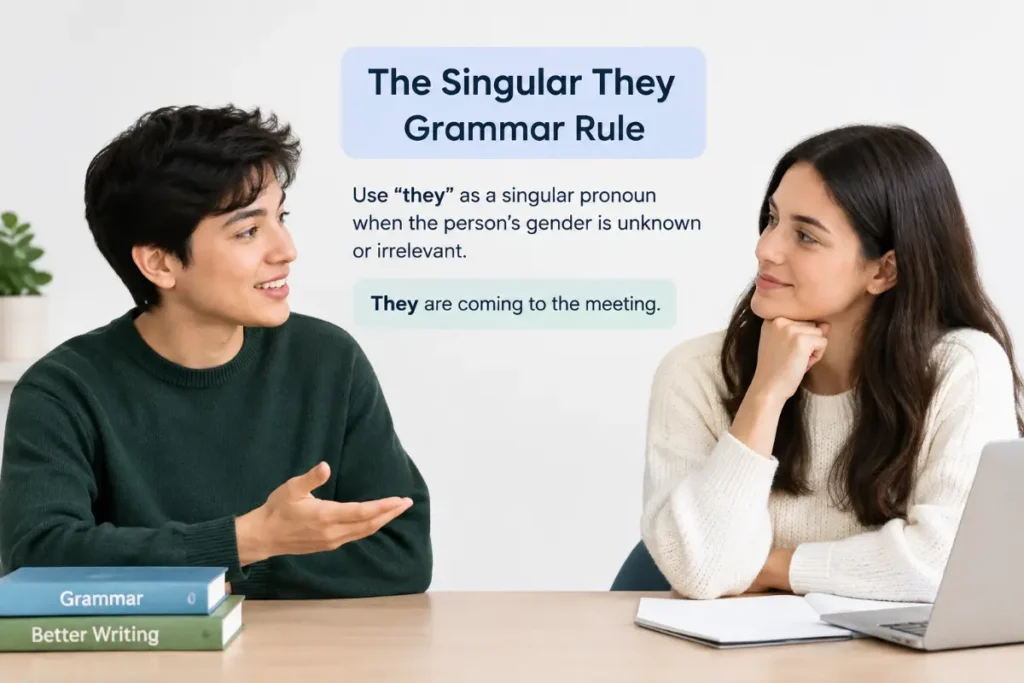
Singular they is the use of “they,” “them,” “their,” and “themselves” to refer to one person. It shows up in three main situations:
- Unknown or unspecified person: If a customer calls, ask them to leave a message.
- Indefinite pronouns (everyone, someone, nobody): Everyone should bring their own lunch.
- A specific person whose pronouns are they/them: Alex said they would present the results.
In each case the pronoun points to a single person, but the grammar treats it the way English treats “you,” which can also refer to one person or many.

A Longer History Than Most People Expect
Purdue OWL’s page on gendered pronouns and singular they notes that singular they appears as far back as a 1382 translation of the Bible, and that famous writers including Charles Dickens and Jane Austen used it throughout the 19th century. It wasn’t until the 18th century that some grammarians declared it invalid, arguing that a plural pronoun couldn’t refer back to a singular noun.
That objection never actually stopped people from using it. Everyday speakers kept saying “someone left their umbrella” and “nobody wants to admit their mistakes” without noticing any conflict, which is exactly why the rule struggled to take hold outside of formal grammar books.
Where the Style Guides and Dictionaries Stand Now
The formal acceptance has caught up with the everyday usage. Purdue OWL notes that singular they has been officially recognized by the Associated Press, the American Psychological Association, the Modern Language Association, the Oxford English Dictionary, and Merriam-Webster. The Chicago Manual of Style has also moved toward accepting it in recent editions. Two milestones are worth knowing: the American Dialect Society chose singular they as its 2015 Word of the Year, and Merriam-Webster made “they” its 2019 Word of the Year after adding a definition for its use in referring to a nonbinary person.
For writers, the practical takeaway is simple: in nearly every mainstream style guide, singular they is now acceptable in formal writing, not just casual speech.
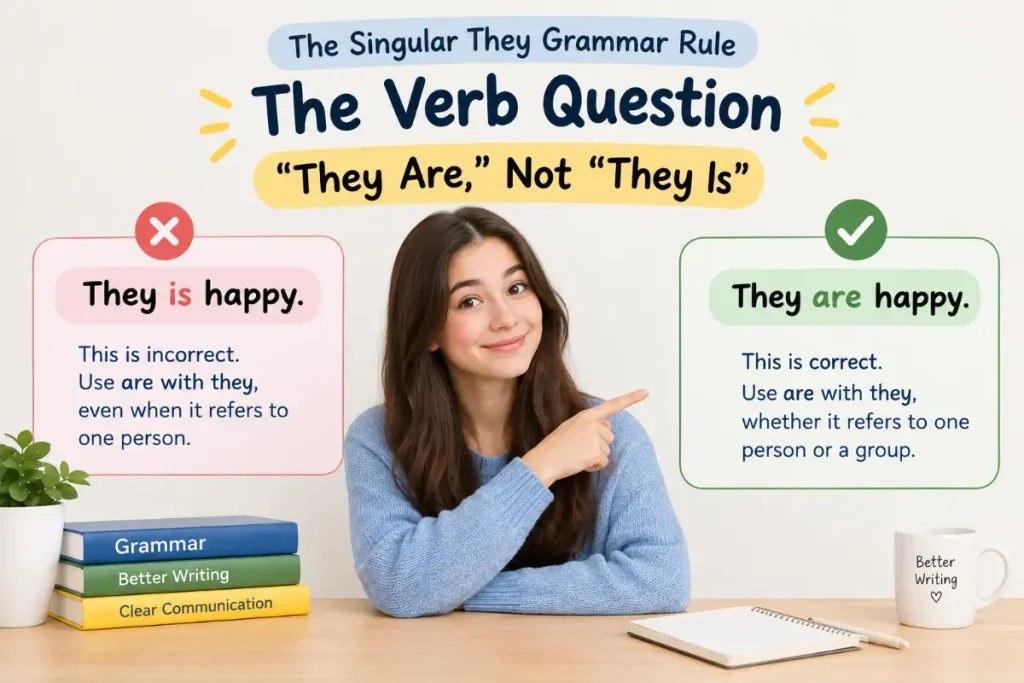
The Verb Question: “They Are,” Not “They Is”
Even when “they” refers to one person, it takes a plural verb.
- Alex said they are running late.
- My colleague mentioned they were tired.
- Incorrect: Alex said they is running late.
The reasoning is the same as with “you”: “you are” is standard even when you’re speaking to a single person, and “they are” follows the identical pattern. The pronoun’s meaning can be singular, but its grammatical form stays plural.
Themself vs. Themselves
The reflexive form is where usage is still settling. “Themselves” is the established standard and the safest choice in formal writing.
- Everyone should introduce themselves to the new hire.
“Themself” is listed in Merriam-Webster and is increasingly used when referring to one specific person, but it’s still less widely accepted than “themselves” in edited prose. If you’re writing for a publication with a specific house style, check its guidance before choosing.
Singular They vs. “He or She”
For decades, “he or she” was the standard workaround when a person’s gender was unknown. Today, many style guides recommend singular they instead, since “he or she” reads as clunky when repeated and leaves out people who don’t identify as either.
- Clunky: A good manager listens to his or her team and supports his or her goals.
- Cleaner: A good manager listens to their team and supports their goals.
When to Rephrase for Clarity
The one real limitation of singular they is that it can create genuine ambiguity when a sentence also involves other people who could be referred to by the plural “they.”
- Ambiguous: The manager told the employee that they needed a raise. (who needed the raise?)
- Clearer: The manager told the employee, “You need a raise,” or The manager told the employee that the employee needed a raise.
This isn’t a flaw in the pronoun itself, just a reminder that any pronoun with more than one possible reference benefits from a quick clarity check.
How to Use the Singular They Grammar Rule in Everyday Writing
The easiest way to apply the singular they grammar rule is to decide what kind of reference you are making. If you are talking about one person whose identity or gender is unknown, using an indefinite pronoun, or referring to someone who uses they/them pronouns, singular they can fit naturally into the sentence.
Use Singular They for an Unknown Person
When you don’t know who a person is, singular they avoids unnecessary assumptions about gender.
- If a customer calls, ask them to leave a message.
- If someone forgot their keys, they can pick them up at the front desk.
- A student should contact their instructor if they need help.
Here, each pronoun refers to one person, even though they takes its standard plural verb form.
Use It With Words Like “Everyone” and “Someone”
Singular they commonly follows indefinite pronouns such as everyone, someone, anyone, nobody, and no one.
- Everyone should bring their own lunch.
- Someone left their phone on the table.
- Nobody wants to admit their mistake.
- Anyone can change their answer later.
These sentences avoid the older and often cumbersome he or she construction while keeping the reference general.
Use the Person’s Pronouns When They Are Known
Singular they can also refer to a specific person who uses they/them pronouns.
- Jordan said they would present the results.
- Alex told me they are running late.
- Sam finished their report before the deadline.
In this situation, the important point is consistency. Once you know that someone uses they/them pronouns, use those forms consistently when referring to that person.
Keep the Verb Form Consistent
One of the easiest mistakes to make is treating singular they like a singular noun and writing they is or they was. Even when they refers to one person, standard usage calls for the plural verb forms.
- Correct: They are ready.
- Incorrect: They is ready.
- Correct: They were late.
- Incorrect: They was late.
- Correct: They have finished.
- Incorrect: They has finished.
Think of singular they as similar to you: the reference can be singular, while the verb form remains plural.
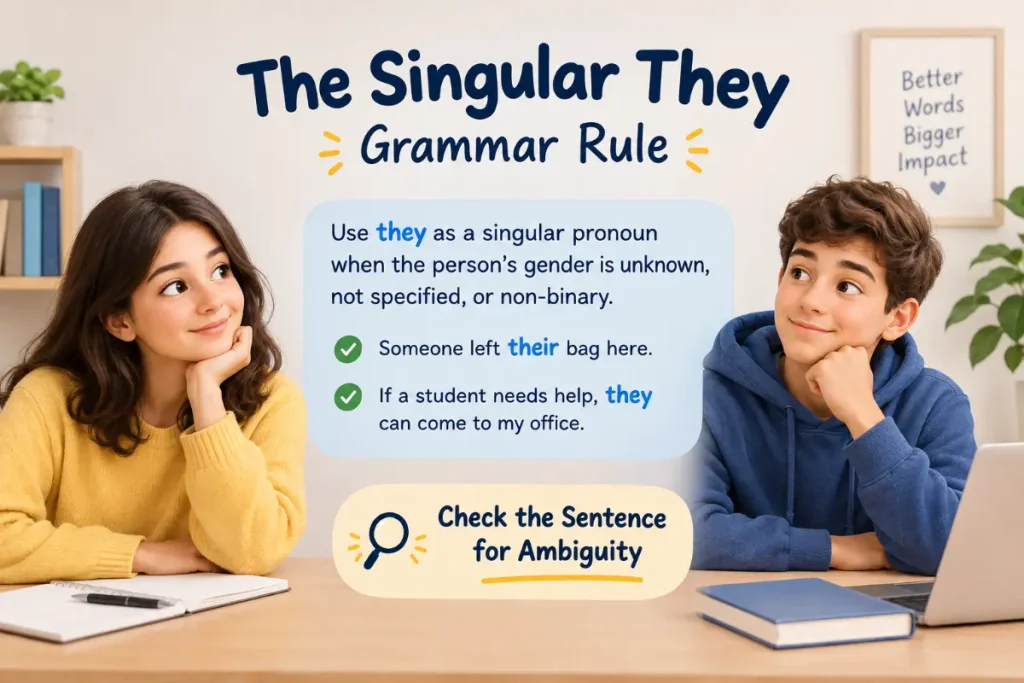
Check the Sentence for Ambiguity
Finally, read the sentence once more to make sure every they, them, and their has a clear reference. If the pronoun could refer to more than one person, repeat the noun or restructure the sentence.
- Unclear: The manager told the employee that they needed a raise.
- Clear: The manager told the employee, “You need a raise.”
- Clear: The manager told the employee that the employee needed a raise.
The goal of the singular they grammar rule is not simply to replace every he or she. Good usage also requires clear references, consistent pronouns, and the correct verb form. Once those checks become habitual, singular they fits naturally into everyday, academic, and professional writing.
Quick Reference Table
| Situation | Example | Notes |
|---|---|---|
| Unknown person | If someone calls, tell them I’ll call back. | Widely accepted in all style guides |
| Indefinite pronoun | Everyone brought their coat. | Centuries of consistent use |
| Specific person using they/them | Jordan said they’re ready. | Follow the person’s stated pronouns |
| Verb form | They are (never they is) | Plural verb even for one person |
| Reflexive | themselves (standard); themself (emerging) | Themselves is the safer formal choice |
Common Mistakes People Make
Mistake 1: Using a singular verb with singular they, as in “they is coming.” The verb stays plural.
Mistake 2: Assuming singular they is a brand-new invention that hasn’t been accepted by mainstream references, when it has centuries of documented use and current backing from major style guides and dictionaries.
Mistake 3: Creating ambiguity by using “they” for one person in a sentence that also involves a plural “they,” without rephrasing to make the references clear.
Mistake 4: Reverting to “he or she” repeatedly in the same passage, which reads as clunky compared with singular they.
For another useful perspective, check out Use Whomever Correctly: 10 Simple Rules (2026).
Mistake 5: Switching between “he,” “she,” and “they” for the same person within a single piece of writing, which reads as inconsistent.
Practice Exercise
Rewrite each sentence using singular they, or choose the correct form. Write “C” if it’s already correct. Answers are listed right after, so try each one before checking.
- Everyone should bring his or her own lunch.
- Each student must submit his or her form by Friday.
- If a customer is unhappy, he or she should contact support.
- Someone left his or her umbrella here.
- A good manager listens to his or her team.
- When Alex arrives, they (is/are) going to present.
- My friend said they (was/were) running late.
- Sam left their jacket, and they (has/have) gone to find it.
- Someone should introduce (themselves/himself) to the new hire.
- The manager told the employee that they needed a raise. (Rewrite for clarity.)
- They is coming to the meeting.
- Anyone who wants a ticket should put their name on the list.
- Nobody wants to admit their mistakes.
- Every parent hopes his or her child succeeds.
- The author explained that they wrote the book in a year. (author uses they/them)
- Whoever finishes first gets to choose their prize.
- A doctor must respect his or her patients’ privacy.
- No one should feel that they have to attend.
- Neither of the winners forgot (his or her/their) trophy.
- When a person is nervous, they tend to talk faster.
Answer Key
- “Everyone should bring their own lunch.”
- “Each student must submit their form by Friday.”
- “If a customer is unhappy, they should contact support.”
- “Someone left their umbrella here.”
- “A good manager listens to their team.”
- are
- were
- have
- themselves (the safest formal choice)
- “The manager told the employee, ‘You need a raise.'” (or name the person who needs the raise)
- “They are coming to the meeting.”
- C
- C
- “Every parent hopes their child succeeds.”
- C
- C
- “A doctor must respect their patients’ privacy.”
- C
- their
- C
Frequently Asked Questions
Is singular they considered correct in formal writing?
Yes. AP, APA, MLA, and Chicago all accept it, and both Merriam-Webster and the Oxford English Dictionary recognize it, so it’s appropriate for academic, professional, and journalistic writing.
Why does “they” take a plural verb even when it refers to one person?
Because the pronoun’s grammatical form is plural, just like “you,” which takes “are” whether you’re addressing one person or many. The meaning can be singular while the verb stays plural.
Should I use “themself” or “themselves”?
“Themselves” is the established standard and the safest choice in formal writing. “Themself” appears in Merriam-Webster and is increasingly used for a single person, but it isn’t yet as widely accepted in edited prose.
How do I avoid confusion when “they” could mean one person or several?
Rephrase the sentence, repeat the noun, or use a direct quotation so it’s clear who “they” refers to. This is a clarity check that applies to any ambiguous pronoun, not a special limitation of singular they.
What’s the fastest way to check singular they usage before publishing something?
Look at every “they,” “them,” and “their” in your draft and confirm the reference is clear, the verb is plural (“they are”), and your pronoun choices stay consistent for each person throughout the piece.
Before moving on, you may also want to read Parallel Structure in Writing: 15 Common Mistakes to Avoid (2026) for more helpful grammar tips.
Wrapping Up
The singular they grammar rule turns out to be one of the oldest and best-documented patterns in English rather than a recent shift: in use since the late 1300s, briefly challenged in the 18th century, and now endorsed by every major style guide and dictionary. The practical rules are short: use plural verbs, prefer “themselves” in formal writing, and rephrase when a sentence could leave readers unsure who “they” means.
Once those habits are in place, singular they is the simplest solution to a real problem, giving writers a clean, natural way to refer to one person without guessing at gender or repeating “he or she.” For a related pronoun question that also depends on sentence structure, see our guide to who vs whom.