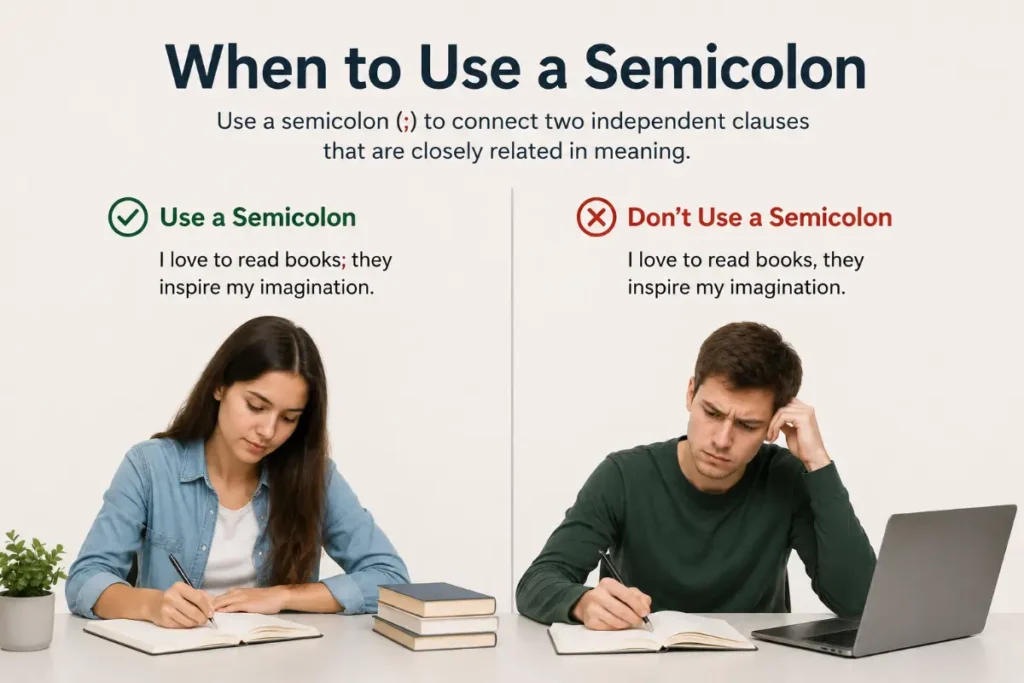
The semicolon has a reputation for being the most intimidating punctuation mark in English — writers either avoid it entirely or sprinkle it in nervously, unsure if they’re using it right. Here’s the good news: a semicolon really only does three specific jobs, and once you know all three, you’ll never have to guess again.
You may also find Punctuate Abbreviations: The 2026 Easy Guide helpful if you want to explore this topic further.
The Quick Answer
A semicolon (;) is used to:
- Join two closely related independent clauses without a conjunction
- I love this city; it never feels boring.
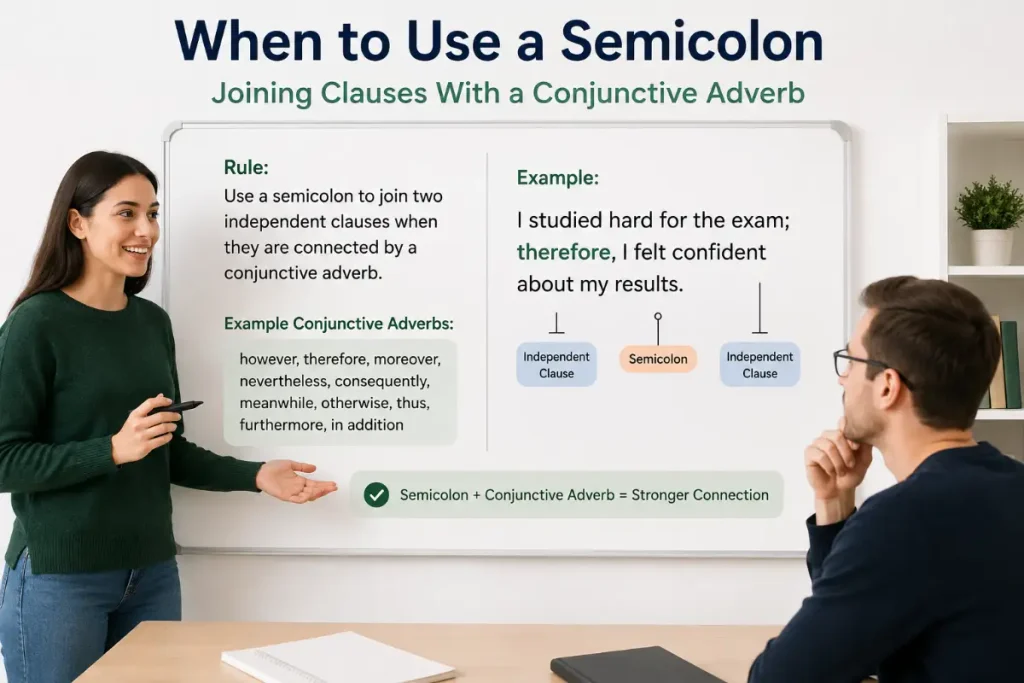
- Join two independent clauses connected by a conjunctive adverb (however, therefore, moreover, etc.)
- The meeting ran long; however, we still covered everything.
- Separate items in a complex list that already contains commas
- We visited Paris, France; Rome, Italy; and Vienna, Austria.
If you’re not doing one of these three specific things, you probably don’t need a semicolon — a comma, period, or colon is more likely what the sentence calls for.
Job 1: Joining Two Closely Related Independent Clauses
This is the semicolon’s most common job. An independent clause is a group of words that could stand alone as a complete sentence — it has a subject and a verb and expresses a full thought. When you have two independent clauses that are closely related in meaning, you can join them with a semicolon instead of a period, creating one sentence that shows the connection between the two ideas.
Examples:
- The concert was sold out; fans lined up for hours anyway.
- She studied every night; her effort paid off on exam day.
- He didn’t apologize; he simply changed the subject.
- The bridge was closed for repairs; traffic backed up for miles.
Purdue OWL puts it precisely: a semicolon works here because you’re linking “two independent clauses together” without a coordinating conjunction like “and” or “but.” The key test is that both halves of the sentence — before and after the semicolon — must be able to stand alone as their own complete sentences. If either half can’t stand alone, you don’t want a semicolon; you likely want a comma instead.
The “could this be two periods?” test: Read each half of your sentence separately. If both halves make complete, grammatically correct sentences on their own, a semicolon is a valid choice for joining them (assuming they’re closely related in meaning).
Job 2: Joining Clauses With a Conjunctive Adverb
Conjunctive adverbs — words like “however,” “therefore,” “moreover,” “consequently,” “nevertheless,” “thus,” and “meanwhile” — connect two independent clauses while showing a specific logical relationship between them (contrast, cause and effect, addition, and so on). When you use one of these words to join two independent clauses, a semicolon goes before it, and a comma goes right after.
Purdue OWL gives this exact pattern: “I am going home; moreover, I intend to stay there.” Notice the structure: independent clause, semicolon, conjunctive adverb, comma, second independent clause.
More examples:
- It rained heavily all afternoon; however, we managed to have our picnic anyway.
- They couldn’t make it to the summit before dark; therefore, they decided to camp for the night.
- The report was thorough; nevertheless, the client wanted more detail.
- Sales dropped in the first quarter; consequently, the team revised their strategy.
This is one of the most common places writers reach for a comma when they should use a semicolon — “It rained heavily, however, we managed to have our picnic” is a comma splice, a genuine error, because “however” is not a coordinating conjunction (like “and,” “but,” or “so”) that can join two independent clauses with just a comma.
Job 3: Separating Items in a Complex List
This job is less well known but genuinely useful: when a list’s individual items already contain commas, using more commas to separate the items themselves creates a confusing pile-up. Semicolons step in to clearly mark where each item ends.
Examples:
- We visited Paris, France; Rome, Italy; and Vienna, Austria.
- The panel included Dr. Sarah Chen, a cardiologist; James Torres, a nurse practitioner; and Maya Patel, a hospital administrator.
- The award went to three finalists: Aisha Bello, for her research on renewable energy; Tomas Reyes, for his work in public health; and Lin Wei, for her contributions to education policy.
Without the semicolons in these examples, the commas already inside each list item would blur together with the commas meant to separate the items, making it genuinely hard to tell where one item ends and the next begins. This is a case where semicolons aren’t optional stylistic flourish — they’re doing real, necessary clarifying work.
What a Semicolon Is Not For
Understanding what semicolons don’t do is just as useful as knowing what they do.
Not for joining an independent clause to a dependent clause. “She left early; because she felt sick” is incorrect — “because she felt sick” can’t stand alone as a sentence, so it needs a comma instead: “She left early because she felt sick,” or restructured with the dependent clause first: “Because she felt sick, she left early.”
Not as a replacement for a colon before a list. “I need three things; milk, eggs, and bread” is incorrect — introducing a list after a complete sentence typically calls for a colon, not a semicolon: “I need three things: milk, eggs, and bread.”
Not for joining a clause to a single word or short phrase. “He was exhausted; completely” doesn’t work, since “completely” isn’t an independent clause. A comma or restructuring the sentence is what’s needed here instead.
The Fastest Way to Check Yourself
Step 1: Do you have two independent clauses that are closely related? If yes, and there’s no conjunction like “and” or “but” joining them, a semicolon works.
Step 2: Are you using a word like “however,” “therefore,” or “moreover” to connect two independent clauses? If yes, semicolon before it, comma after.
Step 3: Are you listing items that already contain commas within themselves? If yes, use semicolons to separate the items clearly.
Step 4: If none of these apply, you probably want a comma, period, or colon instead.
A simple gut-check: try reading the sentence and mentally replacing the semicolon with a period. If both resulting sentences are grammatically complete on their own, the semicolon is doing its job correctly (assuming, again, that the ideas are closely related enough to justify linking them rather than fully separating them).
If comma placement in general still feels shaky beyond just semicolons, the confusion around their, there, and they’re is worth a look too — different mechanics, but the same habit of pausing to check structure rather than relying on instinct alone tends to help across the board.
Semicolon vs. Comma vs. Colon: Quick Comparison
| Semicolon | Comma | Colon | |
|---|---|---|---|
| Joins two independent clauses | Yes, without a conjunction | Only with a coordinating conjunction (and, but, so) | Yes, when the second clause explains or emphasizes the first |
| Before a list | Only if list items contain commas | No | Yes, standard use |
| With conjunctive adverbs (however, therefore) | Yes — semicolon before, comma after | No — creates a comma splice | No |
| Example | I’m tired; I’ll rest soon. | I’m tired, so I’ll rest soon. | I need rest: I’m exhausted. |
When to Use a Semicolon: 9 Easy Rules & Examples
Knowing When to Use a Semicolon can make your writing smoother and easier to read. A semicolon is stronger than a comma but not as final as a period. In most cases, it connects closely related ideas, separates complicated items in a list, or helps organize sentences that already contain commas.
1. Connect Two Closely Related Independent Clauses
Use a semicolon to join two complete sentences when their ideas are closely connected.
Example:
The weather was getting worse; we decided to head home.
Both sides could stand alone as complete sentences, but the semicolon shows their relationship.
2. Use a Semicolon Before “However”
When however connects two independent clauses, place a semicolon before it and a comma after it.
Example:
I wanted to go for a walk; however, it started raining.
A common mistake is using only a comma between the two complete thoughts.
3. Use a Semicolon Before “Therefore”
The same pattern applies to transitional words such as therefore, moreover, nevertheless, consequently, and instead.
Example:
She studied all night; therefore, she felt confident about the test.
The semicolon separates the two independent clauses, while the comma after therefore sets off the transition.
For another useful perspective, check out Comma Before And Rule: 5 Easy Rules You Need to Know (2026).
4. Separate Items in a Complicated List
Semicolons can make a list easier to understand when individual items already contain commas.
Example:
The conference welcomed guests from Austin, Texas; Portland, Oregon; Miami, Florida; and Denver, Colorado.
Using commas alone would make the boundaries between the locations less clear.
5. Connect Two Sentences Without a Conjunction
If two complete thoughts are closely related, a semicolon can connect them without using words such as and, but, or so.
Example:
The store was closing soon; we hurried to the checkout.
This creates a clear connection without needing an additional conjunction.
6. Show Cause and Effect Between Closely Related Ideas
A semicolon can connect two independent clauses when the second idea naturally explains the result of the first.
Example:
The roads were covered in ice; several schools closed for the day.
The second clause is closely connected to the first, so the semicolon works naturally.
7. Separate Long or Detailed List Items
Even when individual list items don’t contain commas, semicolons can improve readability when the items are long or contain their own internal details.
Example:
Our trip included hiking through the national park and taking photographs of the wildlife; visiting the historic downtown district and trying local food; and spending an afternoon at the beach.
The semicolons clearly separate the major parts of the list.
8. Don’t Use a Semicolon to Join a Fragment
A semicolon normally requires a complete independent clause on both sides. If one side is only a phrase or dependent clause, use a different punctuation mark.
Incorrect:
Because I was tired; I went to bed early.
Correct:
Because I was tired, I went to bed early.
Here, Because I was tired cannot stand alone as a complete sentence, so a semicolon doesn’t belong there.
9. Don’t Replace Every Comma With a Semicolon
A semicolon isn’t simply a stronger version of a comma. Use it when there is a grammatical reason to separate closely related complete thoughts or complicated list items.
Incorrect:
My favorite colors are blue; green; and purple.
Correct:
My favorite colors are blue, green, and purple.
For a simple list, commas are the appropriate choice.
Quick Trick to Remember
When you’re unsure When to Use a Semicolon, ask yourself: Can both sides of the semicolon stand alone as complete sentences? If yes, and the ideas are closely related, a semicolon may be a good choice. If you’re separating complicated list items, a semicolon may also improve clarity.
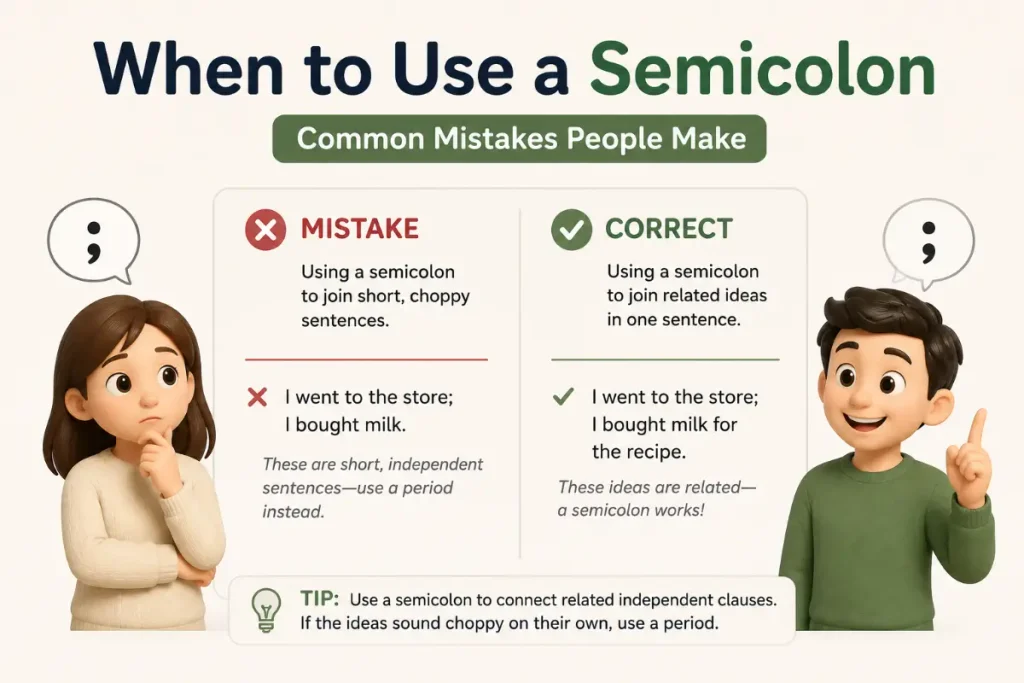
Common Mistakes People Make
Mistake 1: “I love hiking; and I go every weekend.” The semicolon and “and” shouldn’t be used together — pick one. Either “I love hiking, and I go every weekend” (comma plus conjunction) or “I love hiking; I go every weekend” (semicolon alone) is correct, but combining both is redundant.
Mistake 2: “She finished her degree; despite working full-time.” Should use a comma, not a semicolon — “despite working full-time” is a dependent phrase, not an independent clause, so it can’t be joined with a semicolon: “She finished her degree, despite working full-time.”
Mistake 3: “The store closed early, however, we still made it in time.” This is a comma splice — “however” needs a semicolon before it when joining two independent clauses: “The store closed early; however, we still made it in time.”
Mistake 4: “Here’s what we need; flour, sugar, and butter.” Should use a colon, not a semicolon, since this is introducing a simple list after a complete clause: “Here’s what we need: flour, sugar, and butter.”
Mistake 5: Overusing semicolons to sound more sophisticated. Semicolons work best when the two joined ideas are genuinely closely related and roughly balanced in importance. Stringing together loosely connected clauses with semicolons just to seem formal or literary usually makes writing harder to follow, not more polished.
What the Style Guides Say
Purdue OWL, one of the most widely used grammar references in U.S. education, teaches all three core semicolon jobs covered in this guide, and specifically emphasizes the “could this stand alone as two sentences” test as the clearest way to check whether a semicolon is being used correctly. The AP Stylebook and Chicago Manual of Style both follow the same fundamental rules, though Chicago tends to embrace semicolons more readily in longer, more literary or academic sentence structures, while AP style (built for fast-reading news copy) generally favors shorter sentences and uses semicolons more sparingly.
Because semicolon rules are genuinely consistent across every major English-language style authority — unlike some of the more debated usage points covered elsewhere on this site — this is one punctuation mark where getting the mechanics right is entirely a matter of learning the pattern, not navigating competing guidance.
More Examples to Lock It In
- The negotiations stalled for weeks; both sides refused to compromise.
- He trained for months; his dedication showed on race day.
- The proposal was strong; nevertheless, the board wanted more data before approving it.
- Our itinerary includes Tokyo, Japan; Seoul, South Korea; and Taipei, Taiwan.
- The report was late; consequently, the launch date had to be pushed back.
- She didn’t say a word; her silence spoke volumes.
Frequently Asked Questions
Can a semicolon ever be followed by a lowercase letter?
Yes — unlike a period, a semicolon does not start a new sentence, so the word immediately following it is not capitalized (unless it’s a proper noun). “I’m exhausted; tomorrow will be better,” not “I’m exhausted; Tomorrow will be better.”
Is it ever acceptable to start a sentence with a semicolon?
No — a semicolon always joins two clauses within a single sentence; it never begins a sentence, since there would be nothing before it to connect to.
What’s the difference between using a semicolon and just starting a new sentence with a period?
Grammatically, both are usually correct if the two clauses are independent — the choice comes down to style and emphasis. A semicolon signals that the two ideas are closely, deliberately connected, while a period treats them as fully separate thoughts. Neither is inherently more “correct”; it’s a matter of how tightly you want to link the ideas.
Do semicolons work the same way in British and American English?
Yes — the core rules for semicolon usage are consistent across English dialects, though stylistic preferences for how often to use them (versus periods or commas) can vary somewhat by publication, genre, and individual writing style.
What’s the fastest way to catch a semicolon error before publishing something?
For every semicolon in your document, check whether both sides could stand alone as complete sentences. If either side can’t, the semicolon needs to become a comma, or the sentence needs restructuring. This single check catches the vast majority of semicolon misuse.
Practice Exercise
Decide whether each sentence needs a semicolon, comma, or colon in the blank. Answers are listed right after — try each one before checking.
- The flight was delayed for hours___ passengers grew increasingly frustrated.
- She wanted to travel more___ but her budget wouldn’t allow it.
- We need the following supplies___ paper, pens, and folders.
- The team worked overtime___ however, they still missed the deadline.
- He loves cooking___ he makes dinner from scratch every night.
- Our trip included stops in Lyon, France___ Turin, Italy___ and Bern, Switzerland.
- The presentation went smoothly___ nevertheless, a few questions remained unanswered.
- I wanted to leave early___ because traffic was getting worse.
- She finished the marathon___ her training clearly paid off.
- The company announced layoffs___ consequently, morale dropped sharply.
- Here’s what I found___ the results were surprising.
- He apologized sincerely___ she forgave him immediately.
- The museum closes at five___ so we should leave by four.
- We interviewed three candidates___ Maria Lopez, a software engineer___ David Kim, a project manager___ and Priya Nair, a designer.
- The weather improved___ moreover, the roads finally cleared.
Answer Key
- semicolon
- comma
- colon
- semicolon
- semicolon
- semicolon (x2 — complex list with internal commas)
- semicolon
- comma
- semicolon
- semicolon
- colon
- semicolon
- comma
- semicolon (x2 — complex list with internal commas)
- semicolon
If you got twelve or more correct, the three-job framework has already become second nature. For any you missed, go back and check: are both sides independent clauses (semicolon or comma-plus-conjunction), or is a list or explanation being introduced (colon)?
Before moving on, you may also want to read When to Use a Dash Instead of a Comma (2026 Guide) for more helpful grammar tips.
The Bottom Line
A semicolon has exactly three jobs: joining two closely related independent clauses, joining clauses with a conjunctive adverb like “however” or “therefore,” and separating items in a list that already contains commas. If your sentence isn’t doing one of these three things, you probably want a comma, period, or colon instead — and that single distinction resolves nearly every semicolon question you’ll ever run into.