Three words, one sound, and endless confusion. “Their vs There vs They’re” can trip up almost anyone. These words sound almost exactly the same, which is exactly why they’re some of the most commonly confused words in English—even for people who’ve spoken English their whole lives.
The good news: once you understand what each word actually does, the confusion mostly disappears. None of these are hard concepts. They just look similar enough on the page that your brain autocompletes the wrong one if you’re typing fast.
You may also find Bring vs Take: The Perspective Trick That Makes This Simple helpful if you want to explore this topic further.
The Quick Answer
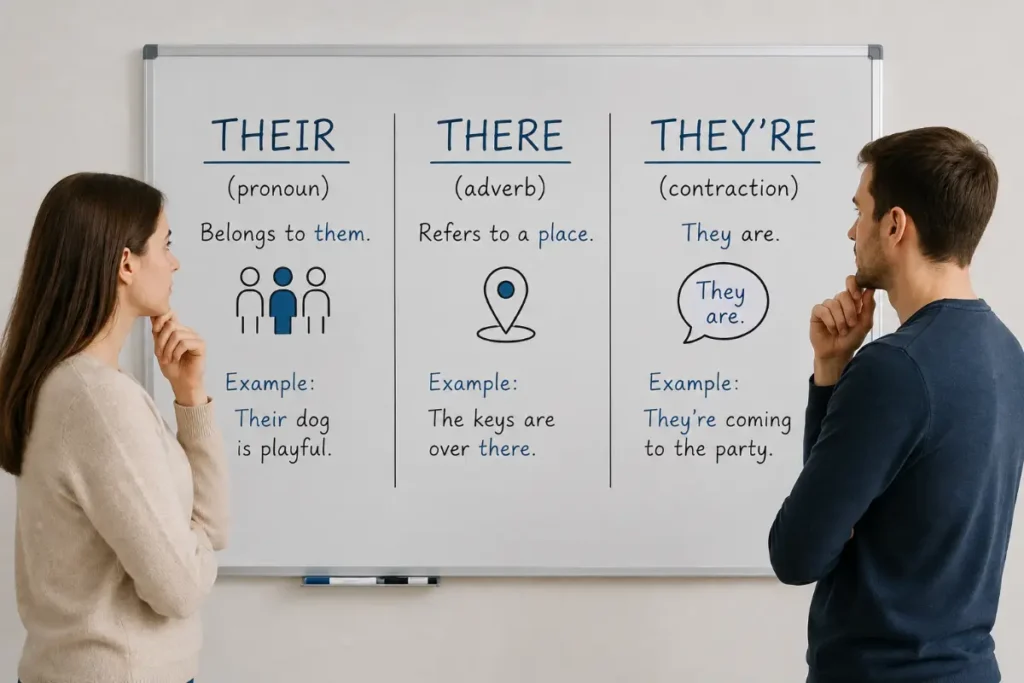
- Their = belongs to them (possession)
- That’s their house.
- There = a place, or used to introduce a sentence
- The keys are over there. / There are three options.
- They’re = contraction of “they are”
- They’re coming over tonight.
If you can replace the word with “they are” and the sentence still makes sense, use they’re. If you’re talking about ownership, use their. Everything else — location, or starting a sentence to say something exists — is there.
Their: Ownership and Possession
“Their” is a possessive pronoun, which means its whole job is to show that something belongs to a group of people (or occasionally, in modern usage, to a single person whose gender isn’t specified).
Examples:
- The neighbors left their porch light on all night.
- Every student brought their own laptop.
- The company updated their return policy last month.
- I couldn’t find their address anywhere.
That third example is worth pausing on. Traditionally, some style guides preferred “its” for companies since a company is technically singular. In practice, “their” is now widely accepted for organizations, especially in American business writing, because it sounds more natural when you’re talking about a group of people making decisions together.
Also notice the fourth example in that list — you’ll never see an apostrophe in “their.” A lot of the confusion with “there’s” versus “theirs” comes from assuming possession always needs an apostrophe (like “dog’s leash”). Pronouns don’t work that way. “His,” “hers,” “its,” “theirs,” and “their” are all possessive without an apostrophe, unlike possessive nouns.
There: Location and Existence
“There” does two separate jobs, and it helps to think of them as two different tools in the same toolbox.
Job 1: Pointing to a place.
- Put the box over there.
- We’re going there next summer.
- I left my phone there yesterday.
In this use, “there” is almost always answering the question “where?” If you can point at something while saying the word, it’s this kind of “there.”
Job 2: Introducing that something exists.
- There are five people in line.
- There’s a problem with the order.
- There used to be a bakery on this corner.
In this use, “there” isn’t pointing anywhere — it’s just setting up the rest of the sentence to say that something exists or is happening. This is sometimes called an “existential there,” and it’s one of the most common sentence openers in English. Almost every “there is / there are” sentence you’ll ever write falls into this category.
A simple memory trick: “there” contains the word “here,” and both words deal with location — “here,” “there,” “where.” If you remember that “here” is buried inside “there,” you’ll never confuse it with the possessive or the contraction.
They’re: The Contraction of “They Are”
This one’s the easiest to check, because you can always expand it back out.
- They’re going to be late. → They are going to be late.
- They’re not sure what happened. → They are not sure what happened.
- I heard they’re moving next month. → I heard they are moving next month.
If expanding it to “they are” sounds wrong or awkward, you don’t need “they’re” — you need one of the other two words instead.
Try it on a sentence people often get wrong: “Their going to love this.” Expand it: “They are going to love this.” That works fine, so the correct word is actually “They’re going to love this,” not “Their.”
Their vs. There vs. They’re: Side-by-Side Comparison
| Word | Type | Meaning | Test |
|---|---|---|---|
| Their | Possessive pronoun | Belongs to them | Can you say “belongs to them”? |
| There | Adverb / sentence starter | A place, or introduces existence | Can you point to it, or say “here” instead? |
| They’re | Contraction | They are | Can you expand it to “they are”? |

The Fastest Way to Check Yourself
Here’s a three-step mental checklist you can run in about two seconds, before you type the word or right after:
- Can you replace it with “they are”? If yes, it’s “they’re.” Done.
- If not, are you talking about something belonging to a group of people? If yes, it’s “their.”
- If neither of those fit, it’s “there.” This covers locations (“over there”) and sentence openers (“there is,” “there are,” “there used to be”).
Notice that step 3 is really a default — if it’s not possession and it’s not a contraction of “they are,” it’s almost certainly “there.” That makes “there” the safest guess when you’re unsure, since it covers the widest range of uses.
Why These Three Words Are So Easy to Mix Up
Linguists call words like this “homophones” — words that sound identical (or nearly identical) but are spelled differently and mean different things. English has a lot of them, but this particular trio causes more errors than almost any other homophone group, for a few reasons.
First, all three words are extremely common. You’ll use one of them in nearly every paragraph you write, which means there are simply more chances to get it wrong compared to a rarer word pair.
Second, autocorrect and predictive typing on phones sometimes “fix” the correct word into the wrong one, especially if you type fast and don’t proofread. A lot of “their/there/they’re” errors in texts and social media posts aren’t actually grammar mistakes — they’re typing errors that spell-check didn’t catch, because all three are real, correctly spelled words. Spell-check only flags words that don’t exist; it has no idea whether you meant the right one.
Third, this is one of the first grammar rules taught in elementary school, which paradoxically makes some adults skip past it mentally — assuming they’ve “already got this,” which is exactly when a slip is most likely to happen.
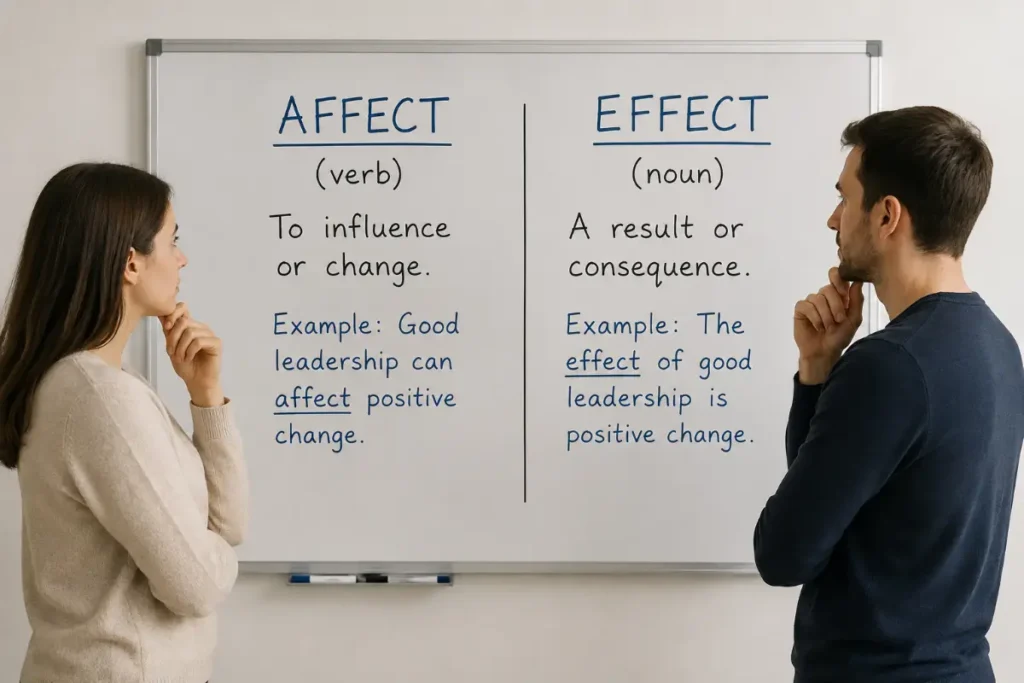
It’s a close cousin of the confusion around affect and effect — different words, same root cause: two options that sound close enough that your fingers move faster than your grammar instincts do.
Common Mistakes People Make
Mistake 1: “Their going to the store.” Should be “They’re going to the store” — this is a contraction of “they are,” not possession.
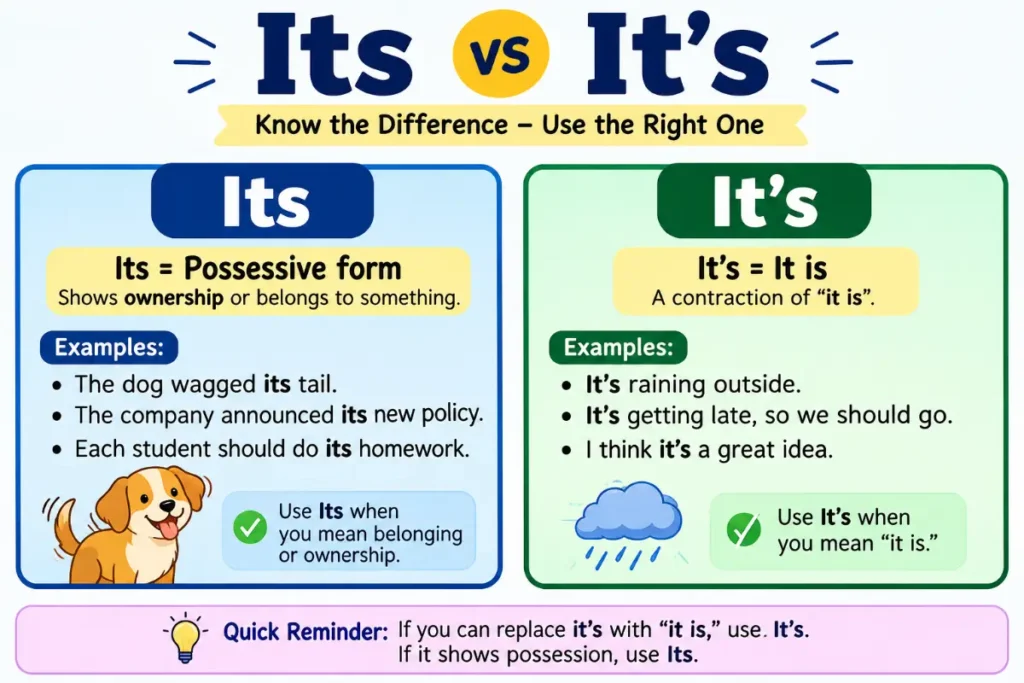
Mistake 2: “The dog wagged it’s tail over there, near they’re house.” This sentence actually has two homophone errors bundled together — “it’s” should be “its” (a separate but related mix-up), and “they’re” should be “their,” since it’s describing whose house it is.
For another useful perspective, check out Discreet vs Discrete: 7 Easy Tricks to Never Mix Them Up (2026).
Mistake 3: “I don’t know if there coming tonight.” Should be “they’re coming tonight” — test it by expanding to “they are coming tonight,” which works.
Mistake 4: “Everyone should bring there own lunch.” Should be “their own lunch” — this is possession, showing that the lunch belongs to each person.
Mistake 5: Confusing “there’s” with “theirs.” “There’s” is a contraction of “there is” (“There’s a package on the porch”). “Theirs” is a possessive pronoun meaning “belongs to them,” used without a noun right after it (“That car is theirs”). These two are spelled and used completely differently, but they sound close enough in fast speech that people sometimes blend them in writing.
Their, There, and They’re Across Different Writing Contexts
The rule itself never changes, but how much it matters shifts depending on where you’re writing.
In texting and social media, these mix-ups are so common that most readers barely register them anymore — autocorrect and speed-typing get the blame more often than the writer. Still, using the correct word consistently tends to make casual writing read as more careful, even when nobody consciously notices why.
In academic and professional writing, this error stands out more than almost any other homophone mistake, mostly because it’s taught so early that adults are expected to have it locked down. A cover letter that reads “Please find attached there resume” instead of “their resume” can undercut an otherwise strong application, simply because it signals the document wasn’t proofread closely.
In business communication — emails, reports, client-facing documents — the stakes are similar. “The client updated they’re contact information” instead of “their contact information” is a small error, but it’s the kind of small error that chips away at a reader’s trust in the rest of the message, especially in formal or first-contact communication.
In published content and journalism, headlines and subheadings leave zero room for a mid-sentence correction. “Their Plan Finally Worked” and “There Plan Finally Worked” mean two very different things (one makes sense, one doesn’t), so getting this right at the headline level matters more than almost anywhere else in writing.
The underlying test — expand to “they are,” check for possession, default to “there” for everything else — works identically no matter the context. What changes is simply how visible the mistake becomes, and in more formal or public writing, it becomes very visible very fast.
What the Style Guides Say
Merriam-Webster classifies “their” as a possessive pronoun, “there” as an adverb (with a secondary function as a pronoun in existential sentences like “there is”), and “they’re” as the standard contraction of “they are.” The AP Stylebook and Chicago Manual of Style both treat this distinction as fixed and non-negotiable — there’s no stylistic variation between American and British usage here, and no publication treats these as interchangeable in formal writing.
Purdue University’s Online Writing Lab (OWL), one of the most widely cited grammar resources for U.S. students and educators, singles out their/there/they’re as one of the most common error patterns in student writing, right alongside its/it’s — which tracks with how frequently both pairs show up in real editing work.

Real-World Examples From Everyday Writing
Seeing all three words together in natural sentences tends to make the pattern click faster than seeing them in isolation:
- They’re bringing their kids over to play there this weekend.
- I think there’s a chance their flight gets delayed, and they’re already stressed about it.
- Put the boxes over there — they’re heavier than they look, so watch their edges.
- There are three restaurants on their list, and they’re deciding between them tonight.
In each of these, notice how the sentence would fall apart if you swapped any two of the words. That’s the real test of whether you’ve internalized the rule — not just memorizing definitions, but being able to hear when a substitution sounds wrong.
More Examples to Lock It In
A longer batch, mixing all three words the way they’d naturally show up in everyday writing:
- They’re planning to repaint their kitchen this weekend, and there’s still paint left over from last time.
- The players left their gear over there after the game.
- There are two seats left, and they’re both in the back row.
- I heard their flight got delayed, so they’re staying at a hotel near there.
- Their dog ran off, but they’re pretty sure it went over there, near the park.
- There used to be a diner on that corner before they’re — wait, before they moved it.
- Their proposal was solid, but there were still questions about whether they’re ready to launch.
- The kids left their backpacks there by mistake.
- There’s a chance they’re wrong about the schedule, but it’s their call either way.
- Their teacher said there would be a quiz, and they’re studying for it tonight.
Notice how naturally all three can appear in the same sentence once you’re not second-guessing each one individually. That’s the real goal here — not memorizing rules forever, but reaching a point where the wrong word just sounds off before you even finish typing it.
Practice Exercise
Fill in the blank with “their,” “there,” or “they’re.” Answers are listed right after — try to answer each one before checking.
- ______ bringing dessert to the party tonight.
- I left my umbrella over ______ by the door.
- The students turned in ______ assignments early.
- ______ are three more emails waiting in the inbox.
- I’m not sure if ______ coming to the meeting.
- The company updated ______ privacy policy last week.
- Put the chairs over ______ before the guests arrive.
- ______ still deciding between the two apartments.
- The neighbors keep ______ trash cans by the side gate.
- ______ used to be a bookstore right on this street.
- ______ moving to a new city next month.
- The kids left ______ shoes by the front door.
- Can you check if ______ any seats left?
- I heard ______ getting married in the spring.
- The company moved ______ headquarters last year.
- ______ a good chance we’ll finish early.
- Leave the packages over ______ for now.
- ______ not sure whose turn it is to host.
- The dog buried ______ favorite bone in the yard.
- ______ going to love this restaurant.
Answer Key
- They’re
- there
- their
- There
- they’re
- their
- there
- They’re
- their
- There
- They’re
- their
- there
- they’re
- their
- There’s
- there
- They’re
- its
- They’re
Wait — number 19 is a deliberate exception: the correct word there is actually “its,” not “their,” since the bone belongs to the dog (a single animal, not a group of people). It’s included on purpose as a reminder that possessive pronouns come in more than one flavor, and pausing to ask “who or what does this belong to?” matters more than pattern-matching to the nearest familiar word. If you got sixteen or more of the other nineteen right, the expansion test has already become automatic.
Frequently Asked Questions
Is it “there’s” or “theirs” when talking about something belonging to a group?
“Theirs” — no apostrophe, and it stands alone without a noun after it. “That table is theirs” is correct. “That’s theirs’ table” is not; “theirs” never takes an apostrophe.
Why doesn’t “their” have an apostrophe like other possessives?
Because it’s a possessive pronoun, not a possessive noun. Regular nouns show possession with an apostrophe plus S (“Sarah’s car”), but pronouns like his, hers, its, ours, yours, and theirs already build possession into the word itself, so no apostrophe is needed or correct.
Is “there” always about location?
No — “there” also introduces existence, as in “there is,” “there are,” and “there was.” In those cases, it’s not pointing to a physical place; it’s simply setting up the rest of the sentence.
What’s the fastest way to catch this error before I publish or send something?
Search your document for “their,” “there,” and “they’re” one at a time (most word processors let you search for exact words) and run the three-step test on each instance. It takes a minute or two but catches nearly every mistake, since this is one of the few grammar errors that’s genuinely easy to isolate and check systematically.
Does autocorrect fix this automatically?
Not reliably. Because all three words are spelled correctly on their own, most spell-checkers won’t flag a wrong-but-valid word. Some advanced grammar tools do catch it based on context, but a manual check is still the most reliable method.
Is one of these three words more commonly misused than the others?
“Their” and “they’re” get confused with each other more often than either gets confused with “there,” probably because they’re both tied to the same subject (a group of people) while “there” usually shifts the sentence toward a location or an introductory statement instead. That said, all three show up in typos often enough that it’s worth checking any sentence where more than one of them appears close together.
Do native English speakers actually struggle with this, or is it mostly a learner issue?
Native speakers make this mistake constantly, usually from typing quickly rather than from not understanding the rule. It’s less a knowledge gap and more a speed-versus-accuracy tradeoff — which is exactly why a quick proofreading pass catches nearly all of these errors before they matter.
Before moving on, you may also want to read Adverse vs Averse: 5 Common Mistakes to Avoid (2026 Guide) for more helpful grammar tips.
The Bottom Line
Their shows ownership. There points to a place or opens a sentence about something existing. They’re is simply “they are” squeezed into one word. The fastest way to check yourself is the “they are” expansion test — if it doesn’t fit, decide between possession (their) and everything else (there).
These three words show up constantly, which means small habits pay off fast. Once the three-step check becomes automatic, you’ll catch these errors before they ever make it into a sentence.