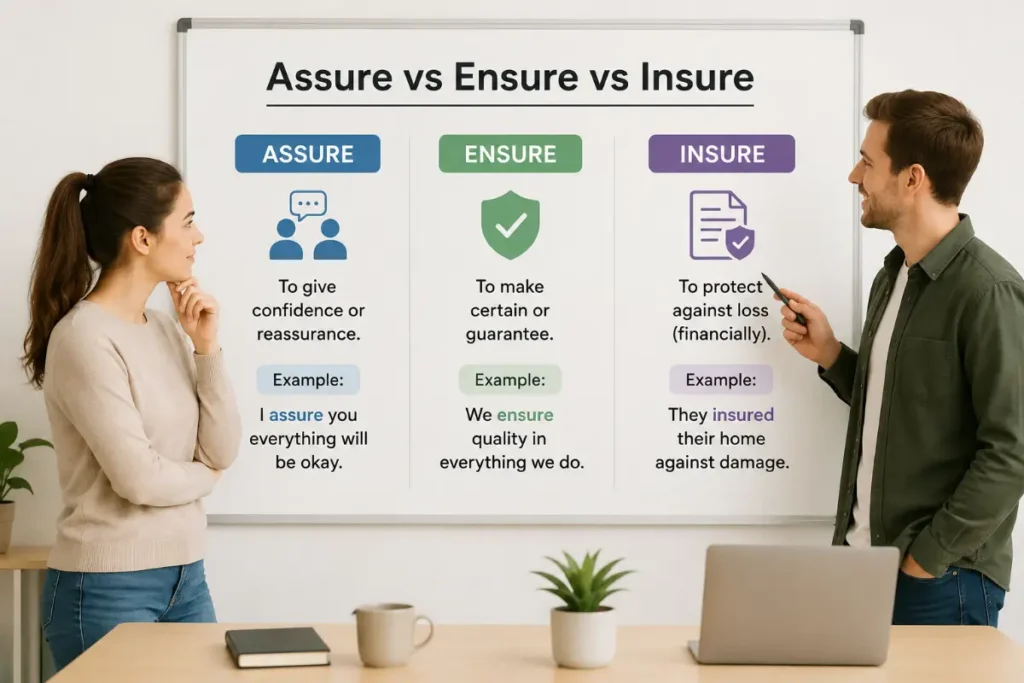
These three words all trace back to the same Latin root, relate to the idea of “making something certain,” and are often mixed up—even in professional writing. Assure vs Ensure vs Insure becomes much easier once you understand the distinct job each word performs in modern English.
Assure means to remove someone’s doubt or reassure them. Ensure means to make certain that something happens. Insure means to provide or obtain financial insurance coverage. Same root, three separate lanes.
You may also find Principal vs Principle: The “Pal” Trick That Actually Works (2026) helpful if you want to explore this topic further.
The Quick Answer
- Assure = to reassure a person, removing doubt from their mind
- I assure you, everything will be fine.
- Ensure = to make certain something happens or is true
- Please ensure the door is locked before you leave.
- Insure = to provide or obtain insurance coverage
- We insured the car for its full value.
The test: are you talking to a person, calming their worries? Use assure. Are you making an outcome certain? Use ensure. Are you talking about an insurance policy? Use insure.
Try it: “Let me ___ you that we’ve handled this before.” This is reassuring a person — so it’s assure: “Let me assure you that we’ve handled this before.”
Now try: “Double-check the settings to ___ everything saves correctly.” This is making an outcome certain — so it’s ensure: “Double-check the settings to ensure everything saves correctly.”
Why This Trio Is Genuinely More Tangled Than Most Pairs
Merriam-Webster is refreshingly candid about this one, noting there is “considerable confusion about whether ensure and insure are distinct words, variants of the same word, or some combination of the two.” They genuinely do have overlapping history — ensure and insure were historically just alternate spellings of the same word for centuries, before English speakers gradually assigned them separate, specialized jobs. Assure has always stood a bit more distinctly apart, since it specifically carries the sense of addressing someone’s doubt or worry, a meaning ensure and insure don’t share.
This means the confusion here isn’t just about people misremembering a rule — the words themselves have a genuinely tangled shared history, which is part of why even careful writers and editors sometimes disagree at the margins about which one fits best in a borderline sentence.

Assure: Removing Doubt From a Person’s Mind
Assure is the one word in this trio that specifically involves reassuring a person — it always, or nearly always, takes a person as its object.
Examples:
- I assure you, the results were accurate.
- She assured her team that layoffs weren’t planned.
- He tried to assure his parents that he’d be careful.
- The doctor assured the patient the procedure was routine.
- Rest assured, we’ve double-checked everything.
Notice that in every case, there’s a specific person (or people) on the receiving end whose doubt or worry is being addressed. That’s the defining feature of assure — it’s fundamentally about emotional reassurance, not just making a fact true.
Ensure: Making Something Certain
Ensure is the general-purpose “make certain” word, used for outcomes, processes, and results rather than people’s feelings.
Examples:
- Please ensure your seatbelt is fastened.
- The new policy is designed to ensure fairness.
- We double-checked the numbers to ensure accuracy.
- Proper maintenance helps ensure the equipment lasts longer.
- The manager’s job is to ensure the project stays on schedule.
Notice the pattern: ensure is almost always followed by a condition, outcome, or fact being confirmed — not a person being comforted. If you can’t identify a specific outcome being guaranteed, ensure probably isn’t the word you need.
Insure: Financial Insurance Coverage
Insure carries the most specific, narrow meaning of the three in modern usage: providing or obtaining an actual insurance policy.
Examples:
- We insured the house against fire and flood damage.
- The company insures its fleet of delivery trucks.
- She insured her jewelry collection for $50,000.
- You need to insure a rental car before driving it off the lot.
- The policy insures against theft and accidental damage.
Merriam-Webster notes that many usage guides specifically recommend restricting “insure” to this financial, contractual sense — even though older and more general uses of insure (closer to ensure’s meaning) do still technically exist in the dictionary. In modern American usage, sticking to insure only for actual insurance-related contexts is the safest, clearest choice.
The Fastest Way to Check Yourself
Step 1: Is a specific person’s doubt or worry being addressed? If yes, it’s assure.
Step 2: Is an outcome, fact, or process being made certain? If yes, it’s ensure.
Step 3: Is this about an actual insurance policy — cars, homes, health, valuables? If yes, it’s insure.
A widely used memory trick: assure relates to reassurance, and both start with “as-” — think of assuring someone as putting their mind at “as-ease.” Ensure contains “en-,” similar to “enable” or “ensure” itself sounding like “make sure” — it’s about enabling a certain outcome. Insure is the one to associate specifically with “insurance” — if you wouldn’t naturally use the word “insurance” nearby, you probably don’t want “insure.”
This three-way split is rarer than most pairs on this site — for a similar shared-root situation involving just two words, see compliment and complement, which splits along comparably specific, non-overlapping lines.
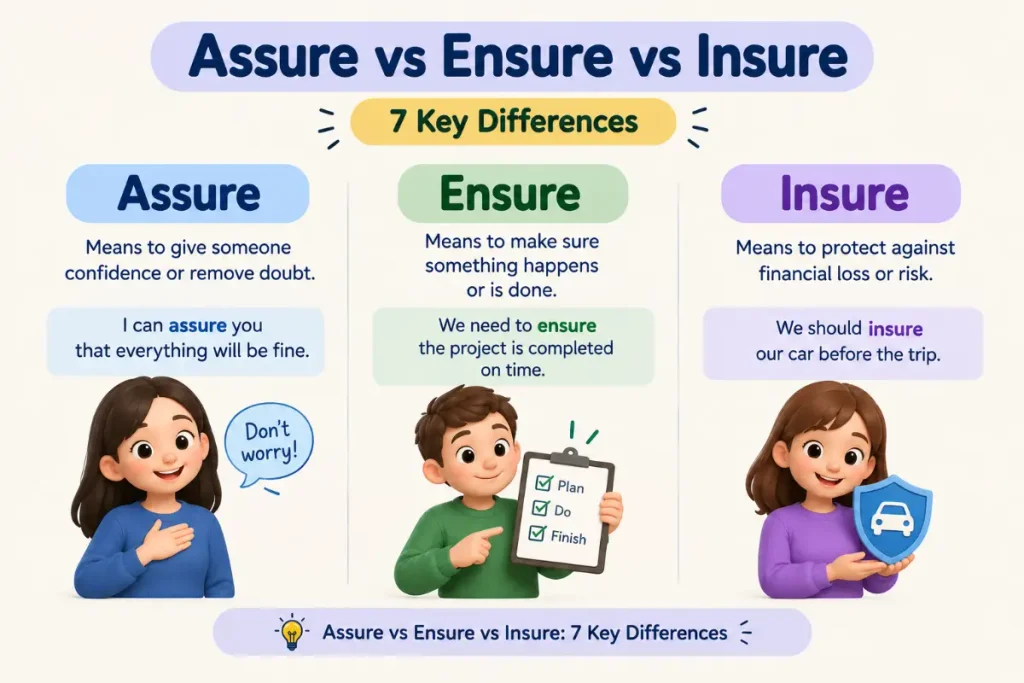
Assure vs Ensure vs Insure: 7 Key Differences
Assure vs Ensure vs Insure can be confusing because all three words relate to making something certain or secure. The easiest way to tell them apart is to focus on what each word acts on: people, outcomes, or financial risks.
1. Basic Meaning
- Assure means to tell someone something confidently or give them reassurance.
- Ensure means to make certain that something happens.
- Insure means to protect against financial loss through an insurance policy.
2. What It Usually Refers To
- Assure → a person
- Ensure → an action, result, or situation
- Insure → property, people, businesses, or financial risks
3. Simple Example
- Assure: I assured her that everything was fine.
- Ensure: Please ensure the door is locked.
- Insure: They insured their home against damage.
4. Common Context
- Assure is common in conversations and personal communication.
- Ensure is common in instructions, professional writing, and formal communication.
- Insure is mainly used when discussing insurance and financial protection.
5. The Main Question
Ask yourself:
- Assure: Am I reassuring someone?
- Ensure: Am I making something certain?
- Insure: Am I protecting against financial loss?
6. Common Mistake
A frequent mistake is using insure when ensure is intended. For example, “Insure everyone follows the rules” is incorrect in standard usage. The correct sentence is “Ensure everyone follows the rules.”
7. Easy Memory Trick
Remember A-E-I:
- A = Assure a person
- E = Ensure an outcome
- I = Insure against financial risk
Once you remember this simple pattern, choosing among these three words becomes much easier.
Assure vs. Ensure vs. Insure: Side-by-Side Comparison
| Assure | Ensure | Insure | |
|---|---|---|---|
| Core meaning | Remove doubt from a person | Make an outcome certain | Provide/obtain insurance |
| Typical object | A person | A fact, outcome, or condition | A valuable asset (car, home, life) |
| Example | I assure you it’s fine. | Ensure the report is accurate. | Insure the property. |
| Financial context? | No | No | Yes, specifically |
| Emotional component? | Yes — reassurance | No | No |
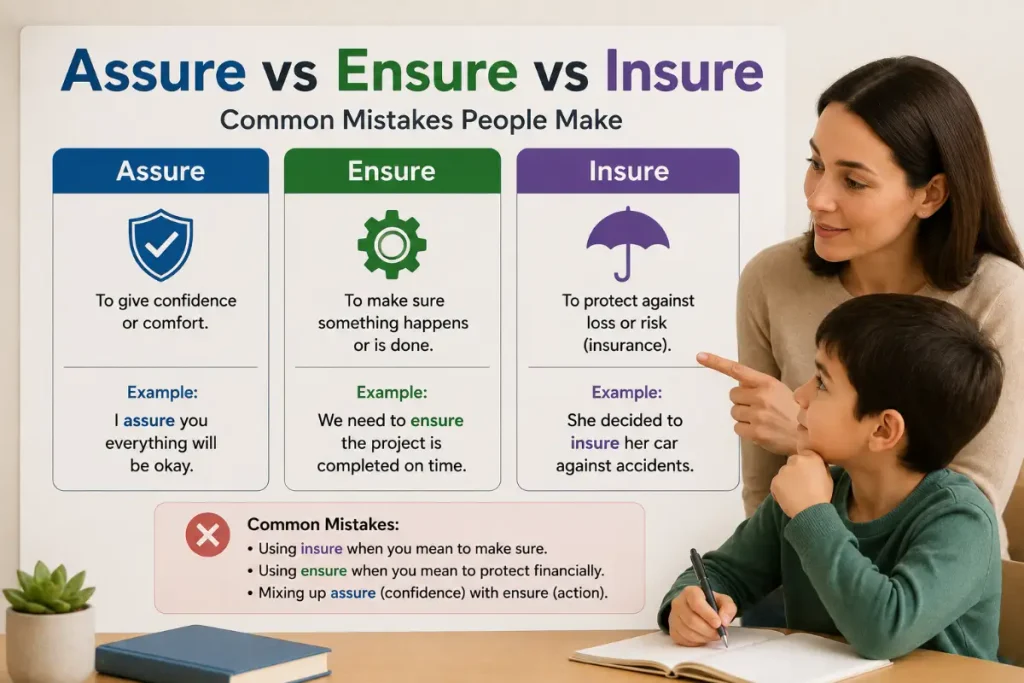
Common Mistakes People Make
Mistake 1: “Please insure the report is submitted on time.” Should be “ensure the report is submitted” — this is about making an outcome certain, not obtaining insurance coverage.
Mistake 2: “I want to ensure you that everything is fine.” Should be “assure you” — this is about reassuring a specific person’s worry, which is squarely assure’s territory.
Mistake 3: “We need to ensure the car before driving it.” Should be “insure the car” — this is specifically about obtaining an insurance policy.
For another useful perspective, check out Imply vs Infer: 7 Key Differences You Need to Know (2026).
Mistake 4: “The manager assured the team’s success by tracking every metric.” Should be “ensured the team’s success” — this is about guaranteeing an outcome through action, not reassuring anyone’s feelings, so it needs ensure.
Mistake 5: Assuming ensure and insure are always interchangeable. While Merriam-Webster notes they were historically alternate spellings and still overlap in some general dictionary definitions, modern careful writing treats them as distinct — insure specifically for insurance contexts, ensure for the broader “make certain” sense. Treating them as fully interchangeable in formal or professional writing risks looking imprecise.
More Examples to Lock It In
- I assure you the contractor is licensed, and we’ve ensured every permit is in place, but you’ll still want to insure the property before construction begins.
- She assured her clients that the firm would ensure timely delivery, and recommended they insure the shipment for its full value.
- To ensure your safety, please assure the instructor you’ve read the waiver, and confirm your equipment is insured for the activity.
- The company assures customers of quality control, works hard to ensure consistent results, and insures every product against manufacturing defects.
Frequently Asked Questions
Are ensure and insure ever truly interchangeable?
Historically, yes — they were originally variant spellings of the same word, and some general dictionary definitions still show overlap. In modern careful usage, though, most style guides recommend keeping them separate: insure specifically for insurance policies, ensure for the broader sense of making something certain. Following that distinction is the safer choice in professional and formal writing.
Can “assure” ever be used without a person as the object?
It’s rare and generally not recommended in modern usage — assure is specifically built around reassuring someone, so it almost always needs a person (or a group of people) as its object. If there’s no person being reassured, ensure is very likely the word you actually need.
Why do all three words look so similar if they mean different things?
They share the same ultimate Latin root relating to making something “sure,” but developed along different paths into English, with ensure and insure sharing an especially tangled history as interchangeable spellings for centuries before splitting into their modern, more specialized senses.
Is there a noun form for any of these three words?
“Assurance” and “insurance” are both standard nouns (as in “life assurance” — more common in British English — and “life insurance,” the more common American term). “Ensure” notably has no standard modern noun form; an older word, “ensurance,” is now considered obsolete.
What’s the fastest way to catch this error before publishing something?
Search your document for each of the three words, and for each instance, ask: is a person’s doubt being addressed (assure), is an outcome being made certain (ensure), or is this about an actual insurance policy (insure)? Since all three are correctly spelled real words, spell-check won’t catch a wrong-but-valid choice, so this manual check is the most reliable method.
Practice Exercise
Fill in the blank with “assure,” “ensure,” or “insure.” Answers are listed right after — try each one before checking.
- Let me ______ you that everything is under control.
- Please ______ the windows are locked before we leave.
- We need to ______ the car before the road trip.
- The teacher ______d the students that the test would be fair.
- Double-check the file to ______ nothing was lost.
- She wants to ______ her engagement ring against theft.
- I can ______ you, the team is fully prepared.
- The company works hard to ______ customer satisfaction.
- They decided to ______ the shipment for its full value.
- He ______d his boss the project would be finished on time.
- Follow the checklist to ______ accuracy.
- You should ______ your home against natural disasters.
- The nurse ______d the family that recovery was likely.
- Regular backups help ______ your data is safe.
- We ______d the equipment before shipping it overseas.
- Rest ______d, we’ve reviewed every detail.
- The policy ______s against fire and water damage.
- Please ______ that all forms are signed before submission.
- She ______d her parents she’d call when she landed.
- To ______ quality, every product is inspected twice.
Answer Key
- assure
- ensure
- insure
- assured
- ensure
- insure
- assure
- ensure
- insure
- assured
- ensure
- insure
- assured
- ensure
- insured
- assured
- insures
- ensure
- assured
- ensure
If you got sixteen or more correct, you’ve genuinely mastered one of the trickiest three-way splits in English. For any you missed, go back and ask: person’s doubt (assure), certain outcome (ensure), or insurance policy (insure)?
A Closer Look at the Business and Insurance Contexts
Since these three words show up so frequently in professional and financial writing, it’s worth breaking down exactly where each one belongs in that specific world.
In customer-facing communication, “assure” dominates — companies assure customers of quality, assure clients their concerns are being addressed, and assure stakeholders that a situation is under control. This is the word for managing emotional confidence, which is why it appears constantly in customer service scripts, PR statements, and client-facing correspondence.
In process and quality writing, “ensure” is the workhorse — quality assurance teams exist specifically to ensure standards are met, project managers ensure deadlines are hit, and compliance departments ensure regulations are followed. Notice that even “quality assurance” as a department name uses the noun form of “assure,” not “ensure,” despite the department’s actual job being much closer to ensuring outcomes — a quirk of established business terminology that’s worth knowing, since it doesn’t perfectly follow the modern verb distinction.
In financial and risk writing, “insure” is reserved specifically for coverage — insuring assets, insuring against loss, insuring a fleet of vehicles. This is the narrowest and most consistently applied of the three modern meanings, with little genuine ambiguity once you’re specifically in insurance-related territory.
Recognizing which professional context you’re writing in — reassurance, process guarantee, or financial coverage — often resolves the correct word choice faster than trying to apply the abstract rule from scratch each time.
Before moving on, you may also want to read Affect vs Effect: The Simple Way to Never Mix Them Up Again for more helpful grammar tips.
The Bottom Line
Assure reassures a person. Ensure makes an outcome certain. Insure covers financial insurance policies. They share a common root and a genuinely tangled history, but modern careful writing keeps them in their own separate lanes — and once you know which lane each one belongs to, this trio stops being confusing.
Assure vs Ensure vs Insure can seem tricky at first, but the distinction is actually simple once you connect each word to its purpose. Use assure for people, ensure for outcomes, and insure for financial protection—and you’ll be able to choose the right word with confidence.