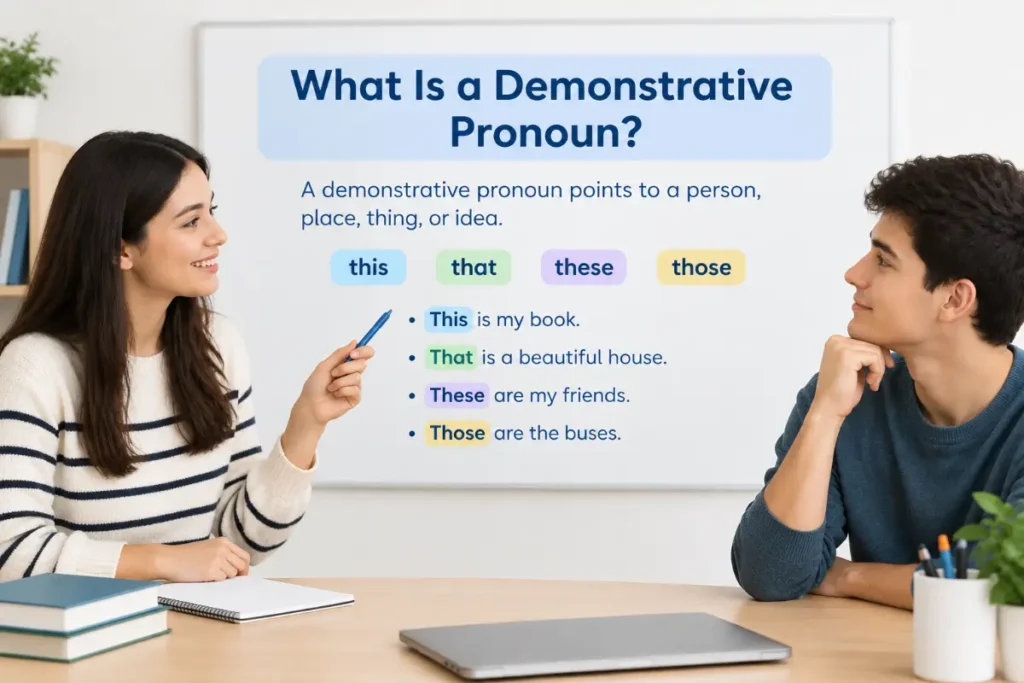
Here’s the short answer to what is a demonstrative pronoun: it’s one of four pointing words, this, that, these, or those, that stands in for a noun instead of describing one. In “Is this your pen?” the word “this” takes the place of the noun and tells you the pen is nearby.
Our guide to types of pronouns lists demonstrative pronouns as one of nine categories. This guide goes deeper on that one category: how near and far, singular and plural work, how to tell a demonstrative pronoun from the same word acting as an adjective, and the vague “this” problem that trips up even experienced writers.
You may also find Its vs It’s: The One-Second Trick to Get It Right Every Time helpful if you want to explore this topic further.
The Four Words
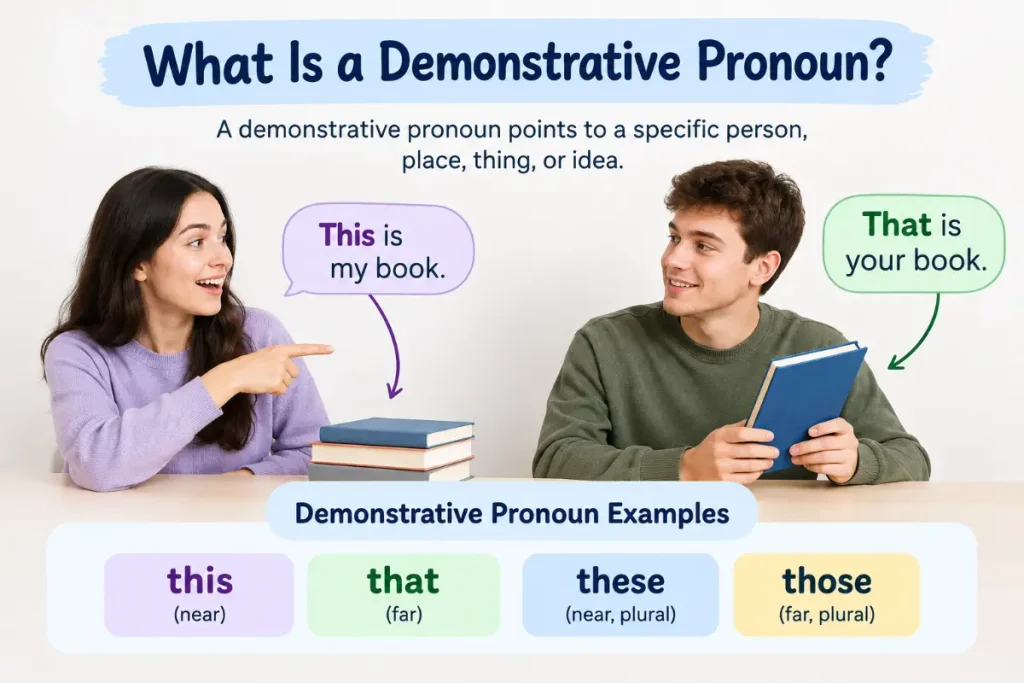
Grammar Monster defines a demonstrative pronoun as a pronoun that represents a noun and shows whether it’s near or distant, including in time. Each of the four words carries two pieces of information: number and distance.
| Singular | Plural | |
|---|---|---|
| Near | this | these |
| Far | that | those |
- Is this your jacket? (one item, nearby)
- Eat these while they’re warm. (several items, nearby)
- Is that yours? (one item, farther away)
- Throw those away. (several items, farther away)
“Near” and “far” can describe time as well as space. “This is the best week I’ve had” points to the present, while “That was a great year” looks back at the past.
Demonstrative Pronoun Examples in Everyday Sentences
Demonstrative pronouns are easier to understand when you see how people use them in everyday conversations and writing. The words this, that, these, and those help identify specific people, objects, ideas, or experiences without repeating their names.
- This is exactly what I needed. — “This” points to one thing nearby or currently relevant.
- That belongs to my brother. — “That” identifies one thing farther away or already mentioned.
- These are fresh from the bakery. — “These” refers to multiple items nearby.
- Those were the best days of my life. — “Those” refers to multiple experiences in the past.
Demonstrative pronouns can also refer to ideas rather than physical objects.
- This makes perfect sense. — “This” refers to an idea or explanation.
- That was an unexpected result. — “That” refers to something that happened previously.
- These are the reasons I disagree. — “These” refers to multiple reasons.
- Those were difficult decisions to make. — “Those” refers to decisions already discussed.
Notice that each bolded demonstrative pronoun stands in for a noun or a noun phrase rather than appearing directly before a noun. This is the key feature that distinguishes a demonstrative pronoun from a demonstrative determiner.
How to Choose Between This, That, These, and Those
Choosing the correct demonstrative pronoun becomes simple when you consider two things: whether you’re referring to one thing or several, and whether the thing is near or distant in space, time, or context.
| Demonstrative pronoun | When to use it | Example |
|---|---|---|
| This | One thing that is near or current | This is my favorite. |
| That | One thing that is farther away or past | That was incredible. |
| These | Multiple things that are near or current | These are delicious. |
| Those | Multiple things that are farther away or past | Those were expensive. |
Use this and these when referring to something close or immediately relevant. Use that and those when referring to something more distant or less immediate.
For example, imagine you’re shopping with a friend. You might say, “This is the shirt I want” while holding one shirt, but “Those are the shoes I saw yesterday” while pointing toward several pairs across the store.
The same distinction applies to time. You might say, “This is a busy week” when talking about the current week, but “That was a busy week” when remembering a week that has passed.
Always check the number as well. Use this and that for singular references, and these and those for plural references. For example, “These are my books” is correct, while “These is my book” incorrectly mixes plural and singular forms.
Demonstrative Pronouns vs. Personal Pronouns: What’s the Difference?
Demonstrative pronouns and personal pronouns both take the place of nouns, but they serve different purposes. A demonstrative pronoun points to a particular person, object, or idea, while a personal pronoun refers to a person or thing using words such as he, she, it, they, we, or you.
Compare these examples:
| Sentence | Pronoun type | Why it fits |
|---|---|---|
| This is mine. | Demonstrative | “This” points to a specific item. |
| It is mine. | Personal | “It” refers to an item already identified or understood. |
| Those are beautiful. | Demonstrative | “Those” points to specific things. |
| They are beautiful. | Personal | “They” refers to people or things already identified. |
| That surprised me. | Demonstrative | “That” points to an event, fact, or idea. |
| She surprised me. | Personal | “She” refers to a particular person. |
The main difference is that demonstrative pronouns emphasize which one or which ones, whereas personal pronouns identify someone or something without directly pointing it out.
For example, if a friend shows you two paintings, you might say, “I like that better.” The word that identifies your choice. Once you’ve established which painting you’re discussing, you could say, “I like it better than the other one.”
Both types of pronouns help avoid unnecessary repetition, but understanding their different functions helps you choose the clearest word for your sentence.
For another useful perspective, check out Lay vs Lie: The Verb Pair That’s Confused English Speakers In 2026.
What a Demonstrative Pronoun Replaces
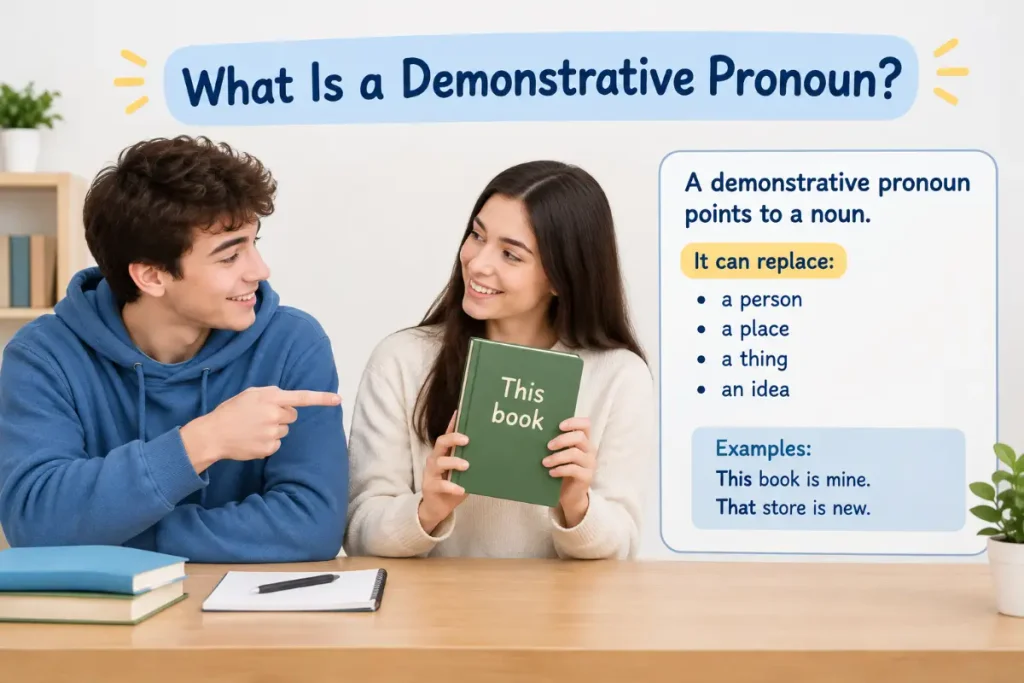
Like every pronoun, a demonstrative pronoun stands in for a noun or noun phrase. Grammar Monster calls that noun the antecedent, and notes that it’s either something already mentioned or something understood from context.
- We tried the lemon cake and the almond cake. Those were both delicious. (those = the cakes, mentioned earlier)
- Hand me that. (the speaker points, so the context supplies the noun)
The antecedent doesn’t always appear in nearby text. In conversation it’s often just whatever the speaker is pointing at.
Pronoun or Adjective? The Noun Test
The same four words can also work as demonstrative adjectives, which grammar guides increasingly call determiners. The only difference is whether a noun follows.
| Demonstrative Pronoun | Demonstrative Adjective |
|---|---|
| This is boring. | This lecture is boring. |
| That is not the answer. | That plan is not the answer. |
| These are tasty. | These apples are tasty. |
| Those are mine. | Those shoes are mine. |
If a noun comes right after the word, it’s describing that noun, so it’s an adjective. If it stands alone and replaces a noun, it’s a pronoun. Our guide to types of adjectives with examples covers the adjective side.
The Vague “This” Problem
This is the issue writers most need to know. A demonstrative pronoun only works when the reader can tell what it points to, and a sentence-opening “This” or “That” often points at a whole idea instead of one clear noun.
- The committee approved the budget, the hiring plan, and the new schedule. This surprised everyone.
What surprised everyone: one of the three items, or all of them together? The writer knows, but the reader has to guess.
Grammar Monster flags this as the most common problem with demonstrative pronouns, and it usually shows up in sentences starting with “This means,” “This explains,” or “This is why.” Its suggested check is to ask yourself the question the pronoun is hiding: What means? What explains? If the answer doesn’t leap out, rewrite.
The easiest fix is to turn the pronoun into an adjective and add a noun.
- The committee approved the budget, the hiring plan, and the new schedule. This decision surprised everyone.
- He ignored the warning. That mistake caused the accident.
Adding one noun costs a word and removes the ambiguity.
“Those Who” and Other Special Patterns
Demonstrative pronouns sometimes introduce a description that tells you who or what they mean, rather than pointing back to something already mentioned.
- Those who study regularly tend to do well. (“those” = the people described by the clause)
- That which does not kill us makes us stronger.
In these cases “those” and “that” are doing real work, since the clause that follows defines them. These clauses are built with relative pronouns, covered in our guide to the list of relative pronouns.
Agreement: Match the Number
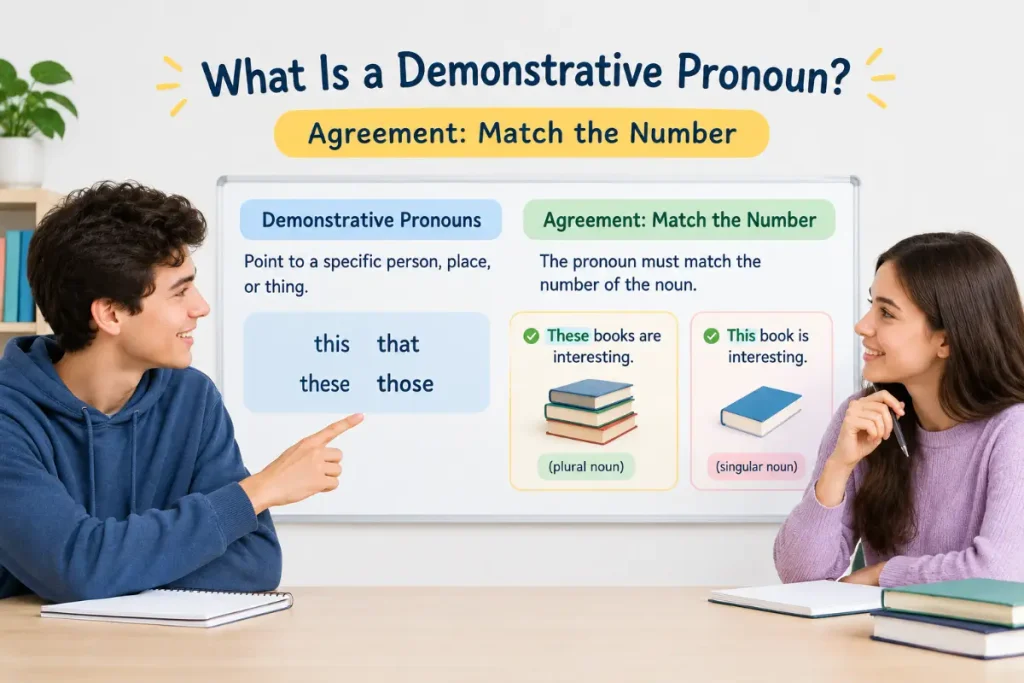
Because these words show singular or plural, the verb has to match.
- That is my favorite song. (singular)
- Those are my favorite songs. (plural)
A frequent slip is writing “Those is…” or “This are…”, especially after a long phrase that pulls attention to a different noun.
Quick Reference Table
| Word | Number | Distance | Example |
|---|---|---|---|
| this | singular | near | This is delicious. |
| these | plural | near | These are fresh. |
| that | singular | far | That was unexpected. |
| those | plural | far | Those belong to Maria. |
Common Mistakes People Make
- Mistake 1: Starting a sentence with a vague “This” or “That” that could point to several things.
- Mistake 2: Mismatching number, as in “These is my favorite” or “That are the shoes.”
- Mistake 3: Calling the word a pronoun when a noun follows it. “This book” uses an adjective, not a pronoun.
- Mistake 4: Using “this” for something clearly distant or past when “that” fits better, such as “This was a great year” about a year long gone.
- Mistake 5: Ending up with two possible antecedents because the demonstrative pronoun sits far from the noun it refers to.
Practice Exercise
For items 1 to 9, say whether the bracketed word is a demonstrative pronoun or a demonstrative adjective. For items 10 to 12, choose the correct word. Rewrite the sentence so the reference is clear for items 13 to 15. For items 16 to 20, identify the pronoun or adjective. Answers are listed right after, so try each one before checking.
- [This] is my favorite song.
- [This] song is my favorite.
- [Those] are my brother’s shoes.
- [Those] shoes are my brother’s.
- [These] are my favorites, not those.
- I like [that] idea.
- [That] was unexpected.
- Do you want [these] or those?
- Pick up [those] books.
- (This/These) is the book I mentioned.
- (That/Those) are my keys on the table.
- (This/These) pictures are beautiful.
- The company cut costs. This surprised investors.
- He ignored the warning. That caused the accident.
- The students protested. This continued for weeks.
- [Those] who work hard succeed.
- [That]’s what I meant.
- [These] days, I walk to work.
- Is [this] yours?
- I don’t want [that] one.
Answer Key
- Pronoun
- Adjective
- Pronoun
- Adjective
- Pronoun (both “these” and “those” stand alone)
- Adjective
- Pronoun
- Pronoun
- Adjective
- This (singular “book”)
- Those (plural “keys”)
- These (plural “pictures,” and it’s an adjective here)
- “This decision surprised investors.” (or another noun that names what surprised them)
- “That mistake caused the accident.”
- “This protest continued for weeks.”
- Pronoun (“those” = the people described by the clause)
- Pronoun
- Adjective (“days” follows)
- Pronoun
- Adjective (it modifies “one”)
Frequently Asked Questions
What’s the difference between a demonstrative pronoun and a demonstrative adjective?
They’re the same four words in different jobs. A demonstrative pronoun stands alone in place of a noun, while a demonstrative adjective (called a determiner in many modern grammars) sits in front of a noun and modifies it.
Is it wrong to start a sentence with “This” or “That”?
No, it isn’t prohibited. The risk is clarity: if the reader can’t tell exactly what the pronoun points to, add a noun after it, as in “This decision” or “That mistake.”
Can a demonstrative pronoun refer to a whole idea?
Yes, and that’s both its strength and its danger. It can sum up a previous sentence efficiently, but it only works when the idea is clear enough that the reader doesn’t have to choose between several possibilities.
Do demonstrative pronouns show time as well as space?
Yes. “This” and “these” suggest something near or current, while “that” and “those” suggest something farther away or past, so “That was a great year” is natural for a past year.
What’s the fastest way to check whether a word is a demonstrative pronoun?
Look at what follows it. If a noun comes next, it’s an adjective. If it stands alone as the subject or object, replacing a noun, it’s a pronoun.
Before moving on, you may also want to read Compliment vs Complement: The One-Letter Difference (2026) for more helpful grammar tips.
Wrapping Up
Understanding what is a demonstrative pronoun comes down to three facts: there are four of them, each shows singular or plural and near or far, and each replaces a noun rather than modifying one. The noun test settles the pronoun-versus-adjective question in a second.
The practical habit worth building is checking every sentence-opening “This” or “That.” If the reader could reasonably ask “this what?”, add the noun, and the sentence gets clearer at almost no cost.