Here’s some genuinely reassuring news before we even start: lay vs lie have been tripping up English speakers since roughly the 14th century. This isn’t a modern texting-era slip or a sign you weren’t paying attention in school — it’s one of the oldest, most persistent mix-ups in the language, and even careful, well-educated writers get it wrong regularly.
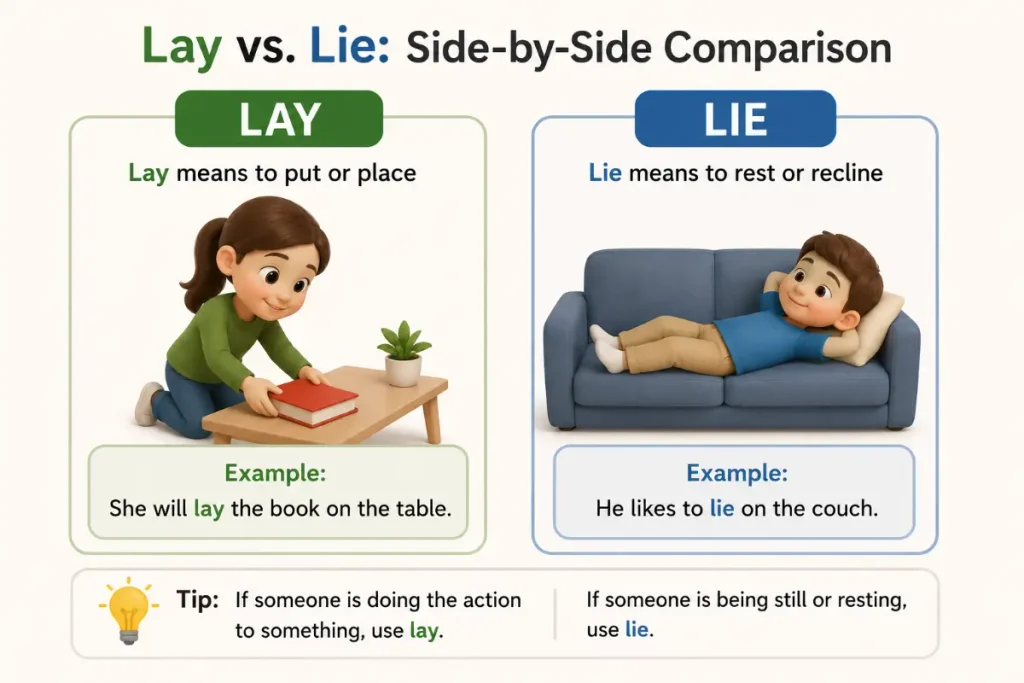
Lay means to place something down — it needs an object, something being placed. Lie means to recline or be in a flat position — it doesn’t take an object; the subject is doing the reclining itself. That’s the core distinction. The reason it gets so confusing comes later, once you add tenses into the mix.
You may also find Who’s vs Whose: 7 Easy Rules to Get It Right (2026 Guide) helpful if you want to explore this topic further.
The Quick Answer
- Lay (needs an object) = to put or place something down
- Lay the book on the table.
- Lie (no object) = to recline or be in a horizontal position
- I’m going to lie down for a nap.
The test: can you ask “lay what?” and get a sensible answer? If yes, use lay. If the subject is doing the reclining themselves, with nothing being placed, use lie.
Try it: “Please ___ the folder on my desk.” Ask “lay what?” — the folder. That works, so it’s lay: “Please lay the folder on my desk.”
Now try: “I need to ___ down for a bit.” Ask “lie what?” — nothing, there’s no object. So it’s lie: “I need to lie down for a bit.”
Why This Pair Is Uniquely Confusing
Most confusable word pairs trip people up because they sound alike or look similar. Lay and lie is different — the real problem is that their past tenses collide. Here’s the collision, laid out plainly:
- Lie (present) → lay (past) → lain (past participle)
- Lay (present) → laid (past) → laid (past participle)
Notice that: the past tense of “lie” is “lay.” That means the correct past-tense sentence “I lay down yesterday” uses the word “lay” — even though “lay” is also its own separate present-tense verb meaning to place something down. This is genuinely one of the more tangled spots in English grammar, and it’s the real reason this pair has confused speakers for centuries, not a lack of understanding of the basic present-tense rule.
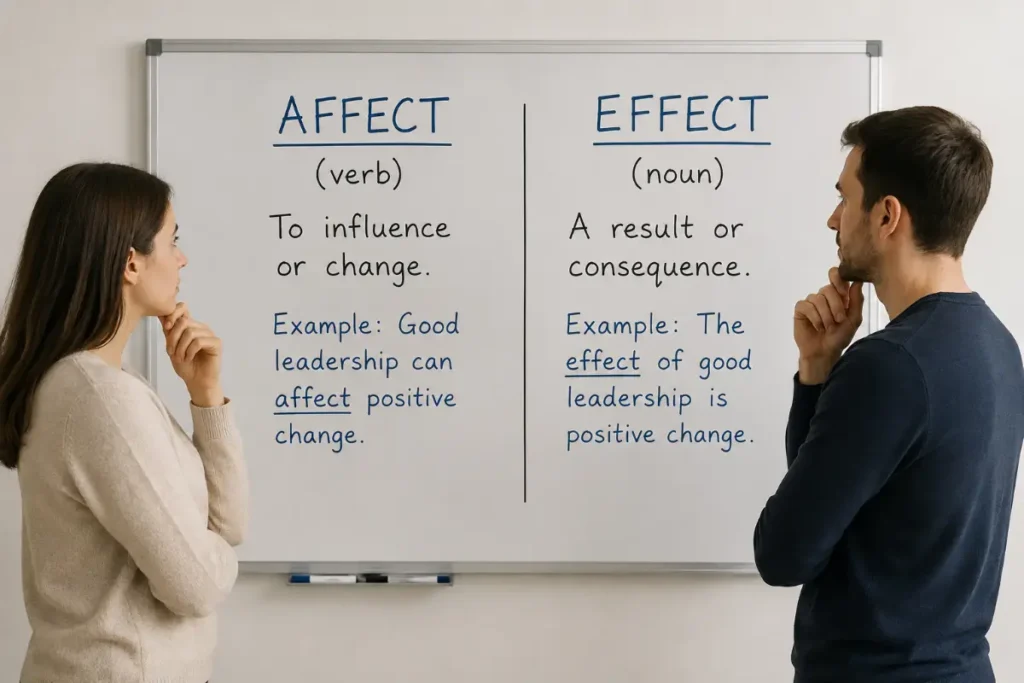
It’s a bit like the exception buried inside affect and effect — a rule that’s simple at the surface level but has one specific complication that trips people up even after they’ve learned the basics.
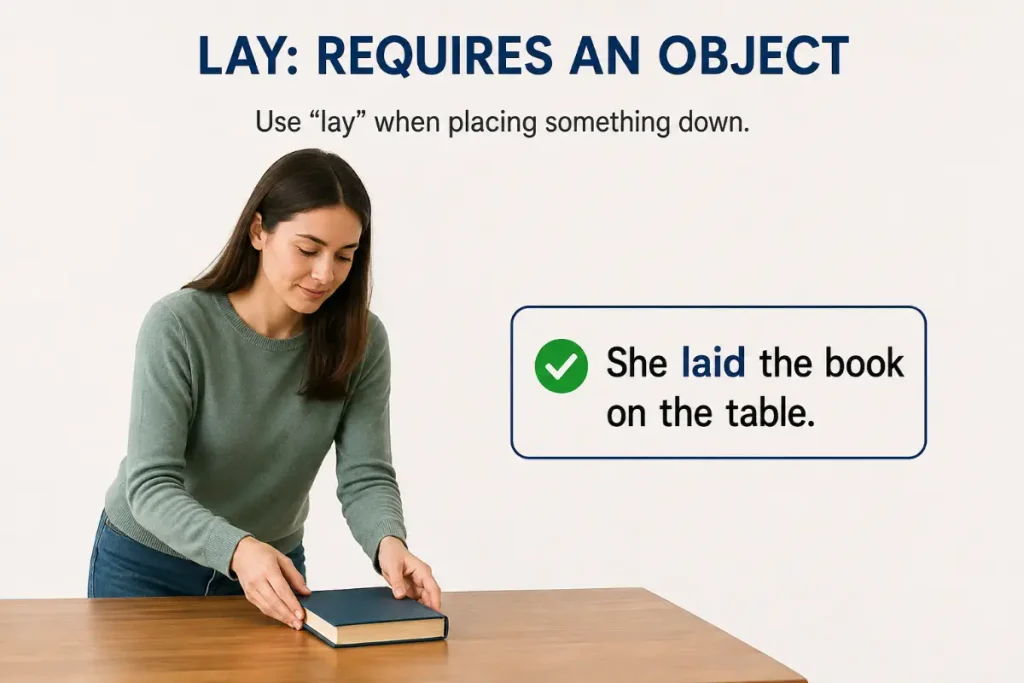
Lay: Requires an Object
Lay always needs something being placed, set, or put down. If you can’t identify what’s being laid, you probably want “lie” instead.
Present tense examples:
- Lay your coat on the bed.
- She lays out her clothes the night before.
- Please lay the documents on my desk.
- He lays bricks for a living.
- The hen lays an egg almost every day.
Notice that last one — “lay” is also the standard verb for birds producing eggs, which is worth knowing since it’s one of the more common non-obvious uses of the word.
Lie: No Object, Just Reclining or Resting
Lie describes someone or something already in, or moving into, a horizontal resting position — with nothing else being placed.
Present tense examples:
- I like to lie on the couch after work.
- The dog lies by the fireplace every evening.
- You can lie down if you’re feeling tired.
- The papers lie scattered across the floor.
- She lies awake most nights before a big presentation.
In every one of these, nothing is being placed by an outside actor — the subject itself (I, the dog, the papers, she) is simply in or moving into a resting position.
Where It Gets Genuinely Hard: The Past Tenses
This is the section worth reading twice, because it’s where almost every lay/lie mistake actually happens.
Lay in the past tense becomes “laid.”
- She laid the baby in the crib. (past tense of lay — placed something)
- He laid his keys on the counter.
- They laid the foundation for the new building.
Lie in the past tense becomes “lay” — yes, the same word as the present tense of “lay.”
- I lay in bed all morning yesterday. (past tense of lie — no object, just reclining)
- The cat lay in the sun for hours.
- He lay awake worrying about the interview.
This is the collision that causes almost all lay/lie confusion. “I lay down yesterday” is correct — but it looks identical to the present-tense verb “lay” that means to place something. The only way to tell them apart is context: is there an object being placed (that’s “lay” the verb), or is the subject just reclining (that’s “lay,” the past tense of “lie”)?
Lie’s past participle is “lain,” used with helping verbs like “has,” “have,” or “had.”
- He has lain in that hospital bed for a week.
- The dog had lain by the door all afternoon.
- I have lain awake many nights thinking about this.
Lay’s past participle is “laid,” also used with helping verbs.
- She has laid out the plans for the renovation.
- They had laid the tracks before the deadline.
A Full Tense Chart, Since This Is the Part Worth Bookmarking
| Present | Past | Past Participle | Present Participle | |
|---|---|---|---|---|
| Lay (place something) | lay | laid | laid | laying |
| Lie (recline) | lie | lay | lain | lying |
If you only remember one thing from this chart, make it this: “lay” shows up as both the present tense of one verb and the past tense of the other. That overlap is the entire source of the confusion, and simply knowing it exists resolves a lot of the mystery.
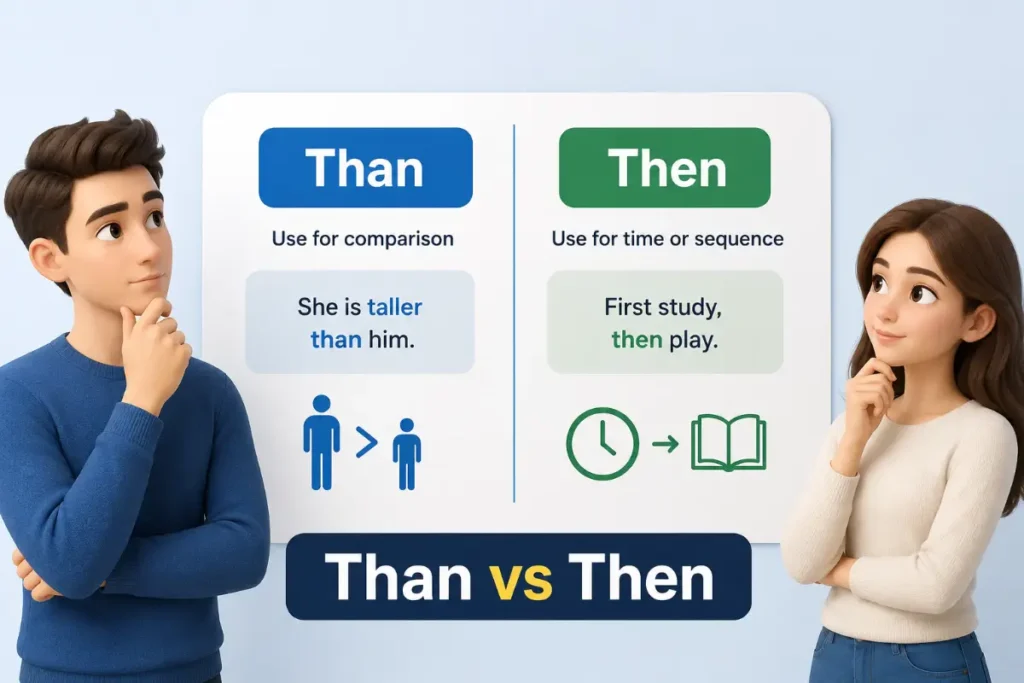
It’s a similar kind of tangle to sorting out than and then — not a sound-alike problem, but a case where two genuinely different jobs happen to share the exact same word in certain forms.
The Fastest Way to Check Yourself
Step 1: Ask “what’s being placed?” If you can name an object, you need some form of “lay.” If nothing is being placed and the subject is just reclining, you need some form of “lie.”
Step 2: Figure out your tense. Present, past, or past participle (used with has/have/had)?
Step 3: Match it to the chart above.
A quick memory trick some writers use: “lay” and “place” both have the letter A, and lay means to place something. “Lie” and “recline” both work without needing anything else — you can recline, and you can lie, using just the subject and nothing more.
Another approach that works well in the moment: try substituting “put” for the word you’re unsure about. “I need to put down for a nap” sounds broken — you can’t just “put,” you have to put something. That broken feeling is your signal that you actually want “lie,” which doesn’t need an object.
Lay vs Lie: Side-by-Side Comparison
| Lay | Lie | |
|---|---|---|
| Needs an object | Yes | No |
| Meaning | To place something down | To recline or rest |
| Present | lay | lie |
| Past | laid | lay |
| Past participle | laid | lain |
| Present participle | laying | lying |
| Example | Lay the blanket down. | Lie down and rest. |
Common Mistakes People Make
Mistake 1: “I’m going to lay down for a bit.” This is extremely common in casual speech, but strictly, it should be “lie down,” since nothing is being placed — you’re the one reclining. That said, this particular slip is so widespread that even Merriam-Webster notes it’s been in use since the 14th century and rarely draws real criticism in casual conversation.
Mistake 2: “The book is laying on the table.” Should be “lying on the table” — the book isn’t placing anything, it’s simply resting there.
For another useful perspective, check out Less vs Fewer: 5 Easy Rules You’ll Never Forget (2026).
Mistake 3: “Yesterday I laid in bed all day.” Should be “I lay in bed all day” — this is the past tense of “lie” (reclining), not “lay” (placing). This mistake happens constantly because “laid” feels like the more natural-sounding past tense to reach for.
Mistake 4: “She has laid there for hours.” If she’s simply resting (not placing anything), this should be “she has lain there for hours” — the past participle of “lie,” not “lay.”
Mistake 5: Confusing “lay” the noun/verb about eggs. “The hen lay an egg” is incorrect; it should be “the hen laid an egg” (past tense) or “the hen lays an egg” (present tense) — since laying an egg does involve placing something (the egg), “lay” (not “lie”) is always the correct verb family here, in every tense.
More Examples to Lock It In
- Lay your bag down and lie on the couch for a minute.
- She laid her phone on the nightstand before she lay down to sleep.
- The workers had laid the pipes before the crew lay the final section of track.
- He’s been lying in the sun since he laid out his towel an hour ago.
- I lay awake last night after laying out my clothes for the morning.
- The cat has lain on that windowsill every day since we laid down the new rug.
- Please lay the tools on the bench once you’re done, then you can lie down.
- They laid the wreath at the memorial before the crowd lay flowers of their own.
What the Style Guides Say
Merriam-Webster is refreshingly candid about this pair, noting directly that “lay and lie have been tripping up English speakers for 700 years” and that the informal use of “lay” in place of “lie” (“I’m going to lay down”) dates back to the 14th century. The dictionary still maintains the formal distinction for standard usage, but the tone of its guidance is notably forgiving compared to some other grammar rules. The AP Stylebook and Chicago Manual of Style both preserve the traditional transitive/intransitive distinction for formal and published writing, where precision is expected regardless of how common the casual slip has become.
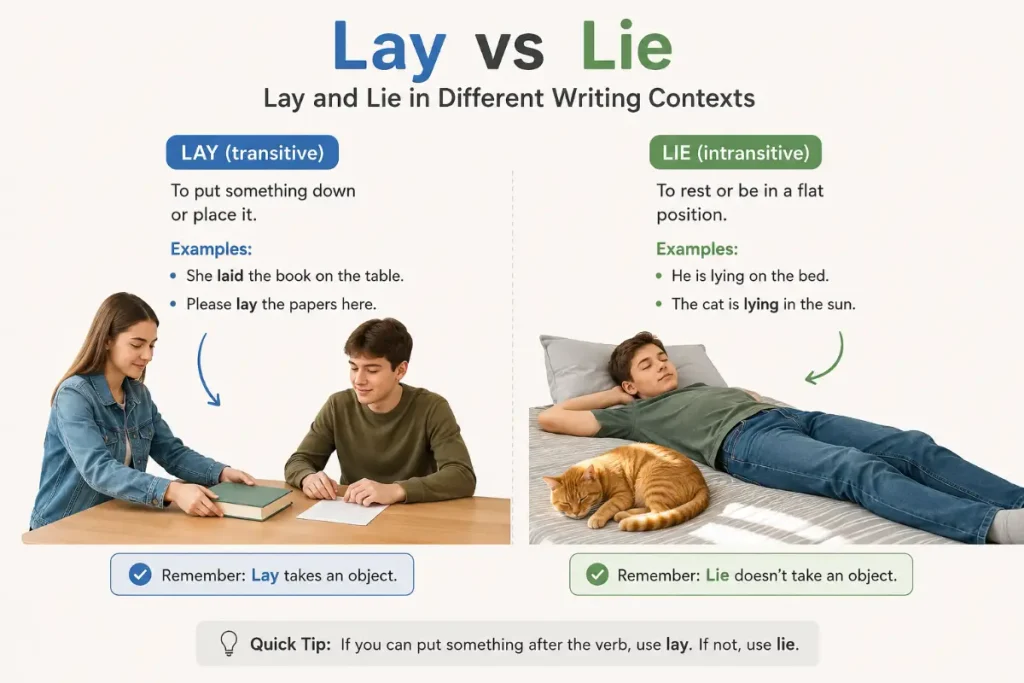
The core grammatical concept here — transitive verbs (which take an object, like lay) versus intransitive verbs (which don’t, like lie) — is taught consistently across every major English reference, even though real-world usage has softened considerably, especially in speech.
Lay and Lie in Different Writing Contexts
In casual speech, “lay down” instead of “lie down” is so common that it barely registers as an error to most listeners — this is one of the clearest examples in English of a “rule” that formal grammar maintains while everyday usage has largely moved past it.
In professional and published writing, the distinction still matters, particularly in journalism, editing, and any writing that goes through a formal review process. A published article that says “the report is laying on my desk” instead of “lying on my desk” is the kind of error that experienced editors catch immediately.
In creative and narrative writing, getting lay/lie right in past tense sentences (“she lay in the grass” versus “she laid the blanket in the grass”) actually matters for clarity, since misusing the verb can genuinely confuse who or what is doing what to whom in a descriptive scene.
In instructional and technical writing, precision matters because lay/lie sentences often involve physical instructions — “lay the cable along the wall” needs to be clearly distinguished from a hypothetical “lie along the wall,” where confusing the two could genuinely muddy a set of directions.
Frequently Asked Questions
Is “lay down” ever actually correct?
Yes, in two situations: when you’re using the imperative to tell someone to place something down where “down” modifies the object’s position (“lay it down”), or when you’re using the past tense of “lie” and simply happen to be using the word “lay” correctly as that past tense (“I lay down yesterday” is grammatically correct, referring to reclining in the past). The commonly criticized use is present-tense “I’m going to lay down” to mean reclining right now, which technically should be “lie down.”
Why is the past tense of “lie” the same word as the present tense of “lay”? Isn’t that a language design flaw?
It’s a historical quirk rather than a flaw — English verb tenses evolved from older Germanic patterns, and “lie” and “lay” happened to end up with overlapping forms as the language changed over centuries. It’s genuinely one of the more awkward overlaps in English, which is exactly why it’s remained confusing for hundreds of years rather than resolving itself the way some other usage debates eventually do.
What about “lie” meaning to tell an untruth — is that related?
No, that’s a completely separate verb with its own conjugation: lie, lied, have lied, lying. It happens to share a spelling with “lie” (recline) in the present tense, but its past tense is “lied,” not “lay,” so it doesn’t create the same confusion once you’re past the present tense.
Does this rule apply the same way in British English?
Yes — the lay/lie distinction is consistent across American and British English. The informal slide toward using “lay” for reclining happens in both dialects, and both maintain the same formal rule in edited writing.
What’s the fastest way to catch this error before publishing something?
Search your document for every instance of “lay,” “laid,” “lie,” and “lain,” then for each one ask: is something being placed (lay family), or is the subject simply reclining (lie family)? Then double check the tense against the chart. It takes a minute, but this is one of the errors spell-check will never catch, since every one of these words is correctly spelled on its own.
Lay vs Lie Practice Exercise
Fill in the blank with the correct form of “lay” or “lie.” Answers are listed right after — try each one before checking.
- Please ______ your keys on the counter.
- I want to ______ down for a few minutes.
- Yesterday, the cat ______ in the sun all afternoon.
- She ______ the documents on the desk this morning.
- He has ______ awake for hours worrying about the exam.
- The workers ______ the foundation last week.
- The dog is ______ by the fireplace right now.
- I ______ in bed until noon yesterday.
- They had ______ the carpet before the movers arrived.
- ______ the blanket over the baby gently.
- The papers have ______ on that desk for a month.
- She was ______ on the beach when the storm started.
- He ______ his phone down and walked away.
- The hen ______ two eggs this morning.
- We ______ awake talking until midnight last night.
- Please ______ the tools down before you leave.
- The book has been ______ open on that page for days.
- Yesterday I ______ the towels out to dry.
- She ______ down as soon as she got home from work.
- The soldiers ______ down their weapons at the ceremony.
Answer Key
- lay
- lie
- lay
- laid
- lain
- laid
- lying
- lay
- laid
- Lay
- lain
- lying
- laid
- laid
- lay
- lay
- lying
- laid
- lay
- laid
If you got sixteen or more correct, you’ve genuinely mastered one of the hardest verb pairs in English — congratulations, since this trips up professional writers too. For any you missed, go back to the tense chart and re-run the “what’s being placed?” test on each one.
Before moving on, you may also want to read Compliment vs Complement: The One-Letter Difference (2026) for more helpful grammar tips.
The Bottom Line
Lay needs an object — you’re placing something. Lie doesn’t — the subject is simply reclining. The real difficulty isn’t the present tense, which is fairly intuitive; it’s that the past tense of “lie” happens to be the word “lay,” colliding with lay’s own present tense. Keep the tense chart handy, and remember that even professional editors double-check this one regularly — it’s not a sign you don’t know grammar, it’s a sign you’re paying attention to a genuinely tricky corner of English.