Confused about Farther vs Further? You’re not alone. Learn the simple difference, when to use each word, and see clear examples that make the choice easy.
Most grammar guides will tell you a clean, simple rule: farther is for physical distance, further is for figurative distance. It’s a useful starting point — but if you dig into how professional editors, major dictionaries, and even literary writers actually use these words, the real answer is more nuanced. This guide gives you both: the quick rule that works 90% of the time, and the honest context for why the other 10% exists.
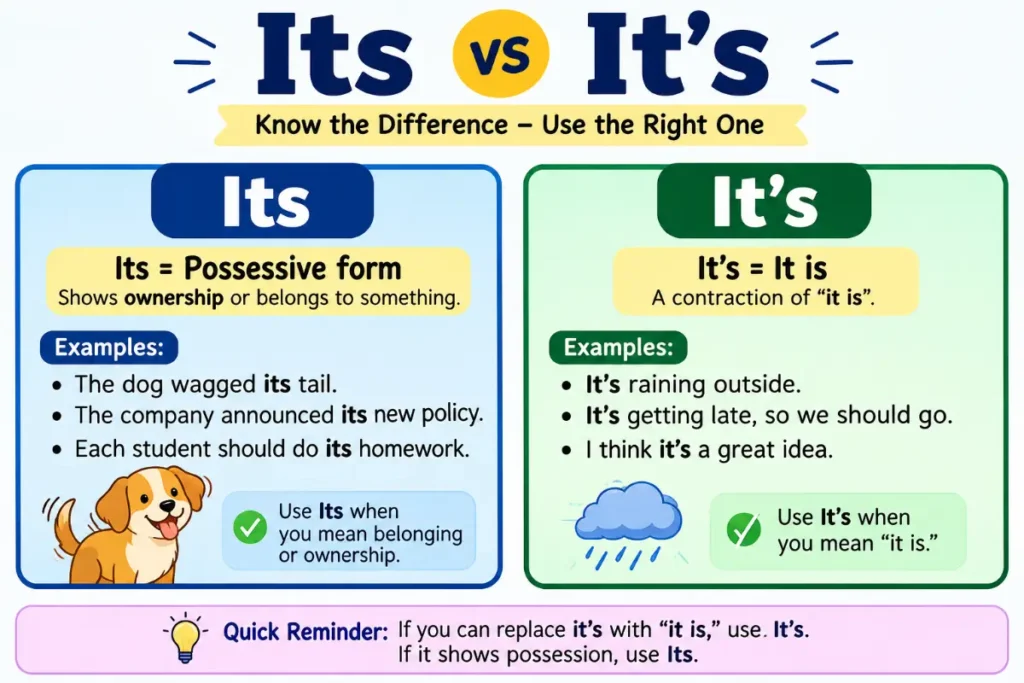
You may also find Its vs It’s: The One-Second Trick to Get It Right Every Time helpful if you want to explore this topic further.
The Quick Answer
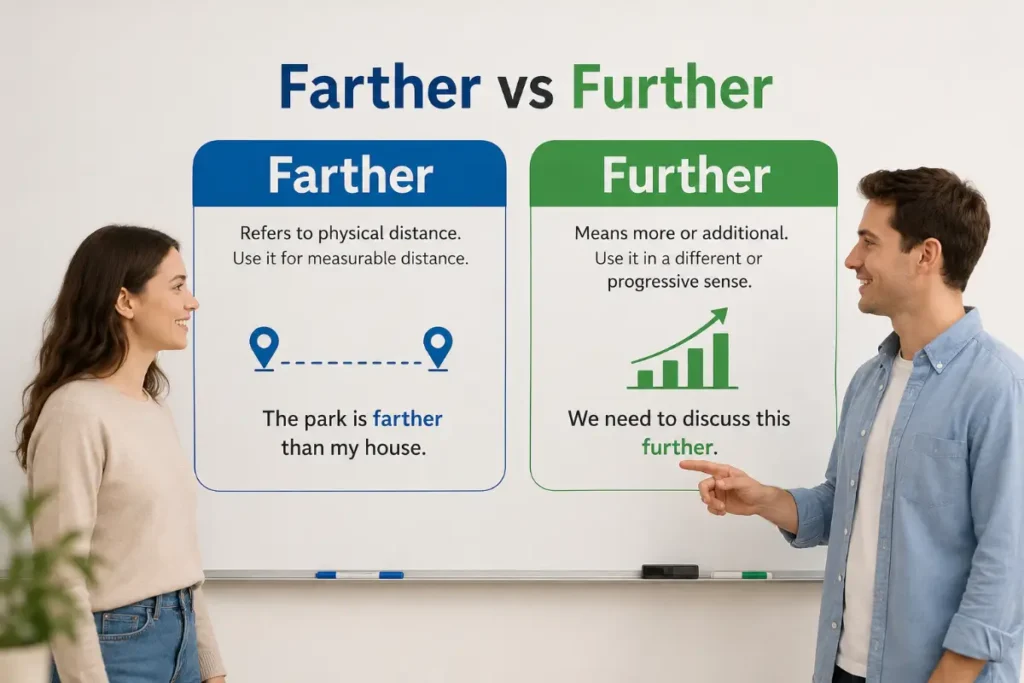
- Farther = physical, measurable distance
- The store is farther than I remembered.
- Further = figurative distance, degree, or “additional”
- We need to discuss this further.
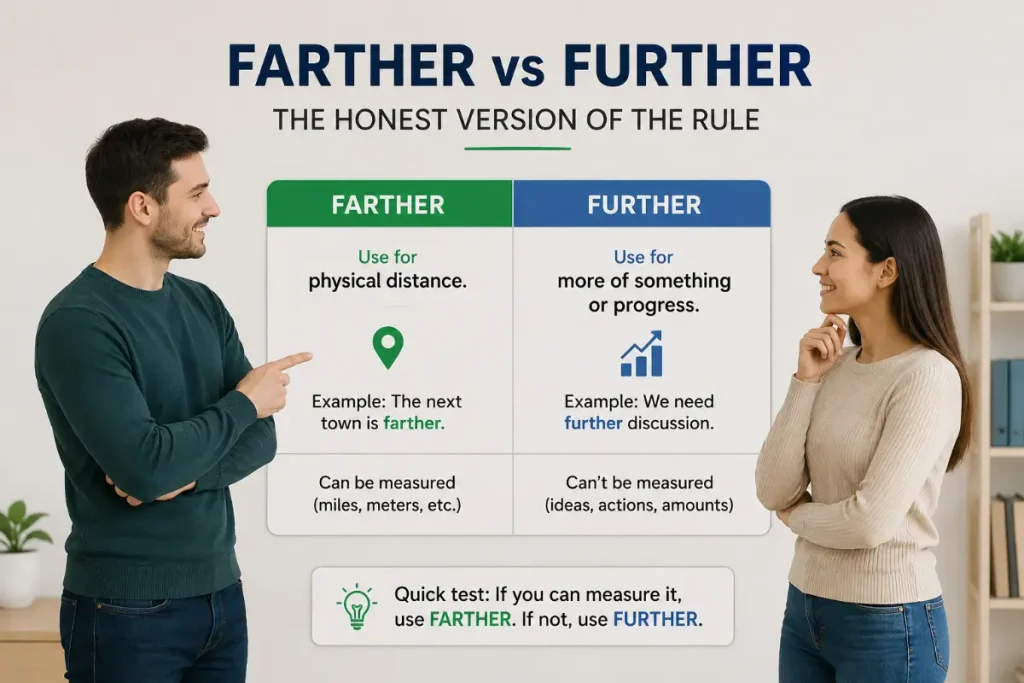
The test: can you measure the distance in miles, feet, or steps? If yes, farther is the safer, more traditional choice. If you’re talking about an abstract idea, a degree of something, or simply “more” or “additional,” use further.
Try it: “I can’t run any ___ today.” Is this physical distance you could measure? Yes — so farther is the traditional choice: “I can’t run any farther today.”
Now try: “Let’s discuss this ___ tomorrow.” Is this a physical distance? No — it’s a continuation of a conversation. So it’s further: “Let’s discuss this further tomorrow.”
The Honest Version of the Rule
Here’s what most quick grammar guides leave out: further and farther share the same root, and for most of English history, they were used interchangeably for both physical and figurative distance. The physical/figurative split is a relatively recent convention — Merriam-Webster notes that the distinction was really only formalized by usage guides starting in the early 1900s, and even now, careful writers and major publications sometimes use “further” for physical distance without it being considered wrong.
What’s genuinely fixed, without exception, is this: further is the only correct choice when you’re using the word as a verb (“to further a cause”) or as an adjective meaning “additional” (“further questions,” “further details”). Farther can never fill those roles — it only ever works as an adjective or adverb related to distance.
So the real, complete rule looks like this:
- If you need a verb meaning “to advance or promote,” it’s always further — no exceptions.
- If you need an adjective meaning “additional,” it’s always further — no exceptions.
- If you’re talking about physical distance, farther is the traditional, safest choice, though further is increasingly accepted here too, especially in British English and in more literary or abstract-leaning physical descriptions.
- If you’re talking about figurative distance, degree, or extent, further is correct.
Farther: Physical Distance
Examples:
- The gas station is farther down this road.
- She lives farther from the office than I do.
- We drove farther than we planned.
- The finish line is farther away than it looks.
- He hit the ball farther than anyone else on the team.
In each of these, you could theoretically pull out a measuring tape or a map and quantify the distance. That’s the hallmark of “farther.”
Further: Figurative Distance, Degree, and “Additional”
Examples of figurative or abstract distance:
- Let’s think this through further before deciding.
- Nothing could be further from the truth.
- Her interest in the topic went further than mine.
- We need to look further into this issue.
Examples of “further” as “additional” (adjective):
- I have no further questions.
- Further details will be provided next week.
- Please contact us for further information.
Examples of “further” as a verb:
- The grant will help further scientific research.
- She hopes this internship will further her career.
- The organization exists to further public education.
Notice that in the verb and “additional” uses, there’s genuinely no gray area — “farther” simply cannot replace “further” in these sentences. Try it: “The grant will farther scientific research” doesn’t work at all. That’s your most reliable anchor when the physical/figurative line gets blurry elsewhere.
The Fastest Way to Check Yourself
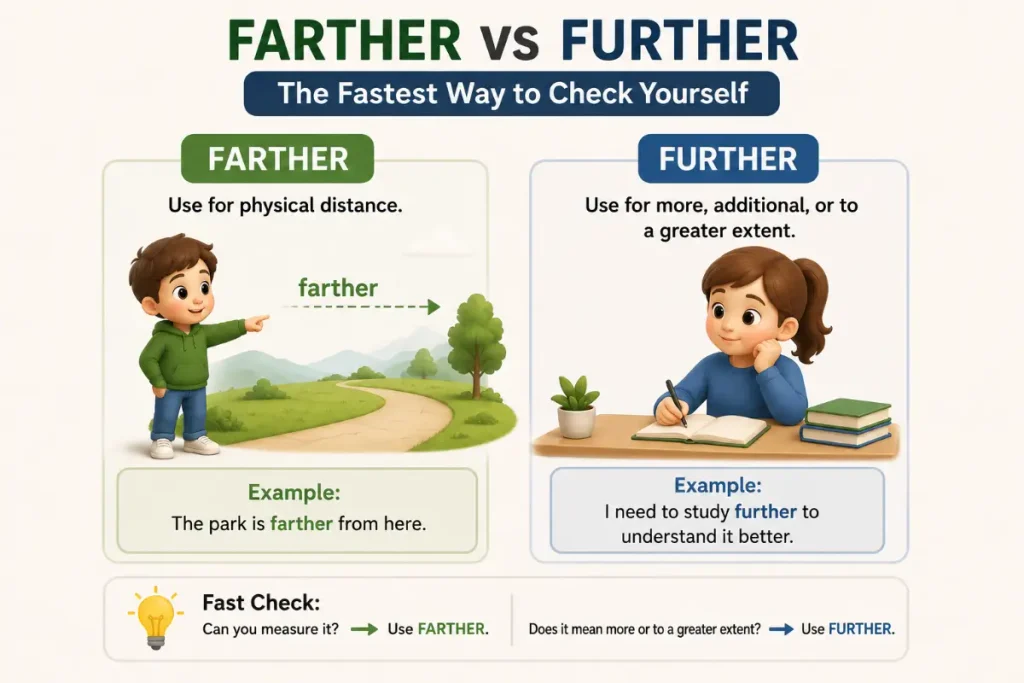
Step 1: Is it a verb, or does it mean “additional”? If yes, it’s always further — done, no further thought needed (see what happened there).
Step 2: If it’s about distance, can you measure it? If yes, lean toward farther, especially in American English and in careful or formal writing.
Step 3: If it’s abstract, conceptual, or about degree rather than physical space, use further.
A widely used memory trick: “farther” contains the word “far,” and “far” is about physical distance. If you can mentally isolate “far” inside the word and picture actual physical space, farther is probably right. “Further” doesn’t contain a distance word at all — it’s the more flexible, abstract-leaning option by default.
Farther vs Further: Side-by-Side Comparison
| Farther | Further | |
|---|---|---|
| Physical distance | Preferred (traditionally) | Increasingly accepted |
| Figurative/abstract distance | Not standard | Correct |
| “Additional” (adjective) | Never correct | Always correct |
| Verb (“to further”) | Never correct | Always correct |
| Example | The lake is farther than I thought. | We need further evidence. |
| Regional note | More common in American English | More flexible, especially in British English |
A Closer Look at Why the Rule Feels Inconsistent
If you’ve ever read a well-edited British newspaper and noticed “further” used for physical distance (“the village is a few miles further along the coast”), you weren’t imagining a mistake — British English has historically been more relaxed about applying the farther/further distinction than American English, where the split has been taught more rigidly in schools and style guides since the early 20th century.
Even within American usage, though, the strict physical/figurative divide has never been fully consistent. Major dictionaries, including Merriam-Webster, explicitly note that the words have overlapping histories and that many respected writers use them interchangeably for distance, even if “farther” remains the more traditionally “correct” choice in that context. This is one of the clearer examples in English of a rule that usage guides created and popularized well after the language itself had already been doing something more flexible.
This is a similar situation to less and fewer — a rule that sounds absolute when you first learn it, but turns out to have more real-world flexibility once you look at how the words are actually used by careful writers and major style authorities.
It’s also worth noting the who vs whom situation runs in almost the opposite direction — a rule that’s genuinely fading from casual use even as formal writing holds onto it, whereas farther and further are more a case of the “rule” being newer and stricter than the actual history of the words.
Farther vs Further Common Mistakes People Make
Mistake 1: “I need farther information before deciding.” Should be “further information” — this means “additional,” which always requires “further,” regardless of any physical/figurative debate.
Mistake 2: “This will farther my understanding of the topic.” Should be “further my understanding” — this is the verb form, and “farther” can never function as a verb.
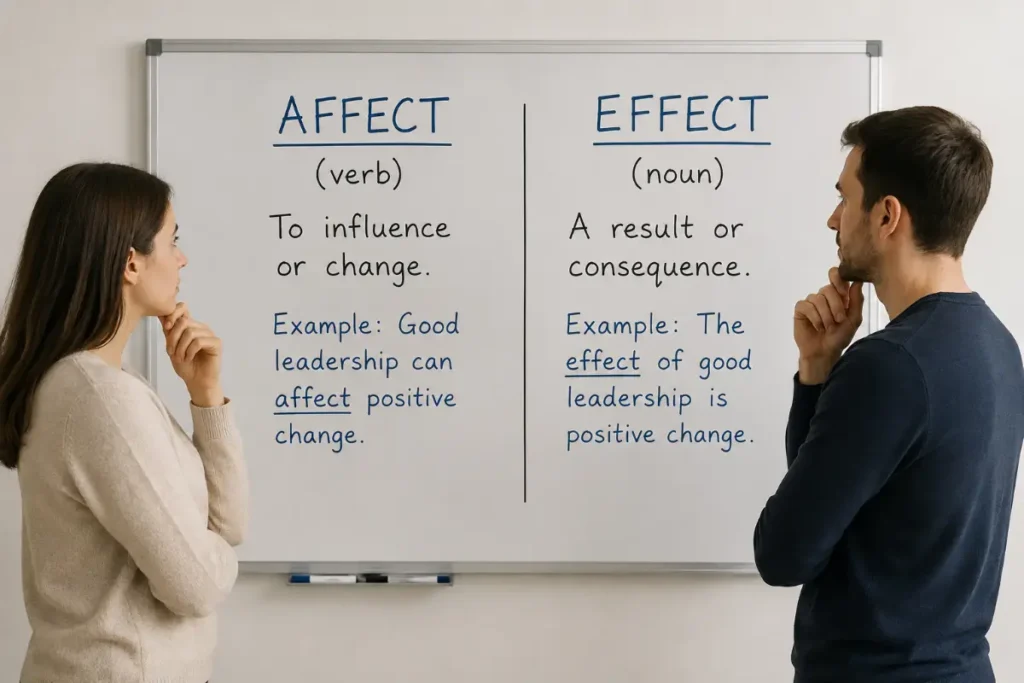
For another useful perspective, check out Affect vs Effect: The Simple Way to Never Mix Them Up Again.
Mistake 3: Treating the physical/figurative rule as absolute and correcting every “further” used for distance. While “farther” is the traditionally preferred choice for physical distance, “further” isn’t technically wrong in that context, especially outside of strict American style guides. Over-correcting someone’s “further” to “farther” in a distance sentence isn’t necessarily fixing an error — it may just be enforcing one particular style preference.
Mistake 4: “Nothing could be farther from the truth” (used correctly, but worth flagging as a common point of confusion). This phrase is actually correct as-is — “farther from the truth” is a fixed, well-established idiom, even though “the truth” is abstract rather than physical. It’s one of the few places where the traditional rule doesn’t fully apply, and it’s worth knowing as an exception rather than assuming it’s a mistake.
More Examples to Lock It In
- We need to research this further before we can decide how much farther the project will need to expand.
- The further into the report I read, the farther the numbers strayed from our projections.
- She walked farther than expected, then stopped to think further about which trail to take.
- Nothing could be further from what we discussed, even though the two ideas aren’t that far apart.
- The company plans to further its mission by expanding farther into new markets.
- I have no further comments, but I did want to point out that the office is farther from the train station than the listing suggested.
What the Style Guides Say
Merriam-Webster is unusually direct about this pair, stating plainly that the simple physical/figurative rule “runs into the buzzsaw of actual usage,” and that historically the two words have been interchangeable for distance. The AP Stylebook maintains the traditional distinction for U.S. journalism — farther for physical distance, further for figurative distance and the verb/adjective uses — making it one of the stricter authorities on this point. The Chicago Manual of Style acknowledges the same historical overlap Merriam-Webster does, while still recommending the traditional split for formal and edited writing where consistency matters.
The throughline across every major source: the verb and “additional” uses of “further” are never in dispute. The distance usage is where flexibility genuinely exists, and different authorities land in slightly different places on how strictly to enforce it.
Farther and Further in Different Writing Contexts
In casual writing, most readers won’t notice or care which one you use for physical distance — this is one of the more forgiving grammar points in everyday communication.
In journalism and AP-style writing, the traditional distinction is expected and enforced, so sticking with farther for physical distance and further for everything else is the safer choice in that context.
In academic and formal writing, further is almost always the right instinct when in doubt, since it correctly covers the figurative, additional, and verb uses without risk — while farther is reserved specifically for clearly measurable distance.
In British-influenced or international English, further is used more broadly, including for physical distance, so don’t be surprised to see it in that role in UK-based publications without it being an error.
A Note on Comparative and Superlative Forms
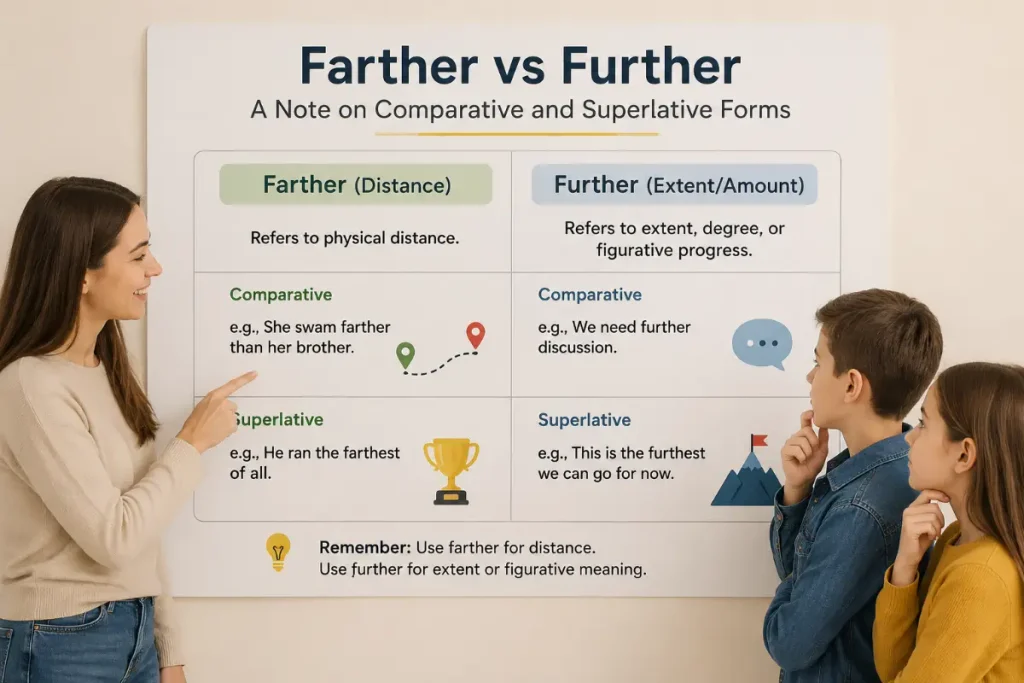
Both words also have comparative-adjacent behavior worth knowing. “Farther” and “further” are themselves already comparative forms of “far” (far, farther, farthest — or far, further, furthest, depending on which branch you’re using). This means you’ll rarely, if ever, need to add “more” in front of either word — “more farther” and “more further” are both incorrect, since the comparison is already built into the word itself.
The superlative forms follow the same split: “farthest” pairs with “farther” for physical distance (“the farthest point on the trail”), while “furthest” pairs with “further” for figurative distance or degree (“the furthest thing from my mind”). As with the base forms, usage guides note some flexibility here too, though “furthest” tends to sound slightly more natural than “farthest” in abstract contexts, mirroring the same distinction that applies to the comparative forms.
Frequently Asked Questions
Is “further” ever wrong to use for physical distance?
Not exactly wrong, but it goes against the traditional American English preference, which favors “farther” for measurable distance. In British English and less formal American writing, “further” is widely accepted in this role too.
Can “farther” ever be used as a verb or to mean “additional”?
No — this is the one part of the rule with no real exceptions. “Farther” only ever functions as an adjective or adverb tied to physical distance. If you need a verb or the meaning “additional,” further is always correct.
Why does “nothing could be farther from the truth” use “farther” for something abstract?
This is a fixed idiom that predates, and doesn’t fully follow, the modern physical/figurative distinction — it’s worth memorizing as an exception rather than trying to apply the general rule to it.
Does this distinction exist in other languages, or is it unique to English?
The specific farther/further split is unique to English, and even within English it’s a relatively recent, somewhat artificial refinement rather than an ancient grammatical feature — which helps explain why it feels less “solid” than rules like subject-verb agreement.
What’s the safest default if I’m not sure which one to use?
When in doubt, further is the safer default, since it correctly covers figurative distance, “additional,” and the verb form without any risk of being wrong — the only place you specifically need farther is when you’re confident you’re describing clearly measurable physical distance in a formal context.
Practice Exercise
Fill in the blank with either “farther” or “further.” Answers are listed right after — try each one before checking.
- The trailhead is ______ than the map suggested.
- We need ______ evidence before making a decision.
- She ran ______ than anyone else in the race.
- Let’s discuss the budget ______ next week.
- I have no ______ questions at this time.
- The house is ______ from the beach than I expected.
- The company hopes to ______ its mission this year.
- Nothing could be ______ from what we intended.
- He walked ______ into the woods than his friends.
- Please provide ______ details about the proposal.
- The ball traveled ______ than the last one he hit.
- We should look into this issue ______.
- The store is a few blocks ______ down the street.
- Her research went ______ than anyone had before.
- I can’t drive any ______ tonight; I’m too tired.
- The scholarship will ______ her education significantly.
- The next town is ______ than it looks on the map.
- We need to think this decision through ______.
- The hikers went ______ than the trail markers recommended.
- There will be ______ updates as the situation develops.
Answer Key
- farther
- further
- farther
- further
- further
- farther
- further
- further
- farther
- further
- farther
- further
- farther
- further
- farther
- further
- farther
- further
- farther
- further
If you got sixteen or more correct, you’ve got a solid handle on the distinction — and if a few slipped by on distance-related sentences, don’t worry too much, since that’s precisely the area where even style guides don’t fully agree.
Before moving on, you may also want to read Assure vs Ensure vs Insure: 7 Key Differences Explained (2026) for more helpful grammar tips.
The Bottom Line
Further is always correct for the verb form and for “additional.” Farther is traditionally preferred for physical, measurable distance, though further is increasingly accepted there too, especially outside strict American style guides. When genuinely unsure, further is the safer default — it’s never wrong for the figurative and additional senses, and it’s increasingly acceptable for distance as well.