These two words differ by just one letter—Advice vs Advise—but that small spelling change also affects pronunciation. Once you know what to listen for, this commonly confused pair becomes much easier to use correctly.
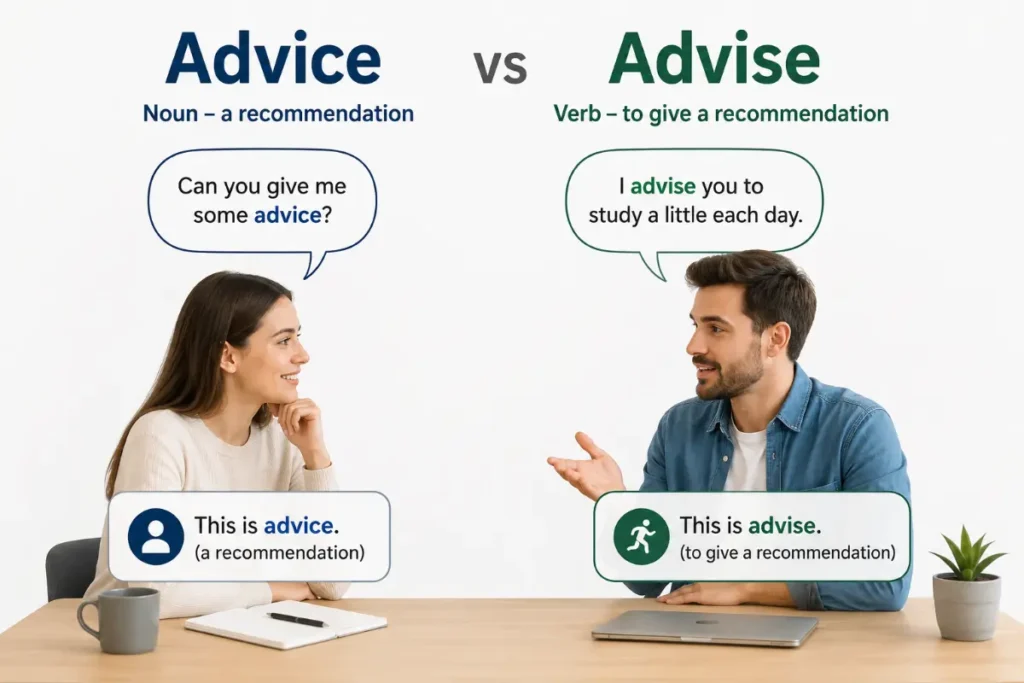
Advice (with a C) is a noun — the recommendation or opinion itself. Advise (with an S) is a verb — the act of giving that recommendation. One letter, one part of speech, one job each.
You may also find Discreet vs Discrete: 7 Easy Tricks to Never Mix Them Up (2026) helpful if you want to explore this topic further.
The Quick Answer
- Advice (noun, rhymes with “ice”) = the recommendation or opinion given
- She gave me great advice about the interview.
- Advise (verb, rhymes with “wise”) = to give a recommendation or opinion
- She advised me to prepare thoroughly for the interview.
The test: is the word a thing being given or received, or an action being performed? If it’s a thing, use advice. If it’s an action, use advise.
Try it: “I really need your ___ on this decision.” Is this a thing you’re asking for, or an action? A thing — you want the recommendation itself. So it’s advice: “I really need your advice on this decision.”
Now try: “Can you ___ me on which option to choose?” Is this asking for a thing, or for someone to perform an action? An action — you’re asking someone to give guidance. So it’s advise: “Can you advise me on which option to choose?”
The Pronunciation Trick That Makes This Easy
Merriam-Webster highlights something genuinely useful about this particular pair: unlike most commonly confused words, advice and advise aren’t pronounced identically. Advice ends with a soft “s” sound, like “ice.” Advise ends with a “z” sound, like “wise” or “eyes.” That’s a real, audible difference — and it happens to line up perfectly with the spelling: the C in advice makes the softer “s” sound, and the S in advise makes the “z” sound.
This means you can actually say the sentence out loud and let your ear help confirm which spelling you need — a trick that doesn’t work for most of the other pairs on this site, since those genuinely sound identical. If a sentence sounds like it ends in “-ice,” you want the noun, advice. If it sounds like it ends in “-ize” or “-ise” with a Z sound, you want the verb, advise.
Advice: The Noun
Advice refers to the recommendation, opinion, or guidance itself — the thing being given or received.
Examples:
- Her advice helped me make the right decision.
- I always appreciate good advice from experienced colleagues.
- He ignored the doctor’s advice and regretted it later.
- Thanks for the advice — I’ll definitely think about it.
- The book offers practical advice for new parents.
Notice that “advice” is an uncountable noun, similar to “information” or “furniture.” You don’t say “I have three advices” — you say “I have some advice,” “a lot of advice,” or “a piece of advice” when you want to refer to one specific recommendation.
Advise: The Verb
Advise describes the act of giving that recommendation, opinion, or guidance to someone.
Examples:
- The lawyer advised her client to settle out of court.
- I would advise against making any sudden decisions.
- The financial planner advises clients on retirement savings.
- Please advise us of any changes to your schedule.
- He advised his team to take the safer route.
Advise also has a slightly more formal, business-oriented sense meaning “to inform” or “to notify,” commonly seen in professional correspondence: “Please advise us of your decision by Friday” essentially means “please let us know.”
The Fastest Way to Check Yourself
Step 1: Is it a thing (a noun) or an action (a verb)? If it’s something you’re giving or receiving, it’s advice. If it’s something you’re doing to someone else, it’s advise.
Step 2: Say it out loud. Does it end with a soft “s” sound like “ice”? That’s advice. Does it end with a “z” sound like “wise”? That’s advise.
Step 3: Try substituting a clear synonym. “Recommendation” or “guidance” works for advice. “Recommend” or “counsel” works for advise.
A memory trick worth knowing: advice and ice both end the same way and are both nouns — things. Advise and wise both end the same way, and giving wise counsel is exactly what the verb describes. That paired-sound association tends to stick especially well, since it’s genuinely how the words are pronounced.
Unlike this pair, accept and except sound almost identical in casual speech, which is exactly why that particular mix-up is harder to catch just by listening — advice and advise are one of the few confusable pairs where your ear can actually do most of the work.
Advice vs. Advise: Side-by-Side Comparison
| Advice | Advise | |
|---|---|---|
| Part of speech | Noun | Verb |
| Pronunciation | Ends in “s” sound, like “ice” | Ends in “z” sound, like “wise” |
| Meaning | The recommendation itself | The act of giving a recommendation |
| Example | good advice | to advise someone |
| Countable? | Uncountable (like “information”) | N/A (it’s a verb) |
| Related words | Advisable, adviser/advisor | Advisory, advising, advised |
Adviser vs. Advisor: A Related Spelling Question
Since it comes up constantly alongside this pair, it’s worth addressing directly: both “adviser” and “advisor” are correct spellings for someone who gives advice, and the difference is purely stylistic rather than grammatical. Merriam-Webster notes there’s no meaningful distinction between them beyond spelling preference, though “advisor” tends to be used more often for people in official or formal positions — a financial advisor, an advisor to the president — while “adviser” appears slightly more often in general or informal contexts. Neither one is “more correct” than the other; different publications and organizations simply have different house-style preferences.
Common Mistakes People Make
Mistake 1: “Can you give me some advise on this?” Should be “advice” — you’re asking for the recommendation itself (a noun), not asking someone to perform the action of advising.
Mistake 2: “I want to advice you against that decision.” Should be “advise” — this is the action of giving a recommendation, so it needs the verb form.
Mistake 3: “She adviced me to wait before signing.” Should be “advised” — advise is a regular verb, so its past tense simply adds “-d,” giving you “advised,” not “adviced,” which isn’t a standard spelling at all.
Mistake 4: “The advisor advice clients on tax strategy.” Should be “advises” — with a third-person singular subject (“the advisor”), the verb needs the “-s” ending: advises, not advice.
Mistake 5: Confusing the two in professional correspondence. “Please advice us of your decision” should be “please advise us” — this specific business phrasing is extremely common, which unfortunately also makes the advice/advise slip in this exact context one of the more frequent errors in professional emails.
More Examples to Lock It In
- She advised me to take her advice seriously, and looking back, I wish I had.
- The consultant’s advice was clear: he advised the company to cut costs before expanding.
- I asked my mentor for advice, and she advised me to be patient with the process.
- Please advise us of any updates; your advice has always been valuable to this team.
- He rarely gives advice unless asked, but when he does advise someone, it’s usually worth hearing.
What the Style Guides Say
Merriam-Webster frames this pair as a genuinely useful example of a “case where one letter changes pronunciation and grammar,” noting that despite the clear distinction, evidence of writers misapplying advice and advise turns up frequently enough to warrant ongoing usage guidance. The AP Stylebook and Chicago Manual of Style both maintain the standard noun/verb distinction without exception, and both note the adviser/advisor spelling flexibility as a matter of house style rather than correctness.
Because the pronunciation difference here is real and consistent (unlike most homophone pairs), this is one of the more teachable distinctions in English — reading a sentence aloud is often enough to resolve any uncertainty, which isn’t true for most of the other commonly confused pairs on this site.
For another useful perspective, check out Their vs There vs They’re: How to Finally Stop Mixing Them Up.
Advice and Advise in Different Writing Contexts
In professional and business correspondence, “please advise” is an extremely common closing phrase in emails, and getting this specific construction right (verb, not noun) is worth double-checking since it appears so frequently in formal writing.
In legal and financial writing, both words show up regularly — a lawyer advises a client, and gives legal advice; a financial advisor advises on investments and offers financial advice. Precision matters here since these documents are often reviewed carefully.
In self-help and advice columns, “advice” as a noun is naturally the dominant word, appearing in titles, headers, and recurring phrasing (“today’s advice,” “reader advice”), making it worth getting the noun form consistently right throughout that kind of content.
In casual writing, this mix-up happens constantly in fast typing, but the real pronunciation difference (unlike most confusable pairs) makes it one of the easier ones to self-correct once you’re specifically listening for it.
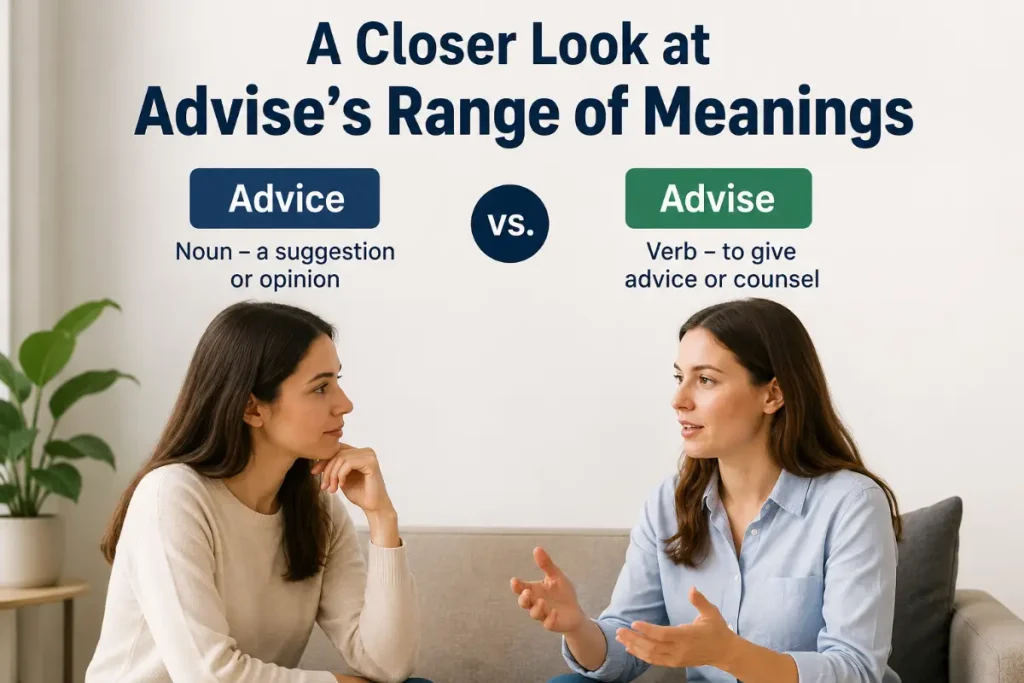
A Closer Look at Advise’s Range of Meanings
Advise covers more ground than just “giving a simple recommendation,” and it’s worth knowing its fuller range since it shows up differently depending on the context.
Recommending a course of action. I advise you to double-check the figures. This is the most familiar sense — suggesting what someone should do.
Warning or cautioning. The airline advised passengers of possible delays. Here, advise carries a sense of alerting someone to a risk or important consideration, not just offering a casual opinion.
Formally informing or notifying. Please advise us of your decision by Friday. This more businesslike sense of advise is essentially a formal synonym for “inform” or “let know,” and it’s extremely common in professional correspondence, contracts, and official notices.
Consulting or conferring. The two doctors advised together on the diagnosis. Less common but still valid, this sense treats advise as a mutual, back-and-forth exchange rather than one person simply telling another what to do.
Each of these senses shares the same core function — advise is always the act of communicating guidance, a warning, or information, which is exactly why it’s a verb, while advice remains the static thing being communicated.
Frequently Asked Questions
Why do advice and advise actually sound different, unlike most confusable word pairs?
This comes down to how English pronounces C versus S in this specific position — the C in advice produces a soft “s” sound, while the S in advise produces a “z” sound. It’s a genuine, consistent pronunciation rule, not just a coincidence, which is why reading the sentence aloud is such a reliable check for this particular pair.
Is “adviser” or “advisor” the correct spelling?
Both are correct and widely accepted. “Advisor” tends to appear more often in formal or official titles (financial advisor, advisor to the CEO), while “adviser” is common in general and journalistic writing, but neither spelling is considered wrong.
Can “advice” ever be used as a verb, or “advise” as a noun?
No — this is one of the cleaner noun/verb distinctions in English, without the crossover exceptions you sometimes see in other pairs. Advice is always the noun; advise is always the verb.
What does “please advise” mean in a business email?
It’s a common, slightly formal way of asking someone to provide information, a decision, or guidance — essentially “please let us know” or “please tell us how to proceed.” It’s the verb form, correctly used, even though it can feel a little terse or old-fashioned in casual correspondence.
What’s the fastest way to catch this error before publishing something?
Read the sentence aloud. If the word ends with a soft “s” sound (like “ice”), you want advice. If it ends with a “z” sound (like “wise”), you want advise. This pair is one of the few where your ear alone can usually catch the error, without needing a substitution test.
Practice Exercise
Fill in the blank with either “advice” or “advise” (or its verb forms). Answers are listed right after — try each one before checking.
- She gave me excellent ______ about my career.
- Can you ______ me on which laptop to buy?
- I always ______ people to save early for retirement.
- His ______ turned out to be exactly right.
- The doctor ______d her to rest for a week.
- We would ______ against signing without reading the contract.
- Thank you for the helpful ______.
- Please ______ us of any scheduling conflicts.
- The consultant’s ______ saved us a lot of money.
- I need someone to ______ me on this legal matter.
- Her ______ was practical and easy to follow.
- The financial advisor ______s clients on investments.
- He rarely gives unsolicited ______.
- They ______d the team to slow down and reassess.
- That’s some solid ______ for a first-time buyer.
- I would ______ caution before making a big purchase.
- The mentor’s ______ shaped her entire career.
- Please ______ me of the total cost before we proceed.
- Good ______ is hard to come by these days.
- The committee will ______ the board on next steps.
Answer Key
- advice
- advise
- advise
- advice
- advised
- advise
- advice
- advise
- advice
- advise
- advice
- advises
- advice
- advised
- advice
- advise
- advice
- advise
- advice
- advise
If you got sixteen or more correct, the sound-based test has already become instinct. For any you missed, try reading the sentence out loud — the “s” versus “z” sound usually gives away the answer immediately.
Before moving on, you may also want to read Continual vs Continuous: 20 Examples That Make It Clear (2026) for more helpful grammar tips.
The Bottom Line
Advice (with a C, sounds like “ice”) is the noun — the recommendation itself. Advise (with an S, sounds like “wise”) is the verb — the act of giving that recommendation. This is one of the rare confusable pairs where reading the sentence aloud genuinely helps, since the pronunciation difference lines up exactly with the spelling.
A simple way to remember Advice vs Advise is to focus on what you’re doing in the sentence: advice is something you give or receive, while advise describes the action of giving it. Once you connect the spelling, sound, and role of each word, this common mix-up becomes much easier to avoid.