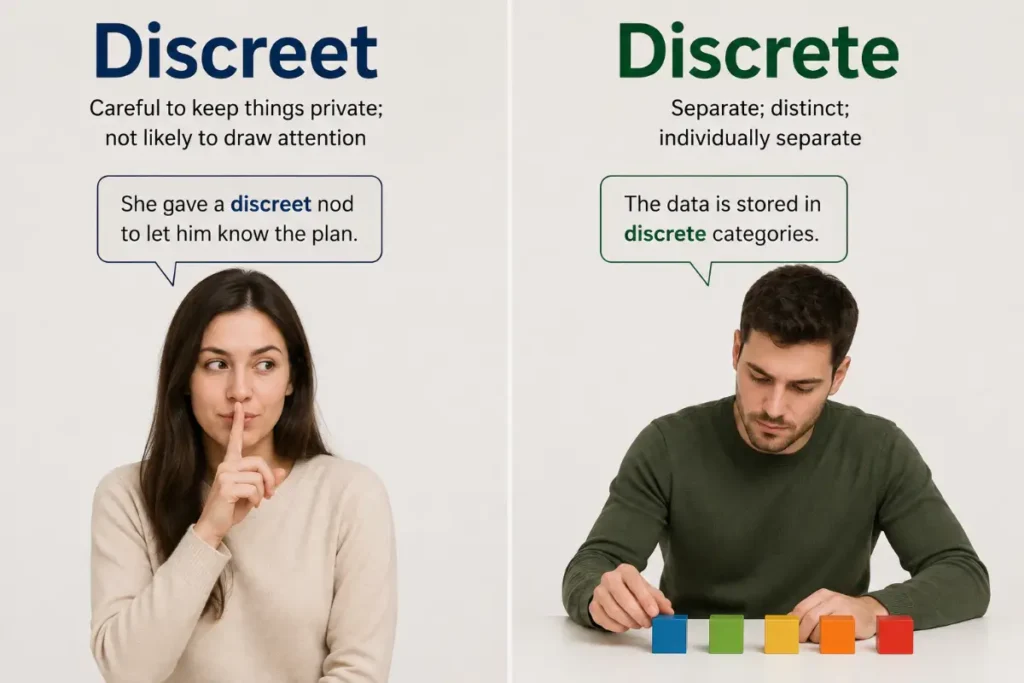
Merriam-Webster offers up what might be the single most elegant memory trick for Discreet vs Discrete: notice that in “discrete,” the letter T sits right between the two E’s, physically separating them—and “discrete” means separate. That one visual detail is genuinely enough to help you remember the difference permanently.
Discreet means careful, tactful, or unobtrusive — especially about sensitive information. Discrete means separate or individually distinct. Same pronunciation, same Latin root, completely different modern meanings.
You may also find Among vs Between: 5 Common Mistakes to Avoid in 2026 helpful if you want to explore this topic further.
The Quick Answer
- Discreet = careful, tactful, keeping things confidential
- She was discreet about the surprise party details.
- Discrete = separate, distinct, individual
- The form has three discrete sections.
The test: are you describing someone being careful, tactful, or private about something? Use discreet. Are you describing something as separate or individually distinct from other things? Use discrete.
Try it: “Please be ___ when discussing the layoffs.” Is this about tact and privacy? Yes — so it’s discreet: “Please be discreet when discussing the layoffs.”
Now try: “The survey was broken into five ___ categories.” Is this about separateness? Yes — so it’s discrete: “The survey was broken into five discrete categories.”
The Memory Trick That Actually Works
This is worth dwelling on because it’s genuinely one of the most reliable tricks covered anywhere on this site: discrete has its two E’s split apart by the letter T — dis-CRE-T-E — and the word itself means “separate.” The spelling literally demonstrates its own meaning. Discreet, by contrast, has its two E’s sitting right next to each other, unseparated — and this is the word that doesn’t mean “separate” at all.
Merriam-Webster confirms both words share the same Latin ancestor, “discretus,” which relates to both “keeping separate” and “discerning” — meaning careful judgment. Over time, English split that shared root into two specialized spellings: discrete kept the “separate” meaning, while discreet took on the “careful judgment, especially about sensitive matters” meaning. Knowing this shared origin helps explain why the words feel so closely linked despite meaning genuinely different things today.
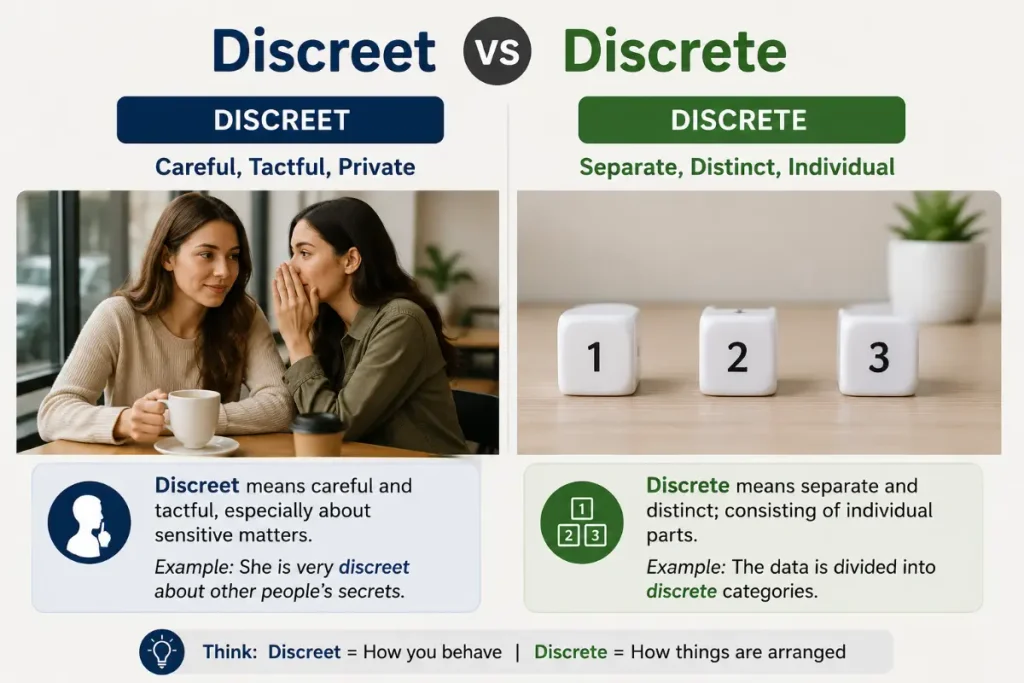
Discreet: Careful, Tactful, Private
Discreet describes behavior, speech, or action that shows good judgment, especially when it comes to keeping information confidential or avoiding embarrassment.
Examples:
- He was discreet about his salary negotiations.
- She handled the sensitive situation with discreet professionalism.
- The hotel offers a discreet entrance for high-profile guests.
- Please be discreet — this information isn’t public yet.
- He gave a discreet nod, signaling it was time to leave.
Notice the recurring theme: discretion, tact, and privacy. Discreet is the word you want anytime you’re describing someone being careful about what they reveal, or something designed to avoid drawing attention.
Discrete: Separate and Distinct
Discrete describes things that are individually separate, distinct, or unconnected from one another.
Examples:
- The project was divided into four discrete phases.
- Each department operates as a discrete unit within the company.
- The data points represent discrete measurements, not a continuous stream.
- We identified three discrete factors contributing to the delay.
- The software processes information in discrete batches.
Notice this word shows up especially often in technical, scientific, mathematical, and data-related writing — “discrete” versus “continuous” is a standard, precise distinction in fields like statistics, computer science, and mathematics, where it describes values that are countable and separate (like whole numbers) as opposed to values that flow continuously (like measurements of time or distance).
7 Easy Tricks to Never Mix Them Up
Mixing up discreet and discrete is easy because they sound exactly the same, but a few simple memory tricks can make the difference stick. Use these seven shortcuts whenever you’re unsure which word to choose.
1. Think “Secret” for Discreet
Discreet relates to being careful, private, or not drawing attention. Think of someone handling a secret quietly and tactfully.
Example: She was discreet about the confidential information.
2. Spot the “T” in Discrete
In discrete, the T sits between the two E’s:
discreTE? More importantly, remember the visual idea of T separating the E’s. Since discrete means separate or distinct, the spelling itself can serve as your reminder.
Example: The experiment consisted of three discrete stages.
3. Connect Discreet With Discretion
The noun discretion shares the same idea as discreet. If someone uses discretion, they act carefully and avoid revealing unnecessary information.
Discreet → discretion → careful/private
4. Connect Discrete With Separate
When something is discrete, it exists as a separate or individually identifiable unit.
Discrete → distinct → separate
This connection makes it much easier to choose the right word.
5. Ask: “Am I Describing Behavior?”
If you’re describing how a person acts, especially when they are being tactful, quiet, or private, choose discreet.
Example: He gave me a discreet warning.
6. Ask: “Am I Describing Separate Things?”
If you’re talking about things that are separate, distinct, or individually identifiable, choose discrete.
Example: The data was divided into discrete categories.
7. Use the Two-Word Memory Shortcut
When you’re stuck, remember this:
Discreet = private and careful
Discrete = separate and distinct
If you can quickly identify whether you’re talking about privacy or separation, you’ll usually have your answer immediately.
The Fastest Way to Check Yourself
Step 1: Are you describing someone being careful or tactful, especially about sensitive information? If yes, it’s discreet.
Step 2: Are you describing something as separate, individual, or distinct? If yes, it’s discrete.
Step 3: Use the spelling trick as your tiebreaker. In discrete, the T separates the two E’s — matching its “separate” meaning. In discreet, the two E’s sit together, unseparated.
A related memory trick some writers use: discreet relates to discretion, a noun everyone already knows means “careful judgment” — if the word “discretion” fits naturally into the sentence you’re checking, you want discreet.
For another useful perspective, check out Elicit vs Illicit: Same Sound, Completely Unrelated Meanings (2026).
This shared-Latin-root split is nearly identical in structure to compliment and complement — two words that once meant the same thing and gradually specialized into separate, non-overlapping modern meanings.
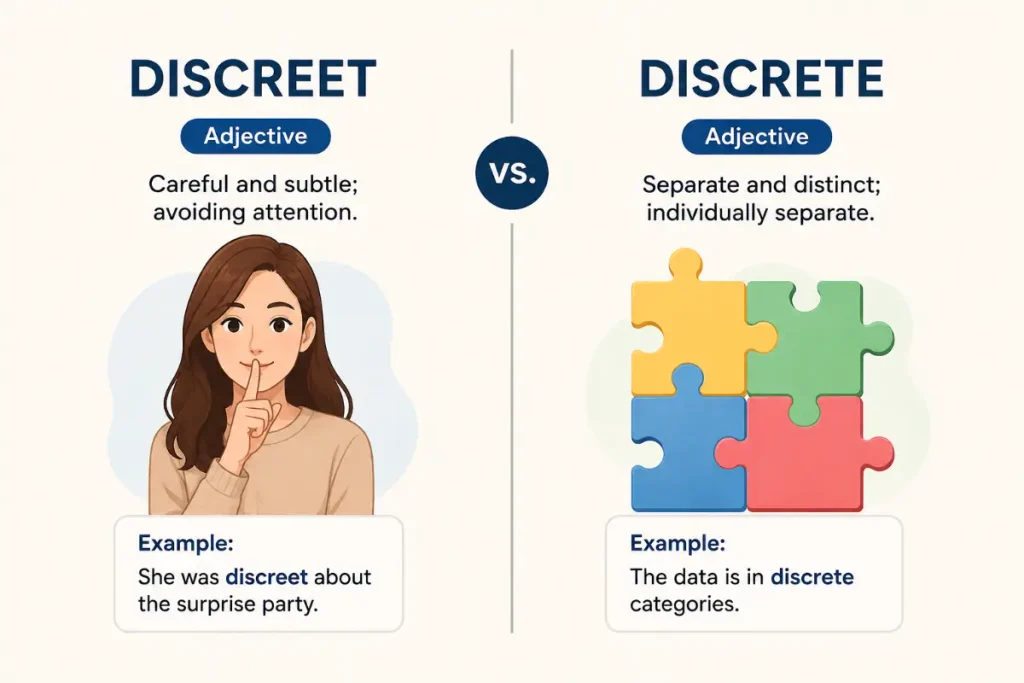
Discreet vs. Discrete: Side-by-Side Comparison
| Discreet | Discrete | |
|---|---|---|
| Meaning | Careful, tactful, private | Separate, individually distinct |
| Spelling clue | E’s sit together, unseparated | T separates the two E’s |
| Related word | Discretion | Discreteness |
| Example | a discreet conversation | discrete categories |
| Common fields | Everyday etiquette, privacy, business tact | Math, statistics, computer science, data |
| Shared origin | Both from Latin “discretus” | Both from Latin “discretus” |
A Closer Look at “Discrete” in Technical Fields
Because discrete carries such a specific, important technical meaning, it’s worth breaking down its use in fields where precision genuinely matters.
- In mathematics and statistics, “discrete” describes data or variables that take on distinct, countable values — the number of children in a family (0, 1, 2, 3…) is discrete data, since you can’t have 2.5 children. This contrasts directly with “continuous” data, like height or temperature, which can take any value within a range.
- In computer science, “discrete mathematics” is an entire foundational field of study focused on structures that are fundamentally separate and countable — like graphs, logic, and integers — as opposed to continuous mathematics, which deals with smoothly varying quantities.
- In signal processing and digital audio, a “discrete signal” refers to data sampled at distinct, separate points in time, as opposed to a continuous analog signal — this is literally the difference between digital and analog technology at a technical level.
- In every one of these technical contexts, “discrete” always means the same fundamental thing it means in everyday writing: separate, distinct, individually countable — just applied with more precision to a specific field.
Common Mistakes People Make
Mistake 1: “The witness gave a discrete account, careful not to reveal too much.” Should be “discreet account” — this describes careful, tactful behavior, not separateness.
Mistake 2: “The survey results fell into three discreet categories.” Should be “discrete categories” — this describes separate, distinct groupings, which needs discrete.
Mistake 3: “She kept her opinions discrete during the meeting.” Should be “discreet” — this describes tactful restraint, not separateness.
Mistake 4: “The data points were treated as discreet values in the analysis.” Should be “discrete values” — a clearly technical, mathematical use requiring the “separate” meaning.
Mistake 5: Assuming spell-check will catch it. Because both words are correctly spelled real words, and their identical pronunciation offers zero help in catching the error while proofreading aloud, this is one of the trickier pairs to self-correct without specifically checking meaning, not sound or spelling instinct.
More Examples to Lock It In
- The consultant was discreet about client details, while organizing her notes into discrete folders for each account.
- He made a discreet exit from the party, careful not to draw attention to the awkward moment.
- The app tracks fitness data as discrete daily entries rather than one continuous stream.
- She handled the layoffs with discreet professionalism, informing each employee in a private, separate conversation.
- The three discrete phases of the project each required a discreet level of confidentiality from the team.
Practice Exercise
Fill in the blank with either “discreet” or “discrete.” Answers are listed right after — try each one before checking.
- Please be ______ about the surprise party plans.
- The report was divided into five ______ sections.
- He handled the negotiation with ______ professionalism.
- The data consists of ______ values, not a continuous range.
- She made a ______ inquiry about the job opening.
- Each team operates as a ______ unit within the organization.
- The hotel has a ______ entrance for VIP guests.
- The software processes information in ______ chunks.
- He was ______ enough not to mention the mistake publicly.
- The experiment identified three ______ variables.
- She kept the medical details ______, sharing only with close family.
- The course covers ______ topics each week.
- His ______ handling of the situation avoided any embarrassment.
- The signal is sampled at ______ time intervals.
- They had a ______ conversation about the budget concerns.
- The categories are entirely ______ from one another.
- Please remain ______ regarding the ongoing investigation.
- The dataset includes several ______ measurements.
- She’s known for being ______ with sensitive information.
- The building has ______ zones for different departments.
Answer Key
- discreet
- discrete
- discreet
- discrete
- discreet
- discrete
- discreet
- discrete
- discreet
- discrete
- discreet
- discrete
- discreet
- discrete
- discreet
- discrete
- discreet
- discrete
- discreet
- discrete
If you got sixteen or more correct, the T-separates-the-E’s trick has already become second nature. For any you missed, go back and ask: tact and privacy (discreet), or separateness (discrete)?
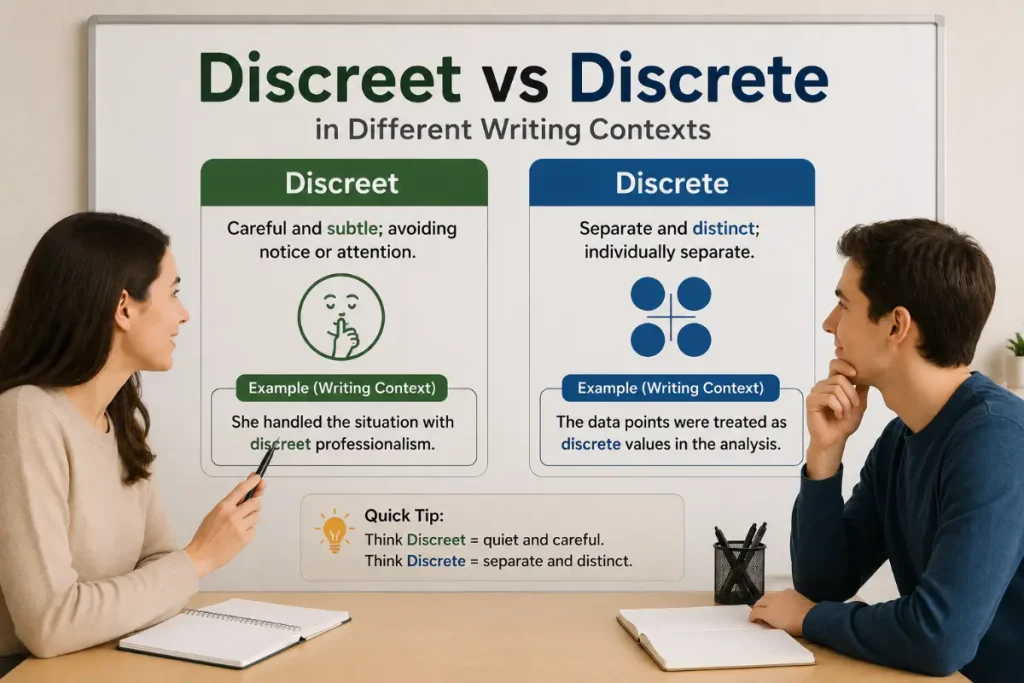
Discreet and Discrete in Different Writing Contexts
- In hospitality, luxury retail, and personal services, “discreet” is a heavily used marketing and service term — discreet packaging, discreet billing, discreet service — signaling privacy and tact to customers who value confidentiality, from high-end retail to healthcare services.
- In human resources and workplace writing, “discreet” appears constantly around sensitive matters — handling complaints discreetly, discreet communication about layoffs or investigations — making it one of the more professionally important words to spell correctly in HR documentation.
- In data science, engineering, and academic technical writing, “discrete” is a load-bearing technical term with precise mathematical meaning, and mixing it up with “discreet” in a research paper or technical specification would look like a genuine error to any reader familiar with the field.
- In general business and everyday writing, both words show up regularly but in different roles — discrete phases of a project, discrete departments, discrete steps in a plan, alongside a manager being discreet about personnel matters or a company being discreet in its public communications during a sensitive period.
Frequently Asked Questions
Why do discreet and discrete share the exact same Latin root if they mean different things now?
Both trace back to “discretus,” a Latin word relating to keeping things separate and to careful discernment or judgment. English eventually split this single root into two specialized spellings — discrete kept the “separate” sense, while discreet took on the “careful judgment, especially about sensitive matters” sense — a split that happened roughly five centuries ago and has held steady ever since.
Is “discreet” becoming less common than “discrete” in modern usage?
Some usage researchers have noted that “discrete” appears more frequently than “discreet” in current written English, partly due to its heavy use in technical, scientific, and data-related fields. That doesn’t mean discreet is falling out of standard use — it remains the correct, expected word for describing tact and privacy — but discrete’s technical applications give it a usage edge in raw frequency.
Is there a noun form for each word?
Yes — “discretion” is the noun form of discreet (careful judgment or the freedom to decide something based on one’s own judgment), while “discreteness” is the noun form of discrete (the state of being separate or distinct). These noun forms follow the same spelling logic as their adjective counterparts.
Does “discrete” always relate to math or technical fields, or is it used in everyday writing too?
While discrete shows up heavily in technical and scientific writing, it’s used constantly in everyday contexts too — discrete steps in a process, discrete parts of a plan, discrete groups of people. The technical usage is simply a more precise, specialized application of the same core “separate and distinct” meaning.
What’s the fastest way to catch this error before publishing something?
Since these words are pronounced identically, checking meaning is the only reliable method: are you describing tact or privacy (discreet), or separateness (discrete)? The spelling trick — the T separates the E’s in discrete, matching its meaning — is the fastest tiebreaker once you’ve identified which meaning you actually need.
Before moving on, you may also want to read Adverse vs Averse: 5 Common Mistakes to Avoid (2026 Guide) for more helpful grammar tips.
The Bottom Line
Discreet means careful, tactful, and private — think discretion. Discrete means separate and individually distinct — and its own spelling proves it, with the T physically separating the two E’s. Same sound, same ancient root, but two genuinely different jobs in modern English.
Discreet vs Discrete may sound identical, but their meanings are easy to separate once you know the trick. Discreet means careful, tactful, and private—think discretion. Discrete means separate and individually distinct, with the T in its spelling helping you remember the distinction. Same sound, different meanings, and now you can use both with confidence.