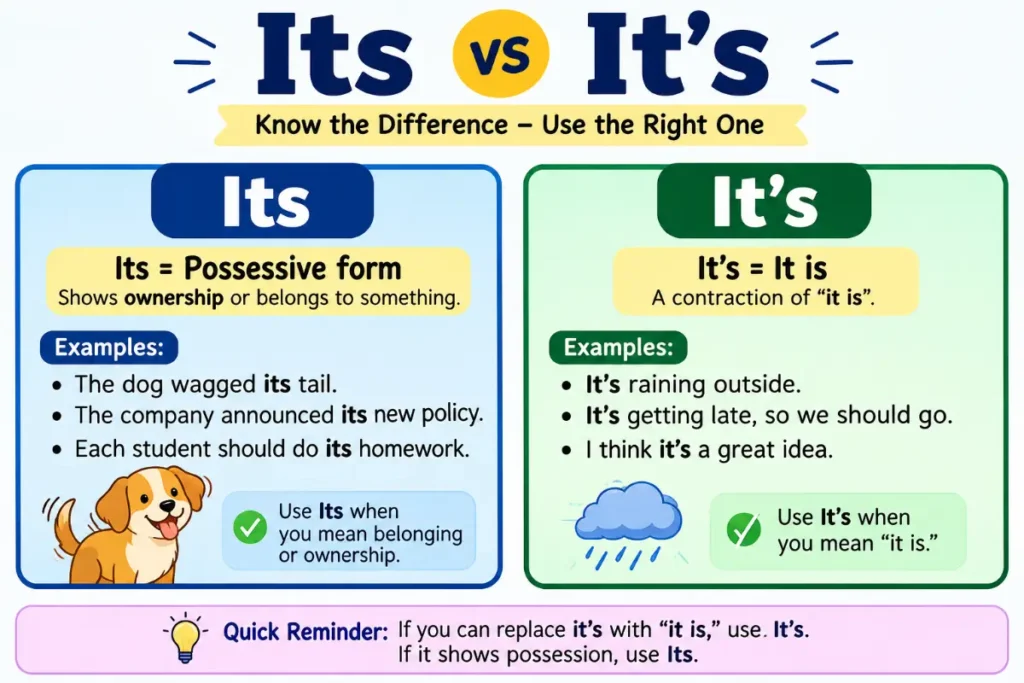
Of every mix-up in English, its vs it’s might be the single most common one — and also the one people feel most embarrassed about getting wrong, since it’s usually taught as a “basic” rule. Here’s the good news: the fix is genuinely simple once it clicks, and it works 100% of the time, with zero exceptions.
Its (no apostrophe) shows possession — something belongs to it. It’s (with an apostrophe) is a contraction of “it is” or “it has.” That’s the whole rule. There’s no version of this pair where the logic bends, unlike a lot of English grammar.
You may also find Less vs Fewer: 5 Easy Rules You’ll Never Forget (2026) helpful if you want to explore this topic further.
The Quick Answer
- Its = belonging to it (possessive)
- The cat licked its paw.
- It’s = “it is” or “it has” (contraction)
- It’s raining outside. / It’s been a long day.
The test: try replacing the word with “it is” or “it has.” If the sentence still makes sense, use it’s. If it sounds wrong or nonsensical, use its.
Try it: “The company changed ___ logo.” Swap in “it is” — “The company changed it is logo.” That’s nonsense, so the answer is its.
Now try: “___ raining again.” Swap in “it is” — “It is raining again.” That works, so the answer is it’s.
Why This Is the Most Confused Pair in English
The reason this trips people up more than almost any other grammar point comes down to one thing: apostrophes usually do mean possession. “Sarah’s car,” “the dog’s leash,” “the company’s policy” — in every one of those, an apostrophe plus S shows ownership. So it’s a completely reasonable instinct to assume “it’s” should follow the same pattern.
But pronouns are the exception to that rule across the board, not just with “it.” Think about “his,” “hers,” “ours,” “yours,” and “theirs” — none of them use an apostrophe to show possession, even though they’re all possessive words. “Its” fits that same family. The apostrophe rule that applies to nouns simply doesn’t apply to pronouns, and “it” is a pronoun.
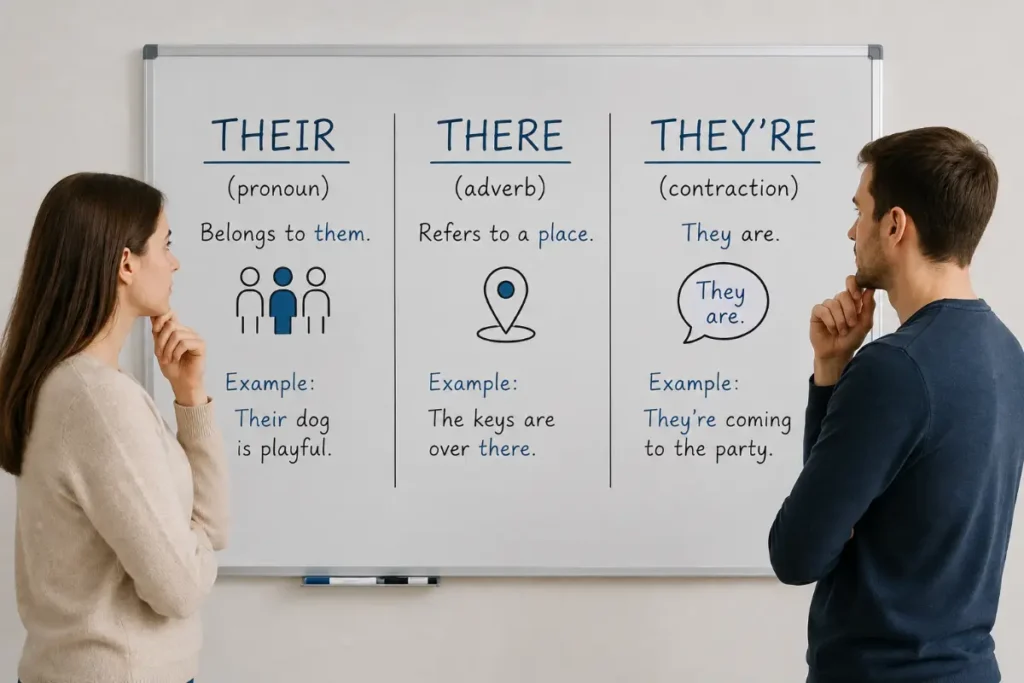
This is closely related to the confusion people run into with their vs. there vs. they’re — in both cases, the apostrophe version is a contraction, not a possessive, even though it looks like it should be the other way around.
Its: Showing Possession
“Its” tells you that something belongs to “it” — an object, an animal, a company, an idea, anything referred to as “it” rather than “he,” “she,” or “they.”
Examples:
- The company updated its return policy.
- The dog wagged its tail excitedly.
- The book lost its cover somewhere in the move.
- Every rule has its exceptions.
- The team celebrated its first win of the season.
Notice that in every one of these, you could ask “whose?” and the answer is “it” (the company’s, the dog’s, the book’s). That’s the possession test — if the sentence is describing ownership by a non-human, non-gendered subject, you want “its.”
It’s: “It Is” or “It Has”
“It’s” only ever means one of two things: “it is” or “it has.” If you can’t expand it into one of those two phrases, it’s the wrong word.
Examples using “it is”:
- It’s cold outside today.
- It’s important to double-check your work.
- I think it’s time to go.
Examples using “it has”:
- It’s been raining all week.
- It’s gotten late faster than I expected.
- It’s taken longer than we thought.
Both uses are extremely common, and the same expansion test works for both — just try both expansions (“it is” and “it has”) and see which one fits the sentence you’re checking.
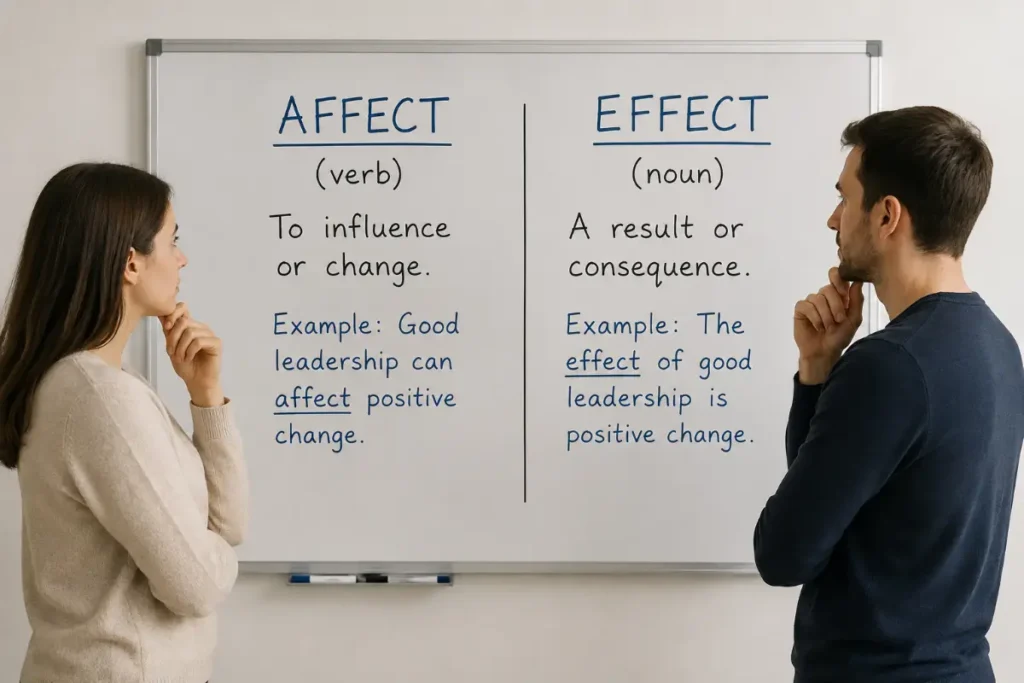
It’s a similar situation to affect and effect: two words that sound related and get used constantly, where one quick mental test resolves the confusion almost instantly once it’s automatic.
The One-Second Trick
Here’s the fastest way to check yourself, and it works every single time without exception:
Read the sentence back with “it is” in place of the word. If it makes sense, you need the apostrophe. If it sounds like gibberish, you don’t.
That’s genuinely the whole trick. Unlike affect/effect or their/there/they’re, this pair doesn’t have edge cases or rare alternate meanings to memorize — it’s a clean, binary test that works 100% of the time.
Some writers also use a visual shortcut: picture the apostrophe in “it’s” as a tiny stand-in for the missing letter in “it is” (the “i” that got squeezed out). If you remember that the apostrophe is replacing something, not adding possession, the whole rule becomes intuitive.
Its vs. It’s: Side-by-Side Comparison
| Its | It’s | |
|---|---|---|
| Type | Possessive pronoun | Contraction |
| Meaning | Belongs to it | It is / it has |
| Example | The bird built its nest. | It’s building a nest. |
| Test | Ask “whose?” | Try “it is” or “it has” |
| Apostrophe | Never | Always |
| Exceptions | None | None |
Common Mistakes People Make
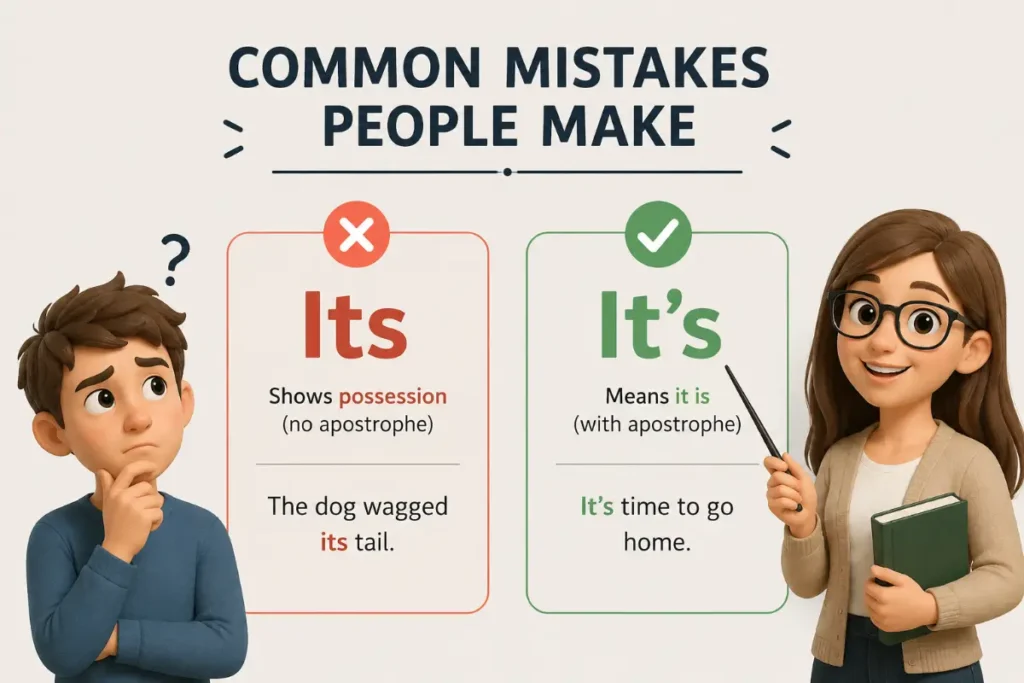
Mistake 1: “The company lost it’s biggest client.” Should be “its biggest client” — this is possession (the client belonged to the company), not a contraction.
Mistake 2: “Its been a long week.” Should be “It’s been a long week” — this is short for “it has been,” so it needs the apostrophe.
Mistake 3: “The dog wagged it’s tail.” Should be “its tail” — the tail belongs to the dog, so no apostrophe.
Mistake 4: Autocorrect making it worse. Some phone keyboards default to inserting an apostrophe whenever you type “its,” assuming you meant the contraction. This actually introduces errors for people who were typing correctly in the first place. If you’re proofreading on mobile, it’s worth double-checking every instance of “it’s” specifically, since autocorrect can silently “fix” a correct word into a wrong one.
Mistake 5: Overcorrecting after learning the rule. Once people learn “pronouns don’t use apostrophes for possession,” they sometimes start dropping the apostrophe from “it’s” even when they mean “it is.” Remember, the rule isn’t “never use an apostrophe with its” — it’s “use the apostrophe only when you mean ‘it is’ or ‘it has.'”
More Examples to Lock It In
- The restaurant changed its menu, and it’s actually better than before.
- It’s clear that the team gave its best effort.
- The plant lost its leaves because it’s been too cold this month.
- Every business has its slow season, and it’s smart to plan for it.
- The car needs its oil changed — it’s been almost a year.
- It’s obvious the app updated its interface recently.
- The company celebrated its anniversary, and it’s grown a lot since then.
- It’s rare for a movie to live up to its hype.
- The storm lost its intensity once it’s moved inland.
- Its hard to say when it’s going to finish.
That last one is intentionally wrong — did you catch it? It should read “It’s hard to say when it’s going to finish,” since both instances mean “it is.” If you spotted it, the expansion test has already become second nature.
Practice Exercise
Fill in the blank with either “its” or “it’s.” Answers are listed right after — try each one before checking.
- The company raised ______ prices last month.
- ______ going to be a long meeting.
- The bird returned to ______ nest before sunset.
- ______ been a while since we last talked.
- The software fixed ______ biggest bug in the update.
- I think ______ time to leave.
- Every plan has ______ weak points.
- ______ clear the team worked hard on this.
- The store extended ______ hours for the holidays.
- ______ amazing how fast the year went.
- The team celebrated ______ first big win.
- ______ hard to say what happens next.
- The city updated ______ recycling program.
- ______ been nice getting to know everyone.
- The app crashed because of ______ own bug.
- ______ probably too late to change the plan now.
- The company shared ______ quarterly results today.
- ______ funny how quickly things changed.
- The garden lost ______ color after the frost.
- ______ worth double-checking before you send it.
Answer Key
- its
- It’s
- its
- It’s
- its
- it’s
- its
- It’s
- its
- It’s
- its
- It’s
- its
- It’s
- its
- It’s
- its
- It’s
- its
- It’s
If you got most of these right without hesitating, the expansion test has already become instinct. If a couple slipped by, go back and try reading each blank out loud with “it is” swapped in — the wrong choice usually sounds off immediately.
What the Style Guides Say
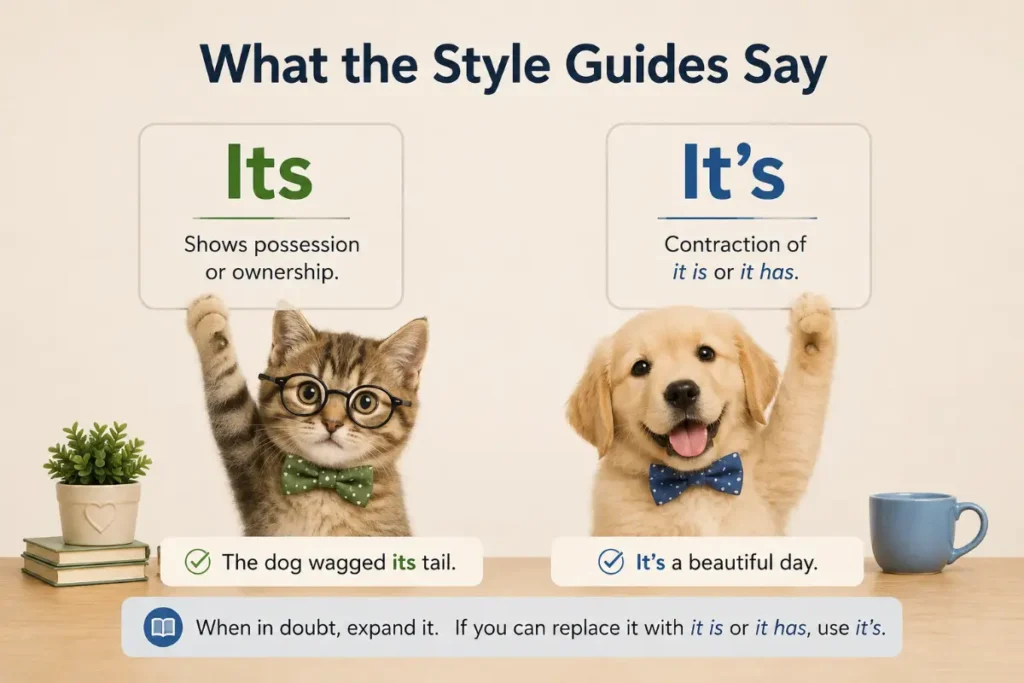
Merriam-Webster lists “its” as a possessive form of “it” with no apostrophe, and “it’s” as a contraction of “it is” or “it has” — full stop, no alternate readings. The AP Stylebook flags this specific mix-up as one of the most frequent errors it sees in submitted copy, and the Chicago Manual of Style treats it the same way every other major U.S. reference does: as a fixed rule with zero acceptable exceptions, unlike some grammar points that vary by style guide or publication.
Purdue OWL, widely used in U.S. writing centers and composition courses, ranks its/it’s among the top handful of errors instructors flag most often in student writing — right alongside their/there/they’re. That consistency across independent, authoritative sources is exactly why this rule is worth memorizing rather than looking up every time: every major reference agrees, with no gray area to navigate.
Where This Mistake Shows Up Most
Some grammar errors are evenly distributed across every kind of writing. This one isn’t. A few places where its/it’s mistakes cluster more than usual:
Company and brand writing. Marketing copy, product descriptions, and “About Us” pages are full of sentences like “the brand and it’s mission” or “the app updated it’s features” — usually because the writer was moving fast and focused on tone rather than mechanics. Ironically, brand voice guidelines often emphasize sounding polished and trustworthy, which makes this exact mistake more damaging in that context than almost anywhere else.
For another useful perspective, check out Among vs Between: 5 Common Mistakes to Avoid in 2026.
Social media captions. Because captions are short and written quickly, its/it’s errors are extremely common here — and mostly harmless, since readers skim captions rather than parse them closely. Still, a business account making this mistake repeatedly can start to look less professional over time, even if no single instance matters much.
Instruction manuals and how-to guides. These often include phrases like “check the device and its settings” or “confirm it’s connected properly,” and because both patterns appear so often side by side, writers sometimes default to one spelling out of habit rather than checking each instance. This is one of the more consequential places to get it right, since confusing instructions can genuinely slow a reader down.
Emails written on mobile devices. Typing on a phone keyboard increases error rates for this pair specifically, partly due to autocorrect behavior and partly because people proofread mobile messages less carefully than messages typed on a full keyboard.
A Deeper Look at Why Pronouns Break the Apostrophe Rule
It’s worth understanding why pronouns don’t follow the same possessive pattern as nouns, because once the logic makes sense, the exception stops feeling like an arbitrary rule you just have to memorize.
Regular nouns need an apostrophe to show possession because, without one, there’d be no way to distinguish a possessive from a plural. “The dogs bones” is ambiguous — plural dogs, or one dog’s bones? The apostrophe in “the dog’s bones” resolves that ambiguity.
Pronouns don’t have this problem. “It,” like “he,” “she,” and “they,” already has a dedicated possessive form built into the word itself — “its,” just like “his,” “hers,” and “theirs.” There’s no ambiguity to resolve, so English never developed an apostrophe convention for these words. The apostrophe in “it’s” isn’t there for possession at all — it’s purely standing in for a missing letter, the same job an apostrophe does in “don’t” (do not) or “can’t” (cannot).
Once you see “it’s” as belonging to the same family as “don’t” and “can’t” — contractions, not possessives — the whole rule stops feeling like a trick and starts feeling like simple logic.
Its and It’s in Different Writing Contexts
In casual writing, this mistake is everywhere and mostly forgiven — texting “its” instead of “it’s” rarely derails a conversation. But it’s still one of the fastest tells that a piece of writing wasn’t proofread, even in low-stakes settings.
In professional writing, this is one of the errors hiring managers and editors notice immediately. A resume or cover letter with “the company grew it’s revenue” instead of “its revenue” can read as careless, even if the rest of the writing is strong — because this particular rule is considered basic enough that getting it wrong stands out.
In published content, this error can actually hurt credibility with readers who do know the rule, and search engines increasingly reward content that reads as carefully edited. A blog post riddled with its/it’s errors sends a small but real signal of lower quality, the same way a typo-filled headline makes a reader trust a site less before they’ve even read the article.
In academic writing, precision matters just as much, especially since so much academic prose relies on describing what something “is” or “has” — exactly the territory where “it’s” belongs.
Frequently Asked Questions
Is there ever a case where “its” needs an apostrophe?
No. This is one of the few grammar rules in English with zero exceptions. “Its” as a possessive pronoun never takes an apostrophe, in any context, formal or informal.
What about “it’s” meaning “it has” — is that really correct?
Yes. “It’s been a while” is just as correct as “it’s raining,” because “it’s” can expand to either “it is” or “it has.” Both are standard contractions.
Why does autocorrect keep changing my correct “its” to “it’s”?
Predictive text on many phones assumes “it’s” is more common in casual writing (which is often true) and defaults to it. This means you may need to manually correct your phone’s autocorrect, especially if you’re writing something more formal like a work email.
Is “its'” ever correct, with the apostrophe after the S?
No — “its'” isn’t a real word in standard English. This sometimes appears when someone mistakenly applies the plural possessive pattern (like “the dogs’ bones”) to “its,” but “its” is already singular and already possessive without any apostrophe at all.
How can I catch this error before publishing something?
Search your document for every instance of “it’s” and “its,” then run the “it is” / “it has” test on each one individually. Because both are correctly spelled words, spell-check often won’t catch a wrong-but-valid choice, so a manual pass really is the most reliable method.
Is this rule different in British English versus American English?
No — its and it’s follow the exact same rule in every major English dialect. Spelling conventions differ between American and British English in plenty of places (color/colour, organize/organise), but the apostrophe logic for pronouns is identical everywhere English is written.
Why do some very experienced writers still get this wrong occasionally?
Mostly speed, not lack of knowledge. Its and it’s is one of those rules almost every fluent writer has memorized, but under time pressure — dashing off a quick email, typing a caption between meetings — fingers sometimes move faster than the rule gets applied. That’s actually reassuring: getting this wrong once in a while doesn’t mean you don’t know the rule, it just means you’re human and typing fast.
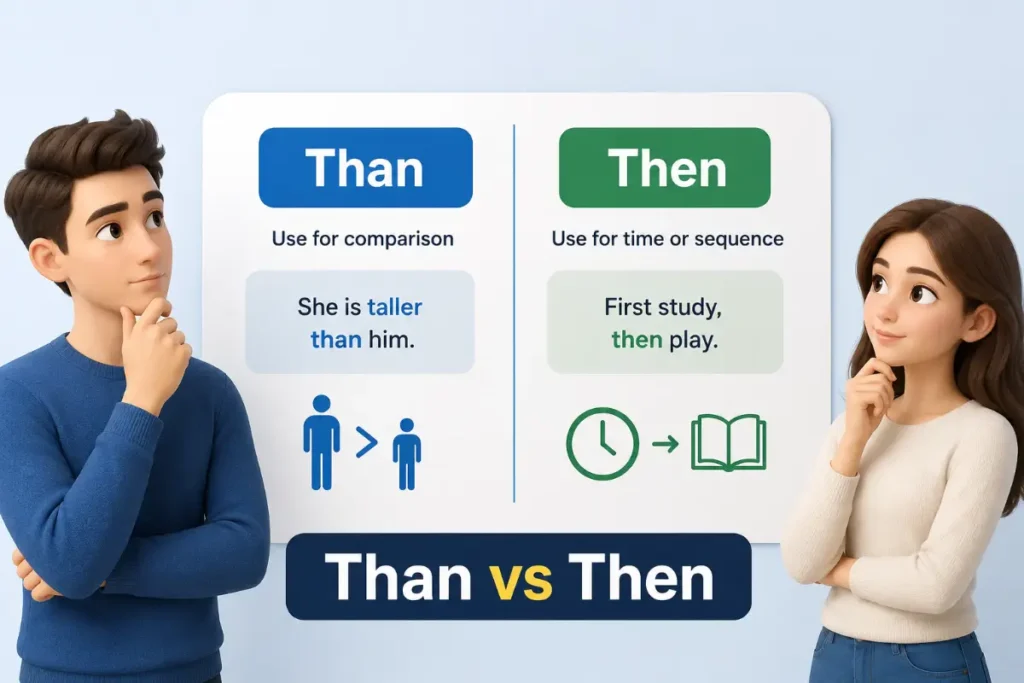
Before moving on, you may also want to read Than vs Then: The Simple Rule That Ends the Confusion (2026) for more helpful grammar tips.
The Bottom Line
Its shows possession, no apostrophe, no exceptions. It’s is short for “it is” or “it has,” always with an apostrophe. The one-second test — try swapping in “it is” — works every time, which makes this one of the easiest grammar rules to master permanently once it clicks.