Confused about quotation marks inside quotation marks rules? When one quote appears inside another, things can get tricky fast. Learn the simple rules for nesting quotes correctly, with clear examples you can use in everyday writing.
The basic quotation marks are simple enough on the surface: double quotes for the outer quotation, single quotes for the one nested inside it. But the genuinely tricky part — the part most guides skip — is what happens at the edges, when punctuation marks pile up right next to each other or when a quote gets nested three levels deep. This guide goes straight at those edge cases.
You may also find When to Use a Dash Instead of a Comma (2026 Guide) helpful if you want to explore this topic further.
The Core Rule, Quickly
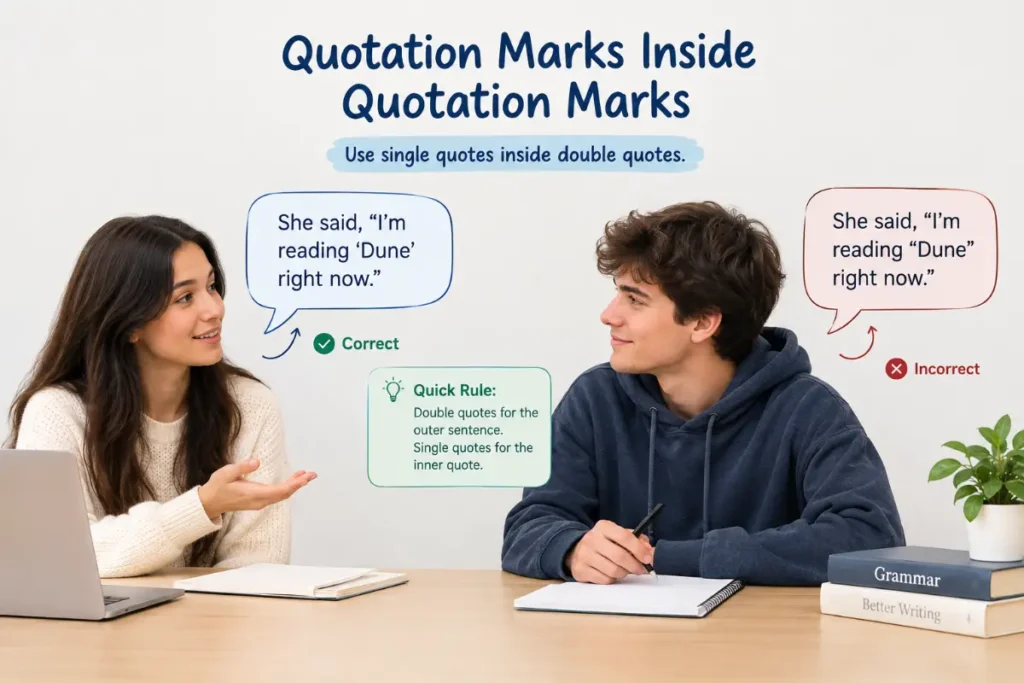
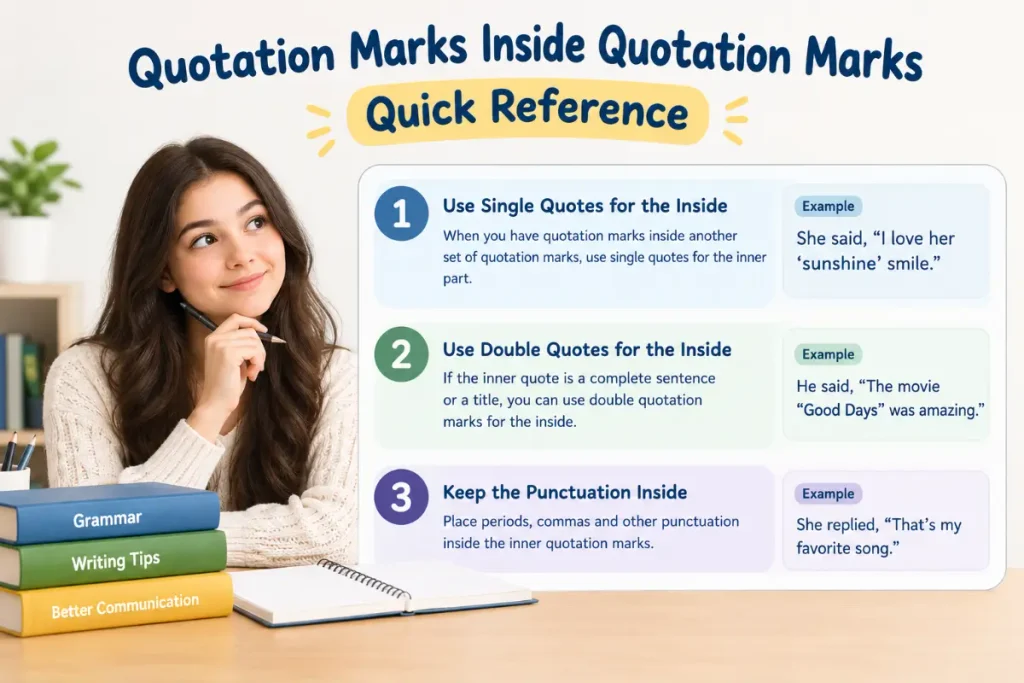
In American English, when you need to show a quotation within a quotation, the outer quote uses double quotation marks and the inner one uses single quotation marks.
- The reporter told me, “When I interviewed the quarterback, he said they simply ‘played a better game.'”
That’s the foundation. Now here’s where it actually gets interesting.
Edge Case 1: When the Single and Double Quotation Marks Land Right Next to Each Other
This is the single most commonly asked question about quotation marks inside quotation marks rules, and the Chicago Manual of Style’s own FAQ addresses it directly. When a nested quotation ends at exactly the same spot as the sentence it’s embedded in, you end up with a single quotation mark immediately followed by a double quotation mark: ‘” or .'”
Chicago’s own guidance: “When single quotation marks are nested within double quotation marks, and two of the marks appear next to each other, a space between the two marks, though not strictly required, aids legibility.”
Without the space:
- He announced, “These quotation marks look terrible.'”
With the space (Chicago’s recommended, more legible option):
- He announced, “These quotation marks look terrible.’ “
Neither is strictly “wrong,” but adding a thin space between the two closing marks makes it visually clear that two distinct punctuation marks are stacking up, rather than looking like a single odd symbol or a typo.
Edge Case 2: Punctuation Placement With the Inner Quote
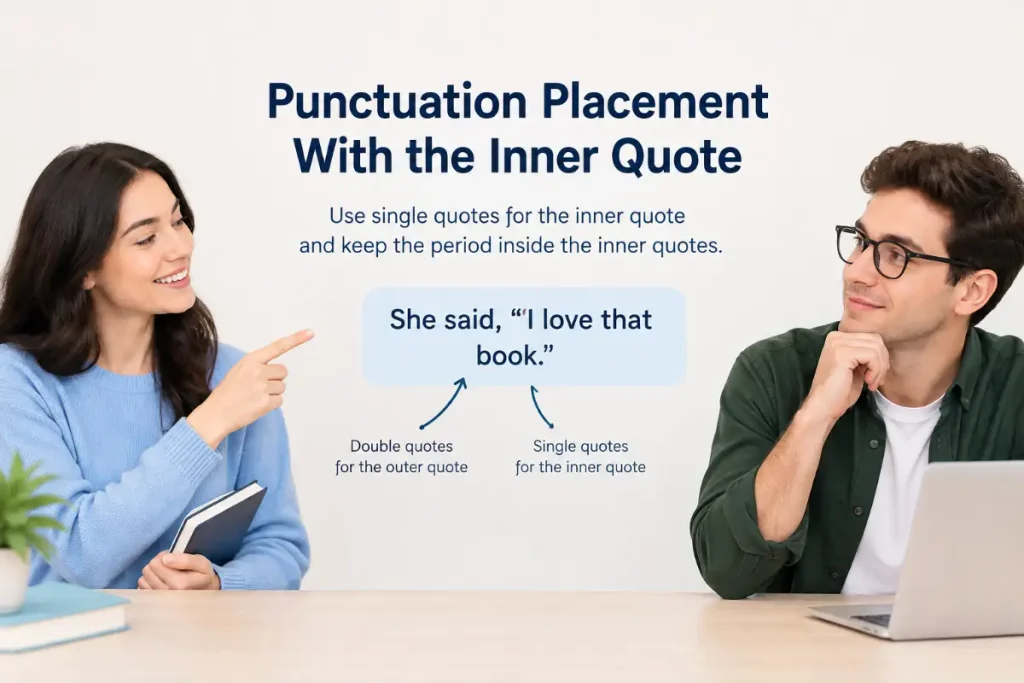
Commas and periods that belong to the inner (single-quoted) material go inside the single quotation marks, following the same logic as standard American quotation mark rules — just one level down.
- She said, “He told me, ‘I’ll be there by six,’ but he never showed up.”
Notice the comma after “six” sits inside the single quotation marks, since it’s part of what “he” originally said, while the sentence continues within the outer double-quoted material.
Edge Case 3: What Happens With Three Levels of Nesting
This is rare, but it does happen — usually when quoting someone who is themselves quoting someone else’s quotation. Most American style guides, including Chicago, recommend simply alternating back to double quotation marks for the third level, though this is explicitly discouraged as a regular practice because of how visually confusing it becomes.
- She said, “He told me, ‘The teacher said, “Class is canceled,” and everyone cheered.'”
Most style guides strongly recommend restructuring a sentence rather than nesting quotations three levels deep. If you find yourself needing this many layers, it’s almost always clearer to paraphrase the outermost or innermost layer instead.
Edge Case 4: Question Marks and Exclamation Points at the Boundary
When a nested quotation ends in a question mark or exclamation point right at the boundary with the outer quote, that punctuation stays with whichever quotation it actually belongs to, and no additional period is added.
- He asked, “Did she really say, ‘I quit’?”
Here, the question mark belongs to the outer question (he’s asking whether she said this), so it sits outside the single quotation marks but inside the double ones — and no extra period is needed at the very end, since the question mark is already doing the job of closing the sentence.
Compare this to a case where the inner quotation itself is the question:
- She said, “He actually asked me, ‘Are you coming?'”
Here, the question mark belongs to the inner quoted question, so it sits inside both the single and double closing marks.
Edge Case 5: British English Reverses the Whole System
This is worth knowing if you’re ever working with UK-published material or writing for a British audience: British convention traditionally reverses the American system entirely — single quotation marks for the primary quotation, and double quotation marks for anything nested inside it.
American: She said, “He told me, ‘Wait here.'”
British: She said, ‘He told me, “Wait here.”‘
Neither system is more “correct” in an absolute sense — they’re simply different national conventions, and consistency within a single piece of writing matters more than which system you choose, provided you’re clear on which audience or publication standard you’re following.
The Fastest Way to Check Yourself
Step 1: Identify the outer quotation first. In American English, that gets double quotation marks.
Step 2: Identify anything quoted within that outer quotation. That gets single quotation marks.
Step 3: Check where punctuation belongs. Commas and periods that are part of the inner quote go inside the single marks; commas and periods that belong to the outer sentence go inside the double marks.
Step 4: If a single and double mark land right next to each other, consider adding a thin space for legibility, following Chicago’s own recommendation.
Quotation Marks Inside Quotation Marks: Quick Reference
| Situation | Rule | Example |
|---|---|---|
| Standard nesting | Double outside, single inside | “She said, ‘stop.'” |
| Marks landing adjacent | Space optional but recommended | “…’quit.’ “ |
| Comma/period belonging to inner quote | Inside single marks | “He said, ‘wait,’ then left.” |
| Question mark belonging to outer sentence | Outside single marks, inside double | “Did she say ‘go’?” |
| Three levels of nesting | Alternate back to double (avoid if possible) | “‘”…'” |
| British English | Single outside, double inside (reversed) | ‘She said, “stop.”‘ |
Common Mistakes People Make
Mistake 1: Using double quotation marks for both the outer and inner quote. “She said, “stop.”” is incorrect and visually confusing — the inner quotation needs single marks: “She said, ‘stop.'”
Mistake 2: Forgetting to close the inner single quotation mark. “He said, ‘I’ll call you tomorrow.” is missing the closing single quote before the closing double quote: “He said, ‘I’ll call you tomorrow.'”
For another useful perspective, check out Apostrophe Rules for Plurals: 9 Simple Rules to Get It Right (2026).
Mistake 3: Placing a comma outside the single quotation marks when it belongs to the inner quote. “She told me, ‘wait here’, and then left” should have the comma inside the single marks, following standard American placement: “She told me, ‘wait here,’ and then left.”
Mistake 4: Mixing American and British conventions within the same document. Using double-then-single nesting in one paragraph and single-then-double in another creates visible inconsistency — pick one national convention and apply it throughout.
Mistake 5: Over-nesting instead of restructuring. Building a sentence with three or more layers of nested quotations, when simply paraphrasing the outer layer would be far clearer, makes writing needlessly hard to follow.
More Examples to Lock It In
- The witness testified, “The officer told me, ‘Stay in your vehicle,’ so I did.”
- She laughed and said, “He actually asked, ‘Is this seat taken?’ like we hadn’t met before.”
- The article quoted him directly: “My coach always said, ‘Practice like you’ve never won.'”
- “Did he really say, ‘I’m not coming back’?” she asked, stunned.
Frequently Asked Questions
Is the space between adjacent single and double quotation marks required, or just recommended?
According to the Chicago Manual of Style, it’s not strictly required, but it’s recommended specifically for legibility, since two quotation marks sitting directly against each other can be hard to read clearly, especially in smaller print or certain fonts.
What should I do if I need to nest a quote more than two levels deep?
Most style guides recommend restructuring the sentence instead, since three or more levels of nested quotation marks becomes genuinely difficult for readers to parse accurately, regardless of how carefully the punctuation is applied.
Does this system change in digital or web writing?
The core American quotation marks inside quotation marks rules stay the same across print and digital writing, though some digital typography (especially “smart quotes” auto-formatting) can sometimes render single and double marks inconsistently, which is worth double-checking in published web content.
Why does British English reverse the entire quotation mark system?
This is simply a difference in historical printing convention between American and British publishing traditions, with no functional advantage to either system — both are internally consistent, just built in opposite directions.
What’s the fastest way to catch nested quotation mark errors before publishing something?
Work outward to inward: confirm the outer quotation is properly opened and closed with double marks (in American English), then check that anything quoted within it is properly opened and closed with single marks, and verify that punctuation at each boundary is placed according to which quotation it actually belongs to.
Practice Exercise
Add the correct quotation marks to each sentence. Use double quotation marks for the main quotation and single quotation marks for a quotation inside it. Answers are listed right after—try each one before checking.
- She said, He told me, Wait here and then left.
- The teacher asked, Did you really say, I forgot my homework?
- He admitted, My father always told me, Work hard and be patient.
- Maria whispered, She just said, Don’t worry about it.
- James said, My sister asked, Are you coming with us?
- The manager announced, The CEO said, We will open the new office next month.
- She asked, Did he really tell you, I never agreed to that?
- The child shouted, Mom said, Don’t touch the stove.
- He explained, My grandfather always said, A little kindness goes a long way.
- The reporter asked, Did the mayor say, We will fix the problem?
- Sarah replied, Tom told me, I need more time.
- The coach said, The captain reminded us, Stay focused until the final whistle.
- He wrote, My teacher once said, Practice makes progress.
- The doctor explained, Your mother said, I feel much better today.
- Lisa asked, Did you hear her say, I will call you tomorrow?
- The guide announced, The tour leader said, Please stay together.
- She recalled, My father asked, Have you finished your work?
- The student admitted, My friend told me, I forgot the assignment.
- He said, The customer shouted, I want a refund.
- The principal announced, The teacher said, Everyone must submit the project by Friday.
Answer Key
The principal announced, “The teacher said, ‘Everyone must submit the project by Friday.'”ome second nature.
- She said, “He told me, ‘Wait here,’ and then left.”
- The teacher asked, “Did you really say, ‘I forgot my homework’?”
- He admitted, “My father always told me, ‘Work hard and be patient.'”
- Maria whispered, “She just said, ‘Don’t worry about it.'”
- James said, “My sister asked, ‘Are you coming with us?'”
- The manager announced, “The CEO said, ‘We will open the new office next month.'”
- She asked, “Did he really tell you, ‘I never agreed to that’?”
- The child shouted, “Mom said, ‘Don’t touch the stove.'”
- He explained, “My grandfather always said, ‘A little kindness goes a long way.'”
- The reporter asked, “Did the mayor say, ‘We will fix the problem?'”
- Sarah replied, “Tom told me, ‘I need more time.'”
- The coach said, “The captain reminded us, ‘Stay focused until the final whistle.'”
- He wrote, “My teacher once said, ‘Practice makes progress.'”
- The doctor explained, “Your mother said, ‘I feel much better today.'”
- Lisa asked, “Did you hear her say, ‘I will call you tomorrow?'”
- The guide announced, “The tour leader said, ‘Please stay together.'”
- She recalled, “My father asked, ‘Have you finished your work?'”
- The student admitted, “My friend told me, ‘I forgot the assignment.'”
- He said, “The customer shouted, ‘I want a refund.'”
- The principal announced, “The teacher said, ‘Everyone must submit the project by Friday.'”
Before moving on, you may also want to read Use an Em Dash: 7 Smart Ways to Use It Correctly (2026) for more helpful grammar tips.
The Bottom Line
The core quotation marks inside quotation marks rules are simple — double marks outside, single marks inside, in American English — but the real skill is handling the edge cases: adding a space when marks land adjacent, placing punctuation correctly at each boundary, and knowing when to stop nesting and restructure instead. Master those edge cases, and this stops being one of the more intimidating corners of English punctuation.
For the broader foundation these rules build on, see our complete guide to using quotation marks correctly — and if you’re formatting spoken conversation rather than embedded quotations, our guide to punctuating dialogue covers that closely related territory.