Confused about How to Punctuate Dialogue without making your writing look awkward? From commas and quotation marks to question marks and dialogue tags, a few simple rules can make conversations feel natural, clear, and easy to follow.
Learning how to punctuate dialogue correctly is one of those skills that separates polished, professional-looking writing from a page that confuses readers within the first exchange. Whether you’re writing a novel, a short story, or a personal essay with a remembered conversation, the rules are consistent and genuinely learnable — and once you’ve internalized them, you’ll never have to second-guess a comma placement again.
You may also find When to Use a Dash Instead of a Comma (2026 Guide) helpful if you want to explore this topic further.
The Quick Answer
The core rules for how to punctuate dialogue in American English:
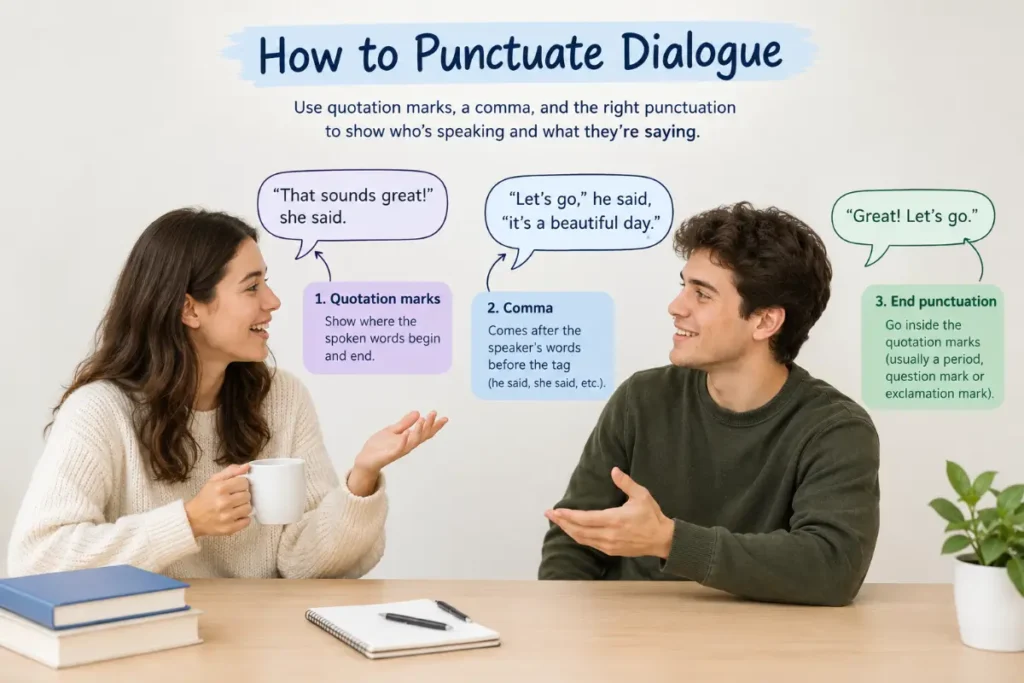
- Enclose spoken words in double quotation marks.
- Keep commas and periods inside the closing quotation mark.
- Start a new paragraph every time the speaker changes.
- Use a comma (not a period) before a dialogue tag like “she said” when the tag follows the quote.
- “I’ll be there by noon,” she said.
- He replied, “That works for me.”
- “Wait,” she said, “I need to grab my coat.”

Rule 1: Enclose Spoken Words in Quotation Marks
Every word a character actually speaks goes inside double quotation marks. Purdue OWL confirms this is standard convention across American fiction and nonfiction writing alike — quotation marks exist specifically to separate spoken words from the surrounding narration, so readers always know exactly who is talking.
- “I don’t think that’s a good idea,” Maria said.
- He shook his head. “We’re not doing that again.”
Rule 2: Commas and Periods Go Inside the Quotation Marks
This is the single most common error in dialogue punctuation, and it’s worth memorizing as an absolute rule in American English: commas and periods always sit inside the closing quotation mark, regardless of the sentence structure around them.
- “I’m exhausted,” she admitted. (comma inside)
- He said, “Let’s call it a night.” (period inside)
Rule 3: New Paragraph for Every New Speaker
Whenever the speaker changes, start a new paragraph — even if the new line of dialogue is only a single word. This is one of the clearest visual signals a reader relies on to follow a conversation without confusion.
- “Are you coming?” she asked.
- “In a minute,” he said.
- “Fine.”
Each of those three lines would appear as its own separate paragraph in a properly formatted piece of dialogue, making it immediately clear that the speaker has switched each time.
Rule 4: Dialogue Tags Use a Comma, Not a Period
A dialogue tag (“she said,” “he asked,” “Maria replied”) is treated as part of the same sentence as the quote, which means it’s introduced or followed by a comma rather than a period — unless the quoted sentence ends in a question mark or exclamation point, which stay as-is.
- “I can’t believe it,” he whispered. (comma before the tag, lowercase “he”)
- She said, “It’s already done.” (comma before the quote)
- “Are you serious?” she asked. (question mark stays; “she” stays lowercase since it’s still one continuous sentence)
Notice that when a dialogue tag follows a quote, the word right after the closing quotation mark is lowercase (unless it’s a proper noun), because grammatically the tag and the quote are functioning as one single sentence, split by the quotation marks.
Interrupted Dialogue Tags: Splitting One Sentence
When a dialogue tag interrupts a single sentence of dialogue, use commas on both sides of the tag, and keep the second half of the quote lowercase, since it’s a continuation of the same sentence.
- “Wait,” she said, “I need to grab my coat.”
Compare this to a dialogue tag that separates two genuinely separate sentences, where a period follows the tag and the second quote starts with a capital letter:
- “Wait,” she said. “I need to grab my coat before we go.”
Both are correct — the difference is simply whether the two halves form one continuous sentence or two separate ones.
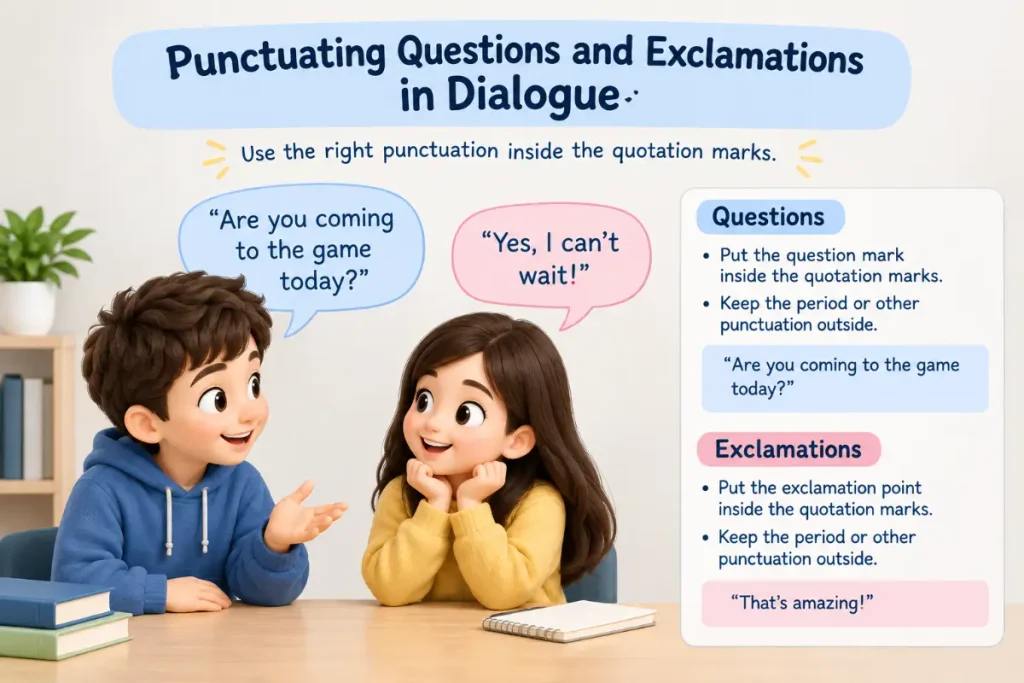
Punctuating Questions and Exclamations in Dialogue
Question marks and exclamation points stay attached to the dialogue itself when the emotion or question belongs to the spoken words, and the dialogue tag that follows still uses a lowercase letter, since it’s still functioning as part of the same overall sentence.
- “Where did you put my keys?” he asked.
- “Watch out!” she shouted.
Multi-Paragraph Speeches by One Character
If a single character speaks for more than one paragraph without interruption, Purdue OWL specifies a rule that surprises a lot of writers: open each new paragraph with a quotation mark, but don’t close the quotation mark until the character’s entire speech is finished.
- “I’ve thought about this for a long time, and I think we need to make some changes around here. “First, I want to reorganize the schedule so everyone has more flexibility.”
Notice the first paragraph has no closing quotation mark at the end — that’s intentional, and it’s the correct convention for representing one uninterrupted, multi-paragraph speech.
Action Beats vs. Dialogue Tags: A Useful Distinction
An “action beat” — a short physical action attached to a line of dialogue instead of a traditional tag like “she said” — is punctuated as its own separate sentence, with a period, not a comma, since it’s not grammatically part of the quote.
- “I don’t know.” She looked away. (period after the quote, since “she looked away” is its own sentence, not a dialogue tag)
Compare this to an actual dialogue tag:
- “I don’t know,” she said, looking away. (comma, since “she said” is a true dialogue tag)
Mixing these up — putting a comma after a quote that’s followed by an action beat rather than a true speech tag — is a common and easily avoidable mistake once you know how to punctuate dialogue correctly for each specific case.
The Fastest Way to Check Yourself
Step 1: Are the exact words being spoken? Enclose them in quotation marks.
Step 2: Does a comma or period fall right at the end of the quoted words? It goes inside the closing quotation mark.
Step 3: Does the speaker change? Start a new paragraph.
Step 4: Is what follows the quote a true dialogue tag (said, asked, replied) or an action beat (she looked away, he stood up)? Tags use a comma; action beats use a period, since they’re separate sentences.
Dialogue Punctuation: Quick Reference
| Situation | Punctuation | Example |
|---|---|---|
| Quote followed by a tag | Comma inside quote | “I’m ready,” she said. |
| Tag followed by a quote | Comma before quote | She said, “I’m ready.” |
| Tag splits one sentence | Commas both sides, lowercase continuation | “Wait,” she said, “I need a minute.” |
| Tag splits two sentences | Period after tag, capital letter continues | “Wait,” she said. “I need a minute.” |
| Quote followed by action beat | Period after quote (separate sentence) | “I’m ready.” She grabbed her bag. |
| New speaker | New paragraph | (line break between speakers) |
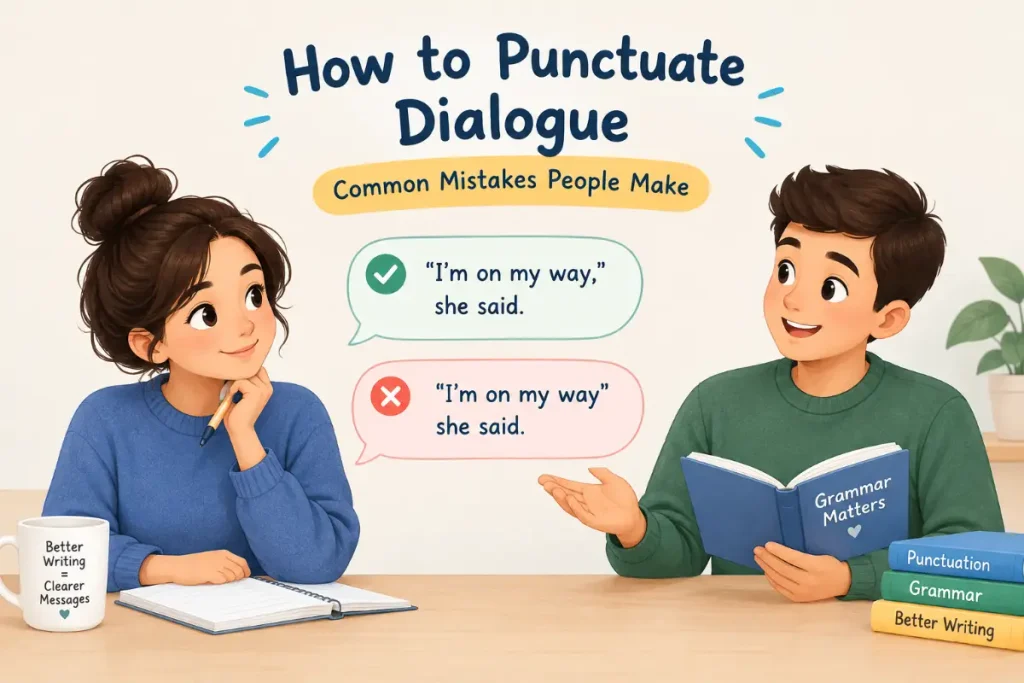
Common Mistakes People Make
Mistake 1: “I’m not sure.” She said. Should be “I’m not sure,” she said — this is a true dialogue tag, so it needs a comma, not a period, and “she” should be lowercase.
Mistake 2: Putting two different speakers in the same paragraph. “Are you okay?” he asked. “I’m fine,” she said. — this should be split into two separate paragraphs, one for each speaker, to avoid confusing the reader about who’s talking.
Mistake 3: “Where are you going”? he asked. The question mark belongs inside the quotation marks, since the question is part of what’s being spoken: “Where are you going?” he asked.
Mistake 4: Capitalizing a continuation after an interrupting tag. “I think,” she said, “We should leave now.” Should be lowercase “we,” since the tag is splitting one continuous sentence: “I think,” she said, “we should leave now.”
For another useful perspective, check out Apostrophe Rules for Plurals: 9 Simple Rules to Get It Right (2026).
Mistake 5: Closing quotation marks after every paragraph of a multi-paragraph speech. This breaks the standard convention covered above — only the final paragraph of an uninterrupted speech should have a closing quotation mark.
More Examples to Lock It In
- “I can’t believe you did that,” she said, crossing her arms.
- He sighed. “I know. I’m sorry.”
- “Are we still meeting tomorrow?” she asked.
- “Of course,” he replied. “Same time as always.”
- “I’ve been thinking about this all week,” Maria said. “I think it’s time we talked about the budget. “Second, I think we should revisit the timeline.”
Frequently Asked Questions
Do these rules for how to punctuate dialogue apply the same way in British English?
No — British publishing conventions often use single quotation marks instead of double, and some British style guides place terminal punctuation outside the closing quotation mark unless it’s part of the original quoted material. The rules in this guide reflect standard American English convention.
What if a character is interrupted mid-sentence by another character?
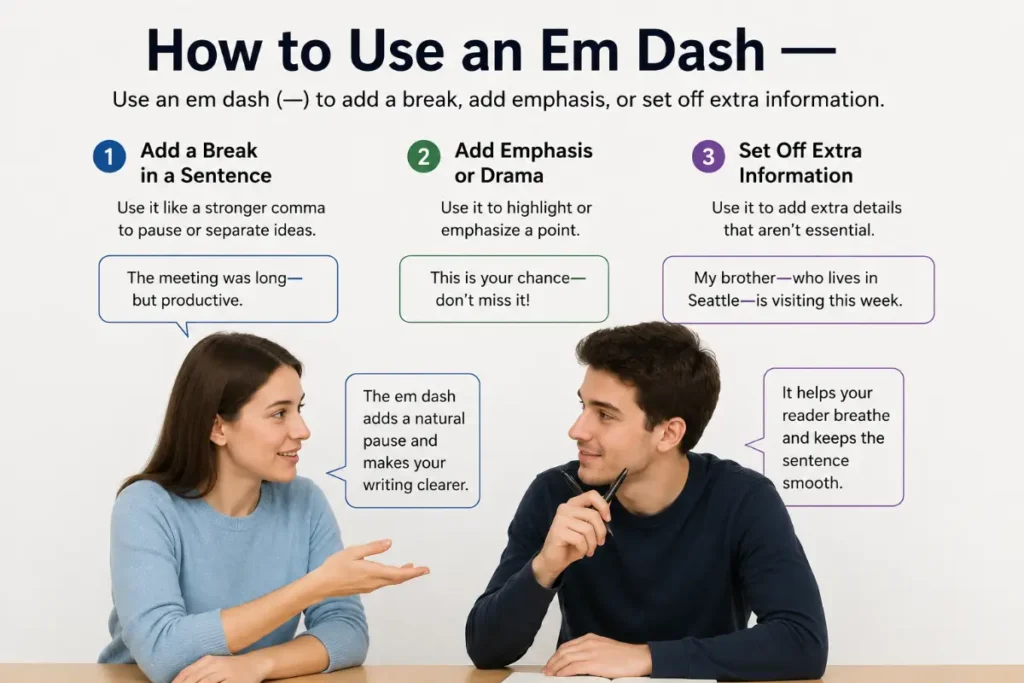
Use an em dash inside the quotation marks to show the interruption: “I was just about to—” “Don’t,” he said, cutting her off. This is different from an ellipsis, which shows a trailing off rather than a sudden interruption.
How do I punctuate internal thoughts that aren’t spoken aloud?
Convention varies by publisher and style guide — some use italics with no quotation marks, others use quotation marks just as with spoken dialogue. Whichever convention you choose, staying consistent throughout the piece matters more than which specific option you pick.
Is it ever acceptable to skip the dialogue tag entirely?
Yes — once readers clearly know who’s speaking from context or an established back-and-forth pattern, dropping the tag entirely is a common and often stylistically preferred choice, as long as the paragraph breaks still clearly signal each change of speaker.
What’s the fastest way to catch dialogue punctuation errors before publishing something?
Read through every line of dialogue and check three things: is the punctuation before a dialogue tag a comma (not a period)? Does every new speaker start a new paragraph? And is the punctuation that belongs to the spoken words actually inside the quotation marks?
Practice Exercise
Add the correct punctuation to each line of dialogue. Answers are listed right after — try each one before checking.
- I’m not going she said
- Are you sure he asked
- Wait she said I forgot my phone
- That’s incredible Maria exclaimed
- I don’t know She shrugged and walked away
- He said We need to leave now
- Why would you do that she demanded
- I think so he said but I’m not certain
- Stop right there the officer shouted
- Fine she muttered under her breath
Answer Key
- “I’m not going,” she said.
- “Are you sure?” he asked.
- “Wait,” she said, “I forgot my phone.”
- “That’s incredible!” Maria exclaimed.
- “I don’t know.” She shrugged and walked away.
- He said, “We need to leave now.”
- “Why would you do that?” she demanded.
- “I think so,” he said, “but I’m not certain.”
- “Stop right there!” the officer shouted.
- “Fine,” she muttered under her breath.
If you got eight or more correct, you’ve genuinely mastered how to punctuate dialogue for the vast majority of everyday writing situations. For any you missed, check whether a comma or period belongs before the tag, and whether the tag itself is a true dialogue tag or an action beat.
Before moving on, you may also want to read Colon vs Semicolon: The Ultimate Usage Guide for 2026 for more helpful grammar tips.
The Bottom Line
Knowing how to punctuate dialogue comes down to four consistent habits: quotation marks around spoken words, commas and periods inside those marks, a new paragraph for every new speaker, and a clear distinction between dialogue tags (comma) and action beats (period). Once these become automatic, dialogue stops being a source of hesitation and becomes one of the more mechanical, rule-based parts of your writing to get right every time.
For the fuller breakdown of quotation mark rules beyond dialogue specifically — including titles, nested quotes, and punctuation placement with colons and semicolons — see our complete guide to using quotation marks correctly. And if the em dash used for interrupted speech in this guide is still unfamiliar territory, our em dash guide covers that mark’s full range of uses.