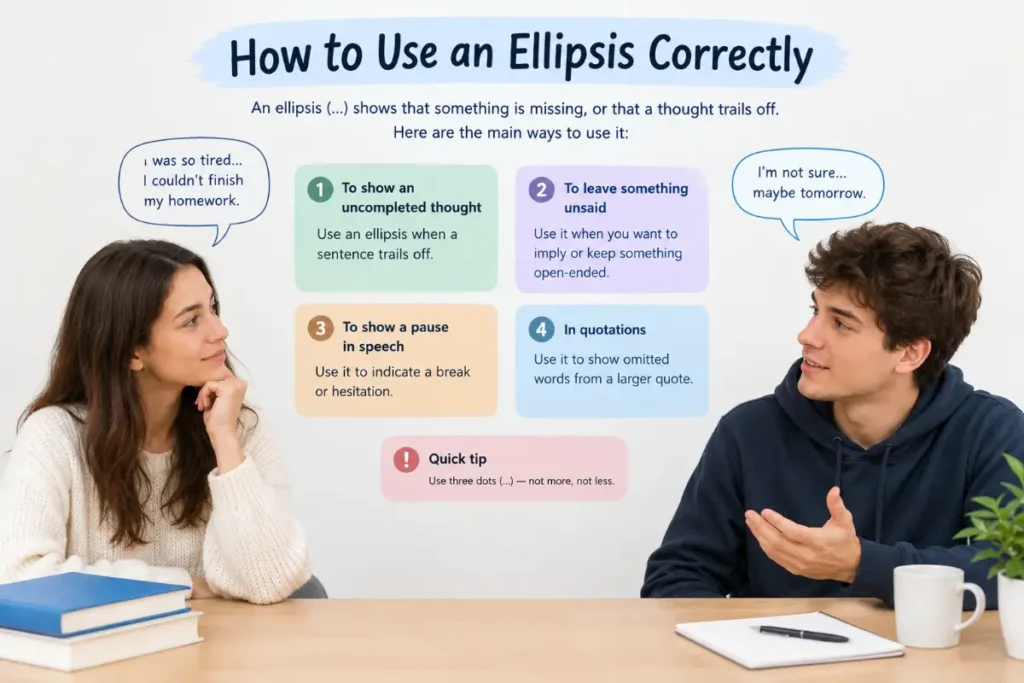
Ever wondered how to use an ellipsis correctly without making your writing look awkward or unclear? Those three little dots (…) can show a pause, omitted words, hesitation, or an unfinished thought—but using them effectively depends on context. In this guide, you’ll learn the simple rules for using an ellipsis correctly, with clear examples you can apply to everyday writing.
Knowing how to use an ellipsis correctly matters more than most people realize, because Merriam-Webster points out this mark has been “thoroughly abused and misused” more than almost any other punctuation mark in English. The good news is that once you separate its two genuinely distinct jobs — showing an omission in a quotation, and showing hesitation or a trailing thought — the confusion mostly disappears.
You may also find When to Use a Dash Instead of a Comma (2026 Guide) helpful if you want to explore this topic further.
The Quick Answer
An ellipsis (…) — three dots, sometimes called “suspension points” — is used to:
- Show that words have been omitted from a quotation
- “Four score and seven years ago… a new nation, conceived in Liberty.”
- Show hesitation, a trailing thought, or an unfinished sentence (mainly in informal or creative writing)
- “I just think that… well, never mind.”
Formal and academic writing generally uses an ellipsis only for the first job. Informal and creative writing uses it for both.
Job 1: Showing Omitted Words in a Quotation
This is the ellipsis’s primary, most formal job: signaling to a reader that you’ve cut something out of a direct quotation, usually because it wasn’t essential to the point you’re making, while preserving the parts that matter.
Example, with the original full quotation:
- “Four score and seven years ago our fathers brought forth on this continent, a new nation, conceived in Liberty, and dedicated to the proposition that all men are created equal.”
Shortened using an ellipsis:
- “Four score and seven years ago our fathers brought forth on this continent, a new nation… dedicated to the proposition that all men are created equal.”
Merriam-Webster confirms this use is standard across academic, journalistic, and legal writing whenever a full quotation is longer than necessary for the point being made. The key ethical rule here matters as much as the punctuation rule: the omission must not change the original meaning or misrepresent what the source actually said.
Formatting the Ellipsis: Spacing and Style Guide Differences
This is genuinely one of the more inconsistent areas across style guides, so it’s worth knowing the major conventions rather than assuming there’s one universal standard.
Three dots, generally with spaces on either side (though not adjacent to a quotation mark):
- She said her plan was to ” … travel first, then figure out the rest.”
Four dots when the ellipsis falls at the end of a complete sentence — three dots for the ellipsis itself, plus a fourth dot functioning as the period:
- “We hold these truths to be self-evident, that all men are created equal….”
Different style guides format the spacing slightly differently — some use a single space before and after the full set of three dots, others insert a thin space between each individual dot. Merriam-Webster notes the specific formatting has genuinely varied across editions and style guides over time. The one rule that matters more than any specific spacing convention: pick one method and use it consistently throughout the same document.
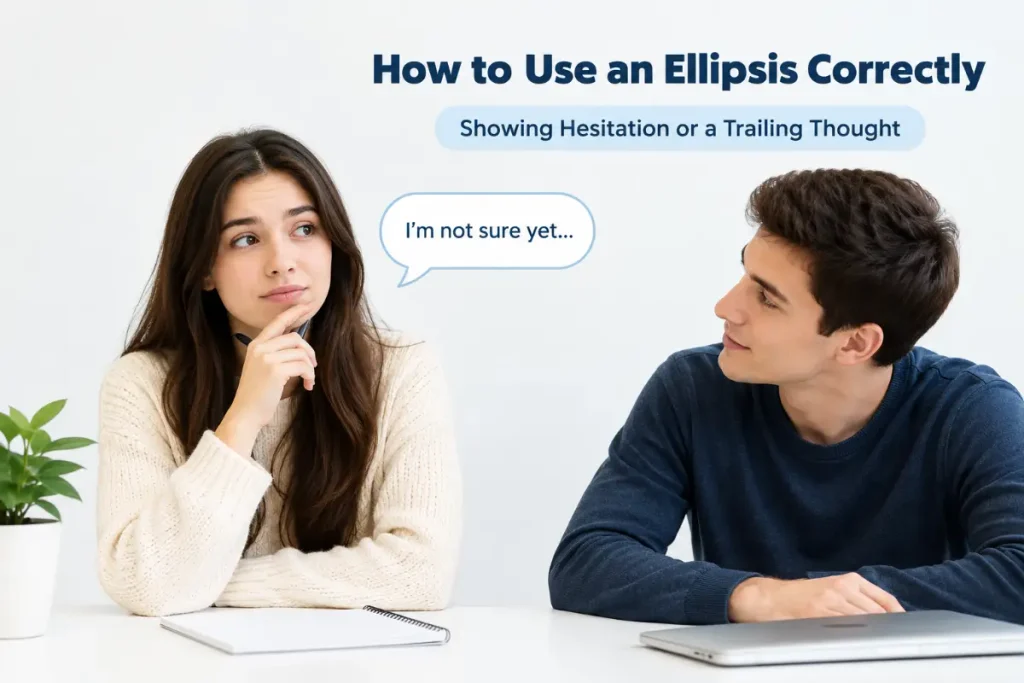
Job 2: Showing Hesitation or a Trailing Thought
In informal writing, dialogue, and creative writing, an ellipsis can represent a pause, hesitation, or a sentence that trails off without finishing — a use Merriam-Webster specifically describes as indicating “faltering speech, especially if the faltering involves a long pause or a sentence that trails off or is intentionally left unfinished.”
- “I don’t know, I just… I thought things would be different.”
- If only she had… well, it didn’t matter now.
- “I wasn’t really… what I mean is… I didn’t mean it that way.”
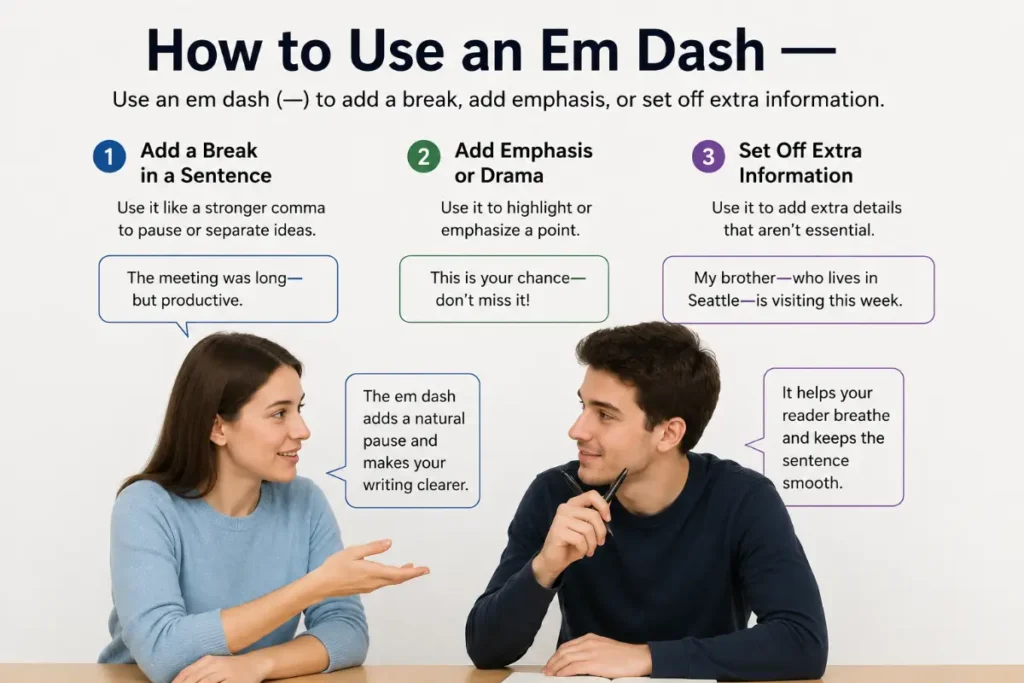
Notice how this use differs meaningfully from the em dash, which is covered in more depth in our em dash guide: an em dash typically signals a sudden, sharp interruption, while an ellipsis signals a softer trailing off or hesitation. If a character is cut off abruptly by someone else, an em dash is usually the better fit; if a character’s own thought fades out or falters, an ellipsis fits better.
Why This Second Use Is Riskier in Formal Writing
Learning how to use an ellipsis correctly means also knowing where it doesn’t belong. Most formal and academic writing avoids the hesitation/trailing-off use entirely, reserving the ellipsis strictly for the omission-in-quotations job. Using an ellipsis to represent a dramatic pause or trailing thought in a business report, academic paper, or professional email tends to read as overly casual or even melodramatic, undermining a more formal tone.
The Fastest Way to Check Yourself
Step 1: Are you quoting a source and cutting out some of the original words? Use an ellipsis, formatted according to whichever style guide you’re following, and make sure the trimmed version doesn’t distort the original meaning.
Step 2: Are you writing dialogue or informal prose where a character or narrator’s thought trails off or hesitates? An ellipsis works here too, though this use is generally out of place in formal writing.
Step 3: Is this actually a sudden interruption rather than a soft trailing off? Reach for an em dash instead — see our em dash guide for the full breakdown of that mark’s distinct jobs.
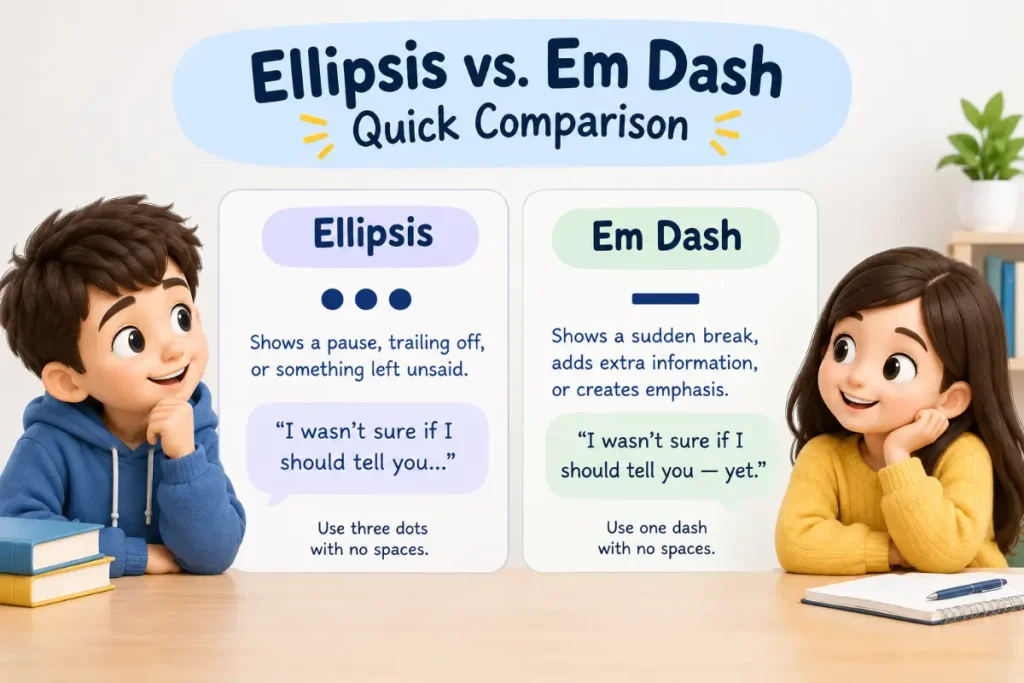
Ellipsis vs. Em Dash: Quick Comparison
| Ellipsis (…) | Em Dash (—) | |
|---|---|---|
| Represents | Omission, or a soft trailing off | Abrupt interruption or emphasis |
| Formality | Used in both formal and informal writing (different jobs) | More common in narrative and informal writing, still used formally too |
| Feel | Gentle, fading | Sharp, sudden |
| Example | “I just thought…” | “I just thought—” “Don’t,” he said. |
Common Mistakes People Make
Mistake 1: Using an ellipsis anywhere a pause feels natural, regardless of context. Overusing ellipses in casual texting or social media (“So I went to the store… and then I saw her… it was so awkward…”) dilutes their impact and can make writing feel scattered rather than deliberately paced.
Mistake 2: Omitting words from a quotation in a way that changes its meaning. This is an ethical problem, not just a punctuation one — trimming “the plan is not going well, though we remain optimistic” down to “the plan is… optimistic” misrepresents what was actually said, which is a much more serious error than any spacing inconsistency.
Mistake 3: Inconsistent spacing within the same document. Using “word… word” in one place and “word . . . word” (with spaces between each dot) elsewhere looks unpolished. Pick one convention and apply it throughout.
For another useful perspective, check out Hyphen vs En Dash vs Em Dash: The Ultimate 2026 Usage Guide.
Mistake 4: Using an ellipsis where an em dash would better capture a sudden interruption. “I was going to say…” “Don’t bother” reads as a soft fade, when the scene actually calls for a sharp cutoff, which an em dash conveys more accurately: “I was going to say—” “Don’t bother.”
Mistake 5: Starting a quotation with an unnecessary ellipsis. Beginning a quoted excerpt with “…and so we conclude” when the sentence naturally starts there anyway (with the surrounding context already making clear it’s a partial quote) is often unnecessary — many style guides, including APA, specifically discourage ellipses at the very start or end of a quotation unless genuinely needed for clarity.
More Examples to Lock It In
- The report noted, “Sales increased significantly in the third quarter… though analysts remain cautious about long-term trends.”
- “I keep thinking about what she said, and I just… I don’t know how to respond.”
- He trailed off mid-sentence: “If only I had…”
- The historian quoted the letter directly: “We arrived at dawn… the village was already in ruins.”
Frequently Asked Questions
Does an ellipsis always need three dots, or can it be more?
Standard formatting is exactly three dots for a mid-sentence omission, with a possible fourth dot added specifically to represent a period when the ellipsis falls at the end of a complete sentence. Using more than four dots isn’t standard in any major style guide.
Is it ever acceptable to start or end a quotation with an ellipsis?
Some style guides, including APA, actively discourage this, recommending instead that you simply begin or end the quotation at the relevant text without an ellipsis, unless the omission at the very start or end would otherwise confuse the reader about what was cut.
What’s the difference between an ellipsis and three separate periods typed in a row?
Functionally, when typed as three periods with appropriate spacing, they serve the same purpose — but proper typesetting often uses a single “ellipsis” character (…) rather than three separate period characters, which can affect spacing and line-wrapping in digital text. Most word processors will auto-convert three typed periods into this single ellipsis character.
Can an ellipsis be used to build suspense in creative writing?
Yes, this is a common stylistic use — a trailing ellipsis at the end of a paragraph or chapter can signal an unresolved thought or a cliffhanger. Like any stylistic device, though, overusing it dilutes the effect, so it’s most powerful when used sparingly.
What’s the fastest way to catch ellipsis errors before publishing something?
For every ellipsis in your document, check that its spacing is consistent throughout, that any omission from a quotation doesn’t distort the original meaning, and that you haven’t reached for an ellipsis in a spot that actually needs the sharper interruption of an em dash instead.
Practice Exercise
Decide whether each blank needs an ellipsis or an em dash. Answers are listed right after — try each one before checking.
- “I was going to tell you, but___” “Just say it,” she interrupted.
- The senator’s quote was trimmed: “We must act now___before it’s too late.”
- “I just feel like maybe I should___” she trailed off, unsure how to continue.
- He had one excuse___traffic.
- “If only she had___” He never finished the thought.
- The report stated, “Revenue grew 12 percent___the highest in company history.”
- “Wait___” she started, but he was already gone.
- “I think, um___I’m not really sure what I think,” he admitted.
Answer Key
- em dash
- ellipsis
- ellipsis
- em dash
- ellipsis
- ellipsis
- em dash
- ellipsis
If you got six or more correct, the sudden-interruption-versus-soft-trailing-off distinction has already become clear. For any you missed, ask: is this a sharp cutoff (em dash) or a gentle fade or quoted omission (ellipsis)?
Before moving on, you may also want to read When to Use a Comma After an Introductory Phrase: 7 Easy Rules (2026) for more helpful grammar tips.
The Bottom Line
Knowing how to use an ellipsis correctly comes down to recognizing its two distinct jobs: marking an omission from a quotation (formal, requires care not to distort meaning) and showing hesitation or a trailing thought (informal, best used sparingly). Keep your spacing consistent, reach for an em dash instead when the moment calls for a sudden interruption rather than a soft fade, and this small three-dot mark stops being one of English’s most misused punctuation marks in your own writing.
For more on how the em dash’s sharper interruption differs from the ellipsis’s softer trail-off, see our complete em dash guide — and if quotation mark placement around omitted or trimmed material still feels uncertain, our guide to using quotation marks correctly covers that ground in full.