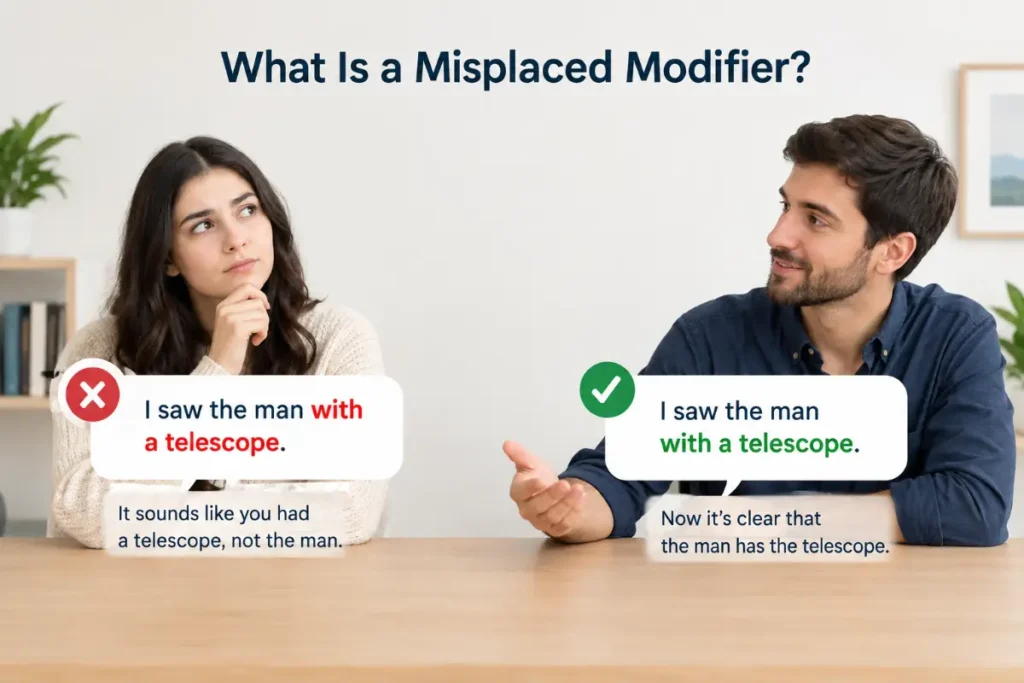
Nearly every good what is a misplaced modifier example search leads to the same kind of sentence: one that’s grammatically fine on paper but accidentally says something absurd, because a descriptive word or phrase landed next to the wrong noun. Unlike a dangling modifier, which has no logical subject to attach to anywhere in the sentence, a misplaced modifier does have a clear, correct subject sitting somewhere nearby — it’s just been separated from it by other words, creating confusion about what’s actually being described.
This distinction matters because the fix is different too. A dangling modifier usually needs a new subject named outright; a misplaced modifier usually just needs to move closer to the word it was always meant to describe.
You may also find Spotting the Sneaky Ones: How to Identify a Dangling Participle helpful if you want to explore this topic further.
The Classic Example That Explains Everything
UNC’s Writing Center offers one of the clearest illustrations of this error in action:
- Misplaced: She wore a bicycle helmet on her head that was too large.
- Fixed: She wore a bicycle helmet that was too large on her head.
Read the first version literally, and it says her head was too large — because “that was too large” landed next to “head” instead of next to “helmet,” which is what it was actually meant to describe. Moving the modifier closer to “helmet” resolves the confusion instantly, without changing a single word.
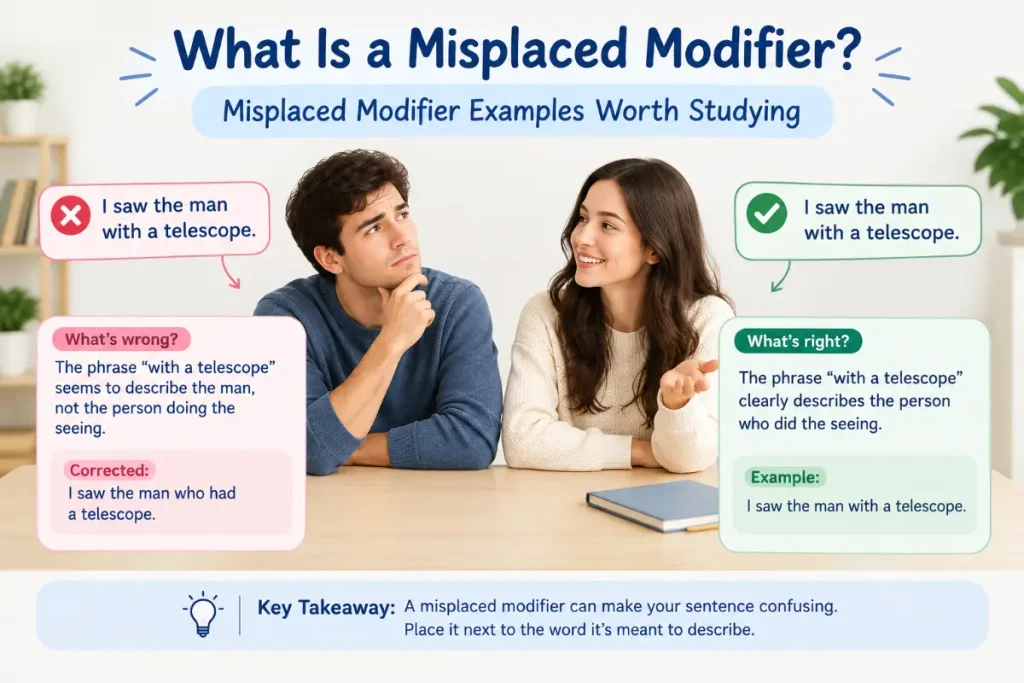
More Misplaced Modifier Examples Worth Studying
- Misplaced: They bought a kitten for my brother they call Shadow.
- Fixed: They bought a kitten they call Shadow for my brother.
In the misplaced version, it briefly reads as though the brother’s name is Shadow, since “they call Shadow” sits right next to “brother” instead of “kitten.”
- Misplaced: The dog under the tree bit Carrie.
- Alternative meaning: The dog bit Carrie under the tree.
This pair is genuinely instructive because both versions are grammatically correct — they just mean different things depending on where “under the tree” sits. The first says the dog (which happened to be under a tree) bit Carrie; the second says the biting happened under the tree. Neither is “wrong” exactly, but only one likely matches what the writer actually meant, which is the whole danger of a misplaced modifier: the sentence still reads smoothly, so the error can slip past a writer entirely.
- Misplaced: The patient was referred to the physician with stomach pains.
- Fixed: The patient with stomach pains was referred to the physician.
The original version accidentally suggests the physician has the stomach pains, not the patient.
Single-Word Modifiers: The Sneakiest Version of This Error
Small limiting words — only, almost, just, nearly, even, merely, simply, hardly, scarcely, exactly — cause a surprising amount of trouble, since moving them by even one word can completely change a sentence’s meaning.
- The shopper almost bought all the ties in the store. (this suggests she almost made the purchase, but ultimately didn’t buy any)
- The shopper bought almost all the ties in the store. (this correctly suggests she bought nearly the entire selection)
Notice how genuinely different these two sentences are, despite differing by only the position of one word. A related classic example: the vendor almost sold all of her pottery technically means she came close to selling any of it — the intended meaning (“she sold nearly all of it”) requires “almost” to sit next to “all,” not next to “sold.”
Misplaced Modifiers vs. Dangling Modifiers: The Key Difference
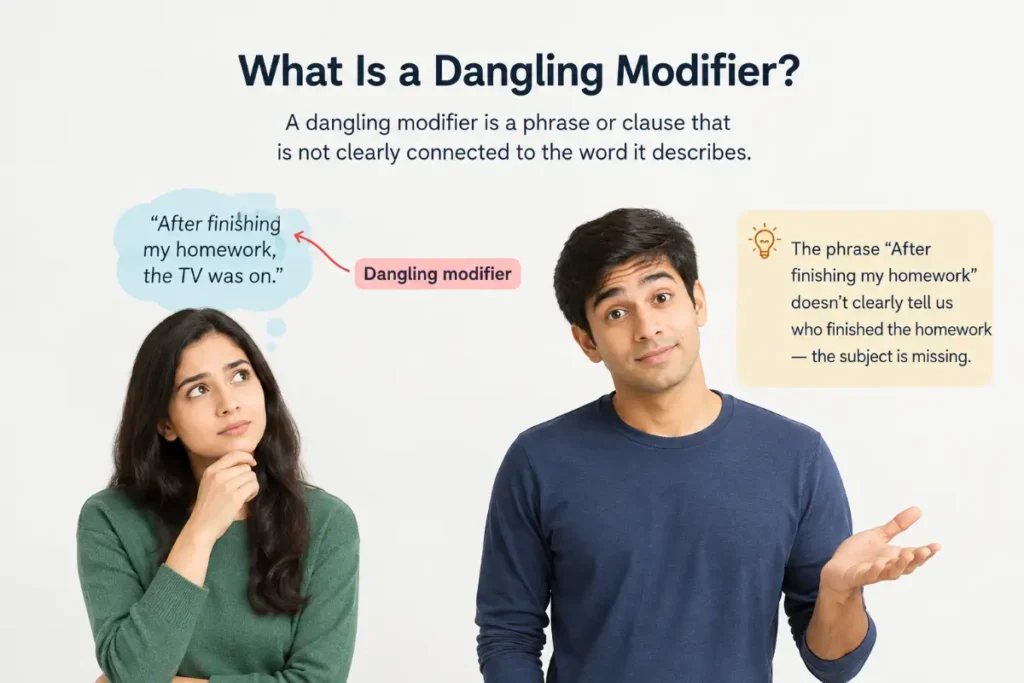
Since these two errors are so often confused with each other, it’s worth stating the distinction plainly. A misplaced modifier has a valid, logical subject present in the sentence — it’s just been placed too far away from it. A dangling modifier has no logical subject at all; the sentence never actually names who or what is performing the described action.
- Misplaced (subject exists, just far away): Buffy called her adorable kitten opening the can of food. (Buffy is present; “opening the can of food” just landed next to “kitten” instead of “Buffy”)
- Dangling (no logical subject at all): Having finished the assignment, the TV was turned on. (nothing in the sentence can logically be the one who finished the assignment)
For the full treatment of that second category, see our what is a dangling modifier guide, which covers the missing-subject version of this problem in depth.
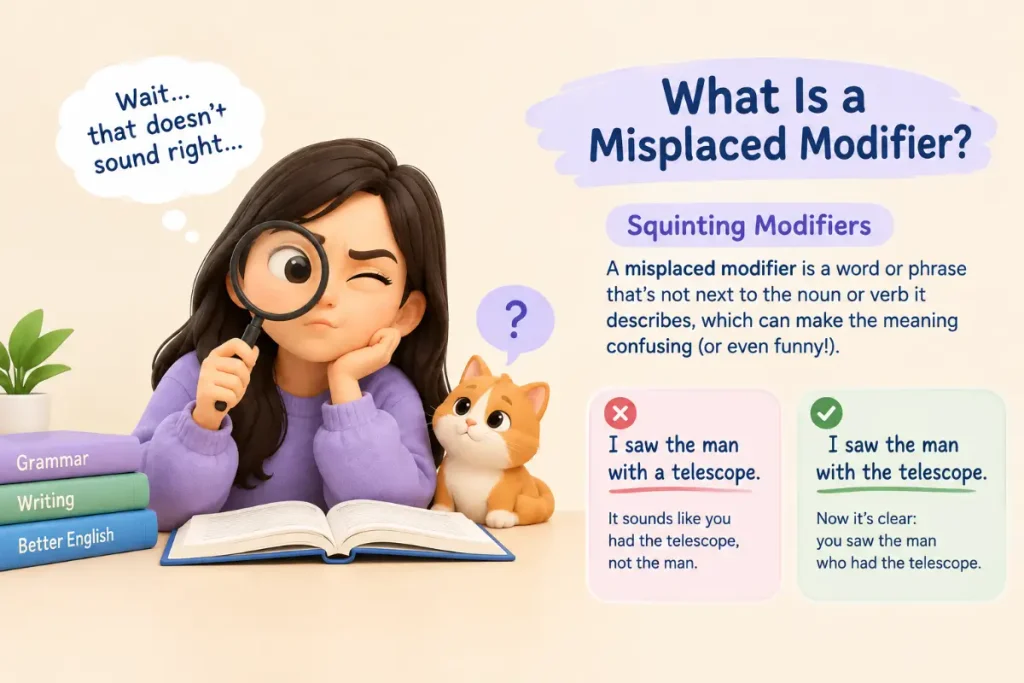
Squinting Modifiers: A Third, Related Category
Some misplaced modifiers create a specific kind of ambiguity called a squinting modifier — where the placement makes it genuinely unclear which of two nearby words or phrases the modifier is meant to describe, since it sits ambiguously between both candidates.
- Squinting: Students who study consistently improve their grades. (does “consistently” describe how they study, or how their grades improve?)
Squinting modifiers are typically fixed the same way as ordinary misplaced modifiers — by relocating the ambiguous word closer to whichever meaning was actually intended.
Two Reliable Fixing Strategies
Move the modifier next to the word it’s meant to describe. This is the most common and often the simplest fix, as shown in nearly every example above.
Rewrite the sentence to make the connection unmistakable, particularly for longer or more complex modifying phrases where simple repositioning still feels awkward.
- Misplaced: Tiered like a wedding cake, Mrs. Deleon unveiled her model for the parade float.
- Rewritten: Mrs. Deleon unveiled her model for the parade float, which was tiered like a wedding cake.
Quick Reference Table
| Misplaced Version | Fixed Version | What Went Wrong |
|---|---|---|
| a helmet on her head that was too large | a helmet that was too large on her head | Modifier landed next to the wrong noun |
| a kitten for my brother they call Shadow | a kitten they call Shadow for my brother | Naming phrase sat next to the wrong noun |
| almost bought all the ties | bought almost all the ties | Single-word modifier one spot too early |
| referred to the physician with stomach pains | the patient with stomach pains was referred | Modifier attached to the wrong person |
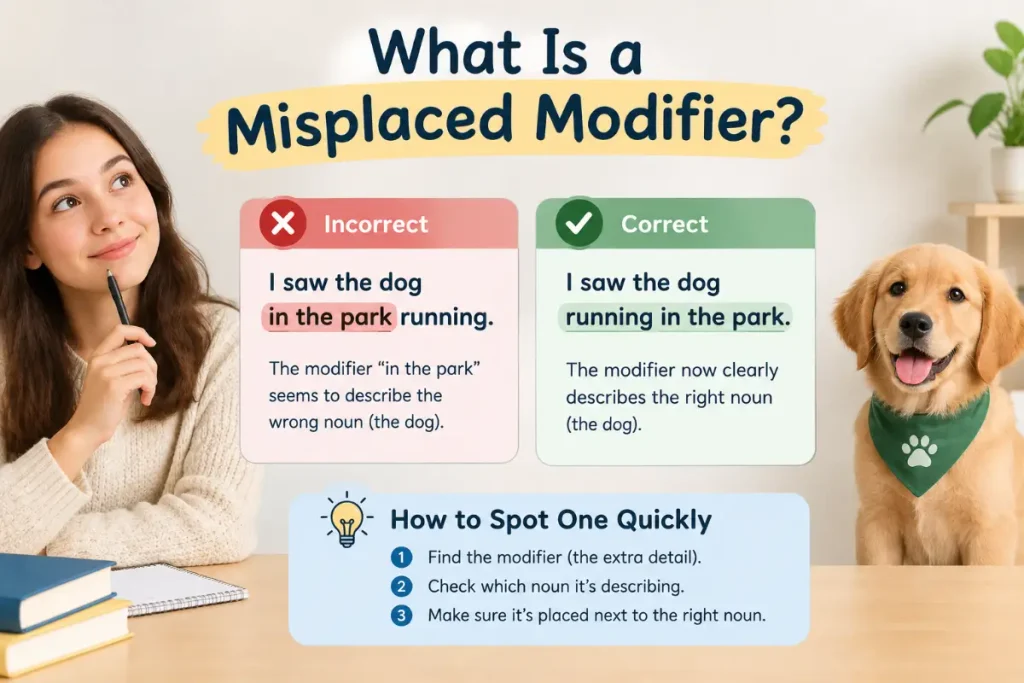
What Is a Misplaced Modifier? How to Spot One Quickly
If you’re wondering what is a misplaced modifier, the easiest way to understand it is to look at what the modifier is actually describing. A misplaced modifier is a word or phrase that is positioned too far from the word it is supposed to modify, making the sentence confusing or unintentionally changing its meaning.
The quickest way to spot one is to check the modifier’s nearest noun or phrase. Ask yourself: “Is this really the word I want the modifier to describe?” If the answer is no, the modifier probably needs to move.
For example:
- Misplaced: She served sandwiches to the children on paper plates.
- Clearer: She served sandwiches on paper plates to the children.
In the first sentence, “on paper plates” appears immediately after “children,” so the sentence can momentarily suggest that the children are on paper plates. Moving the modifier closer to “sandwiches” makes the intended meaning clear.
A Simple Three-Question Test
When editing your writing, use these three questions:
- What word or phrase is being modified?
- Is the modifier positioned close enough to that word?
- Could the current placement create a different or funny meaning?
If the answer to the third question is yes, try moving the modifier closer to its intended target.
This is especially important with small words such as only, almost, just, nearly, and barely. Their position can change the meaning of an entire sentence. For example:
For another useful perspective, check out The Split Infinitive Rule: 13 Common Mistakes to Avoid (2026).
- She almost bought all the ties. → She came close to making the purchase.
- She bought almost all the ties. → She purchased nearly the entire selection.
So, what is a misplaced modifier? In simple terms, it is a modifier in the wrong position. The subject or target is usually present, but the modifier is placed where it can accidentally describe the wrong word. The easiest fix is usually to move it directly beside the word it is meant to describe.
Common Mistakes People Make
- Mistake 1: Assuming a sentence is fine simply because it reads smoothly. Misplaced modifiers rarely sound broken — that’s exactly what makes them easy to miss during a normal read-through.
- Mistake 2: Fixing the wrong part of the sentence. The fix is almost always about relocating the modifier, not changing the words themselves.
- Mistake 3: Confusing a misplaced modifier with a dangling one, and applying the wrong fix strategy — naming a new subject won’t help if the real subject was already present, just poorly positioned.
- Mistake 4: Overlooking single-word modifiers like “only” and “almost,” since they’re small enough to skim past even during careful editing.
- Mistake 5: Leaving a squinting modifier unresolved, assuming context will clarify which meaning was intended — readers shouldn’t have to guess.
Practice Exercise
Identify the misplaced modifier in each sentence and rewrite it correctly. Answers are listed right after — try each one before checking.
- She served sandwiches to the children on paper plates.
- He almost drank the entire pot of coffee.
- The car was found by police with a broken window.
- I only ate one slice of the cake at the party.
- They gave a toy to the boy wrapped in bright paper.
- The waiter brought menus to the guests covered in plastic.
- She nearly finished all of her homework before dinner.
- The teacher handed back tests to the students marked in red.
- He found a wallet on the sidewalk full of cash.
- We saw a movie about robots at the theater downtown.
- The chef served a fish to the guests covered in sauce.
- I just need five more minutes to finish this.
- The librarian returned the book to the shelf with a torn cover.
- She barely ate any of the soup after the long day.
- The mechanic fixed the car for the customer with a flat tire.
- He simply wanted to ask one question during the meeting.
- They delivered a package to the neighbor wrapped in brown paper.
- The photographer took a picture of the mountain with his new camera.
- She only speaks French at home, never English.
- The store sold shoes to customers on sale.
Answer Key (one valid fix shown for each)
- She served sandwiches on paper plates to the children.
- He drank almost the entire pot of coffee.
- The car with a broken window was found by police.
- I ate only one slice of the cake at the party.
- They gave a toy wrapped in bright paper to the boy.
- The waiter brought menus covered in plastic to the guests.
- She finished nearly all of her homework before dinner.
- The teacher handed back tests marked in red to the students.
- He found a wallet full of cash on the sidewalk.
- At the theater downtown, we saw a movie about robots.
- The chef served a fish covered in sauce to the guests.
- I need just five more minutes to finish this.
- The librarian returned the book with a torn cover to the shelf.
- She ate barely any of the soup after the long day.
- The mechanic fixed the car with a flat tire for the customer.
- He wanted to ask simply one question during the meeting. (or: “He wanted simply to ask one question”)
- They delivered a package wrapped in brown paper to the neighbor.
- With his new camera, the photographer took a picture of the mountain.
- She speaks only French at home, never English.
- The store sold shoes on sale to customers.
Frequently Asked Questions
How is a misplaced modifier different from a dangling modifier?
A misplaced modifier has a logical subject somewhere in the sentence, just positioned too far away from it. A dangling modifier has no logical subject present at all — the sentence never actually names who or what is doing the described action.
Are single-word modifiers really as risky as longer phrases?
Yes, often more so — words like “only,” “almost,” and “just” are small enough to slip past a quick read, and moving them by even one position can genuinely change a sentence’s meaning rather than just its clarity.
Can a misplaced modifier ever be genuinely ambiguous rather than just awkward?
Yes — this specific version is called a squinting modifier, where the placement makes it unclear which of two nearby elements the modifier is meant to describe, requiring the writer to clarify which meaning was actually intended.
Why do misplaced modifiers often create unintentionally funny sentences?
Because English generally expects a modifier to describe whatever sits closest to it, so when a phrase lands next to the wrong noun, readers automatically (and often humorously) apply it to that nearby word instead of the one actually intended.
What’s the fastest way to catch misplaced modifiers before publishing something?
For every descriptive word or phrase in a sentence, check what it’s sitting next to and ask whether that’s genuinely what it’s meant to describe. If the nearest noun creates an unintended or absurd meaning, relocate the modifier closer to its actual target.
Before moving on, you may also want to read Use Semicolons in a Sentence: The Easy 2026 Guide for more helpful grammar tips.
Wrapping Up
Working through a real what is a misplaced modifier example makes the pattern unmistakable: the sentence’s subject is present and correct, but a descriptive word or phrase has drifted too far away from the thing it’s supposed to describe, creating confusion or unintended humor along the way. The fix is almost always the same — move the modifier back next to its intended target, or restructure the sentence when a simple move still feels clunky.
Because these sentences usually still sound grammatically smooth, catching them takes a specific kind of attention during editing: reading not just for flow, but for exactly what each modifier is attached to. Once that habit becomes automatic, misplaced modifiers become one of the easier errors to spot and fix on sight.