The split infinitive rule is one of the few grammar “rules” that most professional linguists and dictionaries now openly admit was never a real rule at all. If you’ve ever hesitated over a phrase like “to boldly go,” worried it might be incorrect, you’re reacting to a 19th-century superstition rather than an actual grammatical requirement — and it’s worth knowing exactly where that superstition came from before deciding how to handle it in your own writing.
This guide traces the split infinitive’s strange history, explains what a split infinitive technically is, and — more usefully — walks through the specific situations where splitting an infinitive genuinely makes a sentence clearer, versus the situations where keeping it together reads more smoothly.
You may also find Use Commas in a List: 7 Easy Rules (2026) helpful if you want to explore this topic further.
What Splitting an Infinitive Actually Means
An infinitive is the base form of a verb, typically appearing with “to” attached: to go, to run, to write. A split infinitive happens when a word — almost always an adverb — is inserted between “to” and the verb itself.
- To boldly go where no one has gone before. (split — “boldly” sits between “to” and “go”)
- To go boldly where no one has gone before. (unsplit)
Both versions are grammatically valid sentences. The difference is purely a matter of word placement and, in some cases, subtle shifts in emphasis or clarity.

Where the “Rule” Actually Came From
Here’s the part that surprises most people: Merriam-Webster’s own history of the phrase confirms split infinitives date back at least to the fourteenth century, meaning English speakers have been doing this for roughly seven hundred years. The objection to it didn’t appear until the nineteenth century, when a wave of grammarians tried to force English grammar to mirror Latin grammar — and in Latin, an infinitive is a single, unsplittable word (like “amare,” to love), so there was nothing to split in the first place.
Applying that Latin-based logic to English never actually held up, since English infinitives are a two-word construction (“to” plus a verb) rather than one indivisible unit. Some language commentators go even further, arguing that English isn’t technically “splitting” anything at all, since “to” functions more as an attachment to the infinitive than a true structural part of it. Whatever the precise linguistic argument, the consensus among modern dictionaries and usage authorities is unambiguous: there was never a rational grammatical basis for banning the construction, and generations of writers were needlessly made anxious about a completely natural, longstanding English pattern.
When Splitting the Infinitive Genuinely Improves the Sentence
This is the part worth paying real attention to, since it’s more useful than simply knowing the old rule was wrong. Sometimes moving the adverb changes what the sentence actually means, and in those cases, the split version isn’t just acceptable — it’s the clearer, more accurate choice.
- She asked him to regularly check the mailbox. (he should check it on a regular basis)
- She regularly asked him to check the mailbox. (she asked him repeatedly, at various times)
These two sentences mean genuinely different things, and unsplitting the first one to avoid the “rule” would actually distort the intended meaning. In cases like this, the split infinitive isn’t a stylistic risk — it’s doing real grammatical work.
When Keeping the Infinitive Together Reads Better
That said, plenty of split infinitives can be unsplit without losing any meaning, and in those cases, the unsplit version often flows more naturally, especially in formal or polished writing.
- Split (unnecessary): We need to closely monitor the situation.
- Unsplit (smoother): We need to monitor the situation closely.
Here, moving “closely” to the end of the sentence loses nothing and arguably reads more cleanly. The practical guideline: split when it improves clarity or meaning, but don’t split purely out of habit, and don’t force an awkward unsplit version just to satisfy a rule that was never legitimate in the first place.
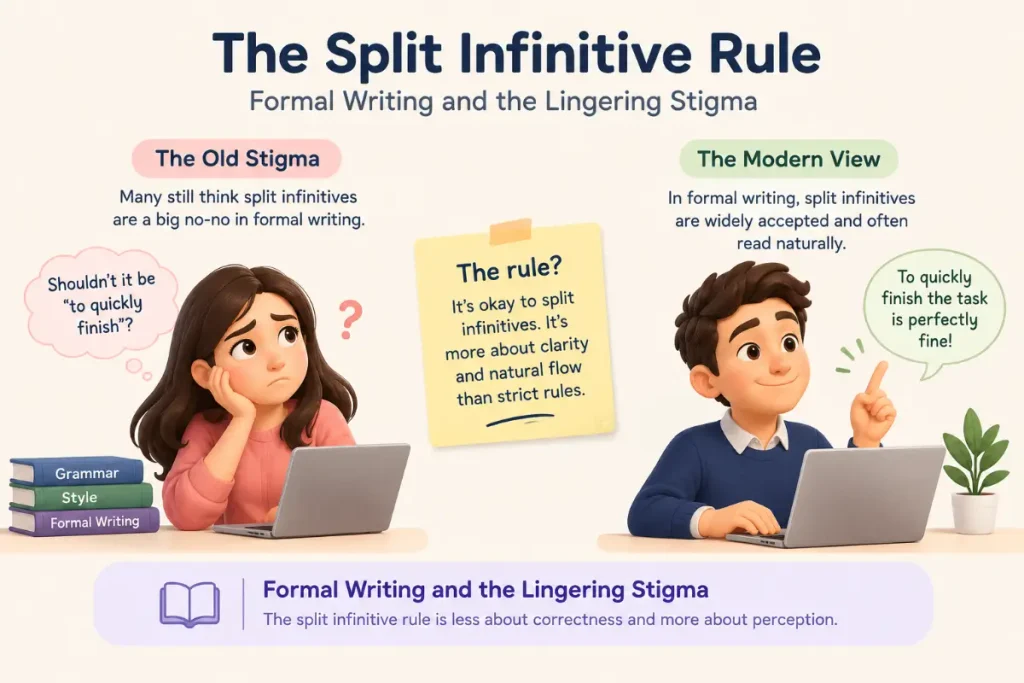
Formal Writing and the Lingering Stigma
Even though the grammatical objection has been thoroughly debunked, the split infinitive still carries a mild stigma in some formal, academic, or legal writing contexts, simply because enough readers were taught the old rule that a split infinitive might briefly catch their attention or read as less polished. This is purely a matter of audience expectation, not correctness — if you know your reader or publication holds onto the traditional preference, avoiding unnecessary splits (specifically the ones that don’t change meaning) is a reasonable accommodation, not a grammatical requirement. For a related case where the “real” rule turns out to be more flexible than the one taught in school, see our guide on farther vs further, another point where usage history is messier than the tidy classroom version suggests.
A Side-by-Side Look
| Sentence Type | Example | Verdict |
|---|---|---|
| Split infinitive, meaning-changing | asked him to regularly check | Keep split — meaning depends on it |
| Split infinitive, no meaning change | to closely monitor | Either works; unsplit often flows better |
| Split infinitive, awkward if unsplit | to really understand the issue | Split version often sounds more natural |
| Famous cultural example | to boldly go | Split; changing it disrupts the well-known rhythm |

Common Mistakes People Make
Mistake 1: Treating every split infinitive as a grammar error. The Split Infinitive Rule is often taught more rigidly than modern English usage supports. A split infinitive can be perfectly clear and natural.
Mistake 2: Rewriting a clear sentence simply to avoid a split infinitive. Moving the adverb can sometimes improve the sentence, but forcing an awkward word order just to follow an outdated rule can make your writing worse.
Mistake 3: Assuming that every adverb between to and the verb creates a problem. In a sentence like “to carefully explain the process,” the placement can be natural and easy to understand.
Mistake 4: Moving the adverb without checking how the meaning changes. “To really understand the issue” and “to understand the issue really” don’t have the same natural emphasis. Fixing the split should never come at the expense of meaning.
Mistake 5: Using several words between to and the verb without considering readability. While a split infinitive can be grammatical, a long interruption such as “to very carefully and completely review” may feel heavy. A cleaner structure may work better.
Mistake 6: Believing that avoiding split infinitives automatically makes writing more formal. Formal writing depends on clarity, precision, and appropriate tone—not on eliminating every split infinitive.
Mistake 7: Following The Split Infinitive Rule so strictly that natural English starts sounding unnatural. If moving the adverb makes the sentence stiff or confusing, keeping the original structure may be the better choice.
Mistake 8: Assuming that all editors, teachers, and style guides agree about split infinitives. Preferences can vary, so writers should consider the expectations of their audience, publication, or institution.
For another useful perspective, check out A Dangling Modifier? Learn It in 9 Easy Steps (2026 Guide).
Mistake 9: Confusing a split infinitive with an ordinary adverbial phrase. Not every word appearing between to and a verb is necessarily an example that needs correction. Look at the grammatical structure before changing it.
Mistake 10: Correcting a split infinitive without reading the entire sentence aloud. A technically rearranged sentence may look acceptable on paper but sound less natural when spoken.
Mistake 11: Thinking that a sentence becomes clearer simply because the infinitive is no longer split. Clarity comes from the whole sentence, so compare both versions rather than automatically choosing the unsplit one.
Mistake 12: Overcorrecting someone else’s writing by changing every split infinitive you find. If the sentence is clear, natural, and appropriate for its context, changing it may accomplish nothing.
Mistake 13: Focusing so much on The Split Infinitive Rule that you overlook bigger problems. Wordiness, ambiguity, repetition, weak sentence structure, and unclear meaning usually deserve attention before a perfectly understandable split infinitive.
Practice Exercise
Decide whether each split infinitive should stay split, or whether unsplitting it would read just as well or better. Answers are listed right after — try each one before checking.
- She wants to really understand the material.
- He promised to always support the team.
- They need to quickly review the proposal.
- I hope to fully explain my reasoning.
- She decided to boldly pursue the opportunity.
- We plan to carefully consider all options.
- He tends to constantly check his phone.
- I want to truly appreciate this moment.
- They agreed to immediately notify the team.
- She asked him to gently close the door.
- We hope to eventually expand the business.
- He continued to slowly improve his technique.
- I need to better understand the process.
- She wanted to finally finish the project.
- They chose to openly discuss the issue.
- He tried to quietly leave the room.
- We aim to significantly reduce costs.
- She hopes to soon travel abroad.
- He wants to clearly explain the results.
- They plan to actively pursue new markets.
Answer Key (both split and unsplit are grammatically valid for all; noted where one reads more naturally)
- Split reads naturally: “to really understand”
- Split preferred; unsplitting changes rhythm awkwardly
- Either works; “to review the proposal quickly” also fine
- Either works
- Split preferred (echoes the famous “boldly go” pattern)
- Either works
- Split reads naturally
- Split reads naturally
- Either works
- Either works
- Split reads naturally
- Either works; “improve his technique slowly” also fine
- Split reads naturally
- Split reads naturally
- Either works
- Split reads naturally
- Either works; “reduce costs significantly” also fine
- Split reads naturally
- Either works
- Either works; “pursue new markets actively” also fine
Frequently Asked Questions
Is the split infinitive rule taught in schools today?
Many schools still teach a mild preference against splitting infinitives, often as a stylistic guideline rather than a hard grammar rule, even though linguists and major dictionaries have thoroughly debunked the idea that it’s grammatically incorrect.
Why is “to boldly go” the most famous example of a split infinitive?
The phrase comes from the opening narration of the original Star Trek series, and its widespread cultural popularity made it the go-to example whenever split infinitives come up in discussions of English grammar, cementing it as shorthand for the entire debate.
Are there cases where a style guide explicitly requires avoiding split infinitives?
Some formal or legal writing contexts still express a preference for unsplit infinitives, largely out of tradition and audience expectation rather than any grammatical necessity — worth checking your specific style guide if you’re writing for a formal publication.
Can splitting an infinitive with more than one adverb ever work well?
It’s riskier and usually reads as more cluttered — “to boldly and confidently go” feels heavier than either splitting with one word or moving the adverbs elsewhere in the sentence.
What’s the best general approach to split infinitives in my own writing?
Split when it clarifies meaning or improves the sentence’s natural rhythm, and don’t split purely out of habit — but there’s no need to anxiously avoid the construction altogether, since the underlying grammatical objection has no real basis in how English actually works.
Before moving on, you may also want to read A Non-Restrictive Clause? 5 Simple Rules (2026) for more helpful grammar tips.
Wrapping Up
Understanding the real story behind the split infinitive rule changes how you should approach it in your own writing: this was never a legitimate grammatical requirement, just a nineteenth-century attempt to force English into a Latin-shaped box that never fit. Splitting an infinitive is grammatically sound and sometimes genuinely necessary for clarity — the goal isn’t blind avoidance, but rather choosing whichever version, split or unsplit, actually serves your sentence best.
If you’re writing for an audience or publication that still holds the traditional preference, a light touch of caution is a reasonable accommodation. But there’s no need to twist a sentence into something awkward just to dodge a rule that dictionaries themselves have called irrational — sometimes the clearest, most natural phrasing is the split one, and that’s perfectly fine.