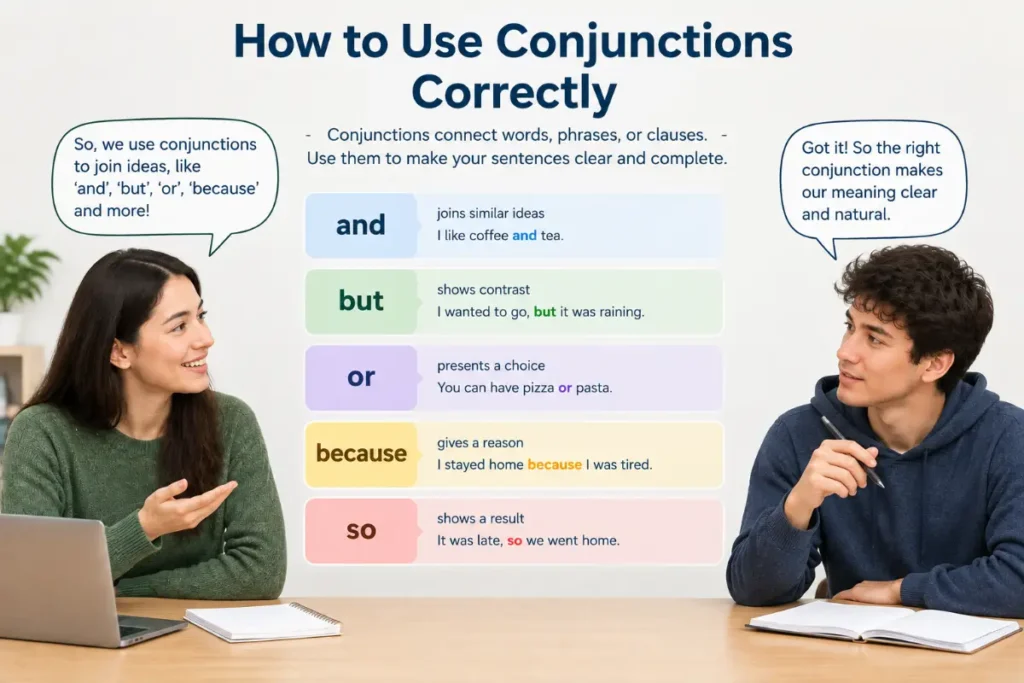
If you’ve ever wondered exactly how to use conjunctions correctly, the confusion usually isn’t about knowing what a conjunction is — most people can spot “and,” “but,” and “because” without a second thought. The real trouble shows up in the punctuation and pairing rules that surround these small connecting words, especially once sentences get longer or start combining several ideas at once.
This guide walks through all three families of English conjunctions — coordinating, subordinating, and correlative — with the specific punctuation habits attached to each, since getting the connector right and getting the comma right are really two separate skills that tend to get mixed up together.
You may also find Fix a Sentence Fragment: The Easy 2026 Guide helpful if you want to explore this topic further.
Meet the Three Families
Every conjunction in English falls into one of three categories, and each category has its own job.
Coordinating conjunctions link two elements of equal weight — words, phrases, or full sentences. There are exactly seven, commonly remembered by the acronym FANBOYS: for, and, nor, but, or, yet, so.
Subordinating conjunctions connect a dependent clause to an independent one, showing a relationship like cause, time, or contrast. Common examples: because, although, since, when, while, unless, before, after.
Correlative conjunctions always travel in pairs, linking two equal, matching elements: both…and, either…or, neither…nor, not only…but also.
Coordinating Conjunctions: Joining Equals
Purdue OWL describes coordination as the tool writers reach for “when writers have two ideas of relatively equal importance.” When a coordinating conjunction joins two complete, independent sentences, a comma goes before it.
- She wanted to leave early, but her ride hadn’t arrived.
- He studied all night, so he felt confident about the exam.
When it joins just two words or short phrases, no comma is needed at all.
- She likes tea and coffee.
- He was tired but determined.
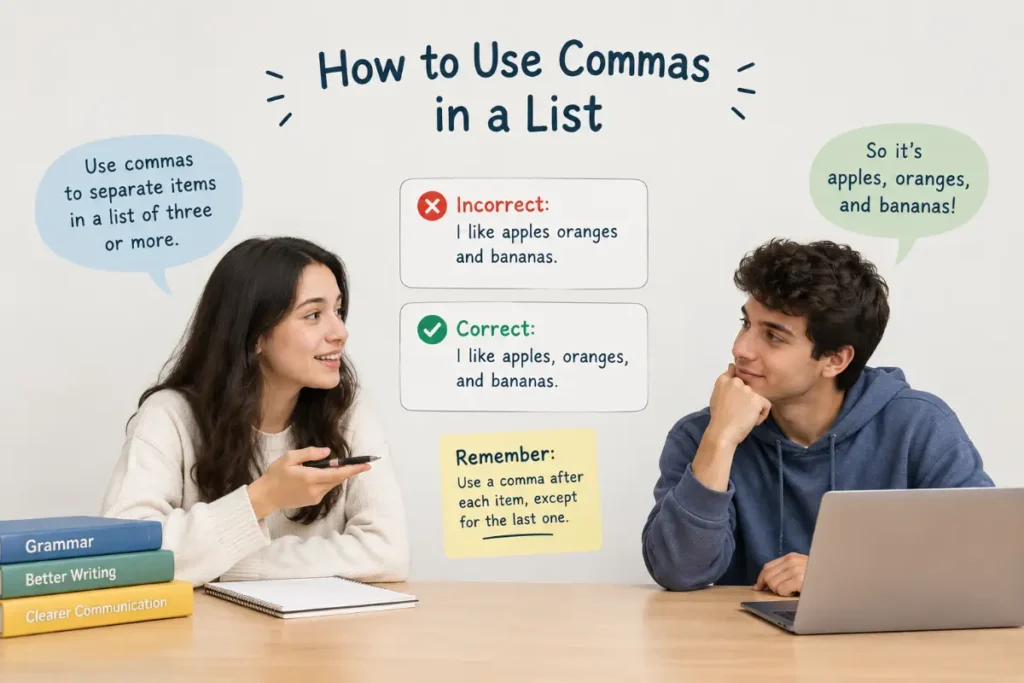
When it joins three or more items in a series, commas separate each item, and whether the final comma (before the conjunction) appears depends on your Oxford comma preference.
- We packed sandwiches, chips, and drinks.
Subordinating Conjunctions: Creating Unequal Partners
A subordinating conjunction introduces a dependent clause — one that can’t stand alone — and attaches it to a main, independent clause. The punctuation depends entirely on word order.
When the dependent clause comes first, it’s followed by a comma:
- Because it was raining, we canceled the picnic.
When the dependent clause comes second, no comma is typically needed:
- We canceled the picnic because it was raining.
This single rule — comma when the dependent clause leads, no comma when it follows — resolves the majority of subordinating conjunction punctuation questions.
Correlative Conjunctions: The Matching-Pair Rule
Correlative conjunctions require whatever follows each half of the pair to match grammatically — the same part of speech, the same structure.
- Correct: She is both talented and hardworking. (adjective, adjective)
- Incorrect: She is both talented and works hard. (adjective, then a verb phrase — mismatched)
- Correct: You can either stay here or come with us.
- Incorrect: You can either stay here or you could come with us. (mismatched structure after each half)
This is really parallel structure applied specifically to paired conjunctions, and it’s one of the more commonly broken rules in everyday writing, since the mismatch often doesn’t “sound” obviously wrong on a first read.
Conjunctive Adverbs: The Look-Alikes That Aren’t True Conjunctions
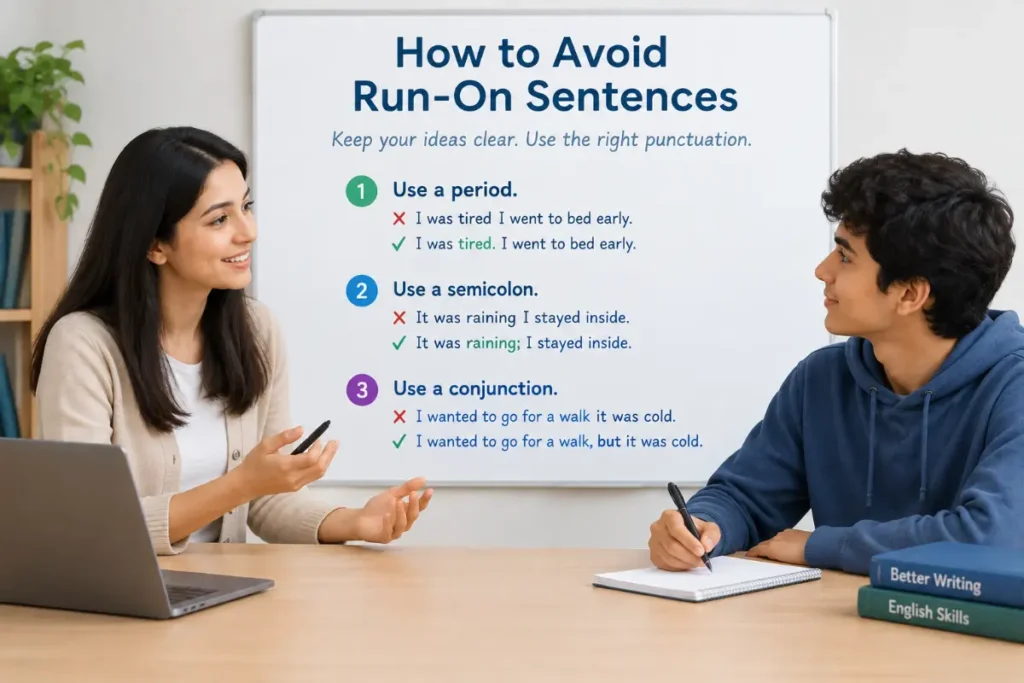
Words like however, therefore, moreover, and consequently look and function like conjunctions but are technically conjunctive adverbs, and they follow a different punctuation rule entirely: a semicolon before, a comma after, when joining two independent clauses.
- The report was late; however, the client remained patient.
Using only a comma before “however” in this construction creates a comma splice — one of the most common conjunction-adjacent errors in professional writing, and one covered in more depth in our comma splice examples and fixes guide.
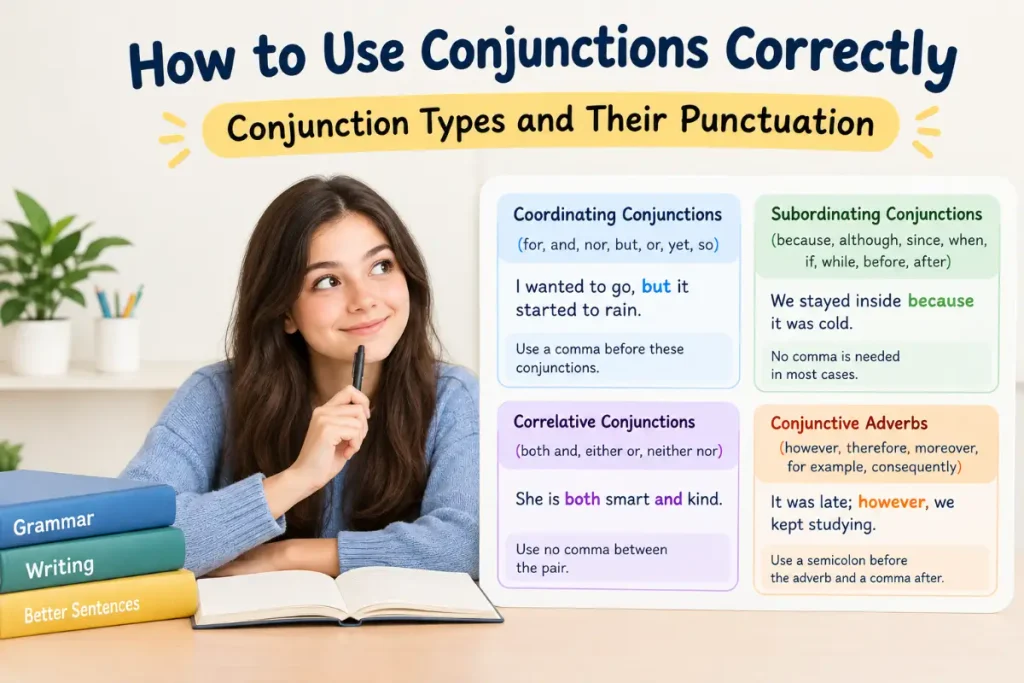
Quick Reference: Conjunction Types and Their Punctuation
| Type | Examples | Punctuation Rule |
|---|---|---|
| Coordinating | and, but, or, so | Comma before, if joining two independent clauses |
| Subordinating | because, although, when | Comma after, if the dependent clause comes first |
| Correlative | either…or, both…and | No comma; requires matching grammatical structure after each half |
| Conjunctive adverb | however, therefore | Semicolon before, comma after |
Common Mistakes People Make
- Mistake 1: “She wanted to go, but was too tired.” — Since both parts share the same subject (“she”), this doesn’t need a comma at all if it’s not two full independent clauses: “She wanted to go but was too tired.”
- Mistake 2: “Although it was raining we still went outside.” — Missing the comma after the introductory dependent clause: “Although it was raining, we still went outside.”
- Mistake 3: “He is not only talented, but also he works hard.” — The extra “he” breaks the matching structure; should be “not only talented but also hardworking.”
- Mistake 4: “The store closed early, however we found another one open.” — This creates a comma splice; “however” needs a semicolon before it: “The store closed early; however, we found another one open.”
- Mistake 5: Starting every single sentence with “and” or “but” throughout a formal document. While grammatically acceptable in moderation (and increasingly common even in professional writing), overusing sentence-initial conjunctions can start to feel stylistically repetitive.
How to Use Conjunctions Correctly
What Is a Conjunction?
A conjunction connects words, phrases, or clauses and shows how their ideas relate. Common examples include and, but, because, although, either…or, and both…and.
How to Use FANBOYS Correctly
The seven coordinating conjunctions—for, and, nor, but, or, yet, so—connect equal elements. When a FANBOYS conjunction joins two independent clauses, use a comma before it.
Example: I wanted to go, but it started raining.
Subordinating Conjunctions by Function
- Reason: because, since, as
- Time: when, while, before, after
- Condition: if, unless
- Contrast: although, though, even though
- Purpose: so that, in order that
Conjunction vs. Conjunctive Adverb
Words such as however, therefore, moreover, and consequently are conjunctive adverbs, not coordinating conjunctions.
Example: The store was closed; however, we found another one.
Conjunctions in Compound and Complex Sentences
Coordinating conjunctions commonly form compound sentences, while subordinating conjunctions form complex sentences.
Compound: I was tired, but I kept working.
Complex: Although I was tired, I kept working.
Common Conjunction Mistakes
Using Neither…Or Instead of Neither…Nor
Use neither…nor for the standard paired structure.
Forgetting the Comma After an Introductory Dependent Clause
When a dependent clause comes first, normally place a comma before the independent clause.
Using However Like But
Do not connect two independent clauses with only a comma and however.
For another useful perspective, check out Subject Verb Agreement Rules: 15 Rules + Easy Examples (2026).
Breaking Parallel Structure
Keep the grammatical structure balanced after pairs such as either…or and not only…but also.
Creating a Fragment
A subordinating conjunction can turn an independent clause into a dependent clause, so check that the sentence has a complete main clause.
Conjunction Examples in Sentences
Coordinating
I wanted tea, but she ordered coffee.
Subordinating
Because it was raining, we stayed inside.
Correlative
Either we leave now or we wait until morning.
Quick Conjunction Test
Before using a conjunction, ask:
- What words, phrases, or clauses is it connecting?
- What relationship does it show?
- Do I need a comma?
- If it is a paired conjunction, are both sides grammatically parallel?
Practice Exercise
Identify the type of conjunction used in each sentence, or fix the punctuation error. Answers are listed right after — try each one before checking.
- She likes hiking and swimming.
- Because he was late he missed the introduction.
- Neither the manager nor the employees were informed.
- The plan failed, however the team regrouped quickly.
- He wanted to stay but had to leave.
- Either you finish the report or you explain why not.
- Although she practiced daily she still felt nervous.
- The dog barked and the cat hissed.
- We can go now or we can wait until morning.
- Both the manager and the assistant were praised.
- She was tired, yet she kept working.
- Since it’s raining we should bring umbrellas.
- He is not only smart but also kind.
- I called twice, so I assumed you were busy.
- Whether you agree or disagree, the decision is final.
- The team lost, but they played well.
- Unless something changes we’ll proceed as planned.
- Not only did she win, but she also broke the record.
- He left early because he felt sick.
- The report was thorough, and everyone appreciated it.
Answer Key
- Coordinating (“and”)
- Missing comma: “Because he was late, he missed the introduction.”
- Correlative (“neither…nor”)
- Comma splice: “The plan failed; however, the team regrouped quickly.”
- Coordinating (“but”), no comma needed (shared subject)
- Correlative (“either…or”)
- Missing comma: “Although she practiced daily, she still felt nervous.”
- Coordinating (“and”)
- Coordinating (“or”)
- Correlative (“both…and”)
- Coordinating (“yet”)
- Missing comma: “Since it’s raining, we should bring umbrellas.”
- Correlative (“not only…but also”)
- Coordinating (“so”)
- Correlative (“whether…or”)
- Coordinating (“but”)
- Missing comma: “Unless something changes, we’ll proceed as planned.”
- Correlative (“not only…but also”)
- Subordinating (“because”), no comma needed (dependent clause follows)
- Coordinating (“and”)
Frequently Asked Questions
Is it grammatically wrong to start a sentence with “and” or “but”?
No — this is one of English’s most persistent grammar myths. Coordinating conjunctions can begin a sentence, and many respected writers and style guides use this technique deliberately for emphasis or pacing, though some formal or academic contexts still prefer avoiding it out of stylistic convention.
What’s the difference between a subordinating conjunction and a conjunctive adverb?
Subordinating conjunctions (because, although, when) create a dependent clause that’s grammatically attached to the main clause. Conjunctive adverbs (however, therefore) connect two independent clauses that could each stand alone, and they require a semicolon rather than just a comma when doing so.
Do correlative conjunctions always need to be right next to the words they’re pairing?
They need to introduce grammatically matching elements, but there’s some flexibility in exactly where they sit in a sentence, as long as the parallel structure holds: “She both cooked dinner and cleaned the kitchen” versus “She cooked both dinner and dessert” are both correct, with “both” positioned differently based on what’s being paired.
How many coordinating conjunctions are there, and how do I remember them?
There are exactly seven: for, and, nor, but, or, yet, so — commonly remembered with the acronym FANBOYS, which spells out the first letter of each one in order.
What’s the fastest way to catch conjunction errors before publishing something?
Identify which family each conjunction belongs to, then apply that family’s specific punctuation rule — comma before for coordinating conjunctions joining independent clauses, comma after for subordinating conjunctions that lead, semicolon before for conjunctive adverbs, and matching structure for correlative pairs.
Before moving on, you may also want to read Avoid Run-On Sentences: The 2026 Quick Guide for more helpful grammar tips.
Wrapping Up
Getting comfortable with how to use conjunctions correctly really comes down to recognizing which of the three families you’re working with, since each one carries its own specific punctuation habit rather than one universal rule covering all connecting words. Coordinating conjunctions want a comma when joining full sentences, subordinating conjunctions want a comma only when the dependent clause leads, and correlative pairs demand matching grammatical structure on both sides.
Once these three patterns become automatic, conjunctions stop being something you have to consciously think about and start functioning the way they’re meant to — as quiet connective tissue that holds your ideas together without drawing attention to themselves. The same instinct for matching structure carries over directly into parallel structure in writing, which is really just this correlative-conjunction rule applied more broadly across any list or comparison.