Ever read a sentence that sounds awkward even though every word seems correct? The problem may be parallel structure in writing. This simple grammar principle helps your sentences sound clearer, smoother, and more balanced.
Once you understand parallel structure, you’ll start noticing broken parallelism everywhere — in menus, job postings, even professional emails. Purdue OWL defines it clearly: parallel structure means “using the same pattern of words to show that two or more ideas have the same level of importance,” whether that happens at the level of individual words, phrases, or full clauses.
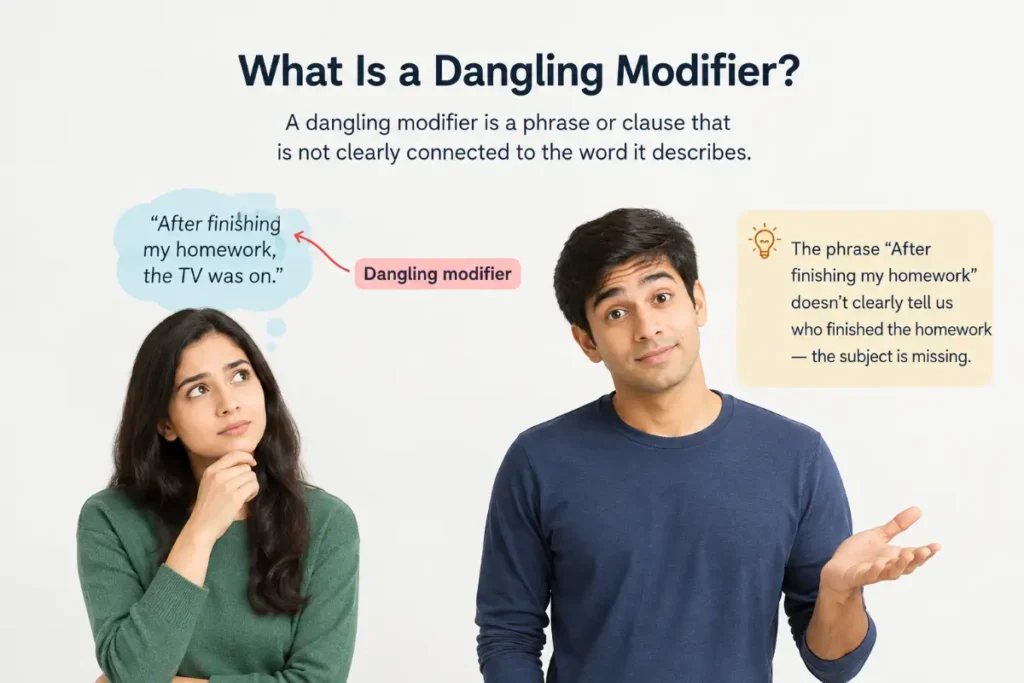
You may also find A Dangling Modifier? Learn It in 9 Easy Steps (2026 Guide) helpful if you want to explore this topic further.
The Quick Answer
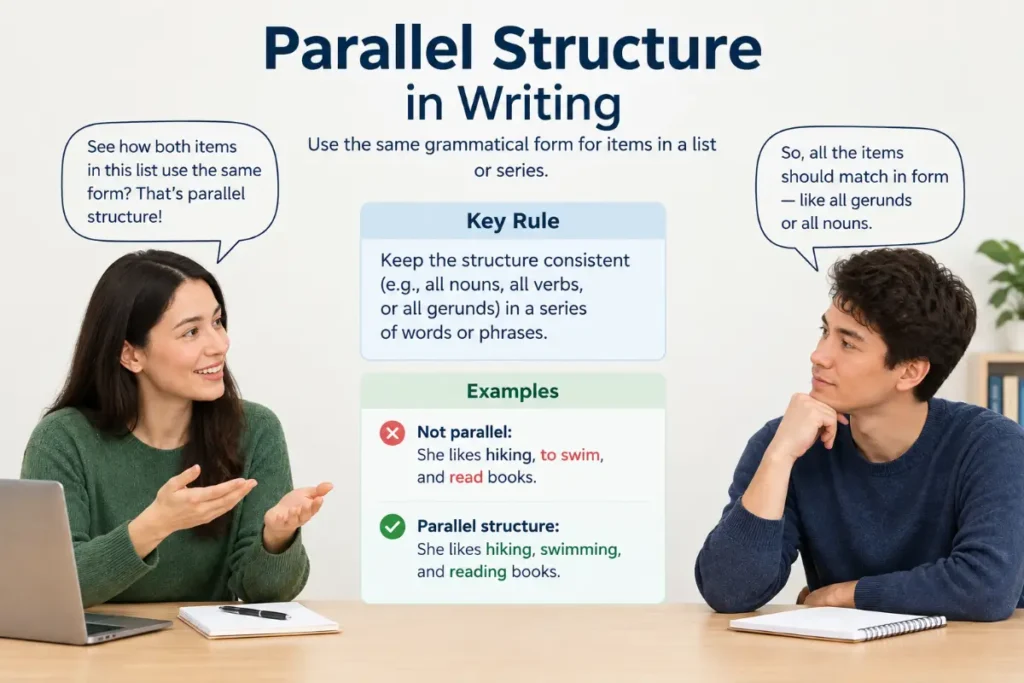
- Not parallel: Mary likes hiking, swimming, and to ride a bicycle.
- Parallel: Mary likes hiking, swimming, and bicycling.
The fix: once you start a list or comparison with one grammatical pattern — here, “-ing” words — every item needs to follow that same pattern. Mixing a gerund (“hiking”) with an infinitive (“to ride”) breaks the rhythm and reads as subtly off, even to readers who couldn’t explain exactly why.
Parallel Structure With Words and Phrases
The most common place parallel structure matters is in a simple list of words or short phrases joined by “and” or “or.”
With gerunds (-ing forms):
- Parallel: Mary likes hiking, swimming, and bicycling.
- Not parallel: Mary likes hiking, swimming, and to ride a bicycle.
With infinitive phrases:
- Parallel: Mary likes to hike, to swim, and to ride a bicycle.
- Also parallel: Mary likes to hike, swim, and ride a bicycle. (Purdue OWL notes you can repeat “to” before every verb, or use it only once before the first — either is correct, as long as it’s consistent)
With adjectives:
- Parallel: The room was bright, spacious, and welcoming.
- Not parallel: The room was bright, spacious, and had a welcoming feel.

Parallel Structure With Clauses
When parallel structure involves full clauses rather than single words, the rule extends further: every clause in the series needs to follow the same grammatical pattern, including matching how each clause begins and staying in the same voice (active or passive) throughout.
- Not parallel: The coach told the players that they should get a lot of sleep, that they should not eat too much, and to do some warm-up exercises before the game.
- Parallel: The coach told the players that they should get a lot of sleep, that they should not eat too much, and that they should do some warm-up exercises before the game.
Purdue OWL also flags a subtler version of this same error: mixing active and passive voice within a parallel series breaks parallelism just as much as mixing sentence patterns does.
- Not parallel: The salesman expected that he would present his product at the meeting, that he would have time to show his slide presentation, and that questions would be asked by prospective buyers. (this last clause shifts into passive voice)
- Parallel: The salesman expected that he would present his product at the meeting, that he would have time to show his slide presentation, and that he would answer questions from prospective buyers.
Parallel Structure in Professional and Employment Writing
This is one of the more practically important applications, since broken parallelism shows up constantly in resumes, cover letters, and job postings — and Purdue OWL’s dedicated guidance for professional writing specifically emphasizes this, noting that “when you are expressing ideas of equal weight in your writing, parallel sentence structures can echo that fact.”
- Not parallel: My degree, my work experience, and ability to complete complicated projects qualify me for the job.
- Parallel: My degree, my work experience, and my ability to complete complicated projects qualify me for the job.
Notice the fix here is subtle — simply adding the missing “my” before “ability” restores the matching pattern across all three items in the list.
Resume bullet points are another common trouble spot, since each bullet ideally starts with the same grammatical structure (usually a past-tense action verb):
- Not parallel: Managed a team of ten; responsible for quarterly reports; leading client meetings.
- Parallel: Managed a team of ten; prepared quarterly reports; led client meetings.
Why Parallel Structure Matters Beyond Just “Sounding Right”
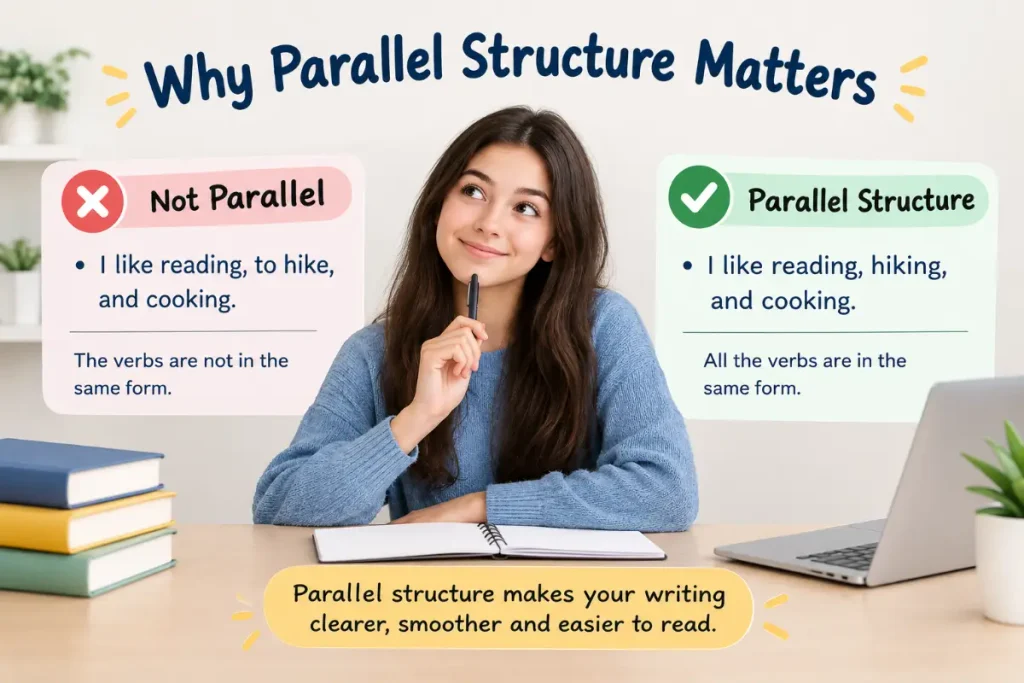
Parallel structure isn’t just a stylistic nicety — it genuinely affects how clearly a reader processes a list or comparison. Matching grammatical patterns signal to the reader that the listed items carry equal weight and belong together conceptually, while a broken pattern subtly disrupts that signal, forcing the reader to work harder to parse the sentence’s structure. This is also why parallel structure is such a powerful tool in persuasive and rhetorical writing — famous parallel constructions (“we shall fight on the beaches, we shall fight on the landing grounds, we shall fight in the fields”) build rhythm and momentum specifically because each clause repeats the same grammatical shape.
The Fastest Way to Check Yourself
- Step 1: Identify the pattern established by the first item in your list or comparison. Is it a gerund, an infinitive, a full clause, a noun, an adjective?
- Step 2: Check that every subsequent item follows that exact same pattern.
- Step 3: If clauses are involved, check that the voice (active or passive) stays consistent throughout the entire series.
- Step 4: Read the list aloud, or stack the items vertically on the page. Purdue OWL specifically recommends this technique — listening for a repeated rhythm, or visually checking that each item starts the same way, makes broken parallelism much easier to spot.
Parallel Structure in Writing: Quick Reference
| Not Parallel | Parallel | Fix Applied |
|---|---|---|
| hiking, swimming, and to ride a bicycle | hiking, swimming, and bicycling | Matched all items to gerund form |
| bright, spacious, and had a welcoming feel | bright, spacious, and welcoming | Matched all items to adjective form |
| that he would present… and questions would be asked | that he would present… and he would answer | Matched voice (active) throughout |
| my degree, my work experience, and ability to… | my degree, my work experience, and my ability to… | Matched possessive pronoun across all items |
Common Mistakes People Make
Mistake 1: Mixing gerunds with infinitives
❌ “She enjoys reading, cooking, and to travel.”
Mixing grammatical forms breaks the pattern. Use matching gerunds: “She enjoys reading, cooking, and traveling.”
Mistake 2: Mixing nouns, gerunds, and infinitives in one list
❌ “The job requires strong communication skills, being organized, and to work independently.”
The three items use different grammatical forms. Make them consistent: “The job requires strong communication skills, organizational ability, and independence.”
Mistake 3: Mixing active and passive voice
Parallel structure applies to voice, too. Switching from active to passive in the middle of a list can make a sentence feel uneven. Check that related actions use the same voice whenever the meaning allows it.
Mistake 4: Using inconsistent forms in bullet points
Resume and report bullets often reveal broken parallelism. For example, “Managed the team,” “Responsible for scheduling,” and “Leading meetings” use different forms. Choose one pattern and stick with it.
Mistake 5: Assuming parallel structure only matters in long lists
Even a two-item comparison should follow the same grammatical pattern. “She’s smart and hardworking” is more balanced than “She’s smart and has a strong work ethic.”
Mistake 6: Mixing verb tenses unnecessarily
❌ “She researched the topic, writes the report, and presented the results.”
The verbs shift between past and present without a reason. If the actions happened in the past, write: “She researched the topic, wrote the report, and presented the results.”
Mistake 7: Breaking parallelism after “either…or”
❌ “You can either take the bus or walking to work.”
The two choices should match: “You can either take the bus or walk to work.”
Mistake 8: Breaking parallelism after “not only…but also”
❌ “The course teaches students not only how to write but also presentation skills.”
Keep both parts in the same form: “The course teaches students not only how to write but also how to present.”
Mistake 9: Mixing adjectives and clauses
❌ “The new system is faster, more reliable, and it saves money.”
The first two items are adjectives, while the third is a clause. A smoother version is: “The new system is faster, more reliable, and more affordable.”
For another useful perspective, check out Use Neither Nor Correctly: The Easy 2026 Guide.
Mistake 10: Using inconsistent infinitive phrases
❌ “Our goal is to improve service, reduce costs, and increasing sales.”
The first two verbs use infinitives, while the last uses a gerund. Write: “Our goal is to improve service, reduce costs, and increase sales.”
Mistake 11: Forgetting parallelism in comparisons
❌ “Working from home is easier than to commute every day.”
The comparison uses a gerund on one side and an infinitive on the other. Write: “Working from home is easier than commuting every day.”
Mistake 12: Mixing phrases and full clauses
❌ “The company wants to expand internationally, increase its revenue, and employees should receive more training.”
The first two items are verb phrases, but the third is a complete clause. Make the structure match: “The company wants to expand internationally, increase its revenue, and provide more employee training.”
Mistake 13: Ignoring parallelism in headings
Headings within the same article or report should generally follow a consistent pattern. For example, “How to Write Clearly,” “Improving Your Grammar,” and “Better Sentence Structure” mix forms. Using “How to Write Clearly,” “How to Improve Your Grammar,” and “How to Structure Sentences” creates a more consistent set.
Mistake 14: Adding unnecessary words to only one item
❌ “She likes reading novels, watching movies, and she enjoys listening to music.”
The extra clause makes the final item structurally different. A cleaner version is: “She likes reading novels, watching movies, and listening to music.”
Mistake 15: Editing for grammar but not for structure
A sentence can be grammatically correct while still lacking parallel structure. During proofreading, don’t just ask whether each word is correct. Look at lists, comparisons, headings, and paired constructions and check whether related elements follow the same grammatical pattern.
More Examples to Lock It In
- Not parallel: He likes running, biking, and to swim. Parallel: He likes running, biking, and swimming.
- Not parallel: The manual explains how to install the software, how to configure settings, and troubleshooting common issues. Parallel: The manual explains how to install the software, how to configure settings, and how to troubleshoot common issues.
- Not parallel: The company values innovation, teamwork, and being efficient. Parallel: The company values innovation, teamwork, and efficiency.
Frequently Asked Questions
Does parallel structure apply to punctuation as well as grammar?
Primarily it’s a grammatical concept, but it often intersects with list punctuation — when list items are properly parallel, they’re also easier to separate clearly with commas or semicolons, since each item’s boundary becomes more visually and grammatically predictable.
Is broken parallelism a serious grammar error, or more of a style issue?
It sits somewhere in between — sentences with broken parallelism are still grammatically comprehensible, but they read as noticeably less polished and can genuinely confuse readers about whether listed items are meant to carry equal weight, which is why it’s taken seriously in professional and academic writing.
How does parallel structure relate to rhetorical devices like anaphora?
Parallel structure is the underlying grammatical foundation that makes rhetorical repetition effective — famous speeches that repeat a phrase at the start of successive clauses rely on parallel grammatical structure to create their rhythm and persuasive power.
Can parallel structure apply across entire paragraphs, not just single sentences?
Yes — some writers use parallel structure at the paragraph level, opening several paragraphs with a similar grammatical pattern to create a rhetorical rhythm across a longer piece, though this is a more advanced stylistic choice than the sentence-level parallelism covered here.
What’s the fastest way to catch parallel structure errors before publishing something?
Stack your list items vertically on the page or read them aloud, listening for a consistent rhythm or checking that each item starts with the same grammatical form — any item that breaks the pattern needs to be revised to match.
Practice Exercise
Identify and fix the broken parallel structure in each sentence. Try to correct each one before checking the answer key.
- She is intelligent, driven, and works hard.
- The report covers our achievements, our challenges, and what we plan to do next.
- He enjoys painting, writing, and to compose music.
- The workshop will teach you how to write a resume, interview skills, and networking.
- Sarah likes hiking, swimming, and to ride her bike.
- The new manager is friendly, organized, and communicates clearly.
- Our goals are to increase sales, improving customer service, and reducing costs.
- He wanted to finish the project, submit the report, and attending the meeting.
- The job requires patience, creativity, and being able to solve problems.
- She spent the afternoon reading emails, answering calls, and to organize files.
- The teacher asked students to read the chapter, complete the worksheet, and that they discuss the questions.
- Good writing should be clear, concise, and should engage the reader.
- We can either take the train or driving to the city.
- The company values honesty, teamwork, and employees who communicate openly.
- He was praised for his dedication, his creativity, and working efficiently.
- The presentation was informative, entertaining, and it inspired the audience.
- She wants a career that offers flexibility, challenges her skills, and provides opportunities for growth.
- The committee’s responsibilities include reviewing applications, conducting interviews, and to make final recommendations.
- They spent the weekend cleaning the house, shopping for groceries, and they cooked dinner.
- The course teaches students how to research effectively, how to organize information, and presenting ideas clearly.
Answer Key
- She is intelligent, driven, and hardworking.
- The report covers our achievements, our challenges, and our future plans.
- He enjoys painting, writing, and composing music.
- The workshop will teach you how to write a resume, how to interview, and how to network.
- Sarah likes hiking, swimming, and riding her bike.
- The new manager is friendly, organized, and communicates clearly.
- Our goals are to increase sales, improve customer service, and reduce costs.
- He wanted to finish the project, submit the report, and attend the meeting.
- The job requires patience, creativity, and problem-solving skills.
- She spent the afternoon reading emails, answering calls, and organizing files.
- The teacher asked students to read the chapter, complete the worksheet, and discuss the questions.
- Good writing should be clear, concise, and engaging.
- We can either take the train or drive to the city.
- The company values honesty, teamwork, and open communication.
- He was praised for his dedication, creativity, and efficiency.
- The presentation was informative, entertaining, and inspiring.
- She wants a career that offers flexibility, challenges her skills, and provides opportunities for growth.
- The committee’s responsibilities include reviewing applications, conducting interviews, and making final recommendations.
- They spent the weekend cleaning the house, shopping for groceries, and cooking dinner.
- The course teaches students how to research effectively, organize information, and present ideas clearly.
If you corrected 16 or more, you have a strong grasp of parallel structure. If you missed a few, review the grammatical pattern in each list and try the exercise again.
Before moving on, you may also want to read Active vs Passive Voice Examples: 15 Easy Examples (2026) for more helpful grammar tips.
The Bottom Line
Getting parallel structure in writing right comes down to one consistent habit: whatever grammatical pattern you establish with the first item in a list or comparison — a gerund, an infinitive, a noun, a full clause — every subsequent item needs to match it, including staying in the same voice throughout. Reading your lists aloud or stacking them vertically on the page remains the fastest, most reliable way to catch a pattern that’s quietly broken.
The key to mastering parallel structure is consistency: once you establish a grammatical pattern, keep that same pattern throughout your sentence or list. Whether you’re using gerunds, infinitives, nouns, or full clauses, matching the structure makes your writing clearer, smoother, and easier to follow.