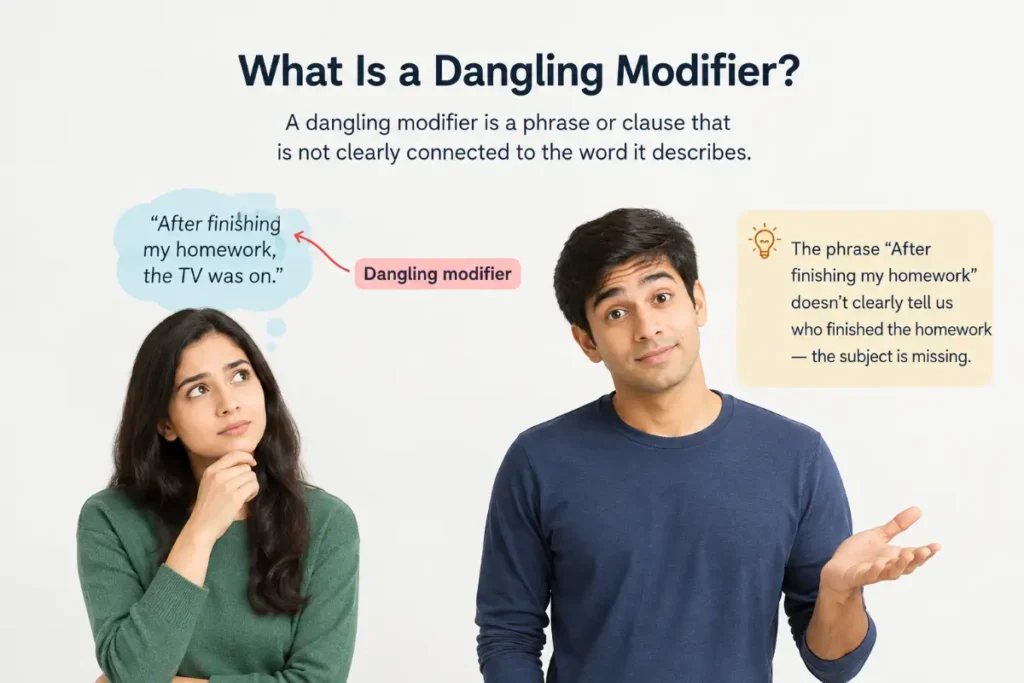
Learning how to identify a dangling participle is really about training your eye to catch one specific kind of sentence opening — the “-ing” or “-ed” phrase that sits at the front of a sentence, quietly describing an action, without anyone actually named to be doing it. This is a narrower cousin of the broader dangling modifier problem covered in our what is a dangling modifier guide, and it’s worth its own focused look because participial phrases specifically are where this error shows up most often in everyday writing.
Once you know exactly what a participle is and what it’s supposed to attach to, spotting a dangling one becomes almost mechanical — a quick, repeatable check you can run on any sentence that opens with an “-ing” or “-ed” word.
You may also find Avoid Passive Voice in Writing: 7 Easy Rules (2026) helpful if you want to explore this topic further.
What a Participle Actually Is
Purdue OWL defines a participle as a verbal — a word built from a verb — that functions as an adjective, most often ending in “-ing” (present participle) or “-ed,” “-en,” “-d,” “-t,” or “-n” (past participle). A participial phrase is the participle plus whatever object, modifier, or complement travels with it.
- Removing his coat, Jack rushed to the river. (“Removing his coat” is the participial phrase, modifying Jack)
- Shaken, he walked away from the wrecked car. (“Shaken” modifies “he”)
- Smiling, she hugged the panting dog. (“Smiling” modifies “she”)
In every correct example, the participial phrase is doing its job properly: it clearly describes the noun sitting right next to it.
The Placement Test: Where the Danger Lives
Purdue OWL states the placement rule directly: “a participial phrase must be placed as close to the noun it modifies as possible, and the noun must be clearly stated.” A dangling participle happens the moment that second condition fails — the noun the phrase is supposed to describe is either missing entirely or replaced by something that can’t logically perform the action.
- Carrying a heavy pile of books, his foot caught on a step. (dangling — a foot can’t carry books)
- Carrying a heavy pile of books, he caught his foot on a step. (fixed — “he” is now the one carrying)
This is the exact test worth running on any sentence that opens with a participial phrase: identify the noun immediately following the comma, then ask whether that noun is actually capable of performing the action the participle describes.
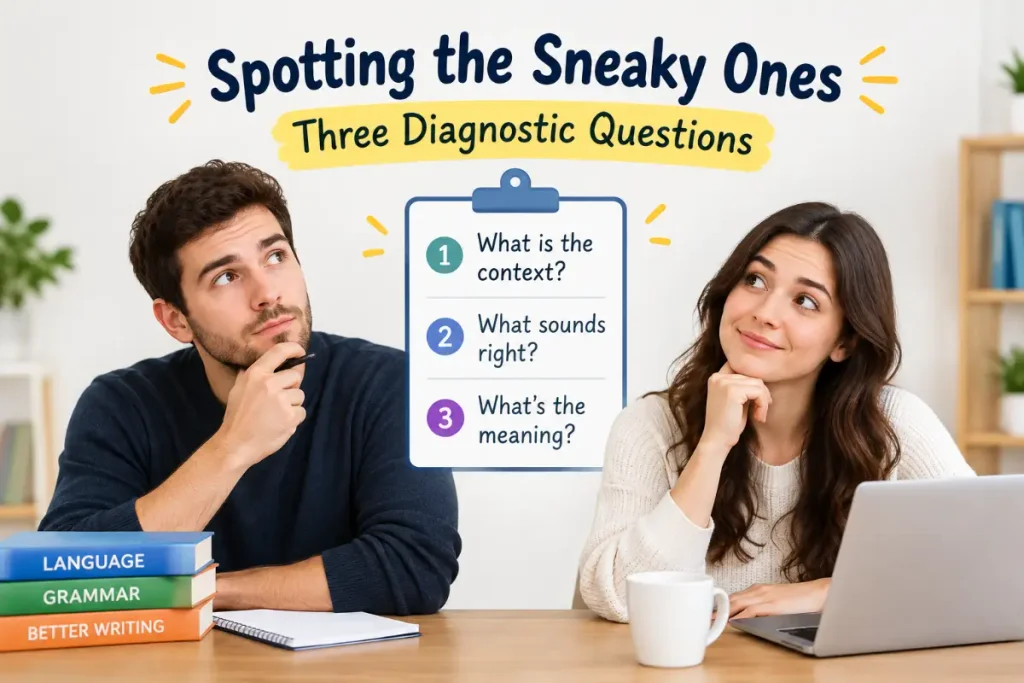
Three Diagnostic Questions
Question 1: What is the participle describing? Identify the action or state the “-ing” or “-ed” word expresses.
Question 2: Who or what is the very next noun in the sentence? This is the subject of your main clause.
Question 3: Could that noun logically be the one doing what the participle describes? If yes, you’re fine. If no — or if there’s no clear noun there at all — you’ve found a dangling participle.
How to Identify a Dangling Participle in Your Own Writing
The quickest way to identify a dangling participle is to slow down and check the relationship between the opening phrase and the subject that follows it. If a sentence begins with an -ing or -ed participial phrase, don’t assume it’s wrong. Instead, ask who or what is supposed to perform the action described by that phrase.
For example, in “Driving to work, the traffic seemed unusually heavy,” the phrase “Driving to work” needs to describe someone who can drive. However, the subject that follows the comma is “the traffic,” which cannot drive. That makes the participial phrase dangle.
A simple three-step check can catch the problem:
- Find the participial phrase. Look for an opening phrase built around an “-ing” or “-ed” form.
- Find the main subject. Identify the noun or pronoun immediately following the comma.
- Connect the two logically. Ask whether that subject could actually perform or experience the action described by the participle.
If the answer is no, rewrite the sentence so the intended subject is clearly connected to the participial phrase. For instance, “Driving to work, I noticed that the traffic was unusually heavy” makes the relationship clear.
This quick check is especially useful when proofreading essays, emails, reports, and other formal writing. Rather than searching for dangling participles by appearance alone, focus on the meaning: the noun being described must logically be able to perform or experience the action in the participial phrase.
More Examples Worth Studying
- Interested in music early, children develop strong intellectual skills. — here, “interested in music” logically describes “children,” so this is correctly attached, not dangling.
- Having been a gymnast, Lynn knew the importance of exercise. — “Lynn” logically could have been a gymnast, so this holds together correctly.
- Walking through the park, the flowers looked beautiful. — dangling; flowers don’t walk. Fix: Walking through the park, I noticed the flowers looked beautiful.
- Exhausted from the trip, the bed looked inviting. — dangling; a bed can’t be exhausted. Fix: Exhausted from the trip, she found the bed inviting.
Past Participles Dangle Too
It’s easy to assume dangling participles only involve “-ing” words, but past participles (“-ed,” “-en” forms) are just as prone to the error.
- Confused by the instructions, the form was filled out incorrectly. (dangling — a form can’t be confused)
- Confused by the instructions, she filled out the form incorrectly. (fixed)
- Written in a hurry, the email contained several typos. (this one is actually fine — “written” logically describes “the email”)
Notice that last example is correctly attached, which is a useful reminder: not every “-ed” opening is dangling. The test is always the same regardless of which participle form you’re checking.
Three Ways to Fix a Dangling Participle
Name the real subject. Add the actual “doer” as the subject of your main clause: Carrying a heavy pile of books, he caught his foot.
Turn the phrase into a full clause. Expand the participle into its own clause with an explicit subject: As he was carrying a heavy pile of books, his foot caught on a step.
Rewrite the sentence entirely. Sometimes restructuring avoids the awkwardness altogether: He tripped while carrying a heavy pile of books.
Quick Diagnostic Table
| Sentence Opening | Next Noun | Logical? | Verdict |
|---|---|---|---|
| Removing his coat, | Jack | Yes | Correctly attached |
| Carrying a pile of books, | his foot | No | Dangling |
| Shaken, | he | Yes | Correctly attached |
| Exhausted from the trip, | the bed | No | Dangling |
| Written in a hurry, | the email | Yes | Correctly attached |
Common Mistakes People Make
Mistake 1: Assuming every sentence starting with an “-ing” word is automatically wrong. Plenty of participial phrases are correctly attached — the test is always whether the following noun logically fits, not the mere presence of a participle.
Mistake 2: Fixing the dangling participle by simply removing the comma, without renaming the actual subject. The comma was never the problem; the missing or mismatched subject is.
For another useful perspective, check out Double Negatives in English Grammar: What’s Correct? (2026 Guide).
Mistake 3: Overlooking dangling past participles because attention tends to focus on “-ing” openings specifically. Both forms need the same identical check.
Mistake 4: Confusing a dangling participle with a misplaced modifier. A dangling participle has no logical subject anywhere in the sentence; a misplaced modifier has a logical subject present, just positioned confusingly far away.
Mistake 5: Trying to fix the sentence by adding more description to the dangling phrase itself, rather than fixing what comes after it. Padding “carrying a heavy pile of books” with more detail doesn’t help if “his foot” still can’t logically carry anything.
Practice Exercise
Identify whether each sentence contains a dangling participle, and fix it if it does. Answers are listed right after — try each one before checking.
- Running late, the bus was missed.
- Excited about the trip, she packed her bags early.
- Covered in mud, the dog needed a bath.
- Reading the manual, the machine still wouldn’t start.
- Frightened by the noise, the cat hid under the bed.
- Having finished the report, the printer jammed.
- Startled by the alarm, he jumped out of bed.
- Working late every night, her health began to suffer.
- Painted a bright yellow, we loved the new fence.
- Waiting at the station, the train finally arrived.
- Determined to succeed, she studied every night.
- Broken beyond repair, they threw out the old chair.
- Tired after the long shift, the couch looked inviting.
- Smiling warmly, the host greeted every guest.
- Left out in the rain, the papers were ruined.
- Driving through the fog, visibility became a real problem.
- Inspired by the lecture, he changed his career path.
- Forgotten on the counter, she found her keys later.
- Annoyed by the delay, the passengers complained loudly.
- Written hastily, the note was hard to read.
Answer Key
- Dangling — “Running late, she missed the bus.”
- Correctly attached
- Correctly attached
- Dangling — “Reading the manual, he still couldn’t start the machine.”
- Correctly attached
- Dangling — “Having finished the report, she noticed the printer jammed.”
- Correctly attached
- Dangling — “Working late every night, she noticed her health suffering.”
- Dangling — “Painted a bright yellow, the fence looked great.” (originally implies “we” were painted)
- Correctly attached (implied “we/they” waiting, though technically ambiguous — often rewritten as “As we waited at the station, the train finally arrived”)
- Correctly attached
- Correctly attached
- Dangling — “Tired after the long shift, he found the couch inviting.”
- Correctly attached
- Dangling — “Left out in the rain, the papers had been ruined.” (still slightly ambiguous; better as “Because they’d been left out in the rain, the papers were ruined.”)
- Dangling — “Driving through the fog, we found visibility to be a real problem.”
- Correctly attached
- Dangling — “Forgotten on the counter, the keys weren’t found until later.”
- Correctly attached
- Correctly attached
Frequently Asked Questions
Is a dangling participle always found at the start of a sentence?
Most commonly yes, but it can also appear at the end of a sentence, following the same logic — the participial phrase still needs a clearly stated, logical noun to attach to somewhere nearby.
How is a dangling participle different from a dangling gerund?
A gerund is an “-ing” word functioning as a noun rather than an adjective, so it plays a different grammatical role. Dangling constructions more commonly involve participles (acting as adjectives) and infinitives, though similar logic applies whenever any verbal phrase is left without a clear subject to modify.
Can a dangling participle ever be intentional for stylistic effect?
It’s rare and generally discouraged, since the ambiguity created is usually a genuine flaw rather than a deliberate effect — unlike some other “broken rules” that skilled writers use on purpose, dangling participles typically just confuse or unintentionally amuse readers.
Why do dangling participles often create funny sentences?
Because the grammar forces an illogical action onto whatever noun happens to follow — a foot carrying books, a bed feeling exhausted — creating an absurd literal image that readers notice immediately, even if the intended meaning is still guessable from context.
What’s the fastest way to catch dangling participles before publishing something?
For every sentence opening with an “-ing” or “-ed” phrase, identify the very next noun and ask whether it could logically perform the action described. If it can’t — or if that noun is missing or vague — revise using one of the three standard fixes.
Before moving on, you may also want to read A Non-Restrictive Clause? 5 Simple Rules (2026) for more helpful grammar tips.
Wrapping Up
Getting comfortable with how to identify a dangling participle comes down to a simple, repeatable habit: find the participial phrase, find the noun that immediately follows it, and ask whether that noun could logically be doing what the participle describes. When the answer is no, the fix is almost always the same — name the real subject, expand the phrase into a full clause, or restructure the sentence entirely.
This is a small, mechanical check, but it catches one of the more common — and more entertaining — errors in everyday writing, from resumes to news articles to casual emails. Once the habit sticks, you’ll likely start noticing dangling participles in other people’s writing just as quickly as in your own.