Apostrophe Rules for Plurals can be confusing, but the basic rule is simple: most plural nouns don’t need an apostrophe. Learn when to use one correctly and avoid common punctuation mistakes.
Here’s the single most important thing to know about this topic, and it resolves the overwhelming majority of cases on its own: apostrophes almost never make a word plural. “Banana’s are on sale” is wrong; “bananas are on sale” is correct. The apostrophe’s real jobs are showing possession and marking missing letters in contractions — not signaling more than one of something.
You may also find Oxford Comma Examples: 21 Ways to Use It Correctly (2026) helpful if you want to explore this topic further.
The Quick Answer
Regular plurals never take an apostrophe. Just add -s or -es:
- dogs, cars, houses, boxes, apples
There are exactly a few narrow exceptions where an apostrophe is used to pluralize something, specifically to avoid confusion:
- Lowercase single letters: Mind your p’s and q’s.
- Some abbreviations without periods, though style guides vary here
- Occasionally, single digits or decades, though modern style increasingly drops this too: the 1990s (no apostrophe, now preferred) versus the older the 1990’s
Everything else — regular nouns, most abbreviations, most numbers — takes a plain -s or -es, with no apostrophe at all.
The Core Rule: Regular Nouns Never Take an Apostrophe to Pluralize
This is worth stating as plainly as possible, because it’s the error that shows up constantly on hand-painted signs, menus, and social media posts: a plural noun does not get an apostrophe.
Correct:
- We sell fresh avocados and tomatoes.
- The neighbors’ kids play in the yard. (this “neighbors'” is possessive, not just plural — more on that distinction below)
- I have three brothers and two sisters.
- The Smiths are hosting a barbecue this weekend. (plural of the family name, no apostrophe)
Incorrect:
- We sell fresh avocado’s and tomato’s.
- I have three brother’s and two sister’s.
- The Smith’s are hosting a barbecue.
That last incorrect example is genuinely one of the most common apostrophe errors in everyday writing — people plan to write “the Smiths are hosting” (simply more than one Smith) but instinctively add an apostrophe, perhaps because they’re thinking of possession (“the Smiths’ house”) when they actually just mean the plural family.
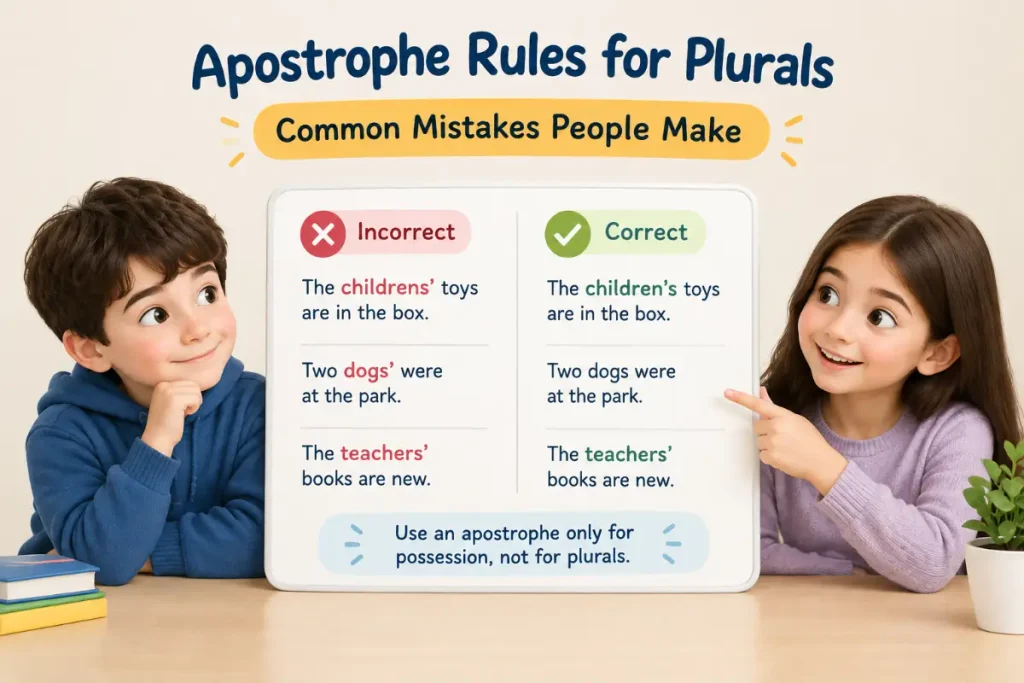
Don’t Confuse Plural With Possessive
This is where most of the real confusion comes from, so it’s worth separating clearly:
- Plural (more than one, no apostrophe): The dogs barked all night.
- Possessive singular (belongs to one dog, apostrophe + s): The dog’s leash is missing.
- Possessive plural (belongs to more than one dog, apostrophe after the s): The dogs’ leashes are missing.
Notice the pattern: for a possessive plural, you first form the regular plural (dogs), and then add just an apostrophe after the existing s — you don’t add another s. This is different from a possessive singular, where you add apostrophe + s to a word that doesn’t already end in s.
More examples:
- The teacher’s desk (one teacher)
- The teachers’ lounge (more than one teacher)
- The child’s toy (one child; “child” doesn’t end in s, so it takes apostrophe + s)
- The children’s toys (more than one child; “children” is an irregular plural that also doesn’t end in s, so it still takes apostrophe + s)
Exception 1: Lowercase Single Letters
When pluralizing a single lowercase letter, an apostrophe is used specifically to prevent the result from being misread as a different word.
- Mind your p’s and q’s.
- She got straight A’s on her report card. (capital letters are more debated — some style guides skip the apostrophe here, since “As” doesn’t create the same confusion “as” would)
- There are two i’s in “skiing.”
Without the apostrophe, “mind your ps and qs” is at least readable, but “dot your is” (meaning the letter i) would be genuinely confusing without the apostrophe, since “is” is already a common word. This specific exception exists purely for clarity, not as a general apostrophe-for-plurals rule.
Exception 2: Numbers and Decades (Increasingly Rare)
Older style guides used to recommend an apostrophe when pluralizing numbers: the 1990’s, in the 1800’s. Modern style — including current Chicago Manual of Style and AP Stylebook guidance — has moved toward dropping the apostrophe in these cases: the 1990s, in the 1800s. This shift reflects a broader trend toward simpler, sparser punctuation in contemporary style guides, and it means the version without an apostrophe is now the safer, more current default.
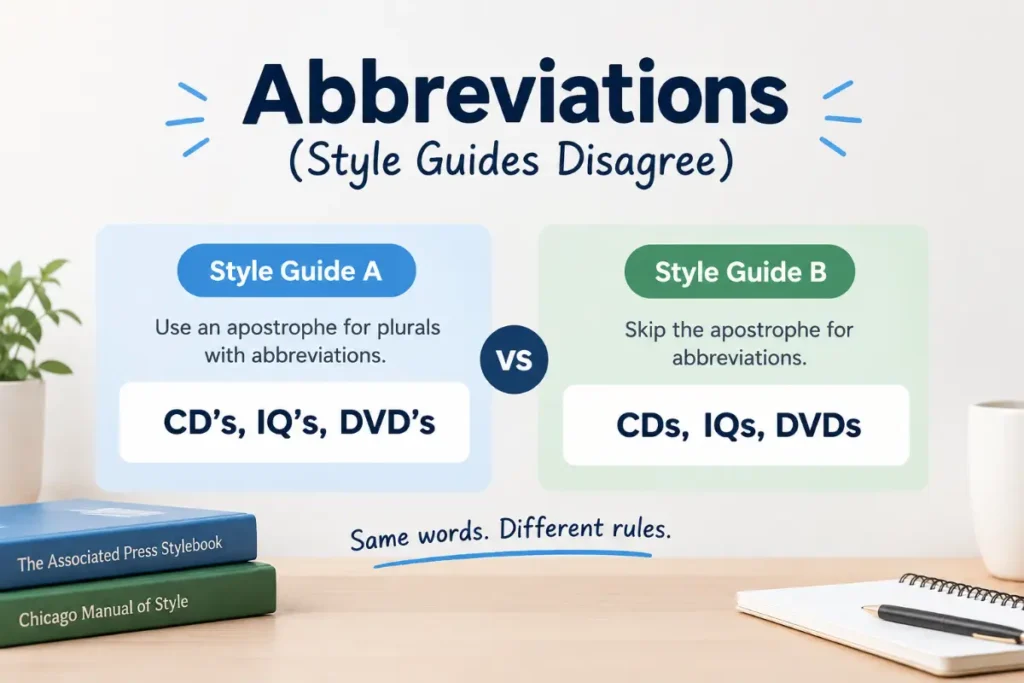
Exception 3: Abbreviations (Style Guides Disagree)
This is one of the genuinely unsettled areas. Pluralizing abbreviations without an apostrophe is now the more common recommendation from most major style guides:
- CEOs attended the summit. (not “CEO’s”)
- She has three PhDs on her team. (not “PhD’s”)
- We need more RVs on this trip. (not “RV’s”)
Some older style conventions still add an apostrophe when the abbreviation includes periods, or when leaving it out would be confusing, but the general modern trend — reflected across most contemporary references — favors skipping the apostrophe for plural abbreviations whenever the meaning stays clear without it.
What About Family Names? (The Trickiest Common Case)
This deserves its own section because it’s one of the most frequently searched apostrophe questions, especially around holiday cards. To make a family’s last name plural, treat it exactly like any other noun — add -s or -es, with no apostrophe:
- The Johnsons are coming for dinner. (not “Johnson’s”)
- We’re visiting the Rodriguezes this weekend. (not “Rodriguez’s” — note the “-es” ending, since the name ends in a z sound)
- The Foxes live down the street. (not “Fox’s”)
If you want to show something belonging to the family collectively, that’s when the apostrophe comes in, and it goes after the s of the plural form: the Johnsons’ house, the Rodriguezes’ car. Merriam-Webster’s guide to plural and possessive names confirms this exact two-step approach — pluralize first, then add the possessive apostrophe — and notes it’s one of the most frequently misapplied rules on precisely this kind of formal correspondence, like wedding invitations and holiday cards, where “The Smith’s” (intending simply “the Smith family”) is one of the most common and visible apostrophe errors people make.
This same plural-versus-possessive confusion is exactly what makes their, there, and they’re tricky too — in both cases, the presence or absence of an apostrophe changes the grammatical job the word is doing, not just its spelling.
The Fastest Way to Check Yourself
Step 1: Are you just talking about more than one of something, with no ownership involved? If yes, don’t use an apostrophe — just add -s or -es.
Step 2: Does something belong to the plural group? If yes, form the plural first, then add just an apostrophe after the existing s (or apostrophe + s if the plural doesn’t already end in s, like “children’s”).
Step 3: Is it a lowercase single letter that would be confusing without an apostrophe? This is one of the few genuine exceptions where an apostrophe helps form a plural.
Step 4: Is it a decade or an abbreviation? Modern style generally skips the apostrophe here too — 1990s, CEOs — though you may see older material that still includes it.
Apostrophe Rules: Quick Reference
| Situation | Apostrophe? | Example |
|---|---|---|
| Regular plural noun | No | cars, dogs, boxes |
| Family name, plural | No | the Johnsons |
| Possessive singular | Yes, ‘s | the dog’s leash |
| Possessive plural | Yes, after the s | the dogs’ leashes |
| Lowercase single letter, plural | Yes | p’s and q’s |
| Decade, plural | No (modern style) | the 1990s |
| Abbreviation, plural | No (modern style) | CEOs, PhDs |
Common Mistakes People Make
Mistake 1: “The Wilson’s are on vacation.” Should be “the Wilsons are on vacation” — this is simply the plural family name, with no possession involved, so no apostrophe is needed.
Mistake 2: “Banana’s: 3 for $1.” Should be “Bananas: 3 for $1” — this is one of the most common signage errors, mistakenly applying an apostrophe to a plain plural.
Mistake 3: “The dog’s are barking.” Should be “the dogs are barking” — again, this is simply plural, not possessive, so the apostrophe doesn’t belong.
For another useful perspective, check out When to Capitalize Job Titles: 7 Rules You Need to Know (2026).
Mistake 4: “The children’s’s toys” or similar double-marking. The correct possessive of the irregular plural “children” is simply “children’s” — never add an extra s or apostrophe on top of that.
Mistake 5: “I got all A’s and B’s on my report card” for capital letters, when your style guide specifies no apostrophe for capitals. This one is genuinely debated — some style guides use apostrophes for capital letter plurals to avoid confusion (“A’s” versus “As,” which could otherwise be misread as the word “as”), while others skip it. Whichever convention you pick, stay consistent throughout the same document, which matters more than which specific choice you make.
More Examples to Lock It In
- The Andersons’ garden always has the best tomatoes, and their neighbors’ yard is just as impressive.
- She earned straight A’s throughout the 1990s, back when CEOs still typed their own memos.
- The children’s playground was full of kids chasing their dogs’ tennis balls.
- Mind your p’s and q’s when you’re visiting the Joneses this weekend.
- The company’s three VPs each have PhDs from different universities.
Frequently Asked Questions
Is it ever correct to write “1990’s” instead of “1990s”?
It used to be more common and accepted, but modern style guides, including current Chicago Manual of Style and AP Stylebook conventions, now generally recommend dropping the apostrophe: “1990s.” You may still encounter “1990’s” in older texts or some house styles, but the no-apostrophe version is the more current, widely recommended choice.
How do I make a last name ending in “s” or “z” plural?
Add “-es” rather than just “-s”: Jones becomes Joneses, Rodriguez becomes Rodriguezes. This follows the same pattern as regular nouns ending in similar sounds, like “box” becoming “boxes.” Never use an apostrophe for this — “The Jones’s” for the plural family is a common but incorrect construction.
What’s the difference between “its” and “it’s” in relation to this topic?
“Its” (no apostrophe) is the possessive form of “it,” while “it’s” (with an apostrophe) is a contraction of “it is” or “it has” — this is a separate but related apostrophe issue. Neither one is about pluralizing anything; both relate to possession and contraction, following the pattern that apostrophes generally aren’t about plurals at all.
Why do some plural letters and numbers use an apostrophe when regular nouns never do?
The narrow exceptions exist purely to prevent misreading — “the 90s” or “mind your ps and qs” could theoretically look confusing without any visual break, so an apostrophe is sometimes used as a reading aid rather than as a true grammatical plural marker. This is different from regular nouns, where adding “-s” or “-es” never creates that same kind of visual ambiguity.
What’s the fastest way to catch this error before publishing something?
For every apostrophe in your document, ask: is this showing possession (something belongs to something), marking a contraction (missing letters), or one of the narrow lowercase-letter exceptions? If none of those apply and you’re just talking about more than one of something, the apostrophe shouldn’t be there at all.
Practice Exercise
Decide whether each sentence needs an apostrophe, and where. Answers are listed right after — try each one before checking.
- The Martinez______ are moving next door.
- I have two sister______ and one brother.
- The dog______ toys are scattered everywhere.
- Mind your p______ and q______ during the interview.
- The company hired three new CEO______ this year.
- The children______ books are on the shelf.
- We sold all the apple______ at the market.
- The teacher______ lounge needs new furniture.
- She earned two PhD______ before turning thirty.
- The 1980______ were a great decade for music.
Answer Key
- Martinezes (no apostrophe — plural family name)
- sisters (no apostrophe — plain plural)
- dogs’ (apostrophe after s — possessive plural)
- p’s and q’s (apostrophe — lowercase letter exception)
- CEOs (no apostrophe — modern style for plural abbreviations)
- children’s (apostrophe + s — irregular plural possessive)
- apples (no apostrophe — plain plural)
- teachers’ (apostrophe after s — possessive plural)
- PhDs (no apostrophe — modern style for plural abbreviations)
- 1980s (no apostrophe — modern style for decades)
If you got eight or more correct, the plural-versus-possessive distinction has already become second nature. For any you missed, ask: is this just more than one (no apostrophe), or does something belong to the group (apostrophe after the s)?
Before moving on, you may also want to read Use Quotation Marks Correctly: The Complete Guide (2026) for more helpful grammar tips.
The Bottom Line
Apostrophe rules for plurals are simpler than they seem: apostrophes almost never make a word plural. Regular nouns, family names, decades, and most abbreviations take a plain -s or -es, while apostrophes mainly show possession or contractions. When in doubt, leave the apostrophe out.
For more on how apostrophes handle possession specifically (rather than plurals), see our guide on who’s vs whose — apostrophes in pronouns follow their own separate logic — and if the its/it’s side of this confusion still trips you up, our its vs it’s guide covers that specific case in full.