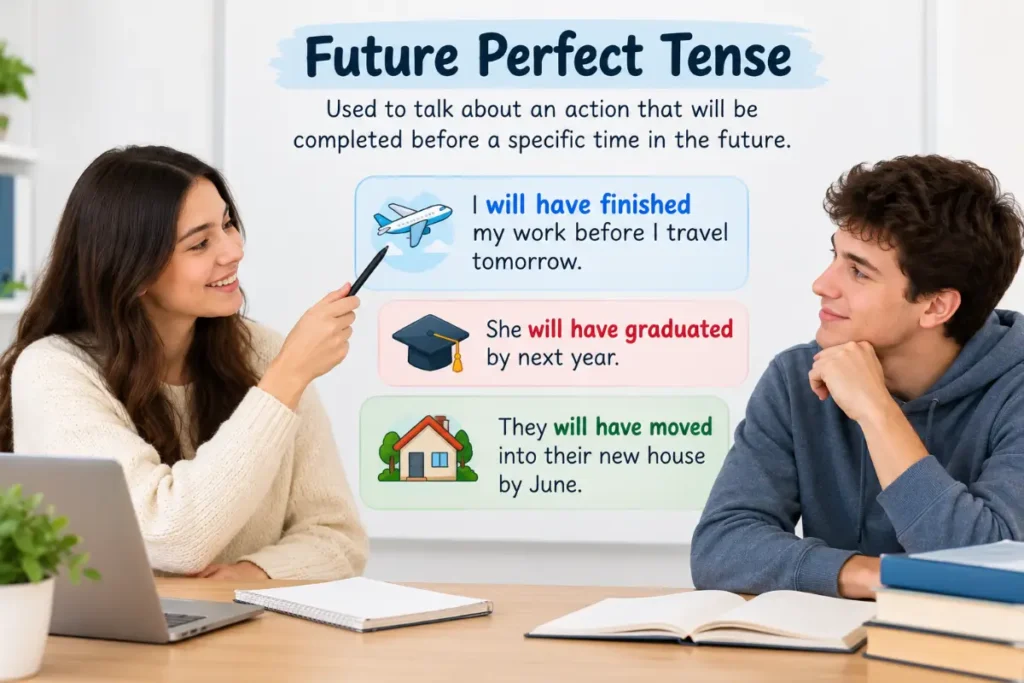
These future perfect tense examples all follow one pattern: will have plus a past participle, used for an action that will be finished before a specific point in the future. “By next June, I will have graduated” doesn’t just say you’ll graduate. It says the graduating will be complete before June arrives.
The tense sounds technical, but it’s built from parts you already use: the future auxiliary will and the perfect form have + past participle. This guide shows how to form it, gives examples organized by situation, explains the time words that call for it, and covers the one trap that catches almost everyone, which is what tense to use in the time clause.
You may also find Modal Verbs List: What Each One Means and When to Use It helpful if you want to explore this topic further.
How the Future Perfect Is Formed
The structure is the same for every subject: will have + past participle.
- I will have finished.
- She will have arrived.
- They will have left.
Purdue OWL’s verb tense guide explains the logic: when your main narration is in the future, an action that happens earlier than that future point takes the future perfect. In other words, you need two future moments, and the future perfect describes the one that comes first.
- By the time the senator finishes his speech, the audience will have lost interest. (the audience loses interest before the speech ends)
Contractions are common in speech and informal writing: I’ll have finished, she’ll have arrived. The negative is will not have or won’t have, and questions invert the subject: Will you have finished by noon?
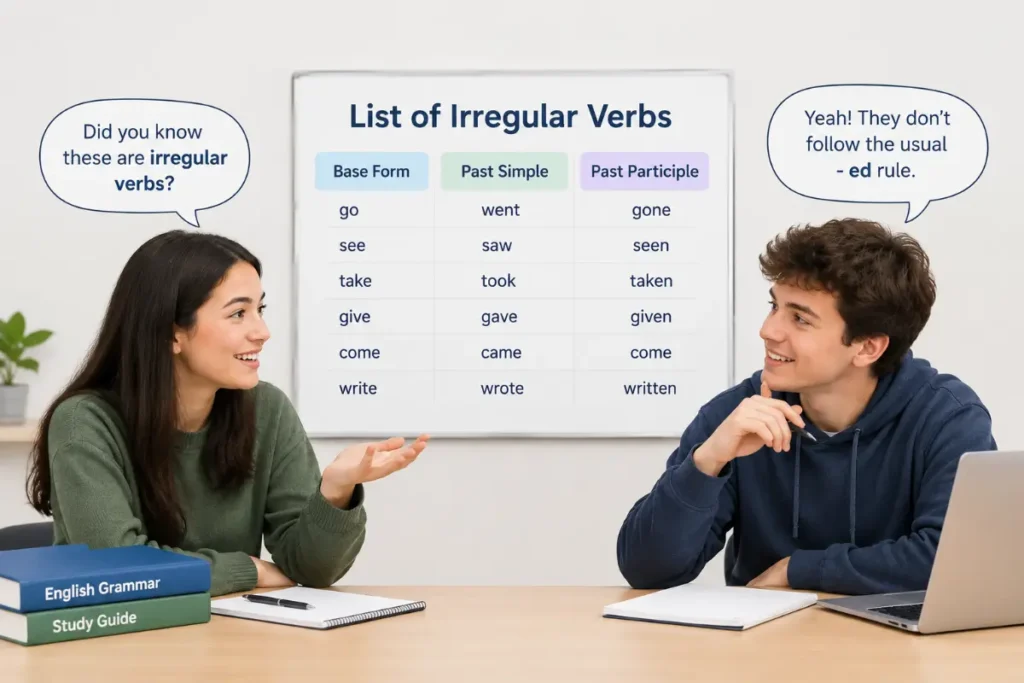
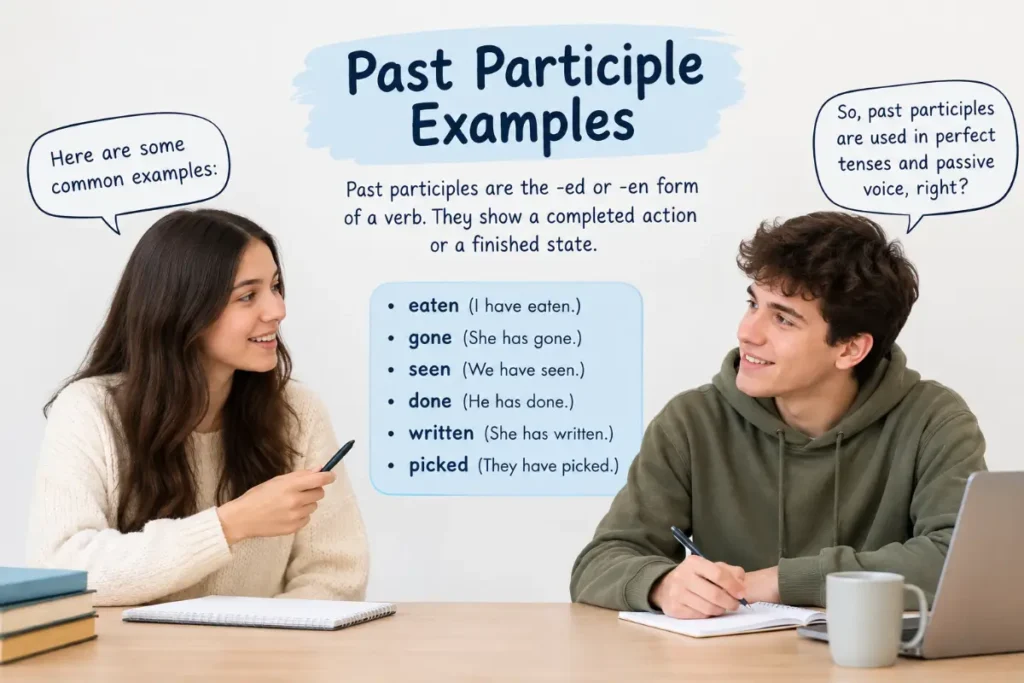
The past participle is the third form of the verb, so irregular verbs need their special forms: will have gone (not “will have went”), will have written, will have eaten. Our list of irregular verbs covers them, and our guide to past participle examples shows how the participle works across tenses.
Future Perfect Tense Examples by Situation

Deadlines and Schedules
- By Friday, I will have finished the report.
- The movers will have packed everything by five o’clock.
- By the end of the week, we will have spent the entire budget.
- She will have read the whole book by tonight.
Milestones and Anniversaries
- By 2030, she will have graduated from medical school.
- In June, they will have been married for ten years.
- By the time he retires, he will have worked here for forty years.
- By next spring, the bridge will have opened.
Events That Will Be Over Before Another
- By the time you arrive, we will have eaten.
- The movie will have started by the time we get there.
- Before the sun rises, the birds will have arrived at the feeder.
- By this time tomorrow, I will have left the country.
Predictions and Totals
- By the end of the year, the company will have hired fifty people.
- By midnight, the votes will have been counted. (passive form)
- In a decade, scientists will have discovered a cure.
Every sentence names or implies a future deadline, and the action will be complete when that moment arrives.
Time Words That Signal the Future Perfect
Purdue OWL points out that time-orienting words like before, after, and by the time are good indicators that a perfect tense is needed. These are the ones to watch for:
- by + a time: by Friday, by noon, by 2030
- by the time + a clause: by the time you arrive
- by then / by that time: By then, I will have moved.
- before: Before the party starts, we will have cleaned.
- by the end of: by the end of the month
If a sentence includes a future deadline like these and describes something finished before it, the future perfect is usually the right choice.
The Trap: What Tense Goes in the Time Clause?
This is the mistake that surprises even experienced writers. The time clause, the part beginning with by the time, before, or after, uses the present simple, not the future.
- Correct: By the time the senator finishes his speech, the audience will have lost interest.
- Incorrect: By the time the senator will finish his speech, the audience will have lost interest.
Purdue OWL’s example shows the pattern: the verb “finishes” is in the present form even though the event is in the future. The future perfect appears only in the main clause. The same rule applies to other time words: Before the sun rises, the birds will have arrived, not “before the sun will rise.”
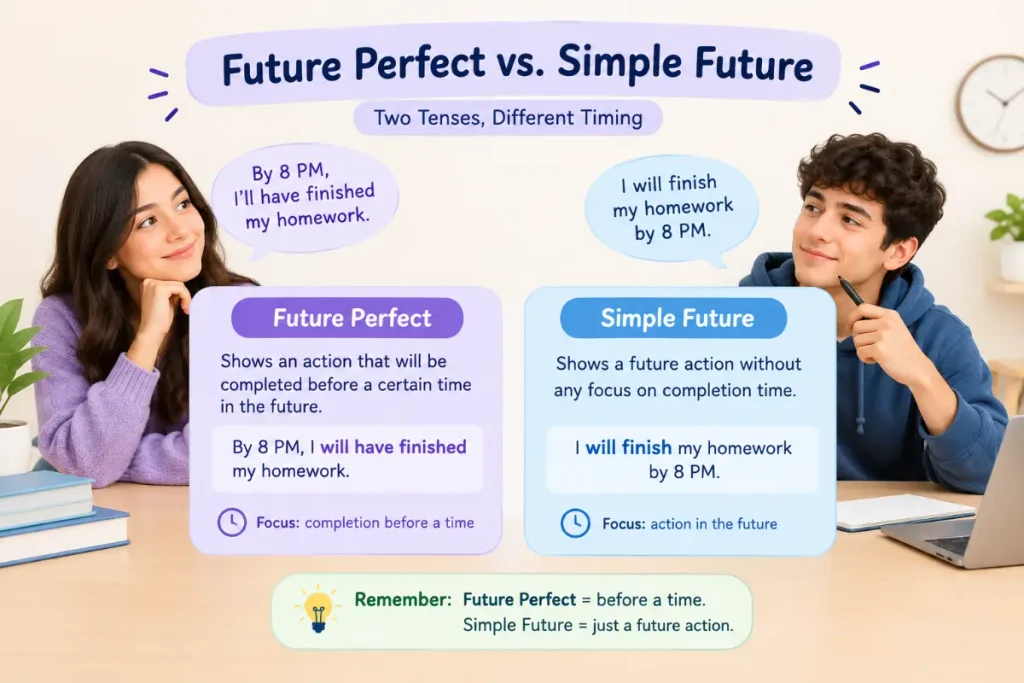
Future Perfect vs. Simple Future
Both tenses talk about the future, but they say different things.
| Simple Future | Future Perfect |
|---|---|
| I will finish the report. | I will have finished the report by Friday. |
| She will graduate. | She will have graduated by June. |
| The action will happen. | The action will be complete before a specific time. |
The simple future describes an action. The future perfect describes a completed action with a deadline.
Future Perfect vs. Present Perfect vs. Past Perfect
Purdue OWL ties each perfect tense to a time frame. The perfect tense shows an earlier action relative to the main narration.
| Main Narration | Perfect Tense for the Earlier Action | Example |
|---|---|---|
| Past | Past perfect (had + participle) | After she had finished, we left. |
| Present | Present perfect (have/has + participle) | After she has finished, we leave. |
| Future | Future perfect (will have + participle) | After she will have finished, we will leave. |
The last example is awkward in practice, since time clauses use the present, so a more natural version is: After she finishes, we will leave. The future perfect works best when the deadline itself is stated with by: By noon, she will have finished.
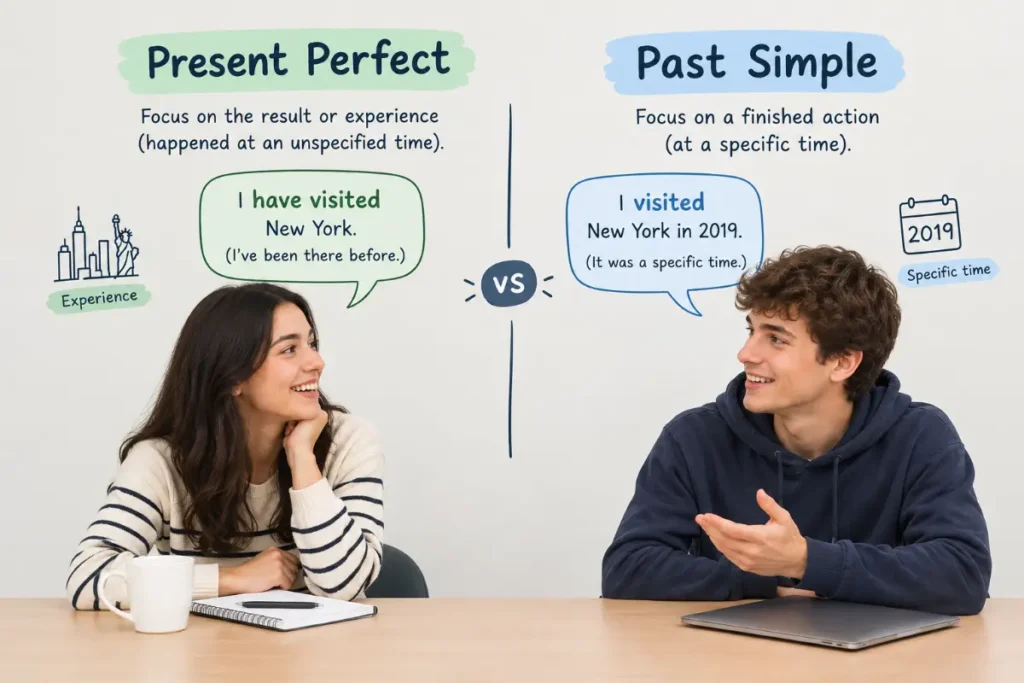
For a deeper look at the first two tenses, see our guide to present perfect vs past simple.
The Future Perfect Progressive
When the action is ongoing before the deadline, the form is will have been plus an -ing verb. Purdue OWL lists it as a related form.
- By June, she will have been teaching for ten years.
- By the time you arrive, I will have been waiting for an hour.
This focuses on the duration of the activity, while the plain future perfect focuses on its completion.
Using It to Make Assumptions
The future perfect can also express an educated guess about something that has probably already happened. This use is common in formal and literary English.
- You will have heard the news by now.
- They will have reached the hotel by this time.
It’s a polite, slightly formal way to say “I assume that…”, and it’s less common in everyday speech.
Future Perfect Tense Examples in Positive, Negative, and Question Forms
The future perfect tense follows the same basic structure in positive sentences, negative sentences, and questions. You only need to know where to place will, have, and the past participle.
Positive Sentences
Use subject + will have + past participle to describe an action that will be complete before a future time.
- I will have finished my homework by 8 p.m.
- She will have reached the office by 9 a.m.
- They will have completed the project by Friday.
- We will have cleaned the house before the guests arrive.
- He will have saved enough money by the end of the year.
Negative Sentences
Use subject + will not have + past participle to say that an action will not be complete by a particular time. You can also use the contraction won’t have in everyday English.
- I won’t have finished the book by tonight.
- She will not have returned home by noon.
- They won’t have completed the work by Monday.
- We won’t have saved enough money by December.
- He will not have learned all the answers before the test.
Questions
To ask whether an action will be complete by a future time, use will + subject + have + past participle.
- Will you have finished your homework by dinner?
- Will she have arrived by the time we leave?
- Will they have completed the project by Friday?
- Will he have saved enough money by next year?
- Will you have read the book before class begins?
Remember that will have stays together in positive sentences, while questions place will before the subject. In all three forms, the main verb must be a past participle, such as finished, written, gone, or eaten.
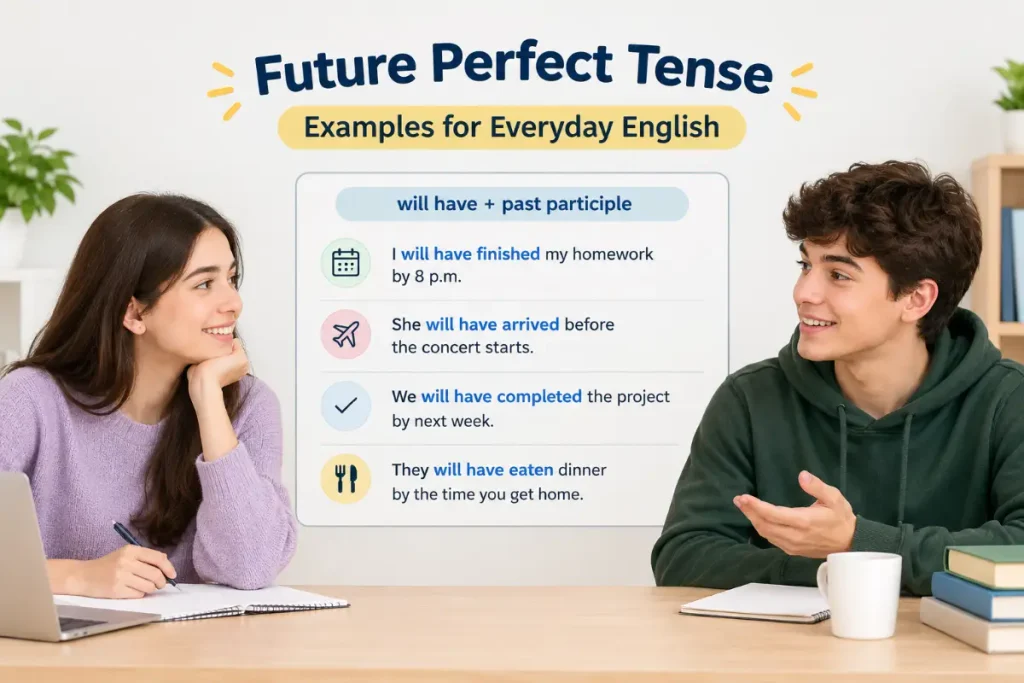
10 Simple Future Perfect Tense Examples for Everyday English
The future perfect tense becomes easier to understand when you connect it to everyday situations. Each example below shows an action that will be complete before a specific future time or event.
- Homework: I will have finished my homework by 7 p.m.
- Work: She will have sent the email before the meeting starts.
- Cooking: Mom will have cooked dinner by the time we get home.
- Travel: We will have reached the airport by noon.
- Reading: He will have read three chapters by bedtime.
- Cleaning: They will have cleaned the kitchen before the guests arrive.
- Saving money: I will have saved $500 by the end of the month.
- Shopping: She will have bought everything on the list by Saturday.
- Learning: You will have learned the basics by the end of the course.
- Finishing a project: We will have completed the project before the deadline.
Notice the common pattern: each sentence connects an action to a future deadline. Words such as by, before, and by the time help show when the action will be complete.
For example, compare these two sentences:
- I will finish my homework tonight. This tells us what will happen.
- I will have finished my homework by 7 p.m. This emphasizes that the homework will be complete before or at that time.
That small difference is the key to using the future perfect tense correctly.
Quick Reference Table
| Use | Pattern | Example |
|---|---|---|
| Completed before a future time | will have + participle | I will have finished by noon. |
| Negative | will not have / won’t have + participle | She won’t have finished. |
| Question | Will + subject + have + participle | Will you have finished? |
| Ongoing before a future time | will have been + -ing | She will have been working. |
| Passive | will have been + participle | The votes will have been counted. |
| Assumption | will have + participle | You will have heard. |
Common Mistakes People Make
Mistake 1: Using the base form instead of the participle, as in “I will have finish” instead of “I will have finished.”
Mistake 2: Using will in the time clause, as in “By the time you will arrive,” instead of “By the time you arrive.”
Mistake 3: Using the present perfect for a future deadline, as in “By tomorrow, I have finished the book,” instead of “By tomorrow, I will have finished the book.”
Mistake 4: Using the future perfect with no future reference point, which leaves the reader wondering “finished by when?”
For another useful perspective, check out When to Use Past Perfect Tense Practical Guide (2026).
Mistake 5: Writing “will had” instead of “will have.”
Mistake 6: Using the wrong participle for irregular verbs, such as “will have went” or “will have wrote.”
Practice Exercise
Complete each sentence with the future perfect, or follow the instruction. Answers are listed right after, so try each one before checking.
- By next Friday, I (finish) the report.
- By the time you arrive, we (eat) dinner.
- By 2030, she (graduate) from medical school.
- In June, they (be) married for ten years.
- The movie (start) by the time we get there.
- By this time tomorrow, I (leave) the country.
- He (not/finish) by noon.
- (you/complete) the project by Monday?
- By the end of the year, the company (hire) fifty people.
- By the time she retires, she (work) here for forty years.
- Choose: By the time he (finishes/will finish) his speech, the audience will have lost interest.
- Choose: Before the sun (rises/will rise), the birds will have arrived.
- Fix: By next month, I will have finish my degree.
- Fix: By the time you will arrive, we will have left.
- Fix: By tomorrow, I have finished the book.
- Which uses the future perfect? (a) I will finish the book. (b) I will have finished the book by Friday.
- By 5 p.m., the movers (pack) everything.
- She (read) the whole book by tonight.
- By the end of the week, we (spend) the entire budget.
- By June, she (teach) for ten years. (Use the progressive form.)
Answer Key
- will have finished
- will have eaten
- will have graduated
- will have been
- will have started
- will have left
- won’t have finished (or will not have finished)
- Will you have completed
- will have hired
- will have worked
- finishes
- rises
- By next month, I will have finished my degree.
- By the time you arrive, we will have left.
- By tomorrow, I will have finished the book.
- (b)
- will have packed
- will have read
- will have spent
- will have been teaching
Frequently Asked Questions
When do I use the future perfect instead of the simple future?
Use the future perfect when an action will be complete before a specific future time, usually named with by or before. Use the simple future when you only need to say that something will happen.
Why do time clauses use the present tense?
English treats the time clause as a condition for the main action, so it takes the present simple even when the event is in the future: “By the time you arrive, we will have left.” Using “will” there is a common error.
Is “will have” the same as “would have”?
No. Will have looks forward to a future deadline. Would have usually describes a hypothetical past, as in “I would have gone if I’d known.”
Can the future perfect be used in the passive?
Yes. The pattern is will have been + past participle: “The votes will have been counted by midnight.”
What’s the fastest way to decide whether I need the future perfect?
Look for a future deadline and an action that must be complete before it. If you can add “by then,” “by Friday,” or “by the time…” and the action will be finished, the future perfect fits.
Before moving on, you may also want to read 20 Conditional Sentences Examples (2026 Guide) for more helpful grammar tips.
Final Thoughts
These future perfect tense examples share one idea: a future deadline and an action that will be finished before it arrives. The structure is simple (will have plus a past participle), and the signal words (by, by the time, before) make it easy to recognize when you need it.
The two habits that matter most are keeping the time clause in the present simple and using the correct past participle, especially with irregular verbs. With those two in place, the future perfect becomes a precise tool for deadlines, milestones, and predictions that the simple future can’t express.