These 20 conditional sentences examples cover the four main types, sorted by one question: how real is the situation? “If you heat ice, it melts” is a fact. “If it rains tomorrow, we’ll stay home” is a real possibility. “If I won the lottery, I’d travel the world” is a daydream. “If she had studied, she would have passed” is a regret about the past.
Each type has its own tense pattern, and mixing them up is the most common conditional mistake. This guide gives five examples of each type, a quick way to choose between them, and the details that apply across all four: the comma rule, unless, formal inversion, and the two “will” and “would” errors that show up everywhere.
You may also find Use Will vs Going To: Simple Guide (2026) helpful if you want to explore this topic further.
How a Conditional Sentence Is Built
Every conditional has two parts: the if-clause (the condition) and the main clause (the result). The UNC Writing Center’s handout on conditionals explains that the verb tense in the if-clause signals how real or hypothetical the situation is. That’s why each type below has its own formula.
The clauses can come in either order, and the order decides the punctuation.
- If you finish early, come find me. (if-clause first: comma)
- Come find me if you finish early. (if-clause second: no comma)
This is the same comma rule as for any opening dependent clause, covered in our guide to when to use a comma after an introductory phrase.
Zero Conditional: Facts and Habits (Examples 1–5)
The UNC handout calls this the “real” condition, not because it already happened, but because it always happens this way. The pattern is if + present simple, present simple.
- If you heat ice, it melts.
- If water reaches 100°C, it boils.
- If you press this button, the screen turns on.
- If students have a question, they ask the teacher.
- If I take the morning class, I use the Metro.
In zero conditionals, when can usually replace if without changing the meaning, because the result is expected every time: When you heat ice, it melts.
First Conditional: Real Possibilities (Examples 6–10)
The first conditional describes something that could realistically happen in the future. The pattern is if + present simple, will + base verb.
- If it rains tomorrow, we will cancel the picnic.
- If you follow the map, you will find the house.
- If the team trains hard, it will win.
- If I finish early, I will call you.
- If governments invest in renewable energy, emissions will fall.
The if-clause stays in the present tense even though it refers to the future. Writing “If it will rain” is the most common first-conditional mistake.
Second Conditional: Unlikely or Imaginary (Examples 11–15)
The UNC handout describes this as “unreal and unlikely,” using if + past simple, would + base verb. The past tense here isn’t about past time. It signals that the situation is imaginary or improbable.
- If I won the lottery, I would travel the world.
- If she had her own television show, she would be unbearable.
- If more people used public transport, air quality would improve.
- If I had more time, I would learn another language.
- If I were you, I would apologize.
“Was” or “Were”?
In the second conditional, formal writing and exams prefer were for all subjects: “If I were taller,” “If she were here.” Was is common in casual speech (“If I was you”), but were is the safer choice in writing, and “If I were you” is a fixed expression.
Third Conditional: Regrets About the Past (Examples 16–20)
The third conditional deals with the past, things that didn’t happen. The pattern is if + past perfect, would have + past participle.
- If she had studied harder, she would have passed the test.
- If I had woken up earlier, I would have caught my flight.
- If we had taken the job offer, we would have lived in different cities.
- If I had arrived earlier, I would have gotten concert tickets.
- If they had left earlier, they wouldn’t have missed the train.
The past perfect in the if-clause is explained in our guide to when to use past perfect tense, which covers the unreal past in more depth. The key point here is that both clauses use participle forms: had + participle in the condition, would have + participle in the result.
Choosing the Right Type
Ask how real the situation is, then match the tense.
| How real is it? | Type | If-clause | Main clause |
|---|---|---|---|
| Always true | Zero | present simple | present simple |
| Real possibility in the future | First | present simple | will + base verb |
| Unlikely or imaginary now | Second | past simple | would + base verb |
| Impossible, in the past | Third | past perfect | would have + participle |
Conditional Sentences Examples in Everyday Conversations
You probably use conditional sentences more often than you realize. Whether you’re making plans with a friend, giving someone advice, or talking about something that could have happened differently, conditionals help you explain what might happen and why.
Here are some examples you’d naturally hear in everyday conversations:
- If you need a ride, I’ll pick you up.
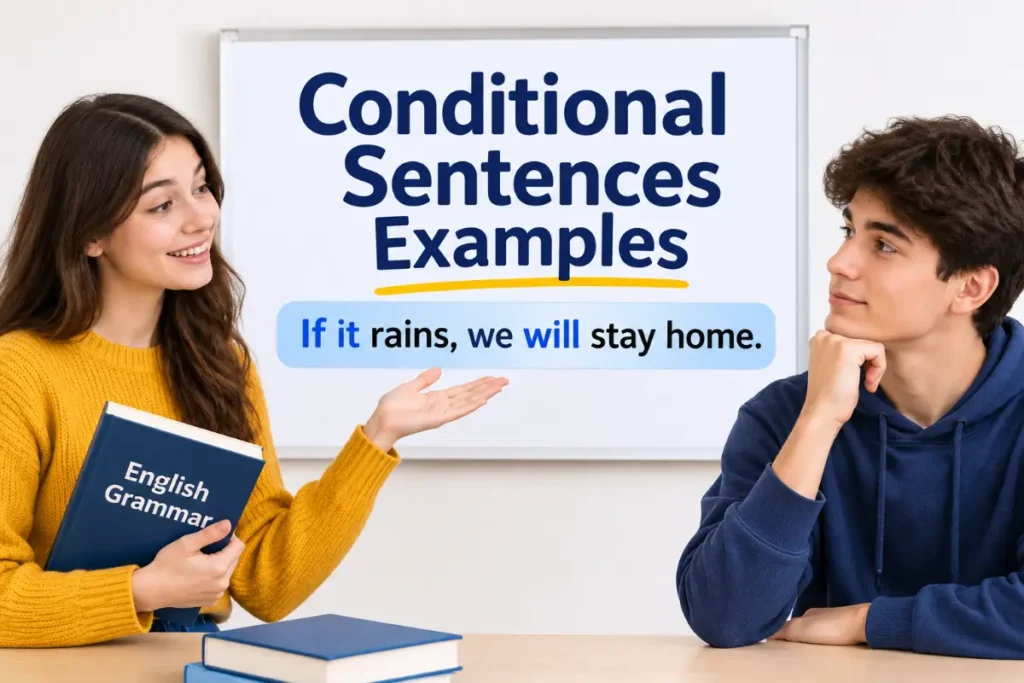
- If it rains tomorrow, we’ll stay home.
- If I had more free time, I’d learn to play the guitar.
- If you don’t hurry, we’ll miss the movie.
- If I had known you were coming, I would have prepared dinner.
- If she calls tonight, I’ll let you know.
- If I won the lottery, I’d buy a house near the beach.
- If you leave the door open, the dog will run outside.
- If we had booked our tickets earlier, we would have saved money.
- If you mix red and blue, you get purple.
Notice that these sentences don’t all describe the same kind of situation. Some talk about realistic plans, some imagine things that may never happen, and others look back at past events.
That’s what makes conditional sentences so useful. They let you talk about everyday possibilities without making your sentences complicated. Once you recognize how people use if, will, and would in conversation, choosing the right conditional becomes much easier.
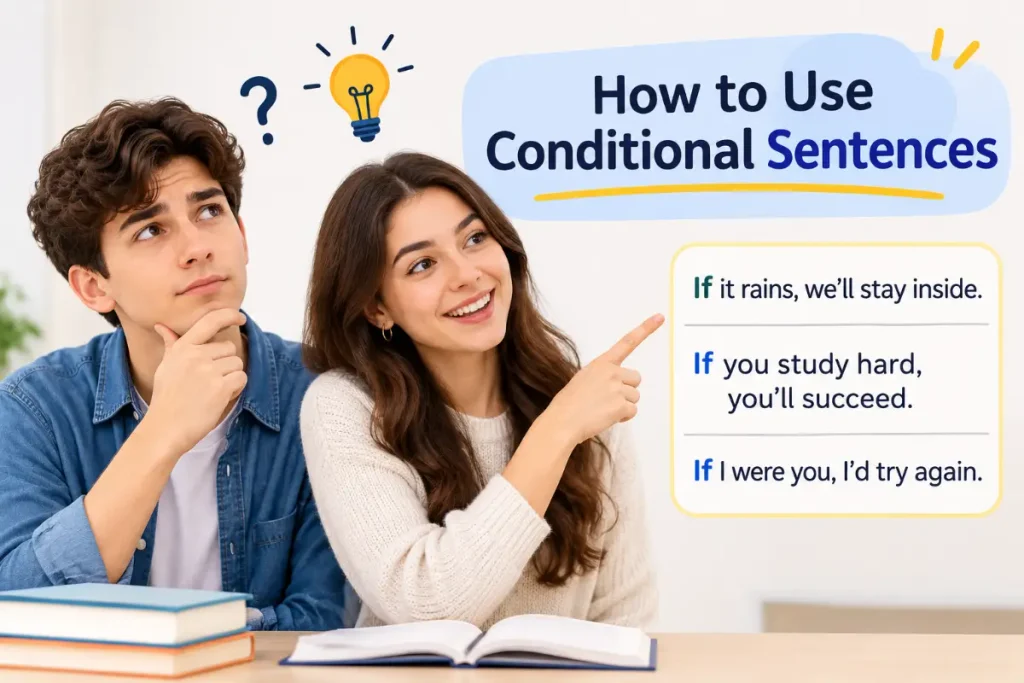
How to Use Conditional Sentences in Everyday Writing and Speaking
Conditional sentences help you connect an action to its possible result. You can use them to make plans, offer advice, explain consequences, or talk about things you wish had happened differently.
The trick is knowing which conditional fits the situation.
1. Talk about possible future events
When something could realistically happen, use the first conditional.
Example: If I finish my work early, I’ll meet you for dinner.
You’re talking about a real possibility. Finishing work early may happen, and meeting for dinner is the expected result.
2. Give advice or talk about imaginary situations
The second conditional is useful when you’re imagining a different situation or suggesting what someone should do.
Example: If I were you, I would talk to the manager.
You’re not actually the other person. You’re imagining yourself in their position to offer advice.
3. Talk about past mistakes or missed opportunities
Use the third conditional when you’re thinking about something that didn’t happen and imagining a different outcome.
Example: If I had left home earlier, I wouldn’t have missed my flight.
You already missed the flight. Now you’re imagining how things might have turned out differently.
4. Explain facts and everyday habits
The zero conditional works when you’re talking about facts, routines, or results that are generally true.
Example: If you don’t get enough sleep, you feel tired the next day.
This isn’t about one particular future event. It describes something that generally happens.
A good way to choose the right structure is to think about what you’re trying to say before writing the sentence. Are you describing a fact, making a prediction, imagining something, or looking back at the past? Your answer will help you choose the correct conditional.
For another useful perspective, check out Past Participle Examples: 50 Easy Examples to Master Grammar (2026).
Conditional Sentences Examples: Positive, Negative, and Question Forms
Conditional sentences aren’t always simple statements. You can also use them to say what won’t happen, explain what might go wrong, or ask someone about a possible situation.
Let’s look at how these forms work.
Positive Conditional Sentences
Positive conditional sentences describe a condition and its result without using a negative expression.
Here are some examples:
- If you practice every day, you’ll become a better writer.
- If she gets the job, she’ll move to Chicago.
- If I had a bigger house, I would get a dog.
- If they had arrived earlier, they would have found better seats.
These sentences explain what happens, could happen, or might have happened under a particular condition.
Negative Conditional Sentences
Negative conditionals use words such as not, don’t, doesn’t, and wouldn’t to show that something may not happen or that a condition isn’t met.
For example:
- If you don’t leave now, you’ll miss the bus.
- If I weren’t so busy, I would help you.
- If she hadn’t forgotten her keys, she wouldn’t have been locked out.
- If you don’t water the plants, they die.
Pay attention to where the negative word appears. It can be in the if-clause, the main clause, or both, depending on the meaning.
Conditional Questions
You can also turn a conditional into a question when asking about possibilities, choices, or imaginary situations.
For example:
- What will you do if it rains tomorrow?
- What would you buy if you won the lottery?
- Would you have helped if I had asked?
- What happens if you press this button?
- Where would you live if you could choose any country?
These questions are common in everyday conversations because they help people discuss plans, explore possibilities, and imagine different outcomes.
One thing to remember: Positive, negative, and question forms don’t create new conditional types. They simply give you different ways to use the zero, first, second, and third conditionals. The tense pattern still depends on the situation you’re describing.
“Unless” and Other Condition Words
Unless means “if not,” and it takes a positive verb because the negative is built into the word.
- I won’t go unless you come with me. (= if you don’t come with me)
- Unless something changes, we’ll proceed as planned.
Other condition words, like as long as and provided that, work as subordinating conjunctions in a conditional clause. Our list of subordinating conjunctions groups them with if and unless under condition.
Formal Inversion: Dropping “If”
In formal writing, the auxiliary verb can move to the front, replacing if.
- Had I known, I would have called. (= If I had known)
- Were I you, I would apologize. (= If I were you)
- Should you need help, call me. (= If you need help)
Inversion sounds formal and a bit literary, so it’s best saved for written contexts.
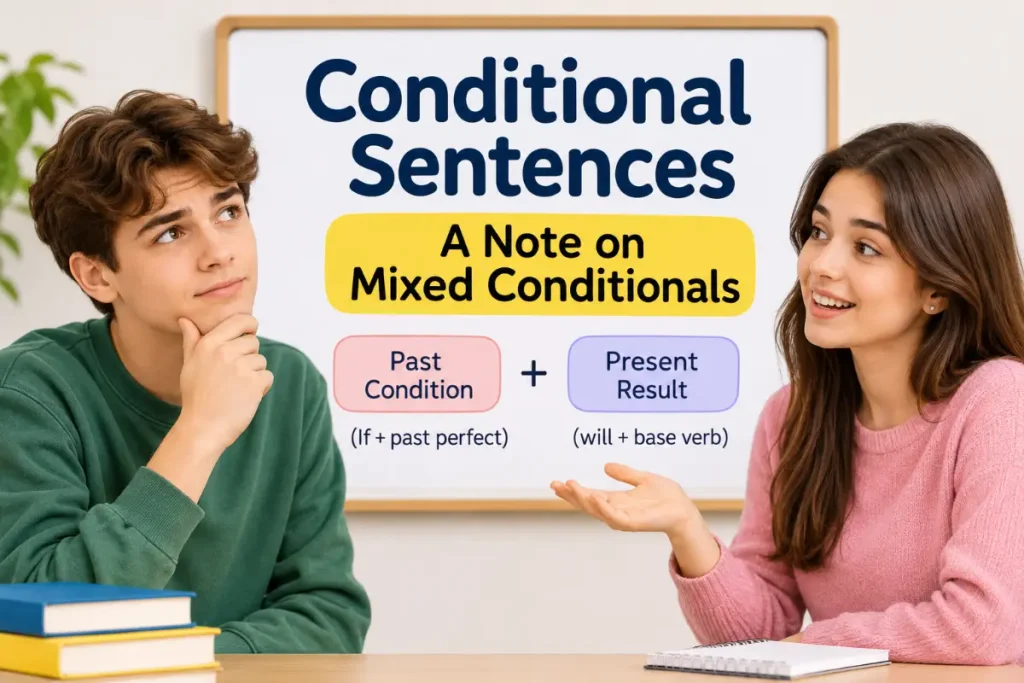
A Note on Mixed Conditionals
Sometimes the if-clause and the main clause point to different times, mixing the second and third patterns. An example is “If I had taken that job, I would be rich now,” where the condition is in the past and the result is in the present. These mixed conditionals deserve their own explanation, since they combine the patterns above in different ways.
Common Mistakes People Make
Mistake 1: Using will in the if-clause, as in “If she will call, I will answer.” The correct form is “If she calls, I will answer.”
Mistake 2: Using would in the if-clause, as in “If I would have time, I would study.” The correct form is “If I had time, I would study.”
Mistake 3: Forgetting the comma when the if-clause comes first.
Mistake 4: Adding a comma when the if-clause comes second, as in “We’ll leave, if it stops raining.”
Mistake 5: Mixing the patterns, as in “If I knew, I would have called,” which blends the second and third conditionals.
Mistake 6: Using a negative verb after unless, as in “Unless you don’t come,” which creates a double negative.
Practice Exercise
Identify the type, choose the correct form, or follow the instruction. Answers are listed right after, so try each one before checking.
- Identify the type: If you heat ice, it melts.
- Identify the type: If it rains tomorrow, we will cancel the picnic.
- Identify the type: If I won the lottery, I would travel the world.
- Identify the type: If she had studied, she would have passed.
- Choose: If it (rains/will rain), we’ll stay home.
- Choose: If I (had/would have) time, I would help.
- Choose: If he (had left/left) earlier, he would have caught the train.
- Choose: I won’t go (unless/if) you come with me.
- Fix: If she will call, I will answer.
- Fix: If I would have more money, I would buy a car.
- Fix: We’ll leave, if it stops raining.
- Add the comma: If you finish early come find me.
- Choose: If I (was/were) you, I would apologize. (formal)
- Rewrite with inversion: If I had known, I would have called.
- Rewrite with unless: I won’t go if it doesn’t stop raining.
- Identify the type: If water reaches 100°C, it boils.
- Identify the type: If I were taller, I would play basketball.
- Identify the type: If the team trains hard, it will win.
- Complete: If she (have) a car, she (drive) to work.
- Complete: If they (not/hurry), they (miss) the bus.
Answer Key
- Zero
- First
- Second
- Third
- rains
- had
- had left
- unless
- If she calls, I will answer.
- If I had more money, I would buy a car.
- We’ll leave if it stops raining.
- If you finish early, come find me.
- were
- Had I known, I would have called.
- I won’t go unless it stops raining.
- Zero
- Second
- First
- had; would drive
- don’t hurry; will miss
Frequently Asked Questions
What are the four types of conditional sentences?
Zero (facts and general truths), first (real future possibilities), second (unlikely or imaginary situations), and third (unreal situations in the past). Many grammar guides also describe mixed conditionals as a fifth category.
Can “will” ever appear in an if-clause?
Usually not, since the if-clause stays in the present tense for future meaning. The exception is a polite request, as in “If you will follow me, I’ll show you the way.”
Should I use “was” or “were” in the second conditional?
Were is standard in formal writing for all subjects, and “If I were you” is a fixed phrase. Was is common in casual speech but best avoided in exams and formal documents.
Do I always need a comma?
Only when the if-clause comes first. When the main clause comes first, no comma is needed.
What’s the difference between the zero and first conditionals?
Zero conditionals state facts that are always true (“If you heat ice, it melts”). First conditionals predict a specific, possible future outcome (“If it rains tomorrow, we will stay home”).
Before moving on, you may also want to read Common List of Irregular Verbs (2026 Guide) for more helpful grammar tips.
The Short Version
Working through these conditional sentences examples shows that the right type depends on one thing: how real the situation is. Zero conditionals state facts, first conditionals describe real possibilities, second conditionals imagine unlikely situations, and third conditionals look back at what didn’t happen. Each has its own tense pattern, and the if-clause is the part that changes.
The habits worth keeping are the comma rule, using the present tense (not will) in a first-conditional if-clause, and never putting would in an if-clause. With those three in place, nearly every conditional you write will be correct.