You send a message asking a friend if she wants to grab dinner. She answers with one word and a few dots: uhm… No yes. No no. Just a pause on your screen.
So what is she saying? Is she thinking, nervous, or politely saying no? If you have ever stared at a message like that, you are not alone. The UHM meaning in text is simple on paper, but the mood behind it changes every time.
This guide explains what it means, how it differs from um and uh, and what it signals in different chats. You will find nine common uses, tone clues, reply ideas, and a few chats to show it in action.
Read on, and the next uhm in your inbox will make perfect sense.
You may also find Emphasize Text Meaning: 7 Clear Answers (2026) helpful if you want to explore this topic further.
Quick Definition
UHM is a written form of the sound people make when they hesitate or pause while speaking. It is a spelling variant of um and a close cousin of uh. In a message, it tells the reader that the writer is thinking, unsure, nervous, or about to say something awkward. The UHM meaning in text is about mood and pacing, not about a word with a fixed definition.
Quick Answer
When someone sends uhm, they are showing hesitation. They may be searching for words, feeling unsure, or softening a tough reply. Sometimes it is a polite way to disagree. Sometimes it is sarcasm. Read the tone of the whole chat to know which one you are seeing.
What Does UHM Actually Mean?
Unlike most slang, uhm is not an abbreviation. Nothing is hiding behind the letters. It is a spelling of a sound, the kind of sound people make out loud when they need a second to think.
Linguists call these sounds filled pauses or hesitation markers. They fill the silence so the listener knows you are not done talking. In text, the same trick works. A uhm tells the reader that a thought is on the way, even if the message has not caught up yet.
Because it is a sound and not a word, there is no official spelling. People type it several ways, and each one carries nearly the same meaning.
| Spelling | Common Feel |
|---|---|
| uh | Short, quick pause |
| um | The standard hesitation sound in American English |
| uhm | A slightly longer pause, a bit more drawn out |
| umm | A longer, more unsure pause |
| uhmm | Stretched, dramatic, or playful |
| er or erm | More common in British writing |
| hmm | Deeper thinking or doubt |
Most people do not pick between them on purpose. They type what feels natural. Still, longer spellings usually hint at a longer or more awkward pause.
Why Do People Type UHM?
In person, a pause comes with a face, a shrug, or a tone. Text removes all of that. So writers add a sound to show what they would have shown with their voice.
Here are the most common reasons.
- To buy time. They need a moment to think before they answer.
- To soften a reply. Uhm, not sure that works for me sounds gentler than a flat no.
- To show nerves. It tells the reader the writer feels shy or anxious.
- To show doubt. It signals that something sounds off or confusing.
- To mark an awkward moment. It sets the tone before the writer says something uncomfortable.
- To add humor. A well placed uhm can make a joke land.
- To copy real speech. Many people simply type the way they talk.
9 Clear Uses of UHM in Text
Here are nine ways people use it, with examples you can spot in the wild.
- Stalling while thinking. Uhm, let me check my calendar.
- Showing uncertainty. Uhm, I think the meeting is at three?
- Marking an awkward moment. Uhm, so about last night…
- Interrupting politely. Uhm, sorry to jump in, but the link is broken.
- Signaling doubt or disagreement. Uhm, I do not think that is right.
- Adding sarcasm. Uhm, excuse me, that was my fries.
- Showing shyness before a question. Uhm, would you maybe want to get coffee?
- Playing it flirty or nervous. Uhm, you look really good in that photo.
- Adding comedic timing. Uhm, I definitely did not just trip over my own feet.
Notice how the pause does different jobs. The same four letters can sound kind, nervous, or sharp. The words around it tell you which one.
How to Read the Tone
You cannot judge uhm by itself. Look at the context, the punctuation, and what comes next.
| Clue | What It Usually Means |
|---|---|
| Uhm… with dots | Thinking, unsure, or nervous |
| Uhm? with a question mark | Confusion or doubt |
| Uhm. with a period | Flat, awkward, or a little annoyed |
| Uhm, excuse me | Sarcasm or a polite call out |
| Uhmmm with extra letters | Long pause or playful drama |
| Uhm then a clear question | Shy, polite, or nervous |
| Uhm alone, no follow up | Stalling or avoiding the topic |
A quick test helps. Ask yourself what would happen if the writer said it out loud. Picture the face. Most of the time, the tone becomes obvious.
UHM vs UM vs UH vs HMM
These sounds look alike, but each one has a slightly different job.
| Sound | What It Signals | Example |
|---|---|---|
| Uh | A short pause before a word | Uh, yeah, that works. |
| Um | A standard pause while thinking | Um, I am not sure. |
| Uhm | A slightly longer or more awkward pause | Uhm, can we talk? |
| Umm | An even longer, more unsure pause | Ummm, maybe? |
| Hmm | Deeper thinking or doubt | Hmm, that is a good point. |
| Er or erm | A British style pause | Erm, I think so. |
The differences are small, and many people use them interchangeably. Dictionaries often treat um and uh as the same kind of hesitation sound. If someone uses uhm, you can read it the same way, with a hint of extra drag.
Spelling and Punctuation Changes the Mood
Small choices make a big difference in text.
| Style | What It Suggests |
|---|---|
| uhm | Casual and relaxed |
| Uhm | Slightly more deliberate |
| UHM | Loud, dramatic, or exasperated |
| uhm… | Hesitant, trailing off |
| uhm?? | Shocked or confused |
| uhm, | A pause before a point |
| uhm lol | Nervous humor |
Capital letters raise the volume. Dots slow the pace. Question marks add confusion. A message that looks calm in lowercase can feel sharp in capitals, so pay attention to the style.
How to Reply to UHM
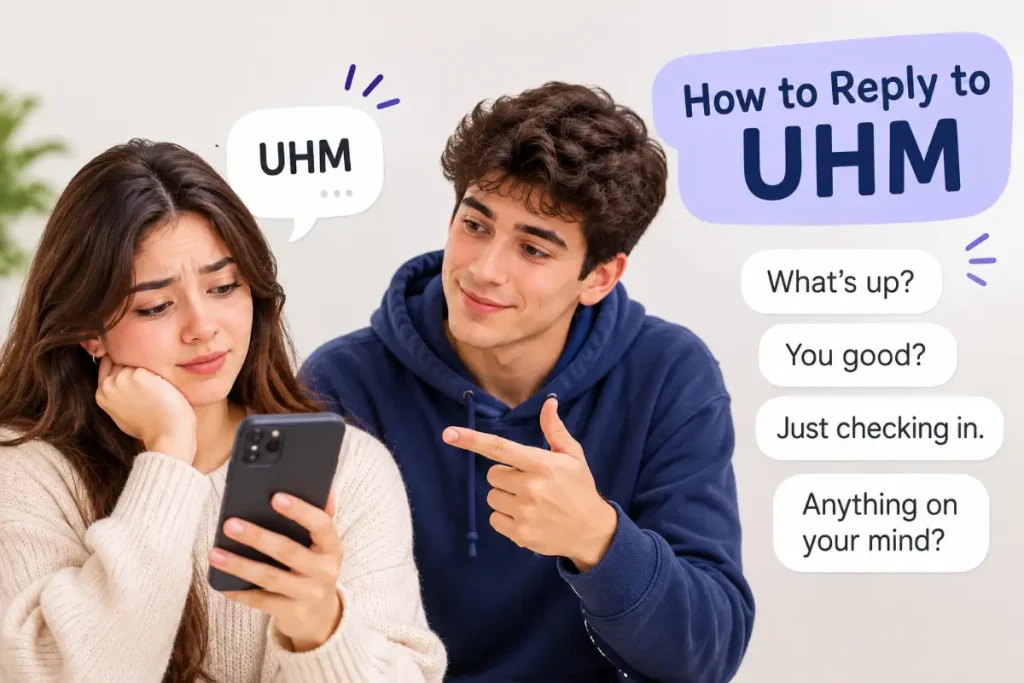
Your reply should match the mood behind it. Here are some easy ways to respond.
When the Sender Seems Unsure
Give them room. A little patience goes a long way.
- Take your time.
- No rush, just let me know.
- Want to talk it over?
When the Sender Seems Nervous
Be warm and clear. A kind tone helps them open up.
- Everything okay? You can tell me.
- You do not have to be nervous. What is up?
- Go ahead, I am listening.
When the Sender Seems Annoyed or Sarcastic
Stay calm. Ask what they mean or own the mistake.
- Did I miss something?
- Fair point. What did I get wrong?
- Sorry, that was my bad.
When the Sender Seems to Be Disagreeing
Invite the full thought. You may learn something.
- You do not agree? Tell me why.
- I am open to hearing your side.
- Let’s figure it out together.
If you are not sure at all, ask. A simple what do you mean? clears up a lot of guesswork.
Sample Chats
Seeing it in real conversations helps.
Unsure about plans
Maya: Want to grab dinner tonight?
Jordan: Uhm, maybe? I have a lot of work.
Maya: No worries. Another night?
Jordan is hesitating. Maya answers kindly and offers an easy way out.
Nervous question
Sam: Uhm, can I ask you something?
Riley: Of course. What is up?
Sam: Would you want to study together this week?
Sam uses the pause to build up courage before asking.
Sarcastic call out
Alex: Uhm, you ate my leftovers.
Chris: Guilty. I will buy you more tomorrow.
Here the sound adds a playful bite. Chris reads the tone correctly and answers with humor.
For another useful perspective, check out FML Meaning in Text: 7 Honest Facts & Replies (2026).
Is UHM Rude?
Usually, no. Most of the time it is a friendly or neutral sound. It simply tells you the writer is pausing.
That said, tone can shift. A flat uhm. followed by a short answer can read as cold or annoyed. A sarcastic uhm, excuse me can sting, especially if the reader did not see it coming. Context decides. If a chat feels tense, a quick check in often clears the air.
Where UHM Works and Where It Does Not
This is casual writing, and it fits best in casual spaces.
Good fits:
- Texts with friends and family.
- Social media comments and captions.
- Group chats.
- Fiction dialogue and scripts, where it shows how someone speaks.
Poor fits:
- Work emails and reports.
- School essays and formal assignments.
- Job applications and cover letters.
- Messages to people you do not know well.
In formal writing, drop the filler and say the thing directly. A clean sentence reads as confident. A pile of hesitation sounds reads as unsure. Writing guides for American English make the same point, since these sounds belong to speech and dialogue more than polished prose.
Common Mix Ups
Because there are no fixed rules, a few misunderstandings come up again and again.
- Thinking it is an abbreviation. It is not. There are no hidden words in the letters.
- Treating every uhm as a no. Often it is just a pause. Give the sender a moment before you assume the worst.
- Reading sarcasm into every one. Many are honest nerves. Look at the chat, not just the sound.
- Overusing it yourself. Too many hesitation sounds can make your message feel unsure or messy.
- Confusing it with the sound of a different word. If you see uhm in a message, the context should make clear it is a pause and not a typo for another term.
Tips for Using UHM Well
Want to use it in your own texts? Keep a few tips in mind.
- Use it with purpose. One well placed uhm beats five in a row.
- Match the mood. Nervous, playful, or serious, your punctuation should fit.
- Follow it with a point. A pause with no point can feel like stalling.
- Skip it in formal messages. Save it for casual chats.
- Read your message back. If it sounds unsure and you meant to sound sure, cut it.
Think of it as a small seasoning. A pinch adds flavor. A handful ruins the dish.
Why Hesitation Sounds Exist at All
Researchers who study language have looked closely at sounds like uh and um. They do not agree on every detail, but one idea shows up often. These sounds work as signals. They tell the listener that the speaker is not finished and that the turn to talk is still taken.
That idea carries over to text. When you see uhm in a message, you know a thought is still forming. It is a small flag that says wait a second, I am working on it. Writers have used spellings of these sounds in dialogue for a very long time, and chat just made the habit faster and more casual.
This also explains why the sound feels so human. Perfect, polished messages can feel cold. A bit of hesitation makes a message feel real, like a person is on the other end who is thinking in real time.

UHM on Different Apps
The meaning stays the same everywhere, but each place has its own style.
| App or Place | How It Usually Shows Up |
|---|---|
| Regular texts | Short pauses, often with dots |
| Instagram and Snapchat DMs | Nervous or flirty, often lowercase |
| TikTok comments | Sarcastic call outs, often in capitals |
| Group chats | Playful interruptions and jokes |
| Gaming chats | Quick stalling in the middle of a match |
| Fiction and scripts | Written dialogue that mirrors speech |
On TikTok, for example, a comment like uhm, the audio is not even working uses the sound as a gentle correction. In a DM, the same sound might signal shyness. Same letters, different jobs.
FAQs
What is the UHM meaning in text?
UHM is a written form of the sound people make when they hesitate. It shows that the writer is thinking, unsure, nervous, or about to say something awkward.
Is uhm the same as um?
Yes, for the most part. Both spell the same hesitation sound. Uhm often feels a bit more drawn out, but most people use them in the same way.
Does uhm mean no?
Not always. It often signals doubt or a polite pause before a no. It can also come before a yes or a question. Read the rest of the message to find out.
Why do people say uhm in a text?
They want to show hesitation, soften a reply, or sound more natural. It copies the way people speak out loud.
Is uhm sarcastic?
Sometimes. When it follows something annoying, like uhm, that was my seat, it often adds a sarcastic edge. In other chats, it is just a pause.
How do I reply to uhm?
Match the mood. If the sender seems unsure, give them time. If they seem nervous, be kind and clear. Ask what is wrong or own the mistake if they seem annoyed.
Is it okay to use uhm in a work message?
It is best to avoid it in formal emails and reports. It can make you sound unsure. In a casual work chat with a friendly coworker, it is usually fine.
What is the difference between uhm and hmm?
Uhm shows a pause while you search for words or feel unsure. Hmm shows deeper thought or doubt. One fills a gap, and the other points to reflection.
Before moving on, you may also want to read CMP Meaning in Text: Decode This Acronym in Seconds (2026) for more helpful grammar tips.
Final Thoughts: Read the Pause
The UHM meaning in text is about more than four letters. It is a pause you can see. It tells you the writer is thinking, unsure, nervous, or choosing their words with care.
Look at the punctuation, the chat, and the follow up. Those clues tell you whether the sound is shy, sarcastic, or simply a pause. Reply with patience, kindness, or humor, depending on what you read.
When in doubt, ask. A quick question beats a wrong guess, and it shows the other person you care enough to listen.