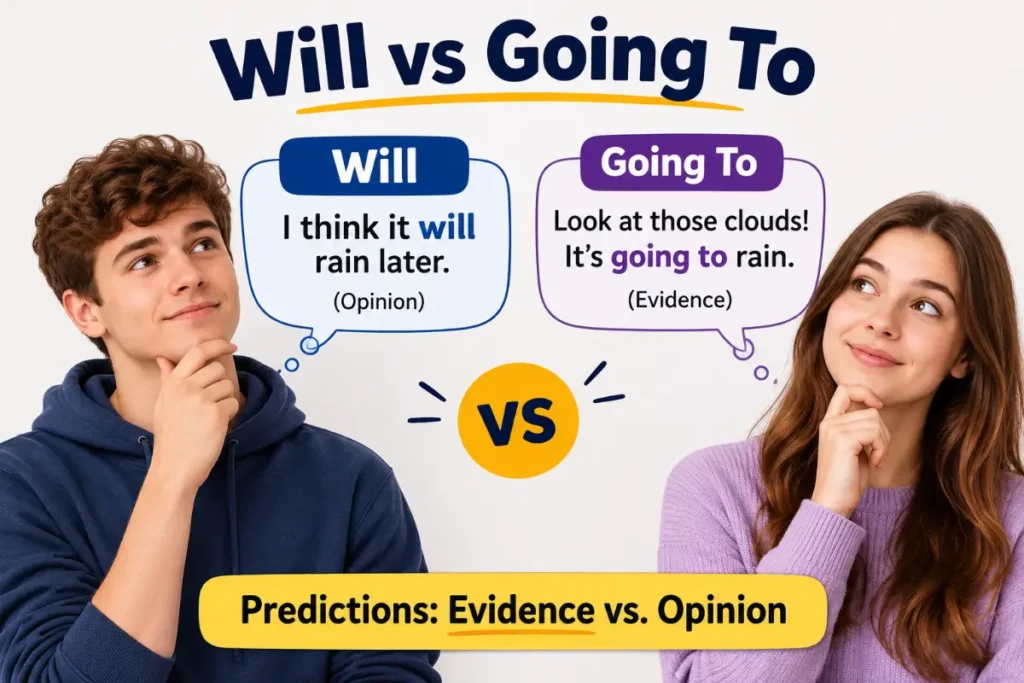
Knowing how to use will vs going to is mostly a matter of understanding what the speaker knew and when they knew it. Both forms talk about the future, and in many sentences either one sounds fine. In a handful of situations, though, one sounds natural and the other sounds slightly off, and the difference almost always comes down to timing, evidence, and attitude.
This guide breaks the choice into clear situations: spontaneous decisions, prior plans, predictions, promises and offers, formal announcements, and polite requests. It also compares both forms with the present continuous and present simple, which also talk about the future, then finishes with common mistakes and 20 practice sentences with answers.
You may also find Use Have Been vs Had Been: 7 Easy Rules (2026 Guide) helpful if you want to explore this topic further.
Start With the Two-Question Test
The British Council’s LearnEnglish page on future forms compares will, “be going to,” and the present continuous, and notes that the choice reflects how the speaker sees the situation. A practical shortcut is to ask two questions:
- Did I decide this just now? If yes, use will.
- Is there a plan or visible evidence? If yes, use going to.
Most sentences fall neatly into one of those two buckets. The rest of this guide explains the exceptions and the shades of meaning.
Spontaneous Decisions: Will
When you decide something at the moment of speaking, English uses “will.” The decision didn’t exist a second earlier, so it can’t be called a plan yet.
- “There’s no milk.” “I’ll buy some on my way home.”
- “The phone’s ringing.” “I’ll get it.”
- “I’m cold.” “I’ll close the window.”
- “This looks heavy.” “Here, I’ll carry it.”
In each case, the speaker reacts to something that just came up. Replacing “will” with “going to” would make the sentence sound as if the speaker had been planning the action all along, which can feel odd: “I’m cold.” “I’m going to close the window” sounds like an announcement, not a helpful reaction.
Existing Plans: Going To
When the decision was made before the moment of speaking, “going to” is the natural choice.
- I’ve decided to quit. I’m going to start my own business.
- She bought paint yesterday. She’s going to redecorate the kitchen.
- We’re going to have a baby in June.
- They’re going to move to Seattle after the school year ends.
The plan already exists in the speaker’s mind, and “going to” signals that it’s settled. If someone asks What are your plans for the weekend?, the answer almost always uses “going to”: I’m going to visit my aunt and then catch up on sleep.
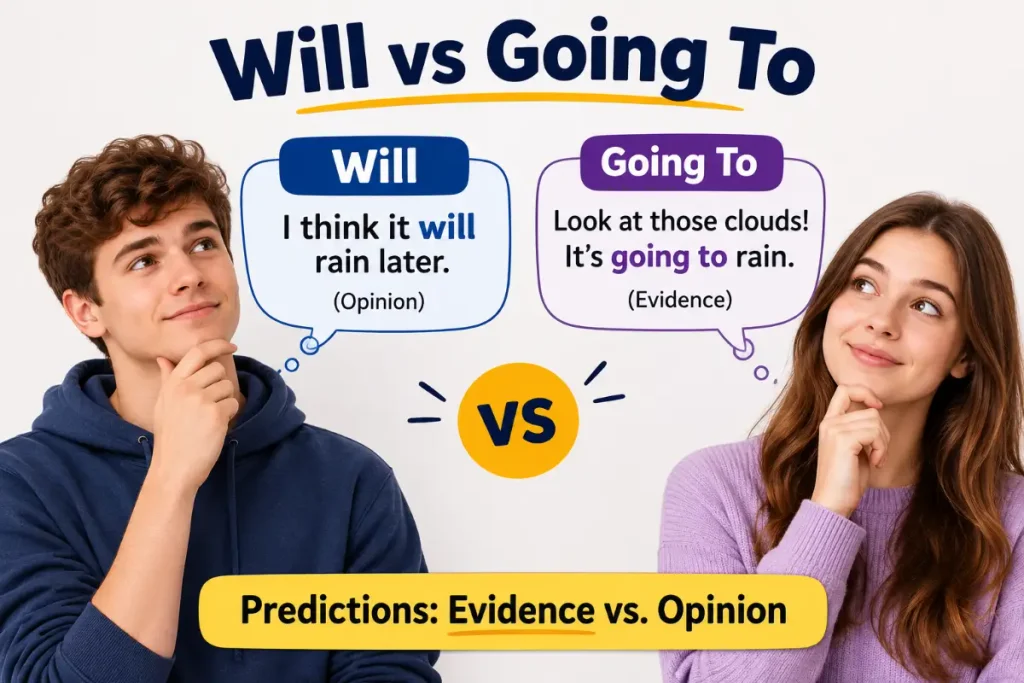
Predictions: Evidence vs. Opinion
Both forms can make predictions, but they signal different things.
Going to often points to present evidence: you can see or know something right now that makes the outcome likely.
- Look at those clouds. It’s going to rain.
- Careful! You’re going to fall!
- She’s pale and shaking. She’s going to faint.
Will usually expresses an opinion, belief, or expectation, often with words like think, believe, expect, probably, and sure.
- I think she’ll win the election.
- It’ll probably be sunny tomorrow.
- I’m sure you’ll enjoy the concert.
- Technology will change the way we work.
The line is blurry in everyday speech. I think it’s going to rain is common and perfectly natural even with no visible cloud. Treat the evidence-versus-opinion distinction as a strong tendency, not an unbreakable law.
Promises, Offers, Threats, and Refusals: Will
“Will” is the standard choice whenever you commit to something.
- I promise I’ll call you tonight. (promise)
- Don’t worry. I’ll help you carry that. (offer)
- If you do that again, I’ll tell your manager. (threat)
- I won’t tell anyone. (refusal or promise)
- The car won’t start. (refusal by an object)
“Going to” would sound strangely detached in these cases. I’m going to help you describes a plan, while I’ll help you gives the other person a commitment.
Questions, Requests, and Polite Offers
The two forms behave differently in questions.
- Are you going to apply for the job? asks about a plan or intention.
- Will you apply for the job? can ask about a plan, but it sounds more like a request or a prediction.
- Will you help me move on Saturday? is a request.
- Shall I open the window? is a polite offer (more common in British English).
- Won’t you join us? is a polite invitation.
If you want to know someone’s intentions, “going to” is usually the more natural choice. If you want something from them, “will” works better.
Formal Announcements and Written English
In formal writing and official announcements, “will” is the standard.
- The meeting will begin at 9 a.m.
- The company will release its quarterly results next week.
- Applicants will be notified by email.
“Going to” sounds conversational, and its spoken contraction gonna is acceptable in casual speech and informal messages but not in formal writing. In emails, you’ll often see both: I will send the report by Friday (formal) versus I’m going to send the report by Friday (friendly, plan-focused).
The Other Future Forms: Present Continuous and Present Simple
Two present-tense forms also talk about the future, and they’re often confused with “will” and “going to.”
Present continuous is used for fixed arrangements, especially with a time or a person involved:
- I’m seeing the dentist at 3.
- We’re meeting Sam at six tomorrow.
Present simple is used for timetables and schedules:
- The train leaves at 8:15.
- The conference starts on Monday.
| Form | Best For | Example |
|---|---|---|
| will | quick decisions, opinions, promises | I’ll take the blue one. |
| going to | prior plans, evidence-based predictions | I’m going to move in June. |
| present continuous | arrangements already made | I’m meeting her at 5. |
| present simple | schedules and timetables | The bus leaves at noon. |
Will and Time Clauses
After words like when, until, before, after, and as soon as, English uses the present simple for future meaning, not “will.” Say I’ll call when I arrive, not when I will arrive. This rule gets a full treatment in our sequence of tenses rules guide. It also applies to “if” clauses, as you can see in our post on zero conditional sentences examples, which compares those patterns with future “if” sentences.
Negatives: Won’t vs. Not Going To
Negatives follow the same logic.
- I won’t be late. (promise)
- I’m not going to be late. (determination, often after a doubt was raised)
- She won’t tell us. (refusal)
- She’s not going to tell us. (prediction or known intention)
Note how “won’t” often carries a sense of willingness or refusal, even with objects: The door won’t open means the door refuses, in effect.
Talking About the Future in Stories and Reports
When describing the past from a past point of view, “will” turns into “would,” and “am/is/are going to” turns into “was/were going to”:
- She said she would call.
- He told us he was going to resign.
“Was going to” is also used for plans that didn’t happen: I was going to call you, but I forgot. For more on how modal verbs behave in such cases, see our modal verbs list.
Will vs. Going To in Real Conversations
Seeing the two forms side by side in a short exchange makes the pattern easier to hear.
Anna: What are you doing this weekend? Ben: I’m going to visit my parents. We’re driving up on Saturday. Anna: Oh, nice. I think the weather will be great. Ben: Really? Look at the sky now. It’s going to rain this afternoon, I’m afraid. Anna: Then take an umbrella. Wait, I’ll lend you mine. Ben: Thanks! I’ll bring it back on Monday.
Notice how each choice does a different job. Ben’s weekend is a plan, so he uses “going to.” Anna’s prediction about Saturday is an opinion, so she uses “will.” Ben’s afternoon forecast relies on the sky he can see, so he uses “going to.” Anna’s offer to lend an umbrella is a quick decision, and Ben’s promise to return it is a commitment, so both use “will.” A single short conversation can contain nearly every use covered in this guide.
Time Expressions and Adverbs That Point Toward One Form
Certain words nudge you toward one form or the other.
Words that often signal “will”: probably, perhaps, maybe, definitely, I think, I expect, I’m sure, I hope, I suppose. These express opinions and degrees of certainty. I’ll probably be late and She’ll definitely agree sound natural.
Words that often signal “going to”: already, just, tonight, this weekend, next week (when the plan exists), and anything that refers to a plan or visible sign. We’re already going to a different restaurant shows a plan that exists now.
Words that fit either: tomorrow, next year, soon, one day. Context and attitude decide, so think about whether the sentence expresses a plan, a prediction, or a commitment.
Warnings, Advice, and Persuasion
When you warn or advise someone, both forms appear, and the choice shapes the tone.
- If you don’t back up your files, you’ll lose everything. (a direct warning using “will”)
- You’re going to regret this. (a prediction based on what the speaker sees)
- I’ll tell you what, I’ll split the cost with you. (an offer made in the moment)
In persuasive writing such as advertising, “will” dominates because it sounds confident and definite: This course will change the way you write. “Going to” would weaken that tone by sounding like a casual aside.
Register and Regional Notes
“Shall” is far less common in everyday American English than in British English. Americans mostly keep it for polite offers (Shall I start?) and formal or legal documents (The tenant shall pay rent on the first of each month). Elsewhere, “will” takes over.
Contractions matter. I’ll, you’ll, she’ll, we’ll, they’ll, and it’ll are normal in speech and informal writing. The negative won’t is a contraction of “will not.” In formal documents, writers often spell out “will not.”
“Gonna” is the spoken form of “going to,” and it’s perfectly normal in casual conversation, song lyrics, and text messages. Avoid it in essays, reports, and professional emails.

Business and Professional Writing
In emails and reports, the form you choose affects how firm or friendly the message sounds.
- I will send you the updated figures by Friday. (firm commitment)
- I’m going to send you the updated figures by Friday. (friendly, plan-focused)
- I’ll send you the figures by Friday. (casual and quick)
- The figures will be available on Friday. (formal, impersonal)
For project updates, “going to” works well for plans in progress (We’re going to launch in March), while “will” suits official statements and commitments (The product will launch in March). Choosing deliberately lets you set the right level of formality and certainty.
Common Mistakes People Make
Mistake 1: Using “will” for something already decided. I will visit my aunt this weekend; I already told her. Better: I’m going to visit my aunt.
Mistake 2: Using “going to” for a sudden decision. “I’m cold.” “I’m going to close the window.” Better: I’ll close the window.
For another useful perspective, check out Sequence of Tenses Rules: 8 Key Rules To Master It in 2026.
Mistake 3: Using “will” in a time clause. I’ll call you when I will arrive. Use when I arrive.
Mistake 4: Using “will” when the evidence is obvious. Look at those clouds! It will rain. Better: It’s going to rain.
Mistake 5: Using “going to” for formal announcements. The meeting is going to begin at 9 a.m. sounds casual in an official notice. Use will begin.
Mistake 6: Treating the two as always interchangeable. Often either works, but not always, and choosing the better one is what makes English sound natural.
Mistake 7: Using “shall” with everyone. In American English, “shall” mostly appears in offers and formal or legal writing. In everyday speech, “will” is the usual choice.
Practice Exercise
Choose the better form. Answers follow.
- A: There’s no milk. B: I ___ buy some. (will / am going to)
- I’ve decided: I ___ start my own business. (will / am going to)
- Look at those clouds! It ___ rain. (will / is going to)
- I think she ___ win the election. (will / is going to)
- We ___ meet Sam at 6 tomorrow. (will / are meeting)
- “The phone’s ringing.” “I ___ get it.” (will / am going to)
- I promise I ___ call you tonight. (will / am going to)
- She’s bought paint. She ___ redecorate the kitchen. (will / is going to)
- Careful! You ___ fall! (will / are going to)
- The meeting ___ begin at 9 a.m. sharp. (will / is going to)
- “I’m cold.” “I ___ close the window.” (will / am going to)
- They ___ have a baby in June. (will / are going to)
- I’m sure you ___ enjoy the concert. (will / are going to)
- He’s studying hard. He ___ become a doctor. (will / is going to)
- Don’t worry. I ___ help you carry that. (will / am going to)
- I ___ visit my aunt this weekend; I already told her. (will / am going to)
- Wow, look at that car! It ___ crash! (will / is going to)
- I think it ___ be sunny tomorrow. (will / is going to)
- Which expresses an arrangement? (a) I’ll see the dentist at 3. (b) I’m seeing the dentist at 3.
- Which is a spontaneous decision? (a) I’m going to order pizza. (b) I’ll order pizza. (said as the idea occurs)
Answer Key
- will
- am going to
- is going to
- will
- are meeting
- will
- will
- is going to
- are going to
- will
- will
- are going to
- will
- is going to
- will
- am going to
- is going to
- will
- (b)
- (b)
Frequently Asked Questions
Is there a real difference between “will” and “going to” for predictions?
Yes, though it’s subtle and often disappears in casual speech. “Going to” tends to rely on present evidence, while “will” expresses an opinion or expectation. Both can be correct in the same sentence.
Which is more formal, “will” or “going to”?
“Will” is more common in formal writing, announcements, and official notices. “Going to” is more conversational, and “gonna” belongs to informal speech only.
Can I use “will” for plans?
You can, but “going to” usually sounds more natural when the plan was decided before you spoke. “I will visit my aunt” sounds like a promise or a spur-of-the-moment decision.
What does “was going to” mean?
It describes a plan or intention in the past, often one that didn’t happen: I was going to call you, but my phone died.
Why does English say “when I arrive” instead of “when I will arrive”?
Time clauses use the present simple for future meaning. “Will” stays in the main clause: I’ll call when I arrive.
Does “will” always sound certain?
Not necessarily. “I think it will rain” shows an opinion, not certainty. Adding words like probably, might, or I expect changes the level of confidence.
Before moving on, you may also want to read Present Perfect Continuous Tense Examples: 30+ Real-Life Uses for more helpful grammar tips.
Wrapping Up
The cleanest way to remember how to use will vs going to is to think about timing and evidence. Use “will” for decisions made as you speak, for opinions, and for promises, offers, and formal announcements. Use “going to” for plans already made and for predictions based on what you can see right now. When something is firmly arranged, the present continuous often fits best.
Don’t worry about perfection in casual speech, where both forms overlap constantly. In writing, matching the form to the situation (and keeping “will” out of time clauses) will make your English sound more precise and more natural.