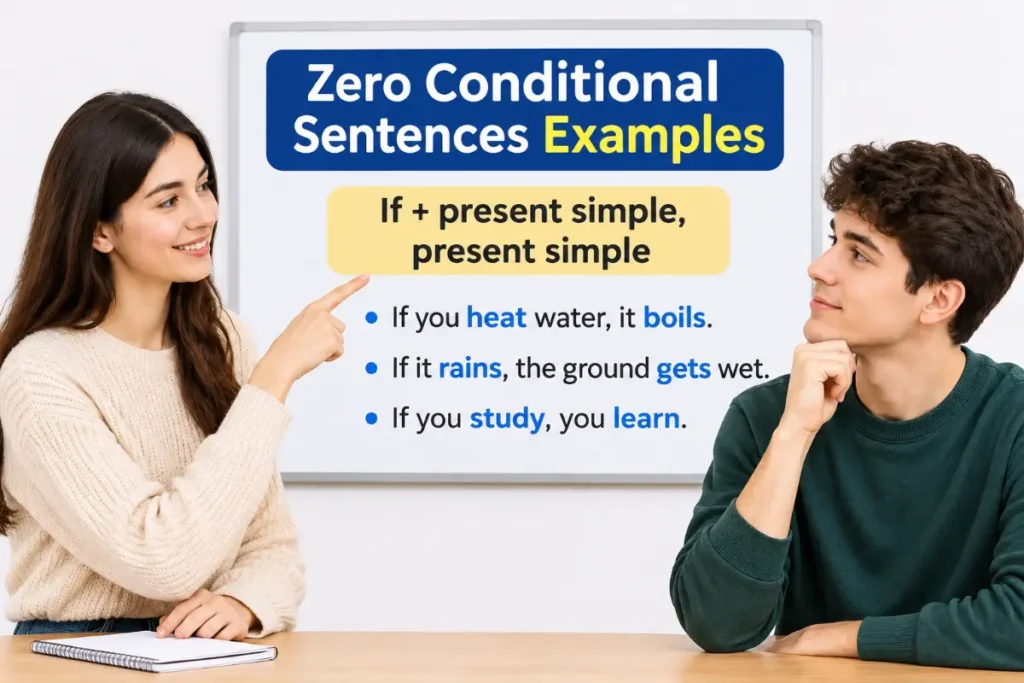
These zero conditional sentences examples show how English talks about things that are always true: scientific facts, general rules, habits, instructions, and cause-and-effect relationships. “If you heat ice, it melts” isn’t a prediction or a guess. It’s simply how the world works, and the zero conditional is the structure built for that job.
The pattern is the simplest of all the conditionals, which makes it a good place to start, but it covers far more ground than most learners expect. This guide walks through the formula, seven different uses, the difference between “if,” “when,” “whenever,” and “unless,” the past-tense version, how to handle negatives and modals, and how the zero conditional differs from the first conditional. You’ll also find mistakes to avoid and 20 practice items with answers.
You may also find Use Have Been vs Had Been: 7 Easy Rules (2026 Guide) helpful if you want to explore this topic further.
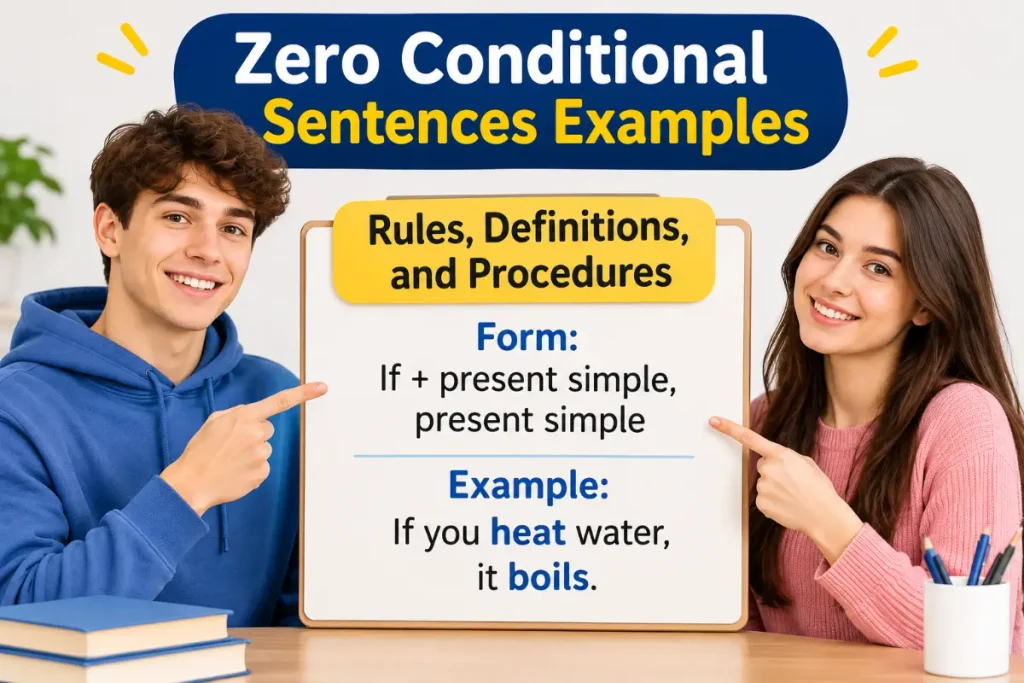
The Formula
If/When + present simple, present simple
- If you heat ice, it melts.
- If I drink coffee at night, I don’t sleep.
- When the sun sets, it gets dark.
Both clauses use the present simple, and there’s no “will” anywhere, because nothing here is a prediction. The British Council’s LearnEnglish page on zero, first, and second conditionals describes the zero conditional as the pattern for things that are generally true, especially laws and rules. The cause and the result are so closely linked that when one happens, the other always follows.
Use 1: Scientific Facts and Natural Laws
This is the classic home of the zero conditional.
- Water boils if you heat it to 100°C.
- If you mix red and blue, you get purple.
- If the temperature drops below zero, water freezes.
- Plants die if they don’t get water.
- If you drop an object, it falls to the ground.
Use 2: General Truths and Personal Habits
The structure also describes patterns that are reliably true for a person or group.
- If I eat nuts, I get a rash.
- My dog barks if someone rings the bell.
- If people don’t exercise, they often gain weight.
- When my sister is stressed, she cleans the house.
- If I skip breakfast, I get a headache by ten o’clock.
Use 3: Rules, Definitions, and Procedures
Because the zero conditional signals “always,” it suits rules and policies.
- If a customer complains, the manager reviews the case.
- If the temperature rises above 40°C, the machine shuts down automatically.
- If you are under 18, you need a parent’s permission.
- If a player touches the ball with a hand, it’s a foul.
Use 4: Instructions and Advice (Imperative Results)
The result clause can be a command. This is extremely common in instructions, safety notices, and everyday advice.
- If you see smoke, call 911.
- If the light is red, stop.
- If you feel dizzy, sit down.
- If you have any questions, ask me.
- If the dough is too sticky, add a little flour.
Notice that the “if” clause stays in the present simple, while the result uses the base form of the verb as an instruction.
Use 5: Technical Writing and Troubleshooting
Manuals and help pages rely on zero conditionals to describe how systems behave.
- If you click “Save,” the file is stored in your documents folder.
- If the battery level is below 10 percent, the screen dims.
- If the app crashes, restart your phone.
- If you enter the wrong password three times, the account locks.
Writers choose this structure because it conveys certainty and predictability: the user can expect the same outcome every time.
Use 6: Cooking and Everyday Practical Knowledge
- If you overmix the batter, the muffins turn tough.
- If you leave milk out, it goes sour.
- When oil gets too hot, it starts to smoke.
Use 7: The Past Zero Conditional
You can also use the pattern to describe general truths in the past by putting both clauses in the simple past.
- If it rained, the match was cancelled. (that’s how it always worked)
- If my grandfather felt tired, he took a nap.
- When the factory whistle blew, the workers went home.
This version describes a past habit or rule that no longer applies. It is different from a third conditional, because the situation isn’t imagined: it really happened, over and over. For the imagined version, see our guide to third conditional examples.
“If,” “When,” “Whenever,” and “Unless”
In zero conditional sentences, “if” and “when” are usually interchangeable, because the result always follows the condition.
- If it snows, the schools close.
- When it snows, the schools close.
- Whenever it snows, the schools close. (“Whenever” stresses every single time.)
This differs from other conditionals, where “if” suggests uncertainty and “when” suggests expectation. In the zero conditional, there’s no uncertainty to express.
“Unless” also works and means “if not”: Plants die unless they get water. It’s a neat way to reverse the condition without using a negative. These words are all subordinating conjunctions, and our guide to using conjunctions correctly covers how they connect clauses.
Negatives, Modals, and Continuous Forms
Negatives work in either clause:
- If you don’t water it, the plant dies.
- If it doesn’t rain, the crops fail.
Modals can appear in the result clause when you want to express possibility or advice rather than a certainty:
- If you heat it too long, it can explode.
- If you feel sick, you should see a doctor.
- If it’s cold, you might need a jacket.
Continuous forms can appear in the “if” clause when describing a temporary situation:
- If you’re feeling unwell, stay home.
- If it’s raining, we usually take the bus.
Word Order and Commas
The two clauses can swap places. A comma follows an opening “if” clause, and no comma is needed when the “if” clause comes second.
- If you don’t water it, the plant dies.
- The plant dies if you don’t water it.
Zero Conditional vs. First Conditional
This is the most common source of confusion. Both use “if + present simple,” but the result clause differs.
| Zero Conditional | First Conditional | |
|---|---|---|
| Meaning | always true, general | specific future possibility |
| Result clause | present simple | will + base verb |
| Example | If it rains, the streets get slippery. | If it rains tomorrow, we’ll stay home. |
| “If” can be replaced by “when”? | yes, with no change | rarely, changes meaning |
If you’re describing something that’s always true, use the zero conditional. If you’re talking about one specific future situation, use the first. To see how “will” works in future talk more generally, read how to use will vs going to.
Zero Conditional vs. a Plain Present-Tense Statement
A zero conditional adds something a simple statement can’t: the explicit link between cause and result. Water boils at 100°C gives a fact. If you heat water to 100°C, it boils spells out the cause and effect. In instructions and explanations, that link makes the guidance clearer and easier to follow.
Building Your Own Zero Conditionals in Three Steps
If you can state a reliable cause and effect, you can write a zero conditional.
- Identify something that is always true. Ice turns to water when it gets warm.
- Name the trigger and the result. Trigger: ice is heated. Result: it melts.
- Put both in the present simple and connect them with “if” or “when.” If ice gets warm, it melts.
Test it by asking whether the sentence would still be true tomorrow, next week, and in a hundred years. If the answer is yes, you have a genuine zero conditional. If the answer depends on a specific situation (If it rains tomorrow…), you’ve drifted into the first conditional.
Zero Conditionals in Different Fields
The structure turns up wherever people explain how things work or what to do in a standard situation.
Science education: If a substance dissolves in water, it is soluble. Definitions in textbooks often take this form, because they link a condition to a classification.
Healthcare guidance: If you have a fever above 39°C, seek medical advice. If a child swallows a battery, go to the emergency room immediately. The imperative result keeps the instruction clear and urgent.
Finance and business: If a customer pays late, the system adds a fee. If sales drop below target, the manager schedules a review. These sentences describe automatic procedures and standing policies.
Customer service scripts: If the item arrives damaged, we send a replacement. The zero conditional presents the policy as reliable and predictable, which reassures customers.
Everyday life: If I miss the 8:15 bus, I’m late for work. When it gets dark, the street lights come on. Personal routines often fit the pattern too.
In each field, the choice of structure signals that the relationship between condition and result is dependable, which is exactly the impression these writers want to create.
Sentences That Look Like Zero Conditionals but Aren’t
Some “if” sentences share the surface pattern but do a different job.
- If you’re hungry, there’s pizza in the fridge. (This offers information. Being hungry doesn’t cause the pizza to be there. Grammarians sometimes call this a relevance conditional.)
- If you ask me, he’s making a mistake. (A fixed phrase giving an opinion.)
- If I may say so, that’s a bold plan. (A polite hedge.)
- If you don’t mind, I’ll open the window. (A courtesy phrase.)
These sentences don’t describe cause and effect, so they don’t follow the zero conditional logic, even though they use the present simple. Telling them apart helps you avoid forcing a pattern where it doesn’t belong.
Writing Clear Instructions With Zero Conditionals
Technical writers, teachers, and anyone writing procedures benefit from a few habits.
- Put the condition first so the reader knows when the instruction applies: If the screen freezes, hold the power button.
- Keep the verbs simple. Use the present simple and the base-form imperative.
- Avoid “will” in these sentences, because it turns a rule into a prediction.
- Be specific about the trigger (below 10 percent, three failed attempts) so there’s no ambiguity.
Following those habits makes manuals, checklists, and help articles easier to follow and less likely to confuse readers.
A Short Example in Context
Here is how zero conditionals look inside a real help-article paragraph about a smart thermostat.
If the display is blank, check the power cable. When the cable is loose, the thermostat shuts off to protect itself. If you see a red light, the device is overheating, so move it away from direct sunlight. If the problem continues, contact support.
Looking at it closely, you can see the structure doing quiet but important work. Every “if” or “when” clause is in the present simple, every result is either a fact (the thermostat shuts off) or an instruction (check the cable), and nothing is hedged with “will” or “might.” The reader gets a clear, dependable rule for each situation. The last sentence even shifts from fact to command without changing the pattern. If the same paragraph used “will,” it would sound like a forecast rather than a rule, which is the wrong tone for an instruction manual.
Common Mistakes People Make
Mistake 1: Putting “will” in the “if” clause. If you will heat iron, it expands. Use If you heat iron, it expands.
Mistake 2: Using “will” in the result clause for a fact. If you freeze water, it will become solid. That’s a first-conditional form. For a fact: it becomes solid.
For another useful perspective, check out Reported Speech Tense Changes: The Complete Backshift Guide (2026).
Mistake 3: Shifting tenses within the sentence. If it rained, the streets get slippery. Keep both clauses in the same time frame.
Mistake 4: Forgetting the comma after an opening “if” clause. If you heat ice it melts.
Mistake 5: Using the zero conditional for one-time events. If it rains today, I get wet describes a specific future event, so the first conditional fits better: I’ll get wet.
Mistake 6: Treating “when” as always meaning “if.” In other structures, they differ. Reserve the interchangeability for the zero conditional.
Mistake 7: Overusing the structure in narrative writing. In stories, using too many general-truth sentences can slow the pace. Save the zero conditional for explanations and rules.
Practice Exercise
Complete each sentence or choose the correct option. Answers follow.
- If you heat ice, it ___ (melt).
- If I drink coffee at night, I ___ (not sleep).
- When the sun ___ (set), it gets dark.
- Plants ___ (die) if they ___ (not get) water.
- If you mix red and blue, you ___ (get) purple.
- If he ___ (be) late, his boss gets angry.
- Water ___ (boil) if you heat it to 100°C.
- If you ___ (press) this button, the machine starts.
- My dog ___ (bark) if someone rings the bell.
- If you ___ (see) smoke, call 911.
- “If you freeze water, it (will become/becomes) solid.”
- “When it rains, the streets (get/will get) slippery.”
- Fix: If you will heat iron, it expands.
- First or zero? If it rains tomorrow, we’ll stay home.
- Zero or first? If I eat nuts, I get a rash.
- Rewrite with “when”: If it snows, the schools close.
- If people ___ (not exercise), they often gain weight.
- Birds ___ (fly) south when winter ___ (come).
- Rewrite with the “if” clause second: If you don’t water it, the plant dies.
- If the temperature ___ (drop) below zero, water ___ (freeze).
Answer Key
- melts
- don’t sleep
- sets
- die / don’t get
- get
- is
- boils
- press
- barks
- see
- becomes
- get
- If you heat iron, it expands.
- first conditional
- zero conditional
- When it snows, the schools close.
- don’t exercise
- fly / comes
- The plant dies if you don’t water it.
- drops / freezes
Frequently Asked Questions
Why is it called the “zero” conditional?
It comes from the numbering used to group conditionals in teaching: zero for general truths, first for real future possibilities, second for unreal present or future situations, and third for unreal past situations. Zero was added later because it describes facts rather than possibilities.
Can I use “will” in a zero conditional sentence?
Not in the standard pattern. If you add “will” to the result, you’ve moved into first-conditional territory, which describes a specific future outcome rather than a general truth.
Can the result clause be a command?
Yes. “If you see smoke, call 911” is a standard zero conditional with an imperative result. This pattern is extremely common in instructions and safety guidance.
Do “if” and “when” mean the same thing here?
In zero conditionals, yes. Both describe a general relationship where the result always follows the condition. “Whenever” adds emphasis on every occasion.
Is the past version of the zero conditional the same as the third conditional?
No. The past zero conditional describes something that really happened regularly (If it rained, we stayed in). The third conditional imagines something that didn’t happen (If it had rained, we would have stayed in).
How do I decide between zero and first conditional?
Ask whether you’re describing something always true (zero) or one specific future possibility (first). If you can replace “if” with “whenever” without changing the meaning, it’s likely a zero conditional.
Before moving on, you may also want to read Third Conditional Examples: Imagining a Different Past (2026) for more helpful grammar tips.
Wrapping Up
Studying zero conditional sentences examples makes the pattern easy to spot: “if” or “when” plus the present simple in both clauses, used for facts, rules, habits, and instructions. Keep “will” out of it, remember that “if,” “when,” and “whenever” are interchangeable here, and use the past-tense version only for habits that no longer apply.
When you’re unsure whether you need the zero or first conditional, ask yourself whether the outcome is always true or tied to one particular future situation. That one question settles most cases, and with practice the structure becomes second nature in explanations, rules, and instructions.