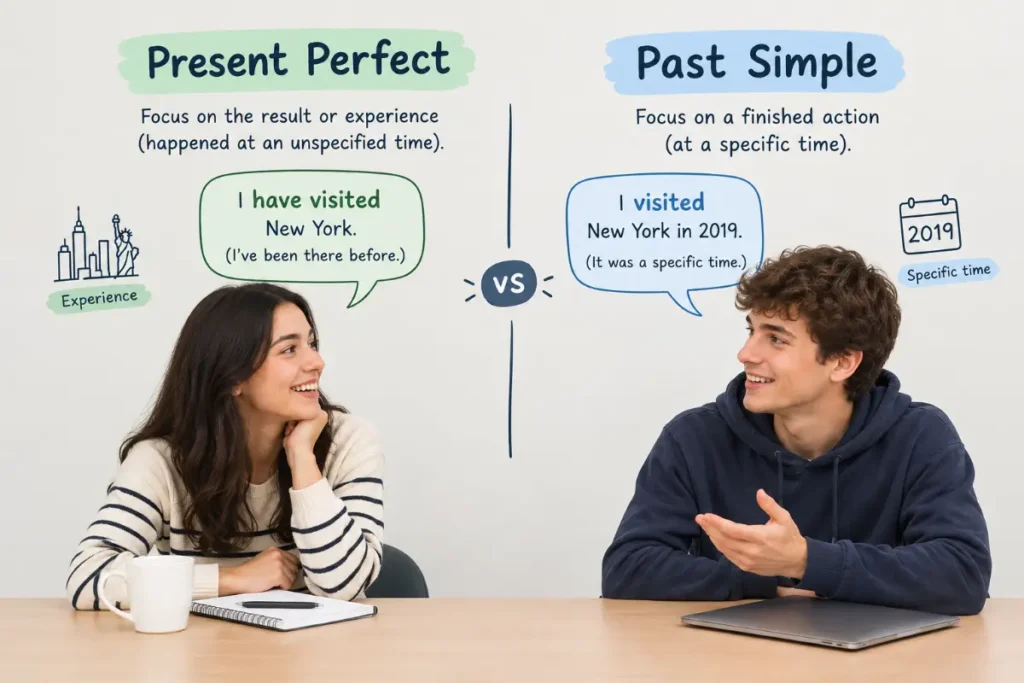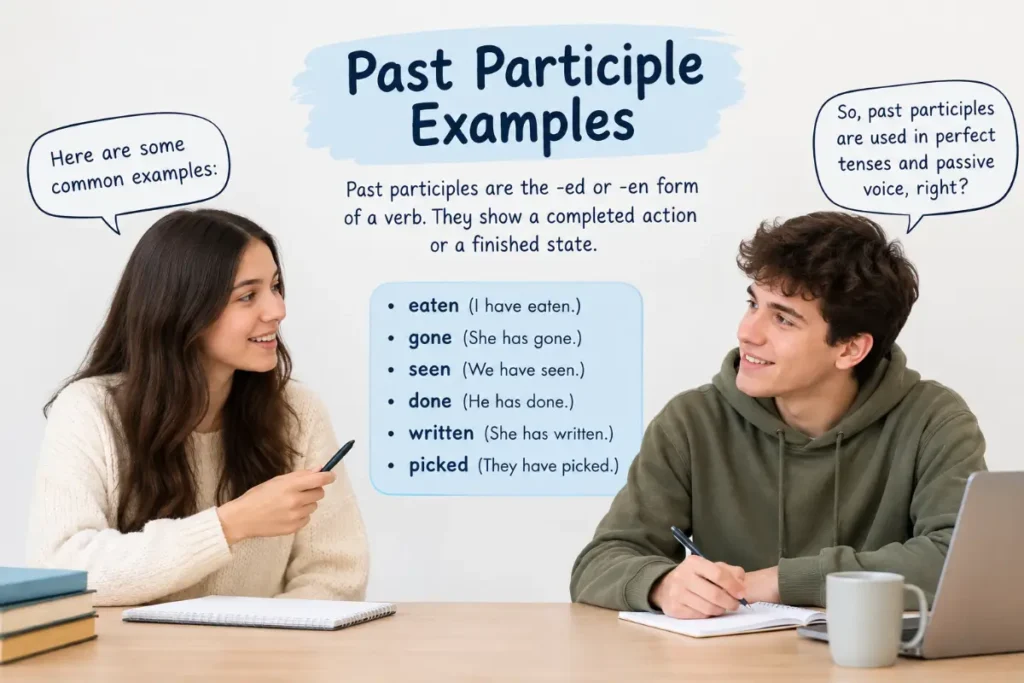
These 25 past participle examples show the four jobs this verb form does in everyday English: building perfect tenses, forming the passive voice, working as an adjective, and starting participial phrases. The past participle is the third form of a verb, the one in “have eaten,” “was broken,” and “a frozen pond.”
Because the form looks different from verb to verb, it causes more trouble than almost any other part of grammar. “I have ate” is wrong, “I have eaten” is right, and the reason is that eaten is the participle while ate is the simple past. This guide sorts twenty-five examples by job, shows how to spot a past participle with a one-second test, and covers the mistakes that appear most often.
You may also find 7 Present Continuous Tense Rules (2026 Guide) helpful if you want to explore this topic further.
What a Past Participle Is
Purdue OWL describes a participle as a verb form that functions as an adjective, and notes that past participles typically end in -ed, -en, -d, -t, or -n. That range is easy to see in familiar verbs:
- -ed: walked, finished, painted
- -en / -n: eaten, broken, chosen, known
- -d / -t: heard, built, kept, left
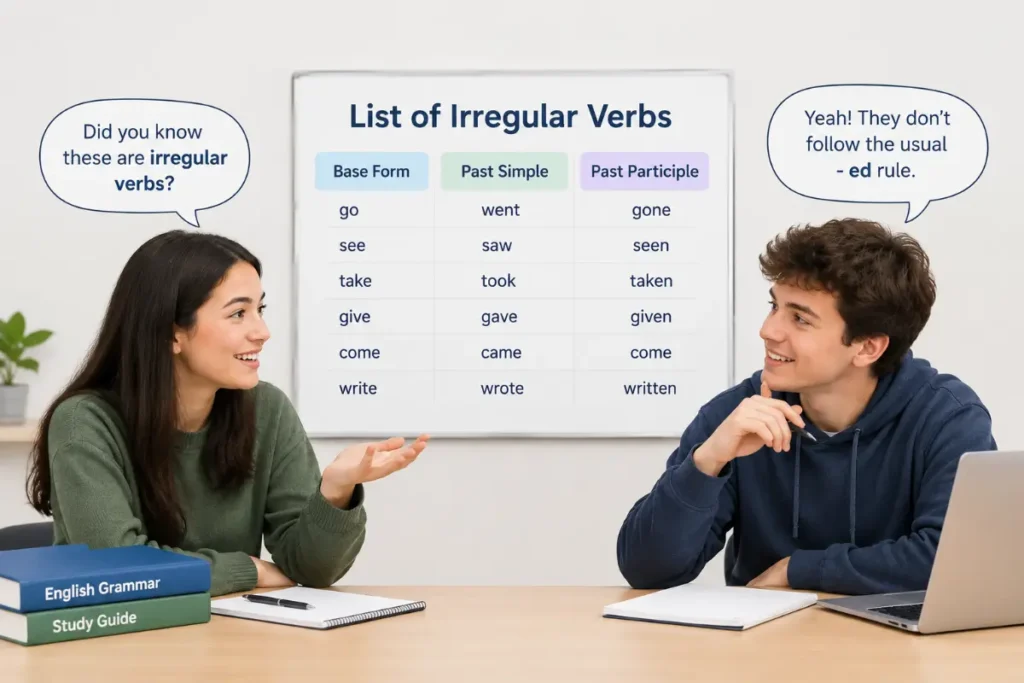
Regular verbs form the past participle by adding -ed, so it looks identical to the simple past (walked, walked). Irregular verbs have their own forms, which is where mistakes happen, and our list of irregular verbs gives all three forms for the most common ones.

The One-Second Test
Put “have” in front of the word. If the sentence makes sense, you’ve found a past participle.
- I have eaten. ✓ (“eaten” is the participle)
- I have ate. ✗ (“ate” is the simple past)
- She has gone. ✓
- She has went. ✗
25 Past Participle Examples in Sentences
Past participles appear in everyday sentences to show completed actions, form the passive voice, and describe people or things. Here are examples that show how to use them correctly.
- Eaten: I have eaten breakfast already.
- Written: She has written a letter to her friend.
- Broken: The broken chair needs to be fixed.
- Gone: He has gone to work.
- Seen: We have seen that movie before.
- Taken: She has taken her medicine.
- Built: They have built a new house.
- Chosen: We have chosen a team leader.
- Driven: He has driven this car for years.
- Forgotten: I have forgotten his name.
- Finished: The work has been finished.
- Made: This cake was made by my mother.
- Found: The missing keys were found under the sofa.
- Stolen: The stolen bike was recovered.
- Frozen: The frozen food is in the freezer.
- Tired: She felt tired after the long walk.
- Closed: The store was closed on Sunday.
- Lost: He has lost his wallet.
- Caught: The ball was caught by the player.
- Spoken: We have spoken about this before.
- Fallen: The fallen leaves covered the yard.
- Known: She has known him since childhood.
- Sent: I have sent the email.
- Drawn: He has drawn a picture of his dog.
- Given: Given enough time, we can finish the project.
Notice that some past participles follow helping verbs, such as have eaten and was made. Others describe nouns, such as broken chair and fallen leaves. The word’s job depends on how it works in the sentence.
Job 1: Perfect Tenses (Examples 1–7)
The past participle follows have, has, had, or will have to build the perfect tenses.
- She has finished her homework. (present perfect)
- They have lived here since 2019. (present perfect)
- We had eaten before the movie started. (past perfect)
- He had written three drafts by Friday. (past perfect)
- By next June, I will have graduated. (future perfect)
- The team has won every game this season. (present perfect)
- She has gone to the store. (present perfect)
Purdue OWL’s verb tense guide lists the patterns as has or have + past participle for the present perfect, had + past participle for the past perfect, and will have + past participle for the future perfect. The tense changes, but the participle stays the same.
Job 2: Passive Voice (Examples 8–13)
The passive voice pairs a form of be with a past participle. The subject receives the action instead of performing it.
- The window was broken by the storm.
- The report is written in plain English.
- The winners will be announced tomorrow.
- The package has been delivered.
- The bridge was built in 1932.
- Mistakes were made.
Our guide to active vs passive voice examples shows when this construction helps and when active voice is the stronger choice.
Job 3: Adjectives (Examples 14–19)
A past participle can describe a noun directly, or follow a linking verb to describe the subject.
- The broken window needs repair.
- A written apology arrived this morning.
- She seems tired.
- The frozen pond was safe to cross.
- He picked up the torn page.
- The door remained closed.
Examples 16 and 19 are predicate adjectives, the adjective that follows a linking verb, a pattern explained in our guide to what is a predicate adjective.
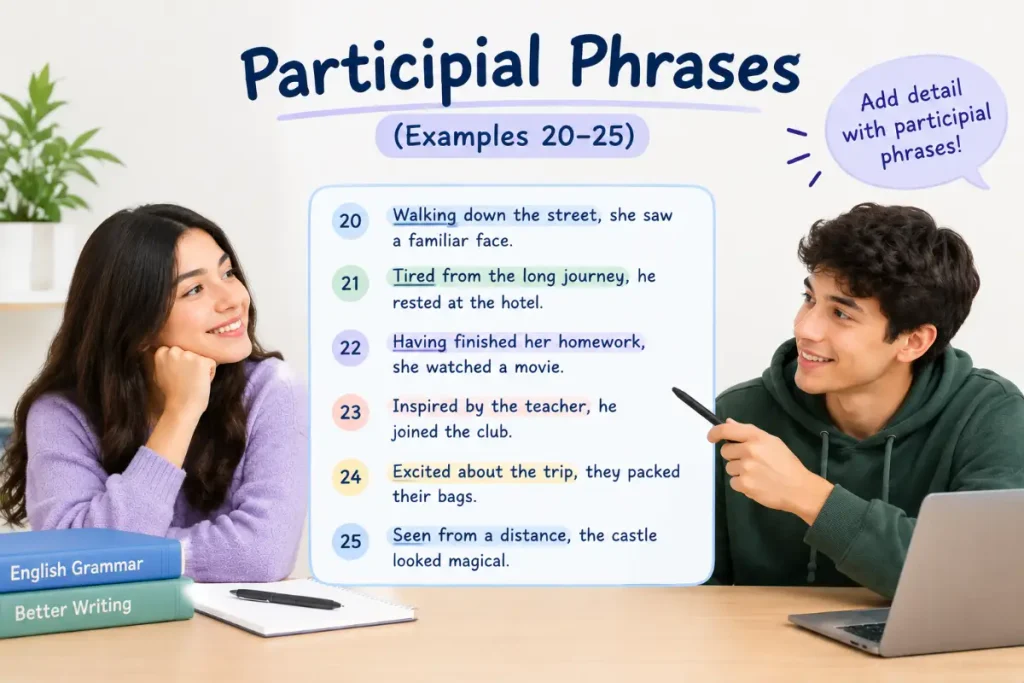
Job 4: Participial Phrases (Examples 20–25)
A past participle can open a phrase that describes a noun nearby. The phrase includes the participle plus its modifiers.
- Exhausted from the trip, she fell asleep instantly.
- The letter written in 1920 was found in the attic.
- Frightened by the thunder, the puppy hid under the bed.
- The cake baked by my grandmother won first prize.
- Covered in snow, the car was hard to find.
- Given a second chance, he made the most of it.
In each case, the phrase describes the noun right next to it. When the noun is missing or wrong, you get a dangling participle, a problem covered in our guide to what is a participial phrase.
Past Participle vs. Simple Past
The two forms look the same for regular verbs and different for many irregular ones. This table shows why the distinction matters.
| Verb | Simple Past | Past Participle | Sentence |
|---|---|---|---|
| walk | walked | walked | She walked. / She has walked. |
| go | went | gone | She went. / She has gone. |
| see | saw | seen | I saw it. / I have seen it. |
| write | wrote | written | He wrote. / He has written. |
| take | took | taken | They took it. / They have taken it. |
| drink | drank | drunk | We drank. / We have drunk. |
Use the simple past for a finished action (“She went home”) and the participle after an auxiliary (“She has gone home”).
List of Common Past Participles With Their Verb Forms
Learning the three forms of common verbs helps you use past participles correctly. The base form names the action, the simple past describes a completed past action, and the past participle works with helping verbs or as an adjective.
| Base Verb | Simple Past | Past Participle |
|---|---|---|
| Be | was/were | been |
| Become | became | become |
| Begin | began | begun |
| Break | broke | broken |
| Bring | brought | brought |
| Buy | bought | bought |
| Choose | chose | chosen |
| Come | came | come |
| Do | did | done |
| Drink | drank | drunk |
| Drive | drove | driven |
| Eat | ate | eaten |
| Fall | fell | fallen |
| Fly | flew | flown |
| Forget | forgot | forgotten |
| Give | gave | given |
| Go | went | gone |
| Know | knew | known |
| See | saw | seen |
| Speak | spoke | spoken |
| Take | took | taken |
| Write | wrote | written |
Quick tip: Regular verbs usually end in -ed in both the simple past and past participle forms. For example, play, played, played. Irregular verbs often change in different ways, so you need to learn their forms.
For more verbs, see our complete list of irregular verbs.
Quick Reference Table
| Job | Pattern | Example |
|---|---|---|
| Present perfect | has/have + participle | She has finished. |
| Past perfect | had + participle | She had finished. |
| Future perfect | will have + participle | She will have finished. |
| Passive | be + participle | The work was finished. |
| Adjective | participle + noun | a finished product |
| Participial phrase | participle + modifiers | Finished early, she left. |
How to Use Past Participles Correctly
Past participles follow a few simple patterns. Learning these rules will help you avoid common grammar mistakes.
1. Use a Past Participle After Have, Has, or Had
Use the past participle to form perfect tenses.
- Correct: I have eaten lunch.
- Incorrect: I have ate lunch.
- Correct: She had written the report.
- Incorrect: She had wrote the report.
Remember that ate and wrote are simple past forms, while eaten and written are past participles.
2. Use a Past Participle in the Passive Voice
The passive voice uses a form of be with a past participle. It focuses on the person or thing receiving the action.
- The window was broken by the storm.
- The invitations were sent yesterday.
- The winner will be announced tomorrow.
3. Use a Past Participle to Describe a Noun
Past participles can work as adjectives that describe people, places, or things.
- The damaged phone needs repair.
- She picked up the fallen book.
- We sat beside the frozen lake.
4. Check That the Participle Describes the Right Noun
A participial phrase should clearly describe the noun it refers to.
- Correct: Exhausted by the long trip, the travelers went to bed.
- Incorrect: Exhausted by the long trip, the hotel room looked inviting.
The second sentence wrongly suggests that the hotel room was exhausted. Place the phrase next to the noun it describes to avoid this mistake.
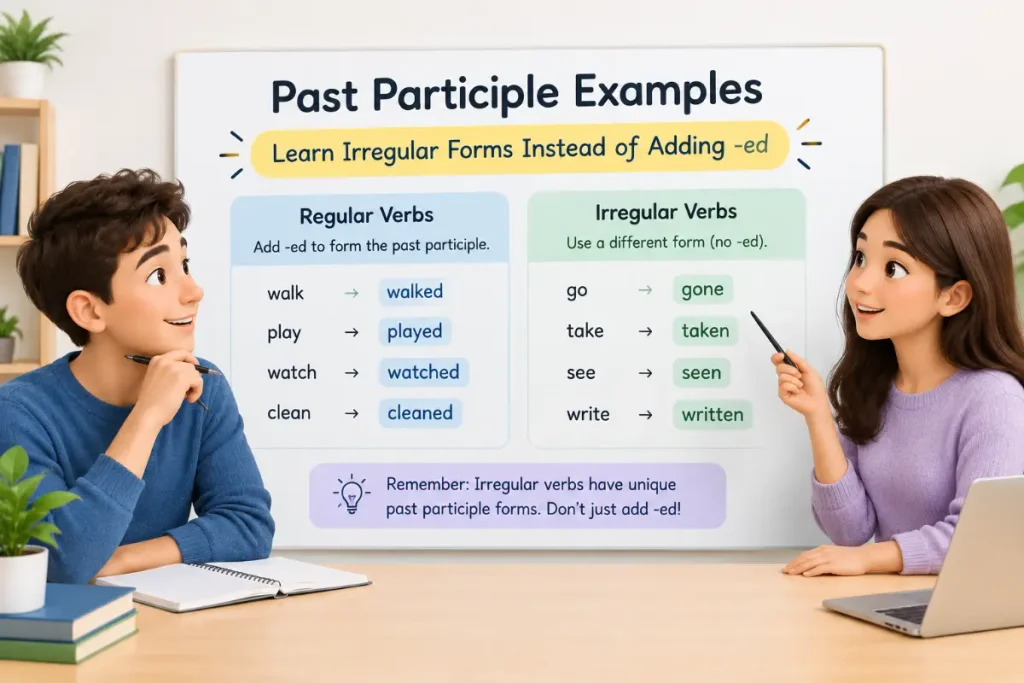
5. Learn Irregular Forms Instead of Adding -ed
Not every past participle ends in -ed. Some common irregular forms are gone, seen, taken, eaten, and written.
- Correct: He has gone home.
- Incorrect: He has went home.
- Correct: They have taken the test.
- Incorrect: They have took the test.
When you are unsure, check a reliable verb list and compare the base form, simple past, and past participle.
Common Mistakes People Make
Mistake 1: Using the simple past instead of the participle after have, as in “I have went” or “she has wrote.”
Mistake 2: Using the participle as a simple past, as in “I seen it” or “he done it.”
Mistake 3: Putting a past participle phrase next to the wrong noun, which makes the sentence say something unintended.
Mistake 4: Adding -ed to an irregular participle, as in “I have teached” or “she has choosed.”
Mistake 5: Mixing up participles that look alike, such as sung/sang, drunk/drank, and swum/swam.
For another useful perspective, check out Present Perfect vs Past Simple: 9 Key Differences (2026 Guide).
Practice Exercise
Identify the past participle in each sentence and say what job it’s doing: perfect tense, passive voice, adjective, or participial phrase. Answers are listed right after, so try each one before checking.
- She has seen that movie twice.
- The cake was eaten by the guests.
- The broken vase lay on the floor.
- Surprised by the news, he sat down.
- They had finished dinner before we arrived.
- The letter was written in 1920.
- He looked worried.
- By June, I will have saved enough money.
- The house built in 1900 is still standing.
- The documents were signed yesterday.
- We have chosen a new color.
- The locked door wouldn’t open.
- Tired of waiting, they left.
- The song was sung beautifully.
- She has driven this road before.
- The stolen car was recovered.
- Given the chance, she took it.
- The team has lost three games.
- The fish was fried in butter.
- The sunken ship was discovered in 1985.
Answer Key
- seen — perfect tense
- eaten — passive voice
- broken — adjective
- Surprised by the news — participial phrase
- finished — perfect tense (past perfect)
- written — passive voice
- worried — adjective (after a linking verb)
- saved — perfect tense (future perfect)
- built in 1900 — participial phrase
- signed — passive voice
- chosen — perfect tense
- locked — adjective
- Tired of waiting — participial phrase
- sung — passive voice
- driven — perfect tense
- stolen — adjective (and “recovered” is a passive participle)
- Given the chance — participial phrase
- lost — perfect tense
- fried — passive voice
- sunken — adjective (and “discovered” is a passive participle)
Frequently Asked Questions
What’s the difference between a past participle and the simple past?
They look identical for regular verbs (walked, walked) but differ for many irregular ones (went versus gone). The simple past stands alone as a finished action, while the participle needs a helper like have, has, had, or be, or works as an adjective.
How do I find the past participle of an irregular verb?
Look it up in a reference list, or test it by putting have in front: “I have ___.” Our list of irregular verbs gives all three forms for the most common ones.
Can a past participle be an adjective?
Yes. Words like broken, frozen, tired, and closed are past participles that function as adjectives, either before a noun or after a linking verb.
Why is it “I have eaten” and not “I have ate”?
Eaten is the past participle, which is the form required after have. Ate is the simple past, which stands alone without a helping verb.
What’s the fastest way to spot a past participle?
Put have in front of the word. If “I have ___” sounds natural, the word is a past participle.
Before moving on, you may also want to read Modal Verbs List: What Each One Means and When to Use It for more helpful grammar tips.
Wrapping Up
These past participle examples show a form that does four different jobs while staying the same word: it completes perfect tenses, forms the passive, describes nouns, and opens participial phrases. The “put have in front” test is the fastest way to confirm you’ve found one and choose the right form.
The habit worth building is learning the irregular participles as a set, since seen, gone, written, and taken are where nearly all the mistakes occur. Once those forms are automatic, the rest of the system, from tenses to passives to adjectives, falls into place.