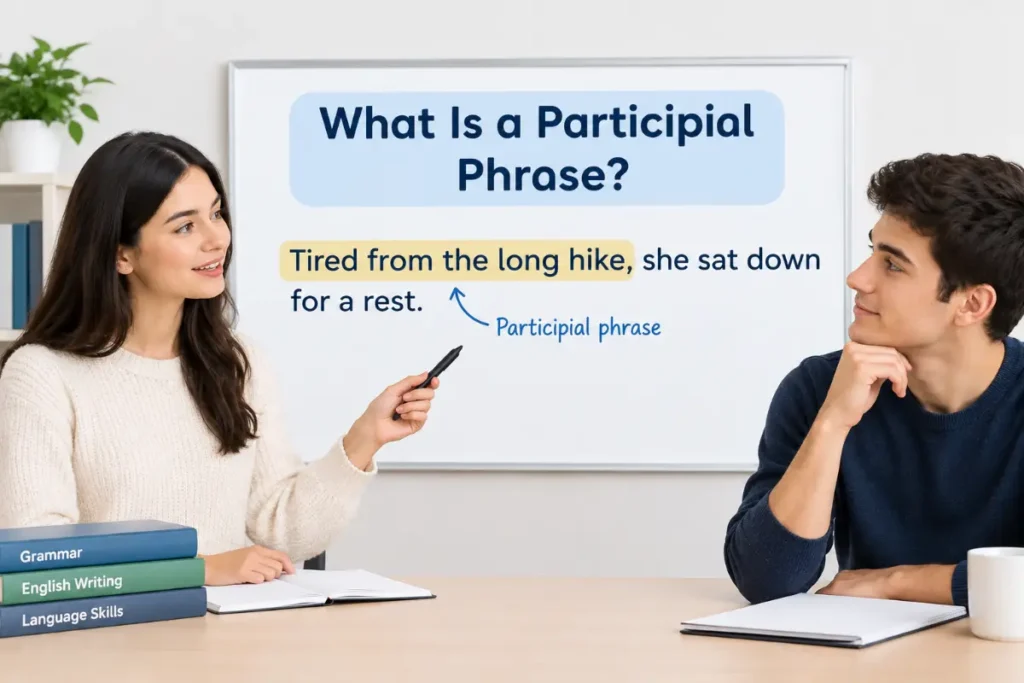
The short answer to what is a participial phrase is that it’s a group of words built around a participle, an -ing or -ed verb form, that works as an adjective by describing a noun or pronoun. In “The man standing by the door is my uncle,” the phrase “standing by the door” tells you which man is meant, exactly as an adjective would.
This guide focuses on the phrase itself: what it’s made of, the difference between present and past forms, where it can sit in a sentence, and which position needs commas. The error that happens when a participial phrase loses its subject, the dangling participle, has its own guide, so we’ll point you there instead of repeating it.
You may also find An Adverb? 25 Easy Examples to Understand It (2026) helpful if you want to explore this topic further.
What It’s Made Of
Purdue OWL defines a participle as a verbal that functions as an adjective. A present participle ends in -ing, and a past participle ends in -ed, -en, -d, -t, or -n. A participial phrase is the participle plus whatever objects, modifiers, or complements travel with it.
- The dog barking at the mail carrier belongs to my neighbor. (present participle phrase)
- The letter written in 1920 was found in the attic. (past participle phrase)
- Frightened by the thunder, the puppy hid under the bed. (past participle phrase)
In each case the phrase answers “which one?” or “what kind?” about a noun, the same questions a plain adjective answers.
Present, Past, and Perfect Forms
Present participial phrases end in -ing and usually describe an action happening at the same time as the main verb.
- Walking through the park, we spotted a fox.
Past participial phrases describe something that was done to the noun, and many end in -ed or take an irregular form.
- The building damaged in the storm will be repaired.
Perfect participial phrases use “having” plus a past participle to show an action that finished before the main action.
- Having finished his homework, Sam went outside.
- Having been warned twice, he finally listened.
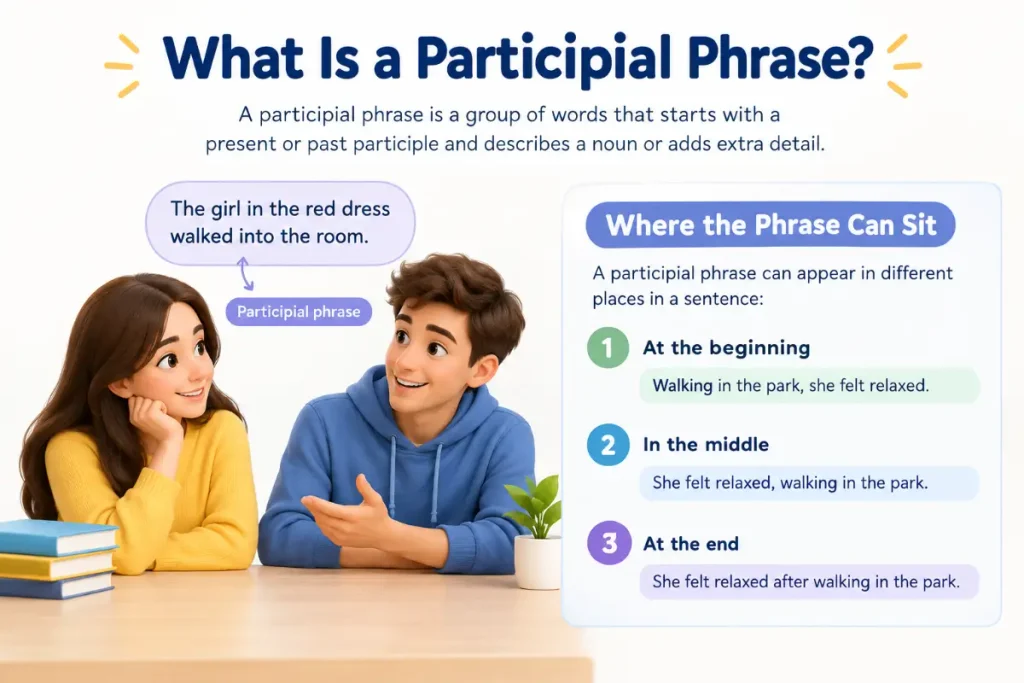
Where the Phrase Can Sit
A participial phrase can open a sentence, sit in the middle, or close it. Each position has its own comma habit.
At the beginning. Purdue OWL’s extended comma rules list participial phrases among the introductory phrases that should be followed by a comma.
- Smiling at the crowd, the singer walked on stage.
Right after the noun it describes. The comma depends on whether the phrase is essential.
- The man standing by the door is my uncle. (essential: it identifies which man, so no commas)
- My uncle, standing by the door, waved. (nonessential: the noun is already identified, so commas)
At the end. A closing phrase is usually set off with a comma when it adds extra detail.
- She walked home, humming a tune.
Participial Phrase Examples in Everyday Sentences
Participial phrases appear in everyday writing more often than you might realize. They help describe people, places, objects, and situations without adding another complete sentence. Once you recognize how they work, you’ll find them in books, articles, conversations, and even your own writing.
A participial phrase starts with a participle, such as an -ing or past-participle form of a verb, and includes any words connected to it. The entire phrase works like an adjective because it describes a noun or pronoun.
Here are some participial phrase examples to help you understand how they work.
1. Describing a person
The girl wearing a red jacket is my cousin.
- Participial phrase: wearing a red jacket
- Word described: girl
The phrase tells us which girl the sentence is about.
2. Describing an object
The car damaged in the accident needs repairs.
- Participial phrase: damaged in the accident
- Word described: car
The phrase gives us more information about the car by explaining what happened to it.
3. Showing a reaction
Surprised by the announcement, Mark looked around the room.
- Participial phrase: Surprised by the announcement
- Word described: Mark
The phrase describes Mark’s reaction to the announcement.
4. Adding detail to an action
The little boy ran across the yard, laughing loudly.
- Participial phrase: laughing loudly
- Word described: boy
The phrase adds information about the boy while keeping the sentence short and natural.
5. Describing something in the past
The book written by a local author became a bestseller.
- Participial phrase: written by a local author
- Word described: book
The phrase identifies the book by providing information about who wrote it.
6. Showing an earlier action
Having completed the assignment, Jessica turned on the television.
- Participial phrase: Having completed the assignment
- Word described: Jessica
The perfect participial phrase shows that Jessica finished her assignment before turning on the television.
Notice that each phrase describes a noun or pronoun rather than serving as the main verb of the sentence. Some participial phrases identify exactly which person or thing you mean, while others simply add extra details.
Remember the comma rule, too. An introductory participial phrase usually needs a comma after it, as in “Exhausted after practice, the players headed home.” A phrase that identifies a noun usually takes no commas, as in “The players wearing blue jerseys won the game.”
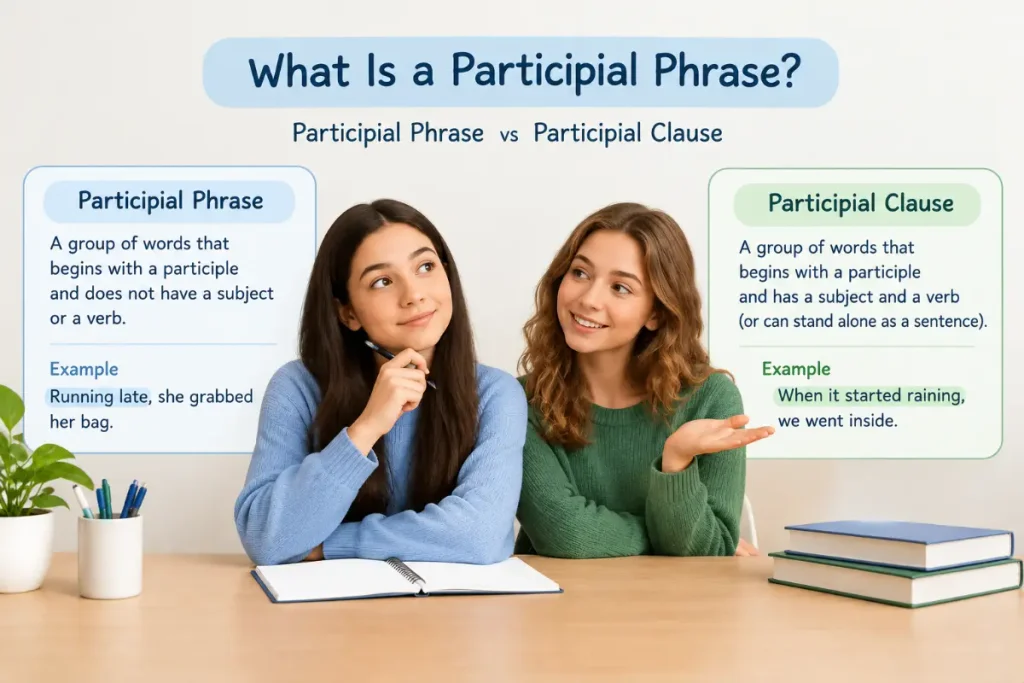
Participial Phrase vs. Participial Clause: What’s the Difference?
A participial phrase and a participial clause are closely related terms, and some grammar resources use them differently. For most everyday grammar questions, the important point is to recognize how a participle and the words around it function in a sentence.
A participial phrase is built around a participle and may include objects, modifiers, or complements. It works like an adjective by describing a noun or pronoun.
For example:
The woman carrying a heavy suitcase entered the station.
- Participial phrase: carrying a heavy suitcase
- Word described: woman
The phrase describes the woman and tells us which woman entered the station.
A participial clause is a clause built around a participle. It may contain its own object or other sentence elements, but it does not function as a complete independent sentence on its own.
For example:
Walking through the crowded market, Daniel stopped at a fruit stand.
The participial clause “Walking through the crowded market” has the participle walking and the additional phrase through the crowded market. It describes Daniel and provides background information about what was happening when he stopped.
Here is another example:
The documents, signed by the manager, were sent to the client.
The participial construction “signed by the manager” describes the documents. It also contains the phrase “by the manager,” which identifies who signed them.
The terminology can overlap: a short participial construction may be called a phrase in one grammar guide and a clause in another. The key is to identify the participle, determine what it describes, and check how it functions in the sentence.
One important distinction remains: a participial construction is not a complete independent sentence by itself. For example, “Walking through the crowded market” leaves the reader waiting for the rest of the thought. Adding a main clause completes the sentence: “Walking through the crowded market, Daniel stopped at a fruit stand.”
How to Identify a Participial Phrase in a Sentence
Finding a participial phrase becomes much easier when you follow a few simple steps. Instead of looking for every word ending in -ing or -ed, focus on how the word functions in the sentence.
Step 1: Look for a participle.
Start by looking for a present participle ending in -ing or a past participle, such as broken, written, chosen, or finished. Perfect participial constructions often begin with having or having been.
For another useful perspective, check out A Proper Noun? 7 Easy Rules & Examples (2026).
For example:
The puppy sleeping under the table belongs to Mia.
The word sleeping is a participle in this sentence.
Step 2: Check whether it describes a noun or pronoun.
Ask yourself which person or thing the participle describes.
In “The puppy sleeping under the table belongs to Mia,” the words “sleeping under the table” describe the puppy. That makes them a participial phrase.
However, in “The puppy is sleeping under the table,” the words “is sleeping” form the main verb phrase. They tell us what the puppy is doing rather than acting as a separate descriptive phrase.
Step 3: Include the words connected to the participle.
A participial phrase can contain more than one word. Include the objects, modifiers, and other elements that belong to the participle.
Consider this example:
The student working on the science project stayed late.
The participial phrase is “working on the science project,” not just “working.” The entire phrase describes the student.
Step 4: Find the noun or pronoun being described.
Every correctly used participial phrase should have a clear word it describes.
In “Covered in fresh snow, the mountains looked beautiful,” the phrase “Covered in fresh snow” describes the mountains.
If the phrase seems to describe the wrong person or thing, the sentence may contain a dangling participle. For example, “Walking into the kitchen, the smoke alarm startled me” suggests that the smoke alarm was walking into the kitchen. A clearer version is “Walking into the kitchen, I was startled by the smoke alarm.”
Step 5: Check the punctuation.
Once you’ve identified the phrase, decide whether it needs commas.
- At the beginning: Use a comma after an introductory participial phrase. Example: “Feeling hungry, Ava made a sandwich.”
- Directly after a noun: Usually omit commas when the phrase identifies which noun you mean. Example: “The employee answering the phone is our manager.”
- Adding extra information: Use commas around a nonessential phrase. Example: “Ava, feeling hungry, made a sandwich.”
These steps help you identify participial phrases accurately without confusing them with main verbs or gerund phrases. With practice, you’ll be able to spot them quickly and use them to make your writing clearer and more descriptive.
Essential vs. Nonessential
The comma logic is the same removal test covered in our guide to what is a non-restrictive clause. Purdue OWL’s example of a nonessential participial phrase is “Company managers, seeking higher profits, hired temporary workers to replace full-time staff.” The phrase adds extra information and can be removed without confusing the reader, so it’s set off with commas.
If deleting the phrase would leave the noun unclear, the phrase is essential and takes no commas.
- The students taking the exam must stay quiet. (remove the phrase and “the students” could mean any students)
- The students, taking the exam, must stay quiet. (this version wrongly suggests all the students are taking the exam)
Participial Phrase vs. Gerund Phrase
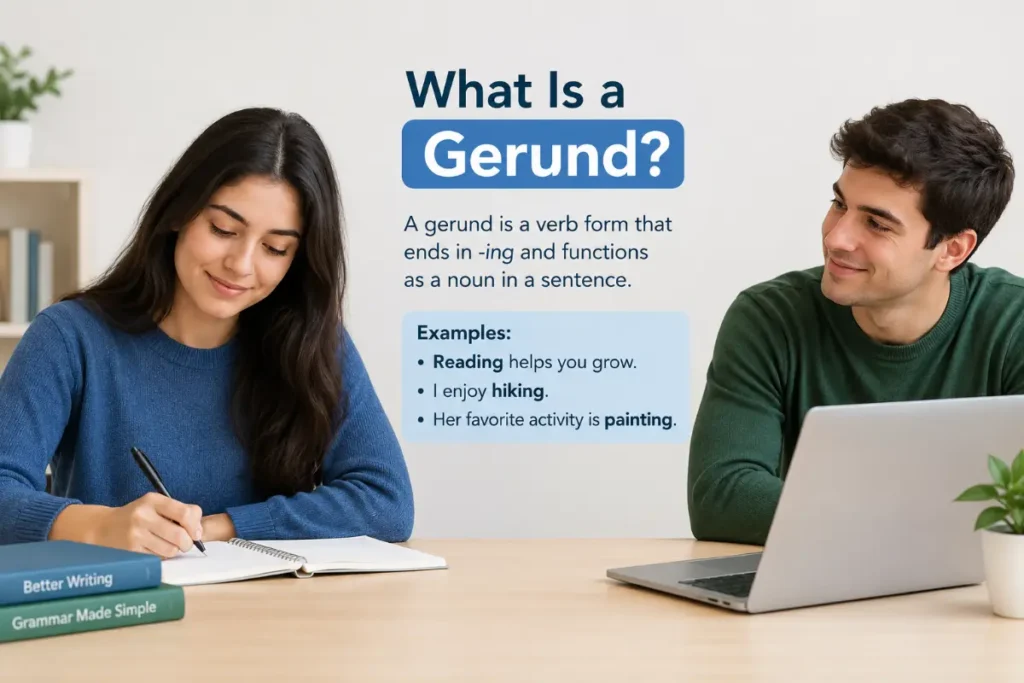
Both begin with an -ing word, so they’re easy to confuse. The difference is the job. A participial phrase describes a noun (an adjective job), while a gerund phrase acts as a noun itself.
- Running across the field, he tripped. (participial: describes “he”)
- Running across the field is good exercise. (gerund phrase: it’s the subject)
Our guide to what is a gerund covers the gerund side, including the “swap it for it” test that separates the two.
Participial Phrase vs. Progressive Verb
The -ing form can also be part of a verb itself.
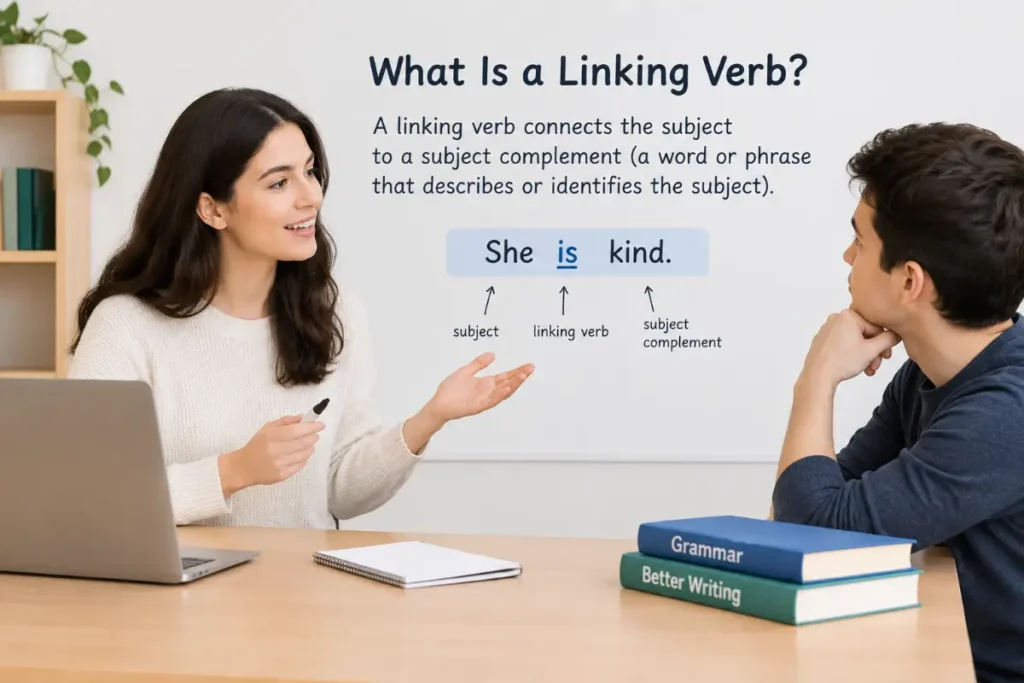
- She is reading a novel. (“is reading” is a progressive verb, not a participial phrase)
- The woman reading a novel is my aunt. (“reading a novel” describes “woman”)
If a form of “be” sits right before the -ing word and the two work together as the verb, it’s a progressive verb. If the -ing phrase describes a noun, it’s participial.
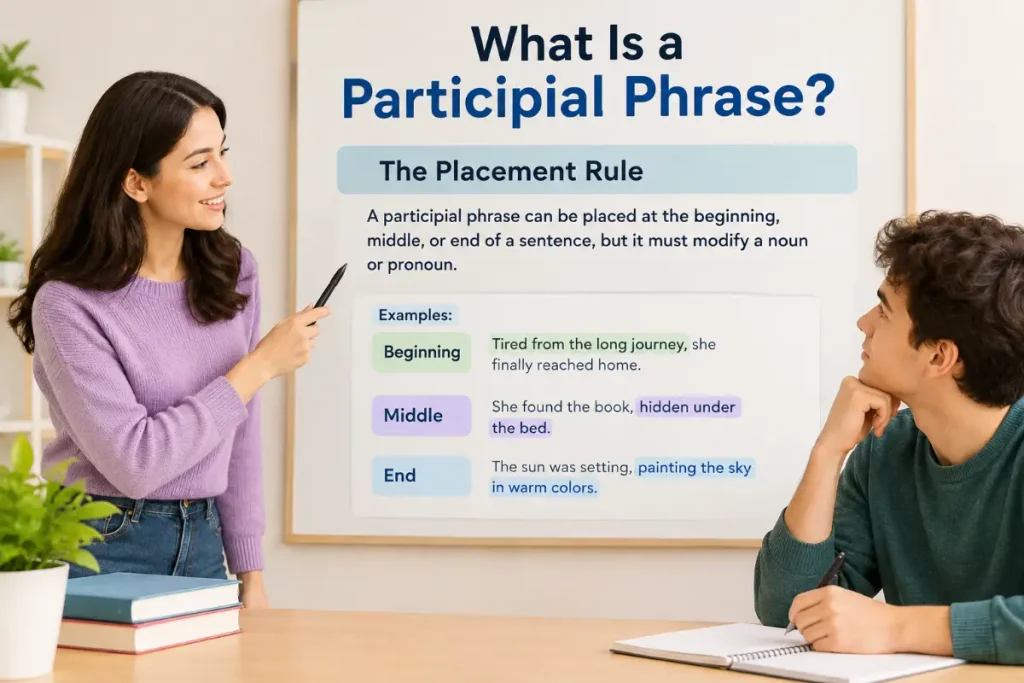
The Placement Rule
A participial phrase should sit next to the noun it describes, and that noun must actually appear in the sentence. When it doesn’t, the phrase ends up describing the wrong thing, which is the dangling participle error covered in our guide to how to identify a dangling participle.
Quick Reference Table
| Type | Example | Describes |
|---|---|---|
| Present | The dog barking at the mail carrier | dog |
| Past | The letter written in 1920 | letter |
| Perfect | Having finished his homework, Sam… | Sam |
| Introductory | Smiling at the crowd, the singer… | singer |
| Nonessential | My uncle, standing by the door,… | uncle |
| Essential | The man standing by the door… | man |
Common Mistakes People Make
- Mistake 1: Putting commas around an essential participial phrase, as in “The students, taking the exam, must stay quiet.”
- Mistake 2: Leaving out the comma after an introductory participial phrase, as in “Smiling at the crowd the singer walked on stage.”
- Mistake 3: Confusing a participial phrase with a gerund phrase, since both can start with an -ing word.
- Mistake 4: Separating the phrase from the noun it describes, so it seems to modify something else.
- Mistake 5: Opening a sentence with a participial phrase whose logical subject isn’t the sentence’s subject, which creates a dangling participle.
Practice Exercise
Identify the participial phrase in each sentence and the word it describes. Answers are listed right after, so try each one before checking.
- Smiling at the crowd, the singer walked on stage.
- The man standing by the door is my uncle.
- Exhausted from the trip, she fell asleep instantly.
- The letter written in 1920 was found in the attic.
- Having finished his homework, Sam went outside.
- The dog barking at the mail carrier belongs to my neighbor.
- Frightened by the thunder, the puppy hid under the bed.
- My sister, wearing a bright yellow coat, waved from across the street.
- The students taking the exam must stay quiet.
- Surprised by the news, he sat down.
- The cake baked by my grandmother won first prize.
- Walking through the park, we spotted a fox.
- The building damaged in the storm will be repaired.
- Tired of waiting, they left.
- The woman holding the umbrella is my aunt.
- Opening the door slowly, she peeked inside.
- Having been warned twice, he finally listened.
- The children playing in the yard are my cousins.
- Covered in snow, the car was hard to find.
- Laughing loudly, the friends told stories until midnight.
Answer Key
- Smiling at the crowd — singer
- standing by the door — man
- Exhausted from the trip — she
- written in 1920 — letter
- Having finished his homework — Sam
- barking at the mail carrier — dog
- Frightened by the thunder — puppy
- wearing a bright yellow coat — sister
- taking the exam — students
- Surprised by the news — he
- baked by my grandmother — cake
- Walking through the park — we
- damaged in the storm — building
- Tired of waiting — they
- holding the umbrella — woman
- Opening the door slowly — she
- Having been warned twice — he
- playing in the yard — children
- Covered in snow — car
- Laughing loudly — friends
Frequently Asked Questions
What’s the difference between a participle and a participial phrase?
A participle is the single verb form, like “barking” or “written.” A participial phrase is the participle together with its objects and modifiers, like “barking at the mail carrier.”
Does a participial phrase always need a comma?
No. An introductory phrase takes a comma after it, and a nonessential phrase is set off with commas, but an essential phrase that identifies which noun you mean takes none.
How do I tell a participial phrase from a gerund phrase?
Check the job it’s doing. If the phrase describes a noun, it’s participial. If it acts as a noun, such as the subject or object of a verb, it’s a gerund phrase.
Can a participial phrase come at the end of a sentence?
Yes. A closing phrase like “humming a tune” in “She walked home, humming a tune” adds extra detail and is usually separated from the main clause by a comma.
What’s the fastest way to spot a participial phrase?
Look for an -ing or -ed verb form (or “having” plus a past participle) that describes a nearby noun rather than acting as the sentence’s main verb.
Before moving on, you may also want to read A Conjunction? The 2026 Guide to Types & Uses for more helpful grammar tips.
Wrapping Up
Once you know what is a participial phrase, the pattern is easy to spot: a participle plus its companions, describing a noun nearby. The punctuation follows one rule of thumb, with a comma after an opening phrase, commas around extra information, and no commas around a phrase that identifies which noun you mean.
Keep the phrase close to the noun it describes and make sure that noun actually appears in the sentence. That habit prevents the dangling errors covered in our related guides and keeps this compact, useful construction working in your favor.