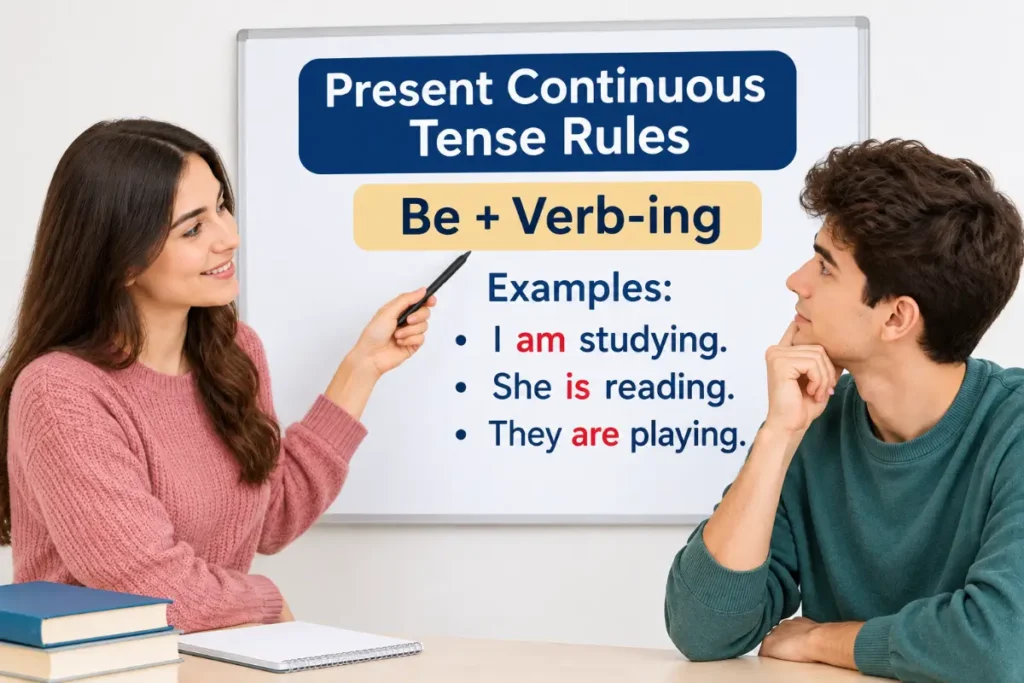
The present continuous tense rules come down to seven ideas: how the tense is formed, and six distinct situations where it belongs. The form is simple, a present form of be plus a verb ending in -ing, as in “She is reading” or “They are playing.” The harder part is knowing when to choose it over the simple present, and which verbs refuse it altogether.
This guide takes the rules one at a time with plenty of examples, then covers the practical details that trip people up: spelling the -ing form, negatives and questions, verbs like know and want that don’t take the continuous, and the difference between “I live” and “I’m living.” Some grammar books call this tense the present progressive. It’s the same tense with two names.
You may also find Mixed Conditionals Explained: 2026 Guide helpful if you want to explore this topic further.
Rule 1: Form It With Be + -ing
The Athabasca University Write Site notes that progressive tenses always use a form of be plus the main verb with an -ing ending. For the present, the form of be is am, is, or are.
| Subject | Form | Contraction |
|---|---|---|
| I | am working | I’m working |
| you | are working | you’re working |
| he / she / it | is working | he’s / she’s / it’s working |
| we | are working | we’re working |
| they | are working | they’re working |
The auxiliary has to agree with the subject, the same agreement logic covered in our guide to subject verb agreement rules. The main verb never changes form, so “She is walk” and “They are walks” are both wrong.

Rule 2: Use It for Actions Happening Right Now
The core use is describing something in progress at the moment of speaking. The Athabasca chart describes the present progressive as showing an action that is happening now, and it lists now, right now, this minute, and this week as common time clues.
- Look! It is snowing.
- She is talking on the phone right now.
- I am writing this sentence.
- The kids are playing in the yard at the moment.
Words like now, right now, at the moment, and currently often appear with it, and so do imperatives like Look! and Listen!
Rule 3: Use It for Temporary Situations Around Now
The action doesn’t have to be happening at the exact moment you speak. It can describe a temporary situation that covers a period around now.
- She is studying for her exams this week.
- I am staying with my cousin until I find an apartment.
- They are renovating their kitchen.
Compare the simple present, which describes something permanent or general: She studies law (her field), versus She is studying for her exams (this week’s activity). The continuous adds a sense that the situation is temporary and in progress.
Rule 4: Use It for Planned Future Arrangements
The present continuous also works for fixed plans in the near future, especially when a time expression makes the future clear.
- We are flying to Rome on Friday.
- I am meeting Sam for lunch tomorrow.
- She is starting her new job next week.
This is a plan that’s already been arranged, often with a specific person, place, or time. It’s different from will, which usually expresses a prediction or a spontaneous decision. Without the time expression, listeners would take the sentence as describing the present.
Rule 5: Use It for Changing and Developing Situations
The continuous is the natural choice for gradual change.
- The weather is getting colder every day.
- Prices are rising.
- Her English is improving quickly.
Verbs like get, become, grow, rise, improve, and change are especially common here.
Rule 6: Use It With Always for Repeated Annoyances
When the continuous is paired with always, constantly, or forever, it expresses a repeated action that annoys the speaker, or that is surprising.
- He is always losing his keys.
- She is constantly complaining about the weather.
Compare He always loses his keys, a neutral statement of habit. The continuous version adds a tone of irritation.
Rule 7: Don’t Use It With Stative Verbs
Stative verbs describe states, not actions, and most of them don’t take the continuous form. Common ones include:
- Mental states: know, understand, believe, remember, mean, doubt
- Feelings and preferences: like, love, hate, want, need, prefer
- Possession: own, belong, have (in the sense of “own”)
- Appearance and senses: seem, appear, hear, smell, taste (in the sense of “have a flavor”)
- Incorrect: I am knowing the answer.
- Correct: I know the answer.
- Incorrect: She is wanting a new phone.
- Correct: She wants a new phone.
Our guide to what is a linking verb covers verbs like seem, appear, and be that describe states rather than actions, which is why they usually stay out of the continuous.
Verbs That Work Both Ways
Some verbs have both a stative meaning and an active meaning, and only the active meaning takes the continuous.
| Stative (simple present) | Active (continuous) |
|---|---|
| I think it’s fair. (opinion) | I am thinking about the offer. (considering) |
| She has two cars. (owns) | She is having lunch. (eating) |
| The soup tastes salty. (has a flavor) | He is tasting the soup. (trying it) |
| The flowers smell lovely. (have a scent) | She is smelling the flowers. (sniffing) |
| He is silly. (a characteristic) | He is being silly today. (behaving that way for now) |
In informal speech, some stative verbs appear in the continuous for emphasis, as in “I’m loving this song,” but standard writing keeps them in the simple present.
Spelling the -ing Form
| Rule | Examples |
|---|---|
| Most verbs: add -ing | walk → walking, play → playing |
| Ends in silent -e: drop the e | make → making, write → writing |
| Ends in -ie: change to -y | lie → lying, die → dying |
| One syllable, one vowel + one consonant: double the consonant | run → running, sit → sitting, stop → stopping |
| Stress on the last syllable: double the consonant | begin → beginning, prefer → preferring |
| Stress not on the last syllable: don’t double | visit → visiting, open → opening |
| Don’t double w, x, or y | snow → snowing, fix → fixing, play → playing |
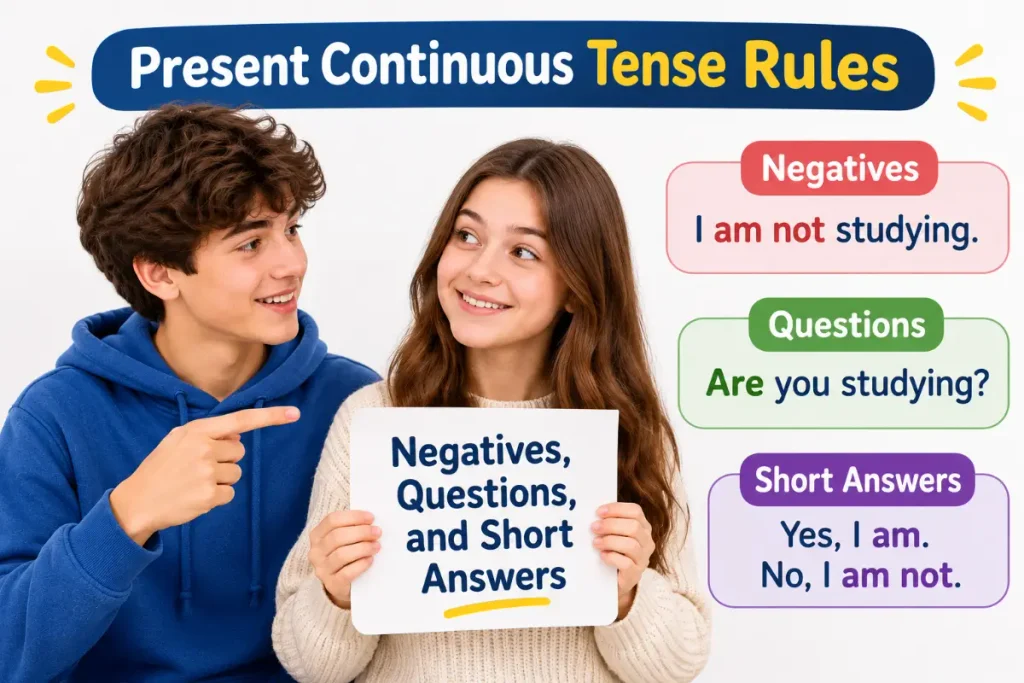
Negatives, Questions, and Short Answers
Negatives put not after the form of be.
- I am not working. / She isn’t working. / They aren’t working.
Questions invert be and the subject.
- Are you listening? Is it raining? What are they doing?
Short answers repeat the form of be.
- Are you working? Yes, I am. / No, I’m not.
Contractions such as it’s (it is) are easy to confuse with the possessive its, a mix-up explained in our guide to its vs it’s.
Present Continuous vs. Simple Present
The two tenses answer different questions. The simple present describes habits and facts, while the continuous describes action in progress.
| Simple Present | Present Continuous |
|---|---|
| She drinks coffee every morning. (habit) | She is drinking coffee now. (in progress) |
| I live in Chicago. (permanent) | I am living in Chicago this year. (temporary) |
| Water boils at 100°C. (fact) | The water is boiling. (happening now) |
The Athabasca chart reinforces the contrast through time clues. The simple present goes with words like every morning, every day, always, usually, frequently, and sometimes. The present progressive goes with now, right now, this week, and this minute.
Present Continuous Tense Examples in Everyday English
The present continuous tense becomes easier to understand when you see how people use it in everyday conversations. From describing what’s happening right now to talking about temporary situations and future plans, these examples show how the tense works in real life.
Examples of Present Continuous Tense in Daily Life
- At home: I am making breakfast right now.
- At work: She is preparing a presentation for tomorrow.
- At school: The students are learning a new grammar rule.
- On the phone: He is talking to his manager.
- While traveling: We are waiting for the bus.
- For future plans: They are visiting their grandparents this weekend.
- For temporary situations: I am staying with my friend this month.
- For changing situations: The days are getting shorter.
Present Continuous Tense Examples With Different Subjects
The form of the present continuous changes depending on the subject. Use am with I, is with singular third-person subjects, and are with you, we, they, and plural subjects.
| Subject | Example |
|---|---|
| I | I am reading a book. |
| You | You are learning English. |
| He | He is playing soccer. |
| She | She is writing an email. |
| It | It is raining outside. |
| We | We are watching a movie. |
| They | They are working together. |
These examples demonstrate the basic structure: subject + am/is/are + verb-ing. Once you understand this pattern, you can form present continuous sentences with almost any subject.
Present Continuous Tense Formula for Affirmative, Negative, and Interrogative Sentences
The present continuous tense follows a consistent formula, but the word order changes when you make a negative sentence or ask a question. Understanding these three sentence structures helps you use the tense correctly in both writing and conversation.
Affirmative Sentence Formula
Subject + am/is/are + verb-ing + rest of the sentence
Examples:
- I am learning English.
- She is cooking dinner.
- They are playing outside.
Negative Sentence Formula
Subject + am/is/are + not + verb-ing + rest of the sentence
Examples:
- I am not working today.
- He is not watching television.
- They are not coming to the party.
In everyday English, contractions are common:
- is not → isn’t
- are not → aren’t
- I am → I’m
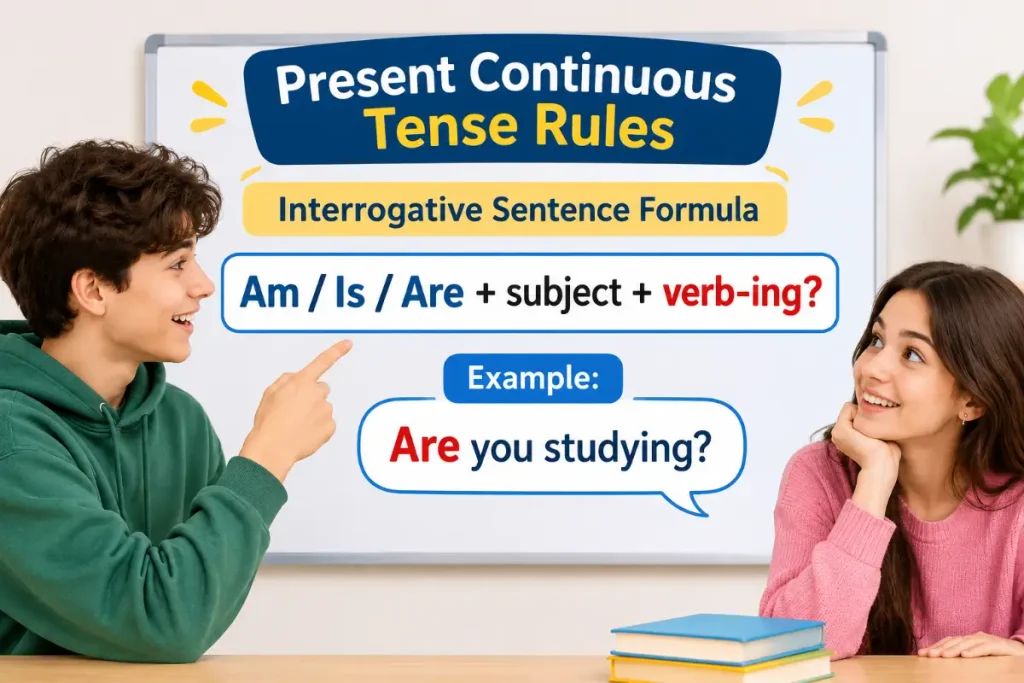
Interrogative Sentence Formula
Am/Is/Are + subject + verb-ing + rest of the sentence?
Examples:
- Are you studying?
- Is she coming today?
- Am I speaking too quickly?
- Are they waiting outside?
For questions beginning with a question word, place the question word before the auxiliary verb:
- What are you doing?
- Where is he going?
- Why are they laughing?
- When are we leaving?
The key difference is word order. Affirmative sentences begin with the subject, negative sentences add not after the auxiliary, and questions place the auxiliary before the subject.
Present Continuous Tense vs. Present Progressive: Is There a Difference?
The present continuous tense and the present progressive tense are two names for the same grammatical structure. Both describe actions or situations that are in progress, temporary, changing, or arranged for the future.
For example:
- She is studying for her exam.
- She is studying for her exam.
Both sentences use the same tense and follow the same grammatical rules. There is no difference in meaning between the terms present continuous and present progressive.
The difference is mainly a matter of terminology. Some grammar books and English-learning resources prefer “present continuous,” while others use “present progressive.”
Both names refer to the same formula:
Subject + am/is/are + verb-ing
| Present Continuous | Present Progressive |
|---|---|
| I am working. | I am working. |
| She is sleeping. | She is sleeping. |
| They are studying. | They are studying. |
| We are traveling tomorrow. | We are traveling tomorrow. |
Whether you call it the present continuous or present progressive, the formation, usage, spelling rules, and common mistakes remain exactly the same.
Quick Reference Table
| Rule | Use | Example |
|---|---|---|
| 1 | Form: am/is/are + -ing | She is working. |
| 2 | Action happening now | It is snowing. |
| 3 | Temporary situation | I’m staying with a friend. |
| 4 | Planned future | We’re flying on Friday. |
| 5 | Changing situation | Prices are rising. |
| 6 | Annoying repeated habit | He’s always losing his keys. |
| 7 | Not with stative verbs | I know the answer. |
Common Mistakes People Make
- Mistake 1: Using a stative verb in the continuous, as in “I am knowing” or “she is wanting.”
- Mistake 2: Leaving out the auxiliary, as in “She working now,” instead of “She is working now.”
- Mistake 3: Using the base verb after be, as in “They are play,” instead of “They are playing.”
- Mistake 4: Using the simple present for something happening right now, as in “Look! It snows,” instead of “It’s snowing.”
- Mistake 5: Misspelling the -ing form, such as “runing,” “writeing,” or “lieing.”
- Mistake 6: Using the continuous for a permanent fact, as in “The sun is rising in the east,” instead of “The sun rises in the east.”
Practice Exercise
Complete each sentence, choose the correct form, or follow the instruction. Answers are listed right after, so try each one before checking.
- Look! It (snow) outside.
- She (study) for her exam this week.
- They (not/watch) TV right now.
- (you/listen) to me?
- I (meet) Sam for lunch tomorrow.
- He (always/lose) his keys.
- Choose: I (know/am knowing) the answer.
- Choose: She (has/is having) a shower right now.
- The weather (get) colder every day.
- We (not/work) today because it’s a holiday.
- Spell the -ing form of run.
- Spell the -ing form of make.
- Spell the -ing form of lie.
- Spell the -ing form of begin.
- Spell the -ing form of play.
- Fix: She is wanting a new phone.
- Fix: They are play football now.
- Fix: I am go to the gym tomorrow.
- Choose: He (is being/is) rude to everyone today.
- Choose: What (do you do/are you doing) right now?
Answer Key
- is snowing
- is studying
- aren’t watching (or are not watching)
- Are you listening
- am meeting
- is always losing
- know (“know” is stative)
- is having (active meaning: taking a shower)
- is getting
- aren’t working (or are not working)
- running
- making
- lying
- beginning
- playing
- She wants a new phone.
- They are playing football now.
- I am going to the gym tomorrow.
- is being (temporary behavior)
- are you doing (in progress right now)
Frequently Asked Questions
Is the present continuous the same as the present progressive?
Yes. They’re two names for the same tense. The Athabasca University Write Site uses “progressive,” while many textbooks say “continuous.”
Can I use the present continuous to talk about the future?
Yes, for plans that have already been arranged, especially with a time expression: “We’re flying to Rome on Friday.” For predictions or spontaneous decisions, use will instead.
For another useful perspective, check out Reported Speech Tense Changes: The Complete Backshift Guide (2026).
Why can’t I say “I am knowing” or “I am wanting”?
Know and want are stative verbs, which describe states rather than actions in progress. They stay in the simple present: “I know,” “I want.”
What’s the difference between “I live in London” and “I’m living in London”?
The simple present suggests a permanent or general situation. The continuous suggests it’s temporary or recent: you’re living there for now.
What’s the fastest way to decide between the simple present and the present continuous?
Ask whether you’re describing a habit or fact (simple present) or something in progress or temporary (present continuous). Time words like every day point to the simple present, and now and this week point to the continuous.
Before moving on, you may also want to read Present Perfect vs Past Simple: 9 Key Differences (2026 Guide) for more helpful grammar tips.
The Short Version
Learning the present continuous tense rules starts with the form, am/is/are plus an -ing verb, and then picks up six uses: actions happening now, temporary situations, planned future arrangements, changing situations, and annoying repeated habits with always. The seventh rule is the exception that matters most: stative verbs like know, want, and like don’t take the continuous.
The details to keep handy are the spelling rules for the -ing form and the contrast with the simple present. If you can tell habit from action in progress, you’ll choose the right tense almost every time, and the verbs that work both ways, like think and have, come down to whether the meaning is a state or an action.