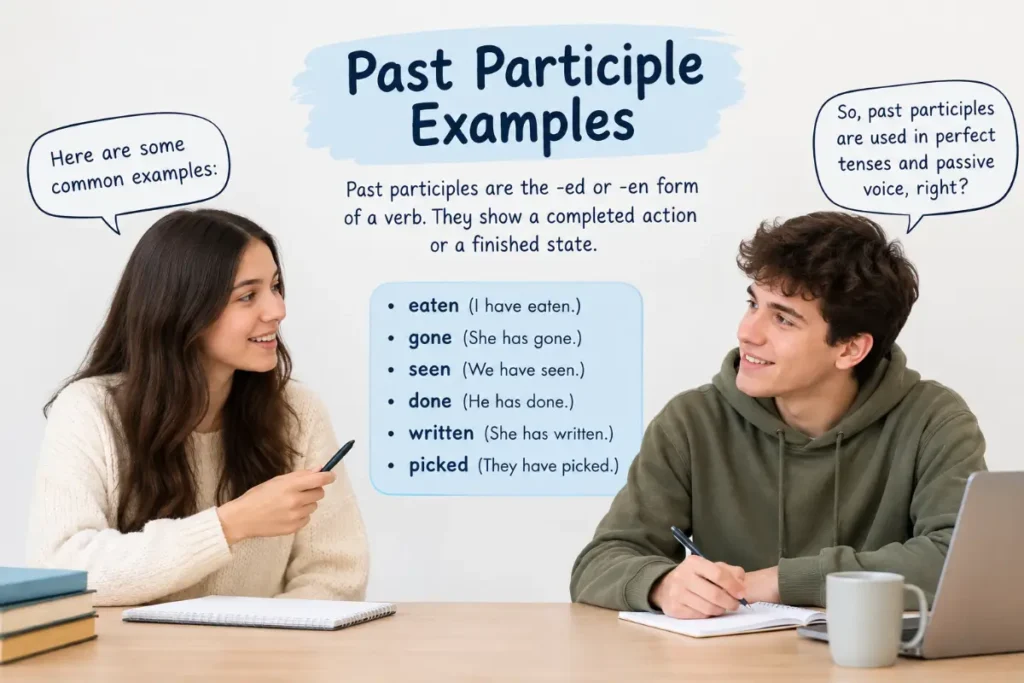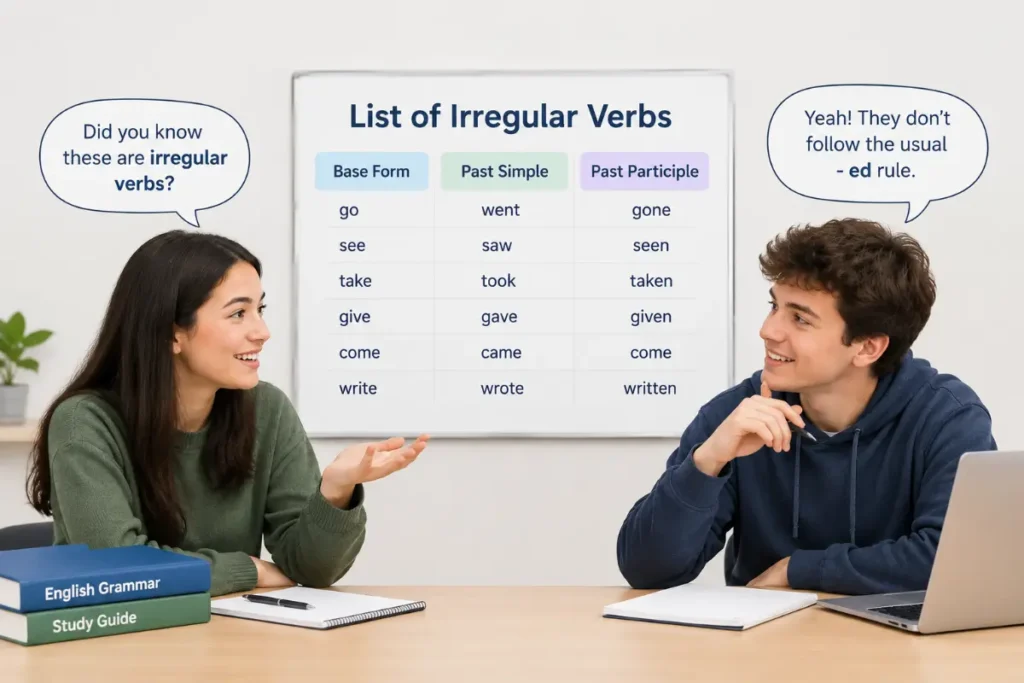
This list of irregular verbs gives you the past and past participle forms of more than ninety of the most common English verbs, grouped by pattern instead of the alphabet. Irregular verbs are the ones that don’t add -ed to form the past: we say “she wrote” and “he has gone,” never “she writed” or “he has goed.”
Sorting the verbs by pattern makes them much easier to learn. Some stay the same in all three forms, some share a past and a participle, and some change every time. Along the way, this guide covers when to use each form, the spelling variants that differ between American and British English, and the mistakes that show up most often in everyday writing.
You may also find Sequence of Tenses Rules: 8 Key Rules To Master It in 2026 helpful if you want to explore this topic further.
How to Read the Tables
Every verb has three forms that matter.
- Base form: the dictionary form (write)
- Simple past: used for finished actions (She wrote a letter.)
- Past participle: used with have/has/had and with be (She has written a letter. The letter was written yesterday.)
The past participle can also work as an adjective, as in “a broken window” or “the written word,” which connects to our guide to what is a participial phrase. And the choice between the simple past and the participle after have is exactly what’s at stake in present perfect vs past simple.
The forms below match standard lists such as the Gallaudet University English Center’s irregular verb list, which also notes accepted variants like dived/dove and dreamed/dreamt.
Group 1: All Three Forms Are the Same
These are the easiest irregular verbs because nothing changes. Many end in -t or -d.
| Base | Past | Past Participle |
|---|---|---|
| bet | bet | bet |
| broadcast | broadcast | broadcast |
| burst | burst | burst |
| cast | cast | cast |
| cost | cost | cost |
| cut | cut | cut |
| hit | hit | hit |
| hurt | hurt | hurt |
| let | let | let |
| put | put | put |
| quit | quit | quit |
| read | read | read |
| set | set | set |
| shut | shut | shut |
| spread | spread | spread |
| split | split | split |
Read looks identical in all three forms, but the pronunciation changes: “reed” in the base form and “red” in the past and participle.
- Yesterday I put the keys on the table.
- We have cut costs this year.
Group 2: The Past and the Participle Match
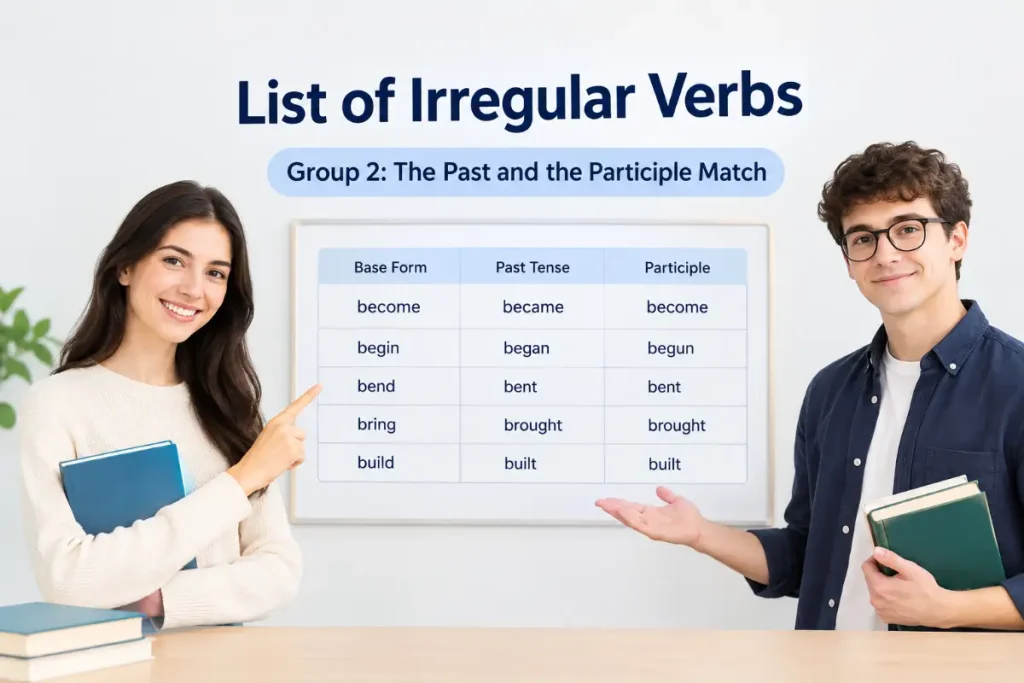
Here the base form is different, but the past and the participle are the same. If you can remember the past form, you already know the participle.
| Base | Past | Past Participle |
|---|---|---|
| bend | bent | bent |
| bring | brought | brought |
| build | built | built |
| buy | bought | bought |
| catch | caught | caught |
| creep | crept | crept |
| deal | dealt | dealt |
| dig | dug | dug |
| feed | fed | fed |
| feel | felt | felt |
| fight | fought | fought |
| find | found | found |
| hang (objects) | hung | hung |
| hear | heard | heard |
| hold | held | held |
| keep | kept | kept |
| lay | laid | laid |
| lead | led | led |
| leave | left | left |
| lend | lent | lent |
| lose | lost | lost |
| make | made | made |
| mean | meant | meant |
| meet | met | met |
| pay | paid | paid |
| say | said | said |
| sell | sold | sold |
| send | sent | sent |
| sit | sat | sat |
| sleep | slept | slept |
| spend | spent | spent |
| stand | stood | stood |
| teach | taught | taught |
| tell | told | told |
| think | thought | thought |
| understand | understood | understood |
| win | won | won |
- She bought a car last week.
- She has bought a car.
- He taught history for ten years.
Group 3: All Three Forms Are Different
These are the verbs that cause the most mistakes, because the simple past and the participle look nothing alike. Learn them as a set of three.
| Base | Past | Past Participle |
|---|---|---|
| be | was/were | been |
| begin | began | begun |
| bite | bit | bitten |
| blow | blew | blown |
| break | broke | broken |
| choose | chose | chosen |
| do | did | done |
| draw | drew | drawn |
| drink | drank | drunk |
| drive | drove | driven |
| eat | ate | eaten |
| fall | fell | fallen |
| fly | flew | flown |
| forbid | forbade | forbidden |
| forget | forgot | forgotten |
| forgive | forgave | forgiven |
| freeze | froze | frozen |
| give | gave | given |
| go | went | gone |
| grow | grew | grown |
| hide | hid | hidden |
| know | knew | known |
| lie (recline) | lay | lain |
| ride | rode | ridden |
| ring | rang | rung |
| rise | rose | risen |
| see | saw | seen |
| shake | shook | shaken |
| sing | sang | sung |
| speak | spoke | spoken |
| steal | stole | stolen |
| swear | swore | sworn |
| swim | swam | swum |
| take | took | taken |
| tear | tore | torn |
| throw | threw | thrown |
| wake | woke | woken |
| wear | wore | worn |
| write | wrote | written |
- She broke the vase. (simple past)
- She has broken the vase. (participle)
- They sang at the concert. / They have sung together for years.
Group 4: The Base Form and the Participle Match
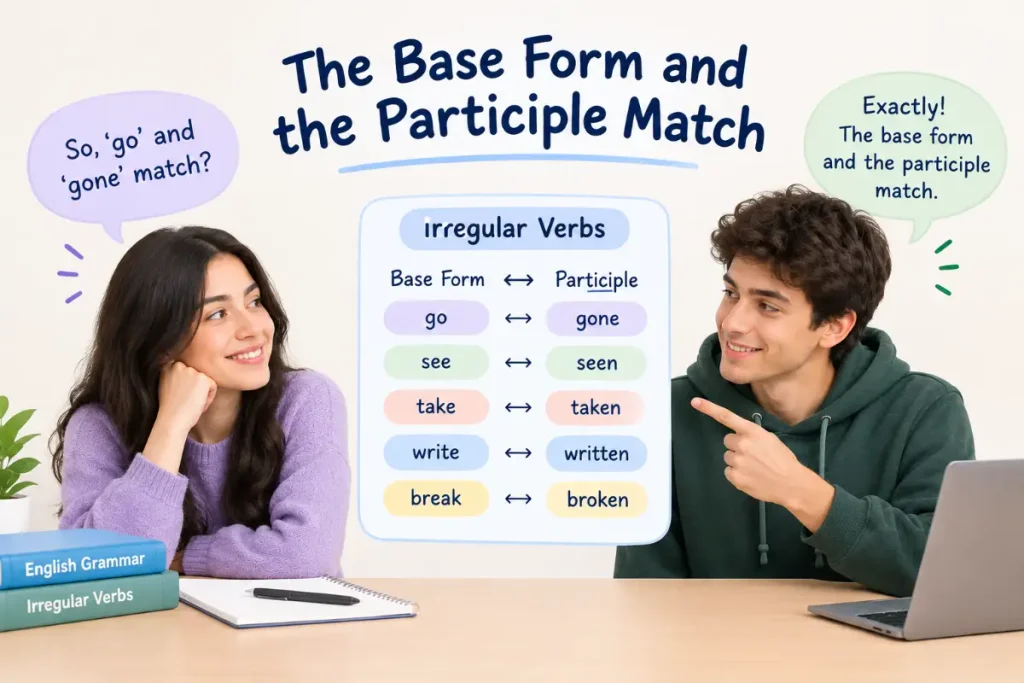
A small group repeats the base form as the participle.
| Base | Past | Past Participle |
|---|---|---|
| become | became | become |
| come | came | come |
| run | ran | run |
- The weather became colder.
- The weather has become colder.
- He ran a mile. / He has run a mile.
Verbs With Accepted Variants
Some verbs have two correct forms, and the choice often depends on region or meaning.
| Base | Past | Past Participle | Note |
|---|---|---|---|
| get | got | got / gotten | American English usually uses gotten; British English uses got |
| dive | dived / dove | dived | Dove is common in American English |
| dream | dreamed / dreamt | dreamed / dreamt | Dreamt is more British |
| burn | burned / burnt | burned / burnt | Burnt is more British |
| learn | learned / learnt | learned / learnt | Learnt is more British |
| spell | spelled / spelt | spelled / spelt | Spelt is more British |
| prove | proved | proved / proven | Proven is common as an adjective |
| show | showed | showed / shown | both are accepted |
| light | lit / lighted | lit / lighted | lit is more common |
Hang has an extra wrinkle. For objects, the forms are hung, hung (“She hung the picture”). For executions, the traditional forms are hanged, hanged (“The prisoner was hanged”). The distinction is worth knowing in formal writing.
Memory Patterns That Make the List Easier
Many irregular verbs follow recognizable sound patterns.
- -ought / -aught: bring, buy, catch, fight, teach, think → brought, bought, caught, fought, taught, thought
- i – a – u: begin, drink, ring, sing, swim → began/begun, drank/drunk, rang/rung, sang/sung, swam/swum
- -ew / -own: blow, fly, grow, know, throw → blew/blown, flew/flown, grew/grown, knew/known, threw/thrown
- -oke / -oken: break, speak, wake → broke/broken, spoke/spoken, woke/woken
- -ave / -iven: give, forgive → gave/given, forgave/forgiven
- -ose / -osen: choose, freeze (and rise → rose/risen) → chose/chosen, froze/frozen
Learning these clusters turns a list of dozens of verbs into a handful of patterns.
Verbs That Look Alike and Behave Differently
Three pairs of verbs cause constant confusion because one needs an object and the other doesn’t.
| No object | Needs an object |
|---|---|
| lie, lay, lain | lay, laid, laid |
| sit, sat, sat | set, set, set |
| rise, rose, risen | raise, raised, raised |
The lie/lay pair is the trickiest because the past tense of lie is lay, a collision explained in our guide to lie vs lay vs laid.
Quick Reference: The Four Patterns
| Pattern | Examples |
|---|---|
| All three the same | cut, put, hit, set |
| Past = participle | bring/brought/brought, make/made/made |
| All three different | go/went/gone, write/wrote/written |
| Base = participle | come/came/come, run/ran/run |
Common Mistakes People Make
- Mistake 1: Using the simple past instead of the participle after have, as in “I have went,” “she has wrote,” or “they have ate.”
- Mistake 2: Using the participle instead of the simple past, as in “I seen it” or “he done it.”
- Mistake 3: Adding -ed to an irregular verb, as in “bringed,” “buyed,” “teached,” or “thinked.”
- Mistake 4: Mixing up the i–a–u verbs: “she has sang” instead of “has sung,” “he has swam” instead of “has swum,” “the bell has rang” instead of “has rung.”
- Mistake 5: Using “drank” as a participle, as in “I have drank all the water,” instead of “I have drunk.”
- Mistake 6: Using the wrong verb in the lie/lay and sit/set pairs.
Practice Exercise
Write the correct simple past or past participle form of the verb in parentheses. Answers are listed right after, so try each one before checking.
- She has already (write) the report.
- They (go) to Paris last year.
- He has (break) his phone.
- We (see) that movie yesterday.
- I have (eat) breakfast.
- The bird (fly) away.
- She has (choose) a new color.
- He (take) the bus to work.
- They have (begin) the project.
- I (forget) her name.
- The lake has (freeze).
- She has (teach) math for ten years.
- We (buy) tickets yesterday.
- He has (run) five miles.
- The class (begin) at nine.
- They have (drink) all the juice.
- She (wear) her blue dress.
- I have (know) him since 2015.
- The vase (fall) off the shelf.
- He has (give) us a gift.
Answer Key
- written
- went
- broken
- saw
- eaten
- flew
- chosen
- took
- begun
- forgot
- frozen
- taught
- bought
- run
- began
- drunk
- wore
- known
- fell
- given
Frequently Asked Questions
Why are some English verbs irregular?
Many irregular verbs are among the oldest and most frequently used words in the language, and they kept older forms rather than adopting the -ed pattern. Their forms were passed down through speech, which is why they follow patterns but don’t follow one single rule.
How many irregular verbs are there?
The count varies depending on whether you include rare verbs, prefixed forms like “understand” and “withstand,” and variants. Most lists for everyday use cover roughly one hundred of the most common ones, which is why a pattern-based list like this one works well for learning.
For another useful perspective, check out Use Will vs Going To: Simple Guide (2026).
Is “gotten” correct?
Yes. Gotten is the standard American English participle of get, while British English uses got. Both are correct in their regions.
Is it “dived” or “dove”?
Both are accepted. Dove is common in American English, while dived is standard in British English and works everywhere.
What’s the best way to learn irregular verbs?
Learn them by pattern rather than alphabetically, practice in full sentences, and review the participle forms especially, since the participle is the form most often used incorrectly after have and has.
Before moving on, you may also want to read Reported Speech Tense Changes: The Complete Backshift Guide (2026) for more helpful grammar tips.
How to Learn the List
Keep this list of irregular verbs as a reference, but study it by pattern: the verbs that never change, the ones where the past and participle match, the ones where every form is different, and the small group that repeats the base form. Focus first on the third group, since go/went/gone and write/wrote/written are where most real-world errors happen.
Once you know which form belongs where, the rules are short: use the past form for finished actions, and use the participle after have, has, had, and be. With practice, the forms start to sound right, which is the surest sign you’ve learned them.