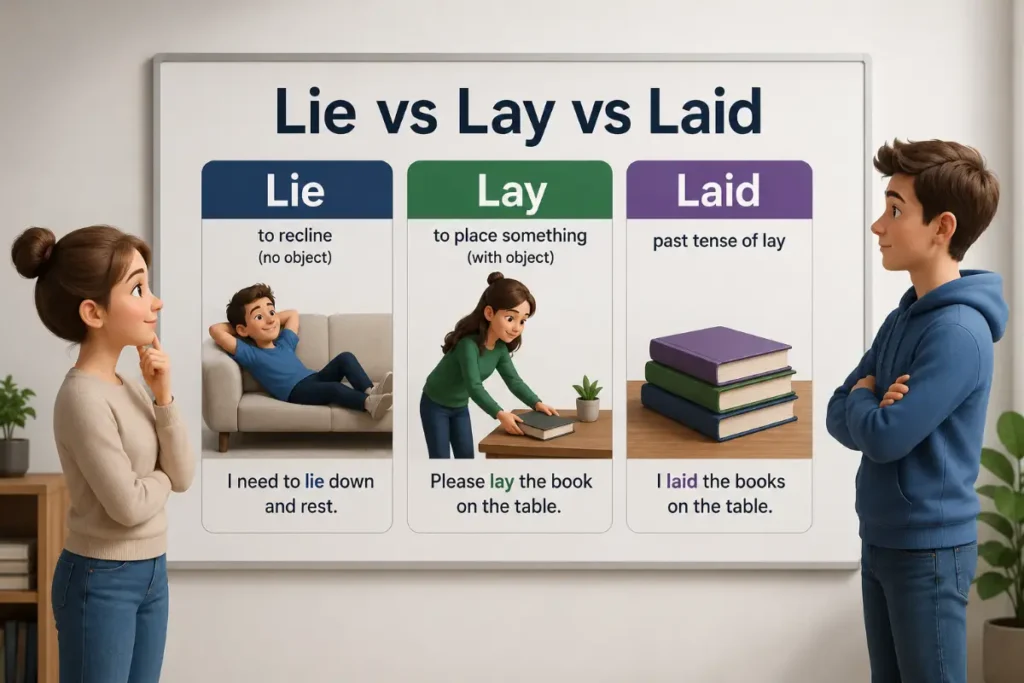
If you’ve got the present tense of Lie vs Lay vs Laid under control but still freeze up when you need the past tense, you’re not alone. This guide focuses on the tricky distinctions that trip up even people who know the basic rule.
Quick refresher: lay needs an object (you lay something down); lie doesn’t (you simply lie down). For the fuller present-tense breakdown, our full lay vs. lie guide covers that foundation in depth. Here, we’re going straight at the specific place where things get genuinely confusing: the past tense.
You may also find Good vs Well: Why “I Feel Good” Isn’t Actually Wrong in 2026 helpful if you want to explore this topic further.
The Quick Answer
- Lay → laid (past tense of lay, placing something down)
- She laid the blanket on the bed.
- Lie → lay (past tense of lie, reclining)
- I lay in bed all morning yesterday.
- Lie → lain (past participle of lie, used with has/have/had)
- He has lain awake for hours.
The single most important thing to notice: the past tense of “lie” is the word “lay.” That’s not a typo, and it’s not a mistake — it’s the exact reason this pair has confused English speakers for centuries. The word “lay” is doing double duty: it’s the present tense of one verb (placing something) and the past tense of a completely different verb (reclining).
Why the Past Tense Is Genuinely the Hard Part
Present tense is actually fairly intuitive once you know the object test: “lay” needs something being placed, “lie” doesn’t. Most people get that right without much trouble.
The past tense is where the wheels come off, because of this collision:
- Lay (present) → laid (past)
- Lie (present) → lay (past)
Notice that “lay” appears in both rows — once as a present tense verb, once as a past tense verb, meaning two completely different things depending on which row it’s in. This is exactly why “I lay down yesterday” is correct, even though it looks like it should be the present tense verb “lay” (which would need an object). It isn’t — it’s the past tense of “lie,” and there’s no object because you’re describing yourself reclining, not placing anything.
Merriam-Webster confirms this history directly, noting that the informal use of “lay” to mean “lie down” (as in “I’m going to lay down”) has actually been documented since the 14th century — meaning this isn’t a modern error at all, but a genuinely old and persistent overlap in the language itself.
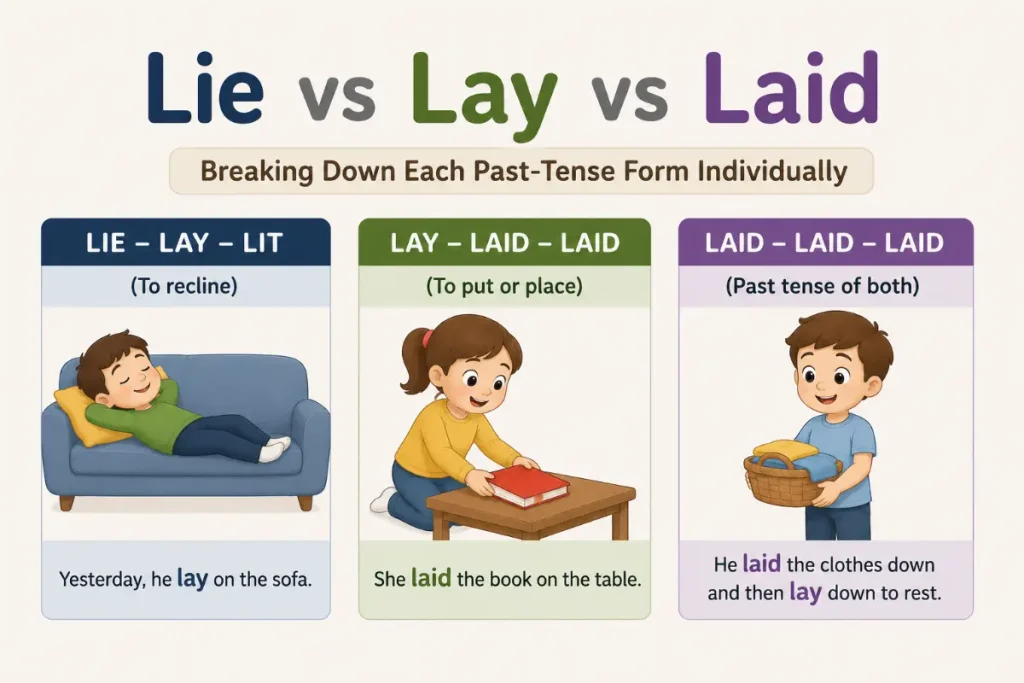
Breaking Down Each Past-Tense Form Individually
“Laid” — past tense and past participle of “lay” (placing something)
- She laid her keys on the counter.
- He laid the foundation for the new building.
- They had laid out the plans before the meeting even started.
- The hen laid three eggs this week.
In every one of these, something specific is being placed — keys, a foundation, plans, eggs. That’s your signal you’re in “lay” territory, and both the simple past and the past participle use the same form: laid.
“Lay” — past tense of “lie” (reclining, no object)
- I lay awake most of the night.
- The dog lay by the fireplace for hours.
- She lay in the grass, watching the clouds.
- He lay motionless after the fall.
In every one of these, nothing is being placed — the subject itself is simply in a reclining or resting position. This is the trickiest form in the entire lay/lie system, precisely because it uses the same spelling as the present-tense placing verb.
“Lain” — past participle of “lie” (used with has, have, had)
- The papers have lain untouched on his desk for weeks.
- She had lain awake worrying about the interview.
- The cat has lain in that same spot all afternoon.
- He has lain in that hospital bed since the accident.
Lain only appears alongside a helping verb — has, have, or had. You’ll never see “lain” standing alone as a simple past-tense verb the way “lay” and “laid” can.
The Fastest Way to Check Yourself in the Past Tense
Step 1: Ask what tense you actually need. Simple past, or past participle (with has/have/had)?
Step 2: Ask whether something is being placed. If yes, and you’re in simple past or past participle, the answer is always “laid” — this form doesn’t change between the two.
Step 3: If nothing is being placed and you’re in simple past, the answer is “lay.” If nothing is being placed and you’re using a helping verb (has/have/had), the answer is “lain.”
A trick that helps specifically with this past-tense confusion: read the sentence and ask “could a rooster do this?” A rooster can’t lay an egg (that requires a hen placing something), but a rooster absolutely can lay down for a nap yesterday — meaning “lay” used without an object, describing rest, is grammatically valid even though it sounds like it should need one.
This kind of “same word, two completely different jobs” collision is rare in English, but it shows up in a milder form with good and well too — where the correct choice depends less on spelling and more on exactly what role the word is playing in that specific sentence.
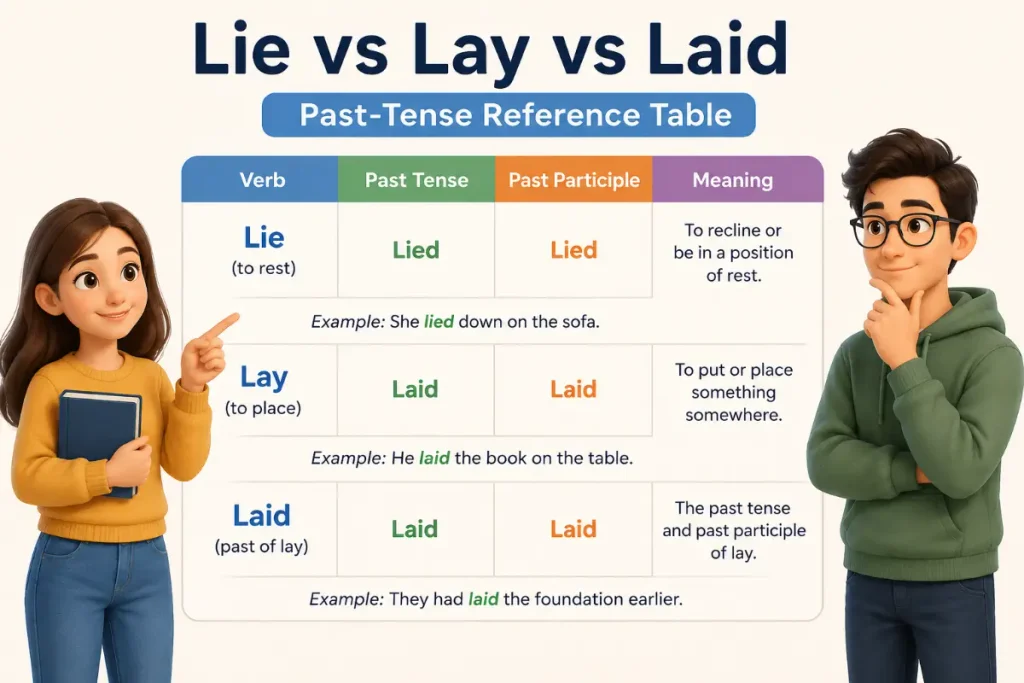
Past-Tense Reference Table
Use this quick Lie vs Lay vs Laid reference table to see how each verb works in the past tense. The examples make these commonly confused forms easier to understand and use correctly.
| Base Verb | Meaning | Present | Simple Past | Past Participle |
|---|---|---|---|---|
| Lay | To place something | lay | laid | laid |
| Lie | To recline | lie | lay | lain |
The row worth memorizing above anything else: lie’s past tense is lay. Everything else about this pair follows more predictably once that one specific fact is locked in.
Common Past-Tense Mistakes People Make
Mistake 1: “Yesterday I laid in bed all day.” This should be “I lay in bed all day” — nothing is being placed; you’re describing yourself reclining, which needs the past tense of “lie,” not “lay.”
Mistake 2: “She has laid there for hours, unable to sleep.” Should be “she has lain there for hours” — this is the past participle of “lie” (reclining), paired with the helping verb “has,” so it needs “lain,” not “laid.”
For another useful perspective, check out Loose vs Lose: The Missing-Letter Trick That Fixes This Forever (2026).
Mistake 3: “The dog laid by the door all afternoon.” Should be “the dog lay by the door” — the dog isn’t placing anything, it’s simply resting there, so this needs the past tense of “lie.”
Mistake 4: “He lay the tools down before leaving.” Should be “he laid the tools down” — tools are being placed, an object is present, so this needs the past tense of “lay,” which is “laid.”
Mistake 5: Defaulting to “laid” for everything in the past tense. Because “laid” sounds like a more “normal” past-tense verb, many writers reach for it automatically, even in sentences that actually call for “lay” (the past tense of “lie”). This is genuinely the single most common error pattern with this entire word family.
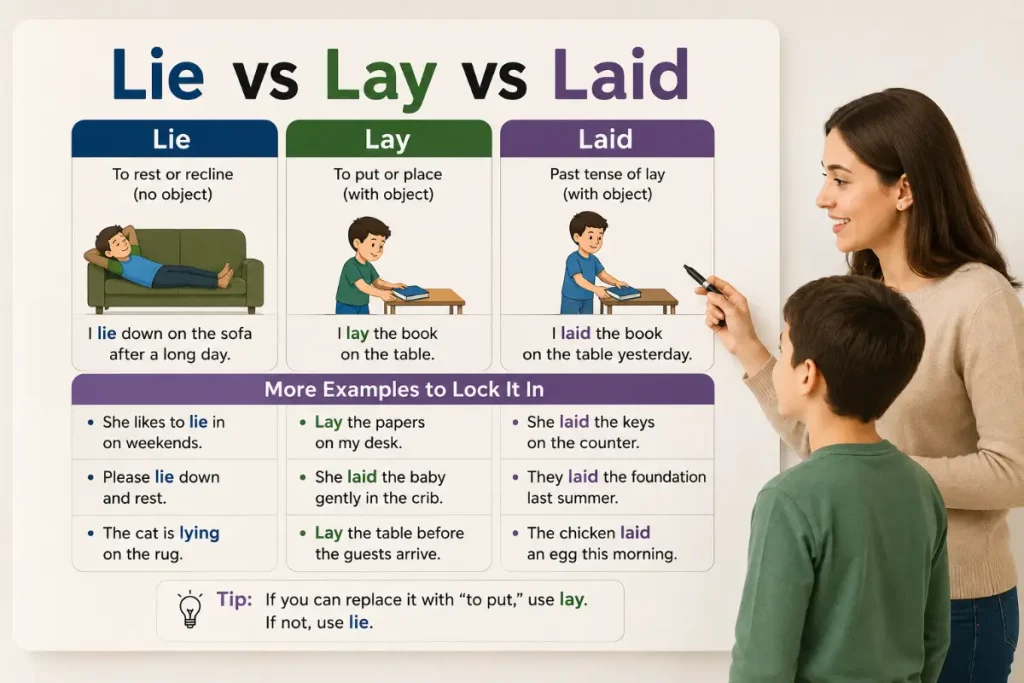
More Examples to Lock It In
- She laid the baby down gently, and he lay there peacefully until morning.
- The workers had laid the new flooring by the time the rug had lain untouched in storage for a decade.
- He lay awake replaying the conversation, wishing he had laid out his concerns more clearly earlier.
- The cat has lain on that windowsill every day since we laid the new cushion there.
- They laid the wreath at the memorial while the crowd lay flowers of their own nearby.
Frequently Asked Questions
Why does “lie” borrow “lay” as its past tense instead of having its own distinct form?
This is a quirk of how English verb tenses evolved from older Germanic language patterns rather than a deliberate design choice — “lie” and “lay” happened to end up with overlapping forms as the language changed over centuries, which is exactly why this collision has confused speakers for hundreds of years rather than resolving itself the way some other usage debates eventually do.
Is it ever correct to say “laid down” without an object?
Only if “down” is functioning to describe the position something was placed into, with the object stated elsewhere in the sentence or clearly implied (“she laid it down”). If you’re describing a person or animal reclining with nothing being placed, “lay down” (not “laid down”) is what the sentence needs in the past tense.
How can I remember that “lain” always needs a helping verb?
Think of “lain” as needing a partner — it never appears alone as a simple past-tense verb the way “lay” and “laid” can. If you’re not using “has,” “have,” or “had” somewhere nearby, you probably don’t need “lain” at all.
Does this past-tense confusion happen in British English too?
Yes — the lay/lie/laid/lain system works identically in American and British English, and the informal slide toward using “lay” for reclining happens in both dialects, with both maintaining the same formal distinction in edited, careful writing.
What’s the fastest way to catch this error before publishing something?
Search your document for “laid,” “lay,” and “lain,” and for each one, ask: is something being placed (lay family, always “laid” in the past), or is the subject simply reclining (lie family, “lay” in simple past, “lain” with a helping verb)? Since spell-check won’t catch a wrong-but-valid word here, this manual check is the only reliable method.
Is there a quick way to tell if a sentence needs “lay” the present-tense verb or “lay” the past-tense form?
Context almost always makes this clear once you’re looking for it: present-tense “lay” appears with a present-tense subject doing the placing right now (“I lay the papers down every morning”), while past-tense “lay” (from “lie”) describes a completed state of reclining in the past (“I lay awake all night yesterday”). If the sentence includes a past-time marker like “yesterday,” “last night,” or “an hour ago,” and nothing is being placed, you’re almost certainly looking at the past tense of “lie.”
Practice Exercise
Fill in the blank with the correct past-tense form: “laid,” “lay,” or “lain.” Answers are listed right after — try each one before checking.
- She ______ the documents on the desk this morning.
- I ______ awake for hours last night.
- The dog has ______ by the door since noon.
- He ______ the foundation for the shed last summer.
- The papers have ______ untouched for a week.
- She ______ in the sun until she got too hot.
- They ______ the new carpet before the guests arrived.
- He had ______ in bed all morning before finally getting up.
- The hen ______ two eggs yesterday.
- The cat has ______ on that chair all day.
- We ______ the blanket over the sleeping baby.
- She ______ there quietly until the storm passed.
- He has ______ awake worrying about the exam.
- They ______ the wreath at the base of the memorial.
- The book has ______ open on that page for days.
- I ______ down for a nap and didn’t wake up for two hours.
- The workers ______ the pipes before the deadline.
- She had ______ in the hospital bed for a week before recovering.
- He ______ his phone on the table and walked away.
- The soldiers ______ down their weapons at the ceremony.
Answer Key
- laid
- lay
- lain
- laid
- lain
- lay
- laid
- lain
- laid
- lain
- laid
- lay
- lain
- laid
- lain
- lay
- laid
- lain
- laid
- laid
If you got sixteen or more correct, you’ve genuinely mastered the hardest part of this entire word family — the past tense is where even experienced writers slow down and double-check. For any you missed, go back to the reference table and re-run the “is something being placed?” test.
Before moving on, you may also want to read Elicit vs Illicit: Same Sound, Completely Unrelated Meanings (2026) for more helpful grammar tips.
The Bottom Line
The present tense of lay and lie is fairly intuitive once you know the object test. The past tense is where it gets genuinely hard, because lie’s past tense happens to be the word “lay” — colliding directly with lay’s own present tense. Keep the reference table close by, and remember: laid always involves placing something, lay (past tense) and lain both describe reclining, with lain reserved specifically for use alongside has, have, or had.
The present tense of Lie vs Lay vs Laid becomes much easier once you know the object test. The real confusion starts with the past tense, because lie becomes lay, while lay becomes laid. Keep the reference table handy, and remember: laid always involves placing something, while lay can describe reclining in the past and lain follows has, have, or had.