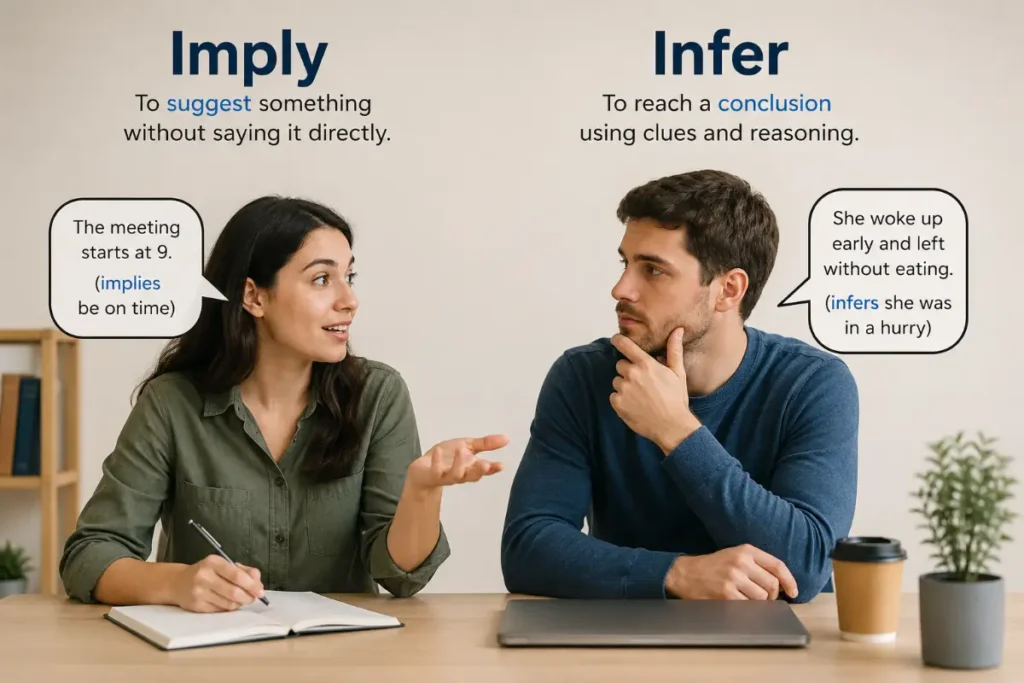
Here’s the cleanest way to think about Imply vs Infer, and it resolves the confusion almost every time: the speaker implies, while the listener infers. One person plants a suggestion; the other picks up on it. Once that direction clicks, this genuinely tricky pair becomes much easier to understand and use correctly.
Imply means to suggest something indirectly, without stating it outright. Infer means to draw a conclusion based on evidence or suggestion. Imply is what you do when you’re communicating; infer is what someone else does when they’re interpreting.
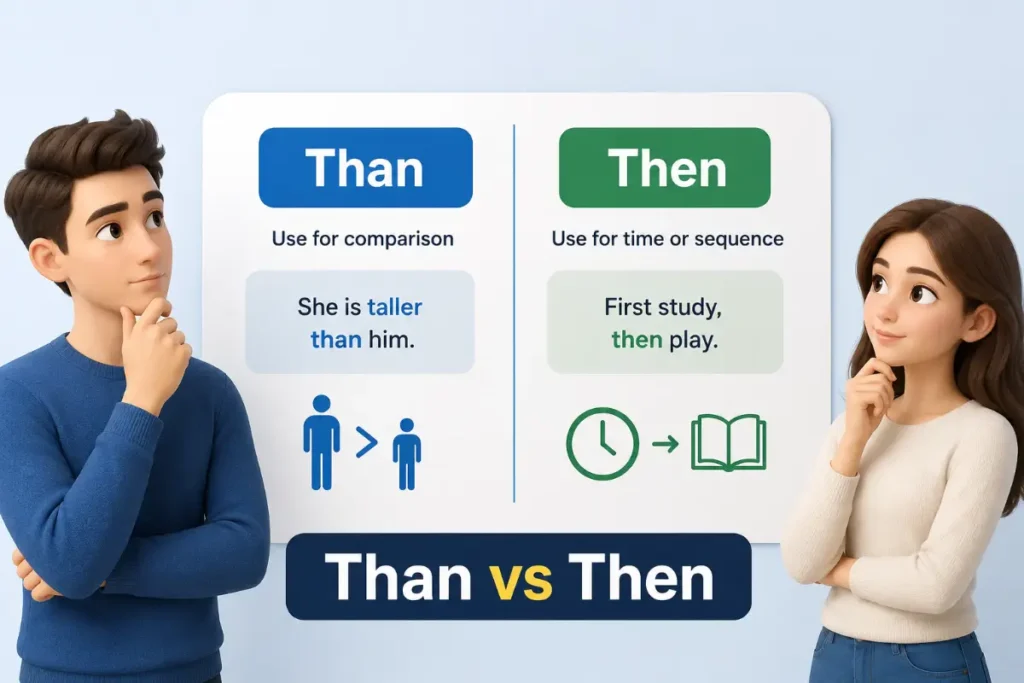
You may also find Than vs Then: The Simple Rule That Ends the Confusion (2026) helpful if you want to explore this topic further.
The Quick Answer
- Imply = to suggest something without saying it directly
- Her tone implied she wasn’t happy with the decision.
- Infer = to draw a conclusion based on evidence or hints
- I inferred from her tone that she wasn’t happy.
The test: are you the one hinting at something, or are you the one picking up on someone else’s hint? If you’re the source, sending the suggestion, use imply. If you’re the receiver, drawing a conclusion from what you observed, use infer.
Try it: “His silence seemed to ___ that he disagreed.” Is silence sending a message, or receiving one? Sending — so it’s imply: “His silence seemed to imply that he disagreed.”
Now try: “From his silence, I ___ that he disagreed.” Is this drawing a conclusion from evidence? Yes — so it’s infer: “From his silence, I inferred that he disagreed.”
Why This Pair Causes Genuine, Long-Running Debate
This isn’t just a matter of people forgetting a simple rule — Merriam-Webster states plainly that “the meanings of infer and imply have overlapped since the 16th century, making the need for a distinction a matter of preference.” Infer has actually been used to mean “suggest” (imply’s modern job) for centuries, including by writers like Shakespeare, and this usage was accepted for a very long time before 20th-century usage commentators began treating it as an error.
That history matters because it explains why you’ll sometimes see “infer” used to mean “imply” even in careful, published writing — it’s not always simply wrong by historical standards, even though modern usage guides, and most readers today, expect the two words to stay in their separate lanes. For clarity and to avoid drawing criticism from readers who do observe the distinction, sticking to the modern, separated meanings is the safer choice in virtually all writing today.
Imply: The Speaker Suggests
Imply is what you do when you communicate something indirectly — through word choice, tone, body language, or context — without stating it explicitly.
Examples:
- She implied that she wasn’t satisfied with the results, without saying so directly.
- His raised eyebrow implied skepticism.
- The report implies that further cuts may be necessary.
- Are you implying that I made a mistake?
- Her silence implied disapproval more clearly than words could have.
Notice that in every case, the subject is the one generating or sending the suggestion — a person speaking, a report making an indirect point, a facial expression conveying meaning without words.
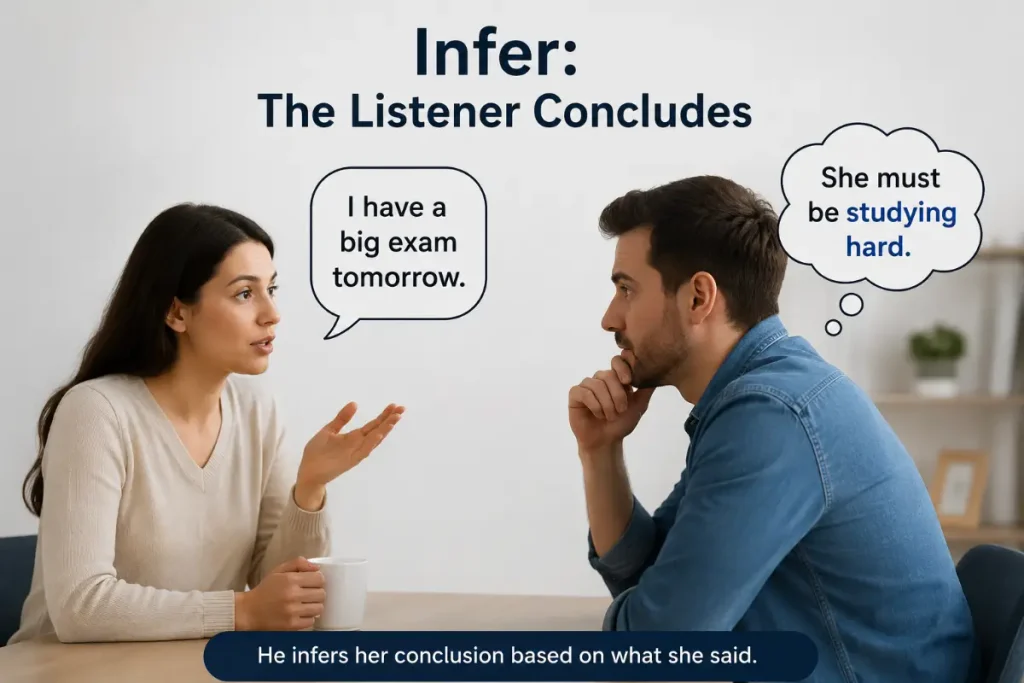
Infer: The Listener Concludes
Infer is what you do when you receive information — spoken, written, or observed — and draw a conclusion from it.
Examples:
- I inferred from her tone that something was wrong.
- Based on the data, researchers inferred a likely cause.
- We can infer his intentions from his past behavior.
- She inferred, correctly, that the meeting had been postponed.
- What can you infer from the evidence presented?
In every case, the subject is on the receiving end — interpreting, deducing, or concluding something based on information that came from somewhere else.
The Fastest Way to Check Yourself
Step 1: Are you the source of the suggestion, or the one interpreting it? Source means imply; interpreter means infer.
Step 2: Try the speaker/listener test directly. “The speaker implies; the listener infers” — this single sentence, as Cambridge Dictionary puts it, resolves the overwhelming majority of cases.
Step 3: Check what follows the word. Infer is very often followed by “from” (“infer from the evidence,” “infer from what she said”) — this reflects the fact that inferring always draws from some outside source. Imply doesn’t typically take “from” in the same way.
A widely used memory trick: imply and plant both relate to the idea of putting something into a conversation — think of implying as planting a seed of meaning. Infer and “in-take” both suggest bringing something in — think of inferring as taking in and processing a clue.
This kind of directional, who’s-doing-what confusion also shows up with bring and take — different mechanics, but the same underlying habit of pausing to ask “which direction is this actually moving?”
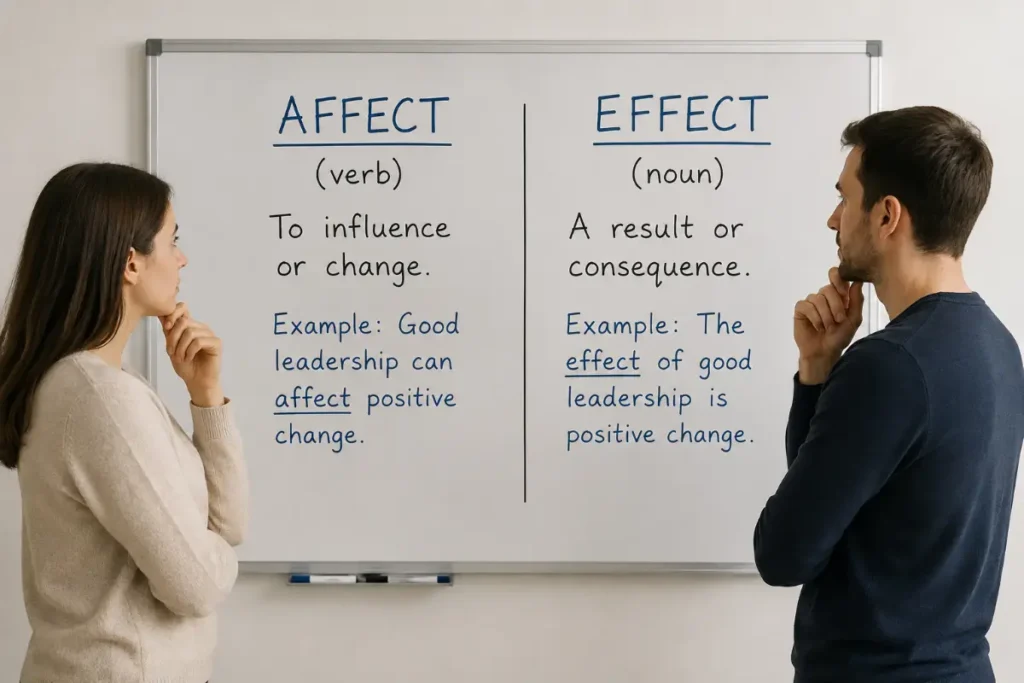
For another useful perspective, check out Affect vs Effect: The Simple Way to Never Mix Them Up Again.
Imply vs. Infer: Side-by-Side Comparison
| Imply | Infer | |
|---|---|---|
| Who does it | The speaker/source | The listener/interpreter |
| Direction | Sends a suggestion | Receives and concludes |
| Example | She implied displeasure. | I inferred she was displeased. |
| Common pairing | Implied by tone, implied by silence | Inferred from evidence, inferred from context |
| Related noun | Implication | Inference |
| Related adjective | Implicit | (No common adjective form) |
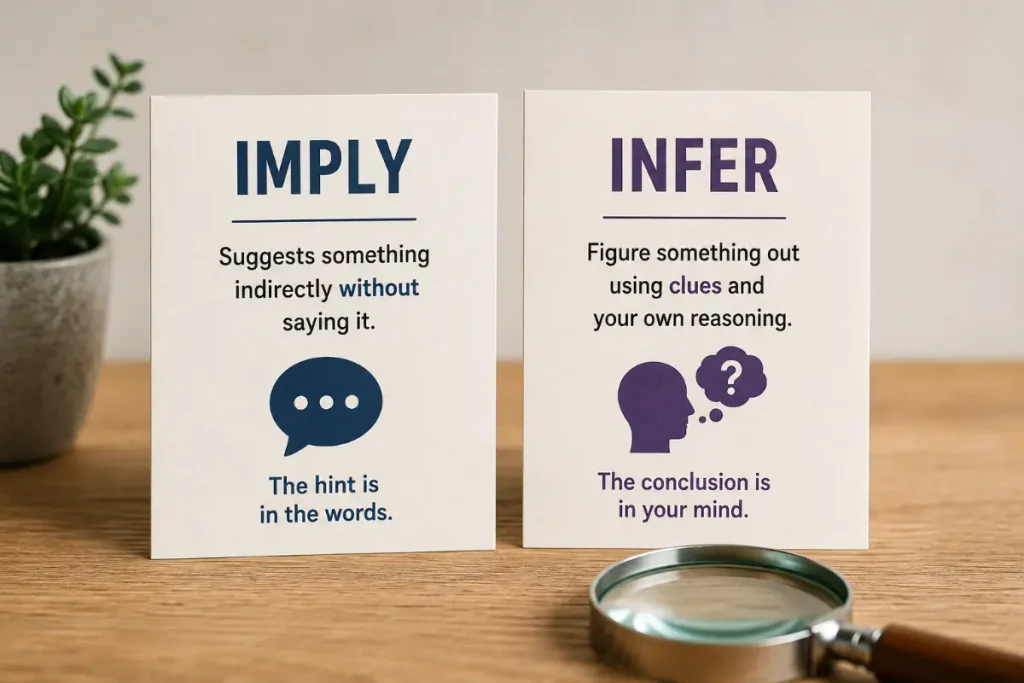
7 Key Differences You Need to Know
Understanding Imply vs Infer becomes much easier when you focus on who is doing what. The speaker or writer implies a meaning, while the listener or reader infers that meaning from the words, context, or clues. Here are seven key differences to help you use both words correctly.
1. Speaker vs. Listener
The speaker or writer implies something, while the listener or reader infers it. In simple terms, one person sends the message, and the other figures it out.
2. Suggesting vs. Understanding
Imply means to suggest an idea without stating it directly. Infer means to understand or conclude something based on what you hear, read, or observe.
3. Direction of Meaning
The meaning moves from the speaker to the listener when someone implies something. It moves from the listener to the conclusion when someone infers something.
4. Intent vs. Interpretation
Imply usually involves the communicator’s intended suggestion. Infer involves the other person’s interpretation or conclusion.
5. Active Roles
The person who implies creates or communicates a hidden or indirect message. The person who infers analyzes the available clues to work out that message.
6. Common Sentence Patterns
You can say, “She implied that she was upset,” because she suggested it indirectly. You can say, “I inferred that she was upset,” because you reached that conclusion from her words or behavior.
7. An Easy Memory Trick
Remember: Speakers imply; readers infer. If you’re putting an idea into someone’s mind indirectly, use imply. If you’re taking clues and reaching an idea yourself, use infer.
Common Mistakes People Make
Mistake 1: “Are you inferring that I’m wrong?” In careful modern usage, this should be “implying” — the speaker asking this question is accusing the other person of suggesting something, not asking whether the other person has drawn a conclusion. This is genuinely the single most common misuse of this pair.
Mistake 2: “I think she’s trying to infer something without saying it directly.” Should be “imply something” — trying to suggest something indirectly is imply’s job, not infer’s.
Mistake 3: “From the way he answered, I implied he was lying.” Should be “I inferred he was lying” — this is about drawing a conclusion from observed behavior, which is infer’s territory.
Mistake 4: Assuming both words can be used interchangeably in formal writing. While Merriam-Webster acknowledges the historical overlap, modern careful writing (especially professional, academic, and published contexts) expects the distinction to be maintained. Using infer to mean “suggest” in formal writing risks reading as an error to a knowledgeable reader, even if some historical usage would technically support it.
Mistake 5: “The evidence infers that the theory is correct.” Should be “implies that the theory is correct” — evidence, data, and reports are all sources generating a suggestion, so they imply; they don’t infer, since inferring requires an interpreting mind drawing a conclusion.
More Examples to Lock It In
- Her carefully worded email implied disappointment, and I inferred from the tone that she wanted an apology.
- The study’s authors were careful not to imply causation, though some readers inferred it anyway.
- He never said he was quitting, but his coworkers inferred as much from what he implied in the meeting.
- The contract doesn’t explicitly state a deadline, but one could reasonably infer one from the implied timeline in the project scope.
- She implied that budget cuts were coming; based on that, the team inferred layoffs might follow.
Practice Exercise
Fill in the blank with either “imply” or “infer.” Answers are listed right after — try each one before checking.
- Her expression seemed to ______ frustration.
- From his tone, I ______ that he was upset.
- Are you ______ing that I can’t handle this?
- Based on the data, we can ______ a strong correlation.
- The manager didn’t say it outright, but she ______d layoffs were coming.
- What do you ______ from his silence?
- His comment seemed to ______ that the project was failing.
- She ______d from the missed calls that something was wrong.
- The report doesn’t state it directly, but it ______s a decline in sales.
- I don’t want to ______ that you’re at fault.
- We can ______ his intentions from his actions.
- Her raised eyebrow ______d disbelief.
- From the evidence, detectives ______d the timeline of events.
- The ad ______s that the product will solve all your problems.
- I ______d from her question that she hadn’t read the report.
- His body language ______d he wasn’t interested.
- What can we reasonably ______ from these results?
- The email ______d a level of urgency that wasn’t stated outright.
- She ______d correctly that the meeting had been rescheduled.
- Nothing in his statement ______d any wrongdoing.
Answer Key
- imply
- inferred
- implying
- infer
- implied
- infer
- imply
- inferred
- implies
- imply
- infer
- implied
- inferred
- implies
- inferred
- implied
- infer
- implied
- inferred
- implied
If you got sixteen or more correct, the speaker/listener test has already become second nature. For any you missed, ask again: is this the source sending a suggestion (imply), or the receiver drawing a conclusion (infer)?
Imply and Infer in Different Writing Contexts
- In journalism and reporting, this distinction matters for legal and ethical reasons — a report that “implies” wrongdoing is making an editorial suggestion, while readers who “infer” wrongdoing are drawing their own conclusion. Careful publications distinguish these deliberately, since implying something false can carry real consequences in a way that noting what readers might infer does not.
- In academic and scientific writing, researchers are often careful to say their data “implies” a relationship without directly claiming it, while being equally careful about what conclusions readers are entitled to “infer” from that same data — the difference between suggesting and asserting is often central to how scientific claims are hedged and qualified.
- In everyday conversation, “are you inferring…?” is extremely common even though it’s usually technically backwards (the speaker asking this question typically means “are you implying”), and most listeners won’t blink at the switch — but it’s exactly the kind of slip that’s worth catching in anything written and published, where a more careful reader might notice.
- In legal writing, precision matters considerably — testimony, contracts, and legal opinions often hinge on exactly what was implied versus what a reasonable person would infer, making this one of the higher-stakes contexts for keeping the distinction precise.
Frequently Asked Questions
Is it ever historically correct to use “infer” to mean “suggest”?
Yes — Merriam-Webster confirms this usage dates back centuries, including in Shakespeare’s writing, and the objection to it as an “error” only really began in the 20th century. That said, modern readers and style guides overwhelmingly expect the imply/infer distinction to be maintained, so using infer to mean “suggest” in contemporary writing risks being read as a mistake, regardless of its historical pedigree.
What are the noun and adjective forms of these words?
“Implication” is the noun form of imply (as in “the implications of this decision”), and “implicit” is a related adjective meaning “understood without being directly stated.” Infer’s noun form is “inference” (as in “a reasonable inference”), but there isn’t a widely used adjective form built directly from infer.
Can something nonhuman, like data or evidence, “infer” anything?
No — inferring requires an interpreting mind drawing a conclusion, so only a person (or a reasoning system) can infer. Evidence, data, and reports can imply something, but they cannot infer anything themselves, since inferring is specifically the act of receiving and interpreting a suggestion.
Why does “infer” so often appear with the word “from”?
Because inferring inherently involves drawing a conclusion from some outside source — evidence, context, behavior, or speech. “Infer from” reflects that directional flow of information coming in, which is part of why checking for “from” nearby can help you quickly identify that infer is the correct word.
What’s the fastest way to catch this error before publishing something?
Ask directly: is the subject of the sentence generating a suggestion (imply), or drawing a conclusion from something else (infer)? The “speaker implies, listener infers” framing resolves nearly every case within seconds, and checking for a nearby “from” can help confirm infer specifically.
Before moving on, you may also want to read Flaunt vs Flout: Which Is Correct? 20 Easy Examples (2026 Guide) for more helpful grammar tips.
The Bottom Line
Imply is what a speaker or source does — suggesting something indirectly. Infer is what a listener or interpreter does — drawing a conclusion from that suggestion or from evidence. The single most reliable test: the speaker implies, the listener infers. Keep that direction of travel straight, and this pair stops being confusing.
Imply vs Infer comes down to who is doing what: the speaker or source implies by suggesting something indirectly, while the listener or reader infers by drawing a conclusion from that suggestion or evidence. The simplest test is to remember that the speaker implies, and the listener infers. Keep that direction clear, and this tricky pair becomes much easier to use correctly.