If you’ve ever answered “I feel good” and had someone smugly correct you to “I feel well,” you’ve been on the receiving end of one of the most persistent—and most overstated—grammar corrections in English. Good vs well can be confusing, but both are correct for different reasons. Once you understand why, that particular grammar gotcha loses all its power.
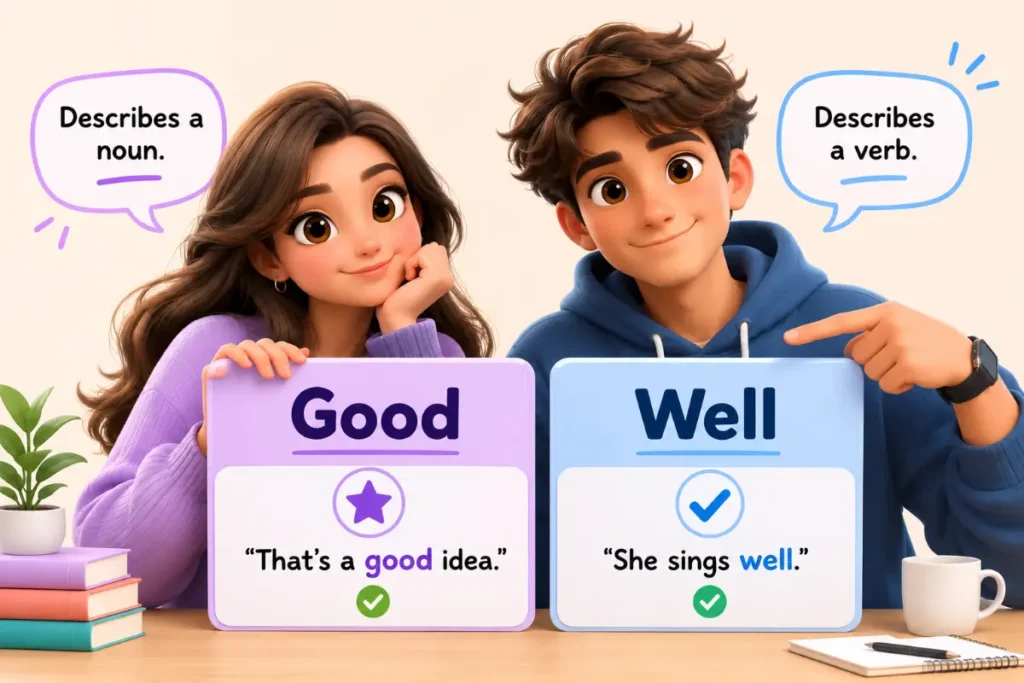
Good is an adjective — it describes people, places, and things. Well is primarily an adverb — it describes how an action is performed. That’s the basic rule. But there’s a specific, well-documented exception involving how you feel, and it’s worth understanding fully rather than just picking a side.
You may also find Lay vs Lie: The Verb Pair That’s Confused English Speakers In 2026 helpful if you want to explore this topic further.
The Quick Answer
- Good (adjective) = describes a noun
- That was a good movie.
- Well (adverb) = describes how an action was done
- She sang well at the concert.
The test: is the word describing a thing (a noun), or describing how an action happened (a verb)? If it’s a thing, use good. If it’s describing the manner of an action, use well.
Try it: “He’s a ___ cook.” Is “cook” a noun here? Yes — so it’s good: “He’s a good cook.”
Now try: “He cooks ___.” Is this describing how he performs the action of cooking? Yes — so it’s well: “He cooks well.”
The “I Feel Good” Exception, Explained Properly
Here’s where most quick grammar guides get this wrong, and where Merriam-Webster is refreshingly precise. “Feel” is what’s called a linking verb in this context — a verb that connects the subject to a description of its state, rather than describing an action being performed. Other linking verbs include “look,” “sound,” “smell,” “taste,” and “seem.” Linking verbs are typically followed by adjectives, not adverbs, because they’re describing the subject itself, not the manner of an action.
That means “I feel good” is grammatically correct — “good” is describing your overall state, just like in “I am happy” or “I am tired.” “I feel well” is also correct, but it means something slightly different: “well” here functions as an adjective specifically related to health, so “I feel well” specifically communicates that you’re not sick, rather than describing your general state of being.
So the real answer isn’t “well is correct and good is wrong” — it’s that both are correct, and they carry a subtle difference in meaning. “I feel good” is broader, covering mood, energy, and general well-being. “I feel well” leans specifically toward physical health. Neither one is a grammar error.
Good: The Adjective
Good describes nouns — people, places, things, and ideas.
Examples:
- That was a good decision.
- She’s a good teacher.
- We had a good time at the party.
- This is a good opportunity.
- He has good instincts.
In every case, “good” is answering the question “what kind?” about a noun sitting right next to it.
Well: The Adverb (Usually)
Well typically describes how an action is performed — it modifies a verb.
Examples:
- She plays the piano well.
- He explained the process well.
- The team worked well together.
- I slept well last night.
- The engine runs well now that it’s fixed.
In each of these, “well” is answering the question “how?” about the verb it’s attached to.

Well as an Adjective (The Health Exception)
This is the specific, legitimate case where “well” functions as an adjective rather than an adverb — describing a state of health.
Examples:
- I don’t feel well today.
- She wasn’t well enough to attend.
- He looks well for someone who just recovered from surgery.
- Get well soon.
Notice that in every one of these, “well” could be replaced with “healthy” or “unwell” (its opposite) and the sentence would still make grammatical sense — that’s the signature of well functioning as an adjective, tied specifically to health and physical condition, rather than as an adverb describing an action.
The Fastest Way to Check Yourself
Step 1: What’s the word describing — a noun, or how an action happened? If it’s a noun, use good.
Step 2: If it’s describing an action, is the verb a linking verb (feel, look, seem, smell, taste, sound) or an action verb (run, play, work, sing)?
Step 3: With linking verbs, both good and well can be correct — good describes your general state, well describes health specifically. With action verbs, well is the standard, grammatically expected choice for describing how the action was performed.
A helpful reframe: instead of asking “which one is correct,” ask “am I describing a thing, or describing how something was done?” That question resolves the vast majority of good/well decisions without needing to memorize the linking-verb exception at all.
Good vs. Well: Side-by-Side Comparison
| Good | Well | |
|---|---|---|
| Part of speech | Adjective | Primarily adverb; adjective for health |
| Describes | Nouns | Actions (adverb) or health state (adjective) |
| Example | a good meal | cooked well |
| With “feel,” “look,” “seem” | Correct — describes general state | Correct — describes health specifically |
| With action verbs (run, play, work) | Informal/nonstandard | Standard, expected |
| Formality | Standard everywhere | Standard everywhere; required in careful/formal writing for actions |
Where “Good” as an Adverb Actually Comes From
You’ll frequently hear sentences like “she sings good” or “the car runs good” in casual, spoken American English, and it’s worth understanding why this happens instead of just labeling it wrong. Merriam-Webster notes that adverbial “good” has been used this way in speech for a very long time, and that it carries a different connotation than “well” — “well” reads as neutral and standard, while “good” in this role feels more emphatic and emotionally charged, which is part of why it’s so common in casual, enthusiastic speech, particularly in sports commentary (“I’m seeing the ball real good”).
That said, in careful writing — reports, essays, professional communication — “well” remains the expected choice for describing how an action was performed. “She sings good” is understood by every English speaker and common in speech, but “she sings well” is what you’d want in anything you’re submitting, publishing, or sending professionally.
For another useful perspective, check out Farther vs Further: 5 Easy Rules to Get It Right (2026).
It’s a similar situation to less and fewer — a rule that’s firmer in formal writing than it is in the way people actually talk day to day, and knowing both registers helps you choose correctly depending on the context.
Common Mistakes People Make
Mistake 1: “She did really good on the exam.” In formal writing, this should be “did really well” — exam performance is an action being described, so the adverb “well” is expected. In casual speech, “did good” is extremely common and understood, but it’s worth adjusting in anything more formal.
Mistake 2: “I’m not doing good these days.” Similarly informal; “I’m not doing well” is the more standard choice in careful writing, since “doing” here functions more like an action being evaluated than a linking-verb state.
Mistake 3: Assuming “I feel good” is always wrong. This is the most common overcorrection. “I feel good” is completely standard, grammatically correct English — “feel” is a linking verb here, and “good” appropriately describes your overall state, not an action. There’s no rule that requires “well” in this specific case.
Mistake 4: “He plays well guitar.” Word order matters here — adverbs describing verbs generally go after the verb (and often after the object), so this should be “He plays guitar well,” not “well guitar.”
Mistake 5: Using “well” where “good” is clearly needed as an adjective for a noun. “That’s a well book” doesn’t work — “well” can’t modify a noun directly the way “good” can (outside the specific health-adjective use, like “a well person”). If you’re directly describing a thing, good is almost always the correct choice.
More Examples to Lock It In
- He’s a good singer, and he performed well at the audition.
- I don’t feel well today, even though I had a good breakfast.
- The team played well together, which made for a good season overall.
- She’s good at her job and explains things well to new hires.
- He looked good in the photo, but he said he wasn’t feeling well that day.
- It was a good movie, well acted and well directed.
- The soup tastes good, but I didn’t cook it as well as I’d hoped.
What the Style Guides Say
Merriam-Webster directly addresses the “I feel good” debate, explaining that the century-old insistence on “well” over “good” after linking verbs rests on shaky grounds — feel is a linking verb, and linking verbs are properly modified by adjectives, which is exactly what “good” is. The AP Stylebook and Chicago Manual of Style both maintain the traditional adjective/adverb distinction for action verbs in formal and published writing, expecting “well” to describe how something was done, while both acknowledge the legitimate adjective use of “well” for health.
The consistent takeaway across every major source: this is one grammar “rule” where the popular correction (“you should say well, not good”) is actually less accurate than the traditional grammar it claims to enforce. Knowing that gives you a genuinely useful piece of pushback the next time someone tries to correct your “I feel good.”
Good and Well in Different Writing Contexts
- In casual speech, “good” frequently substitutes for “well” even with action verbs (“she sings good”), and this is widely understood and rarely a real communication problem, even if it’s not the formally preferred choice.
- In professional and academic writing, “well” is expected for describing actions (“the project went well,” “she performed well under pressure”), while “good” remains correctly reserved for describing nouns directly.
- In creative writing and dialogue, “good” as an adverb often appears intentionally in character speech to sound natural and conversational, which is different from it being a writing error — it’s a deliberate stylistic choice reflecting how people actually talk.
- In health and wellness contexts specifically, “well” as an adjective is the standard, expected phrasing (“feeling well,” “get well soon,” “she’s not well”), and reaching for “good” here isn’t wrong, just slightly less precise about physical health specifically.
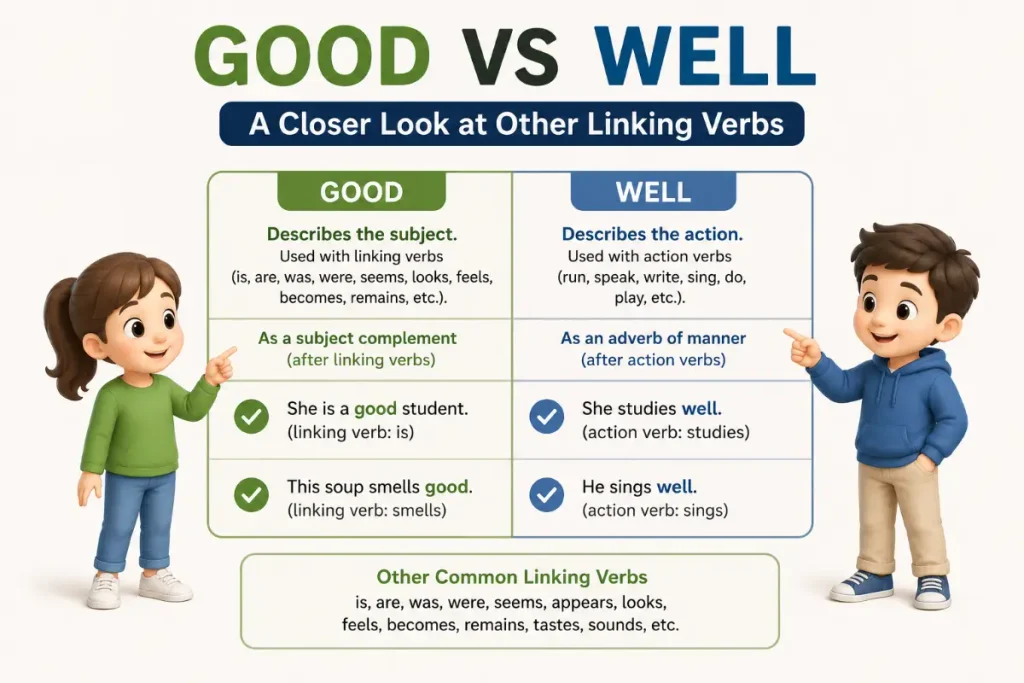
A Closer Look at Other Linking Verbs
Feel isn’t the only linking verb that follows this same good/adjective pattern — look, smell, taste, sound, and seem all work the same way, and knowing this helps you handle a whole family of sentences correctly, not just the “feel good” case.
- You look good in that jacket (describing your appearance, not the manner of looking)
- This cake smells good (describing the cake’s quality, not how it’s smelling something)
- That sounds good to me (describing the idea, not the manner of sounding)
- This soup tastes good (describing the soup, not how it’s tasting)
Each of these follows the same logic as “I feel good” — the linking verb connects the subject to a description of its state or quality, which calls for an adjective. Where it gets genuinely tricky is when these same verbs are used actively rather than as linking verbs. “She smelled the flowers well” (meaning she used her sense of smell effectively) is a completely different sentence structure than “the flowers smelled good” (describing the flowers themselves) — in the first, smell is an action being performed, so it takes the adverb; in the second, smell is linking the subject to a description, so it takes the adjective.
Frequently Asked Questions
Is “I feel good” actually grammatically correct, or just commonly accepted?
It’s genuinely, fully grammatically correct — not just a commonly tolerated error. “Feel” is a linking verb in this context, and linking verbs are properly followed by adjectives describing the subject’s state, which is exactly what “good” does here.
So what’s the actual difference between “I feel good” and “I feel well”?
“I feel good” describes your general state — mood, energy, overall well-being. “I feel well” specifically indicates you’re not sick; “well” here is functioning as a health-related adjective. Both are correct; they just emphasize slightly different things.
Is it ever wrong to say “well” instead of “good”?
Yes — “well” can’t directly describe a noun the way “good” does. You wouldn’t say “that’s a well restaurant”; you’d say “that’s a good restaurant.” Well is reserved for describing actions (as an adverb) or health specifically (as an adjective).
Why do people insist so strongly that “well” is the only correct answer to “how are you?” This traces back to a 19th-century schoolroom correction that treated “good” as applying only to morality, not physical or emotional state — a distinction Merriam-Webster notes was never fully accurate to begin with, even by the grammar standards of the time it was introduced.
Is “good” ever correct as an adverb in formal writing?
Generally no — in careful, formal, or professional writing, “well” remains the expected choice for describing how an action was performed. “Good” as an adverb (“she sings good”) is a feature of informal spoken English, not standard written English.
Practice Exercise
Fill in the blank with either “good” or “well.” Answers are listed right after — try each one before checking.
- She’s a really ______ writer.
- He doesn’t feel ______ today.
- The team performed ______ under pressure.
- That was a ______ decision.
- I slept ______ last night.
- This is a ______ opportunity for growth.
- She sings ______, especially live.
- He looked ______ despite being tired.
- We had a ______ time at the reunion.
- The presentation went ______ overall.
- That’s a ______ point you made.
- He’s not ______; he’s been sick all week.
- She explained the topic ______.
- It smells ______ in here.
- The soup tastes ______ tonight.
- He plays chess extremely ______.
- That was a ______ movie.
- I’m doing ______, thanks for asking.
- The report was written ______.
- She has ______ instincts about people.
Answer Key
- good
- well
- well
- good
- well
- good
- well
- good
- good
- well
- good
- well
- well
- good
- good
- well
- good
- well
- well
- good
If you got sixteen or more correct, you’ve genuinely internalized the noun-versus-action distinction — and remember, on questions like 18 (“I’m doing well” vs. “I’m doing good”), both are defensible depending on whether you’re describing your state or evaluating an action, so don’t stress too hard over that particular one.
Before moving on, you may also want to read Who vs Whom: The Simple Test That Ends the Confusion (2026 Guide) for more helpful grammar tips.
The Bottom Line
Good describes things; well describes how actions are performed, and also doubles as an adjective specifically for health. “I feel good” isn’t a grammar mistake — it’s a linking-verb construction that’s been correct all along, despite generations of well-meaning but inaccurate correction. Use well for actions in formal writing, and don’t let anyone convince you that “I feel good” needs fixing.