Knowing how to use used to vs would is the key to talking about past habits and memories naturally. Both can describe things you did regularly long ago, so they look interchangeable, but one of them has a hidden limit that catches nearly everyone: “would” can’t describe a past state.
This guide sorts out exactly when each one works, when only “used to” will do, and how to avoid the look-alike “be used to,” which means something completely different.
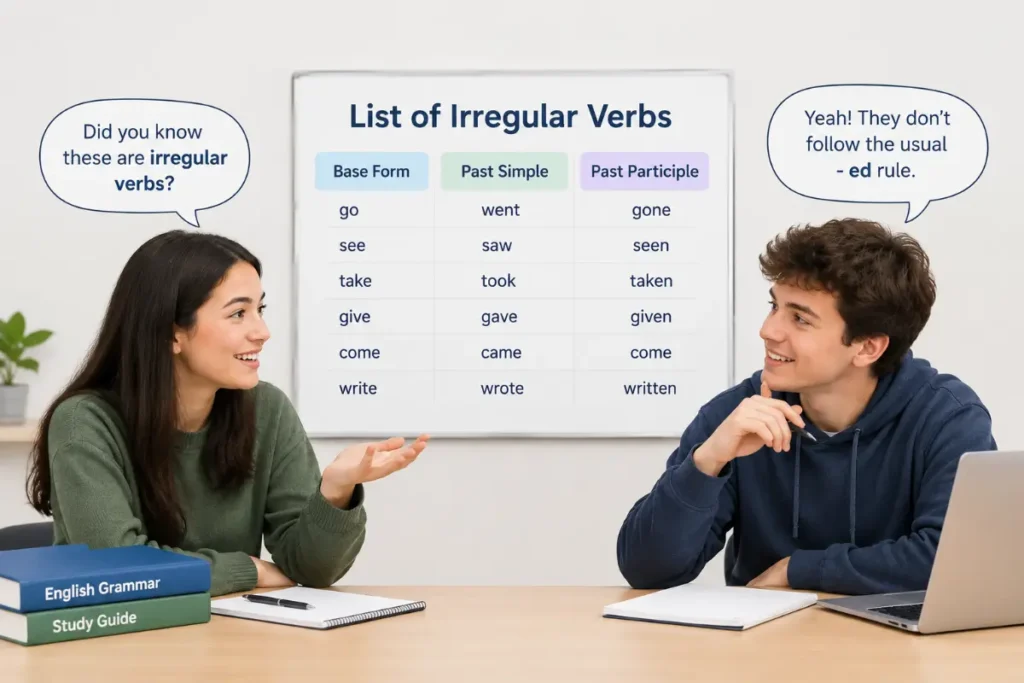
You may also find Common List of Irregular Verbs (2026 Guide) helpful if you want to explore this topic further.
What Each One Describes
Used to describes two things that were true in the past but aren’t anymore: repeated actions (habits) and states (situations).
- We used to visit my grandparents every Sunday. (habit)
- She used to be very shy. (state)
- There used to be a cinema on this street. (state)
Would describes repeated actions only, and it needs a past context that’s already clear.
- Every summer, he would take us fishing.
- On Saturdays, my dad would make pancakes.
The British Council’s LearnEnglish page on past habits explains that we use both to talk about things we did regularly in the past, with “used to” also covering past states.
The Rule That Settles Most Cases
If the sentence describes a state (be, have, know, like, live, believe, own), use used to, not “would.”
- ✔ I used to have a bike.
- ✘ I would have a bike. (this doesn’t mean past possession; it sounds hypothetical)
- ✔ She used to be a teacher.
- ✘ She would be a teacher.
If it’s a repeated action, either works.
- We used to play outside until dark.
- We would play outside until dark.
Setting the Scene Before Using “Would”
“Would” for habits usually follows a sentence that establishes the past time first. That opening often uses “used to” or a clear time frame, and then “would” carries the story.
- When I was a kid, we used to spend summers at my uncle’s farm. We would get up at dawn, feed the chickens, and then run to the creek.
Starting a story cold with “would” can leave listeners unsure whether you mean a past habit or a hypothetical.
Questions and Negatives
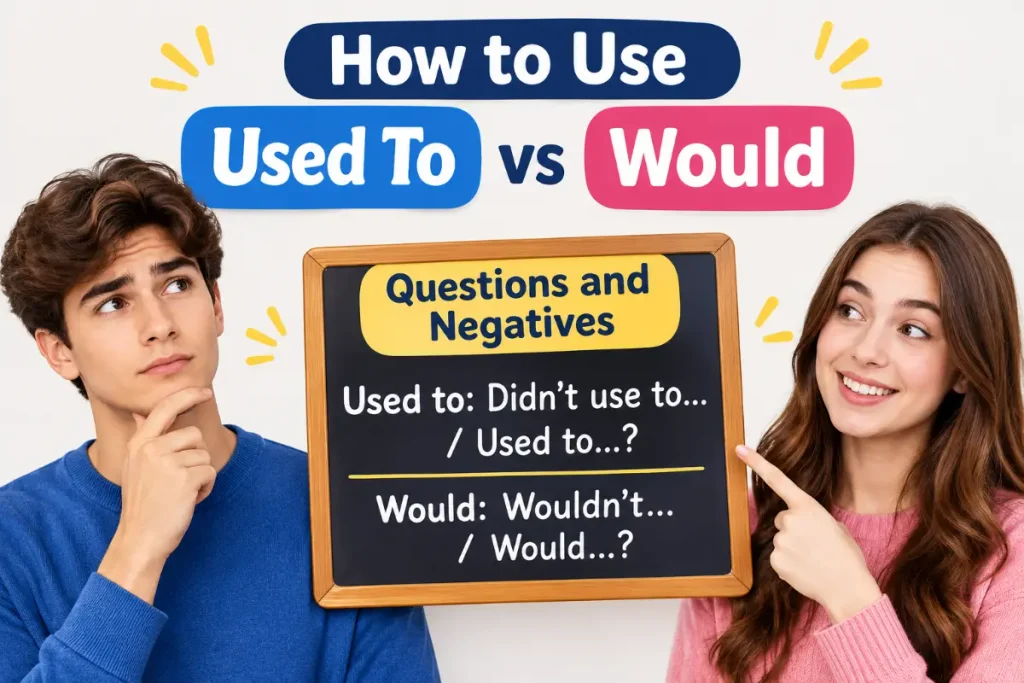
For questions and negatives, “used to” borrows “did” and drops the “d” from “used.”
- Did you use to live here?
- I didn’t use to like olives.
You’ll also see “didn’t used to” in informal writing, but “didn’t use to” is the standard form. “Would” is rare in past-habit questions and negatives, so most speakers choose “used to” or the past simple.
One-Time Events Need the Past Simple
Neither “used to” nor “would” works for something that happened once or for a specific number of times.
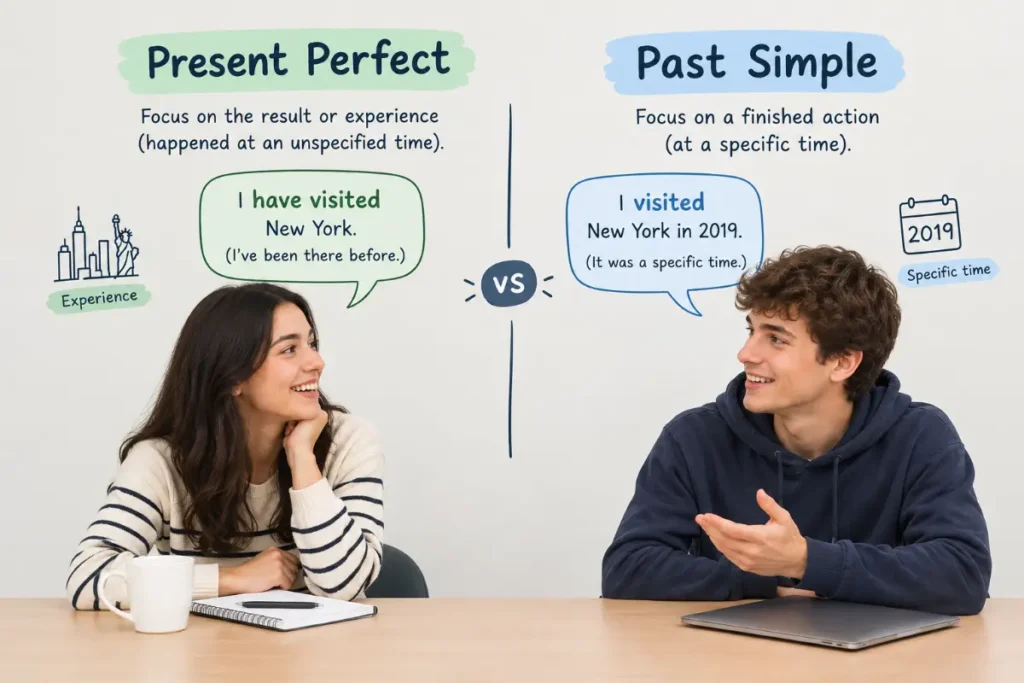
- ✔ I went to Egypt in 2014.
- ✘ I used to go to Egypt in 2014.
Don’t Confuse It With “Be Used To”
“Be used to” and “get used to” mean “be accustomed to.” They’re followed by a noun or an -ing form, and they can appear in any tense.
- I’m used to waking up early. (it’s normal for me)
- It took a month, but I got used to the noise.
- I used to wake up early. (I did this in the past; I don’t anymore)
If you can swap in “accustomed to,” you need “be used to.”
Used To vs. Would: Examples in Everyday English
The easiest way to understand the difference between “used to” and “would” is to see how people use them when talking about childhood memories, old routines, and past experiences. Both forms can describe repeated actions, but only “used to” works for past states.
Here are some everyday examples to make the distinction clearer.
Talking about childhood habits:
- When I was little, I used to ride my bike around the neighborhood.
- Every afternoon, my friends would come over to play.
- We used to visit our cousins during summer vacation.
- My grandmother would tell us bedtime stories every night.
Talking about past states:
- I used to be afraid of dogs.
- She used to have long hair.
- My family used to live in Chicago.
- There used to be a bookstore near my house.
Notice that “would” doesn’t work naturally in these examples because they describe situations or conditions rather than repeated actions.
Talking about old routines:
- My dad used to make breakfast before work.
- Every Sunday, he would take us to the park.
- We used to watch movies together on Friday nights.
- During winter, my mother would prepare hot chocolate for everyone.
Both forms work for these repeated actions because the past time frame is clear.
The key is to look at what the sentence describes. If you’re talking about something you regularly did, you can often use either form. If you’re describing how something was or what someone had, “used to” is the better choice.
When to Use Used To, Would, or the Past Simple
Although “used to,” “would,” and the past simple can all describe past events, they don’t always communicate the same meaning. Choosing the right form depends on whether you’re describing a past habit, a past state, or a completed event.
1. Use “used to” for past habits and states.
Use “used to” when something was regularly true in the past but is no longer true.
- I used to play basketball after school. (past habit)
- She used to work at a bank. (past situation)
- They used to own a small restaurant. (past state)
2. Use “would” for repeated past actions.
Choose “would” when describing actions that happened regularly in a particular past period. The time frame should already be clear.
- Every morning, my grandfather would read the newspaper.
- During summer break, we would swim in the lake.
- Whenever it rained, the children would play board games.
However, avoid “would” for past states such as having a job, owning something, or being a particular way.
3. Use the past simple for one-time events and general past facts.
The past simple is the right choice when something happened once, at a specific time, or when you simply want to report a completed past action.
- I visited New York last summer.
- She graduated from college in 2022.
- We watched that movie yesterday.
- He bought his first car three years ago.
Here’s a quick comparison:
| Situation | Correct form | Example |
|---|---|---|
| Repeated past habit | Used to / Would | We used to play outside. |
| Past state | Used to | I used to be shy. |
| Repeated past action | Would | Dad would cook every Sunday. |
| One-time event | Past simple | We visited Texas in 2020. |
| Specific past achievement | Past simple | She won the competition. |
Remember, “used to” is generally the safest option when you’re unsure whether a past situation describes a habit or a state. Use “would” when you’re clearly describing repeated actions, and choose the past simple for individual completed events.
Can You Use Used To and Would in the Same Sentence?
Yes! You can use “used to” and “would” together in the same sentence or paragraph when talking about past habits and memories. In fact, combining them often makes storytelling sound more natural.
The important thing is to use each expression for the type of situation it describes.
For example:
When I was a child, I used to spend my summers at my grandparents’ house. Every morning, my grandfather would wake up early, and my grandmother would prepare breakfast for everyone.
In this example:
- “Used to spend” introduces a past habit and establishes the time frame.
- “Would wake up” describes a repeated action.
- “Would prepare” describes another repeated action.
Here are a few more examples:
- I used to live near the beach, and my friends would visit me every weekend.
- We used to spend Christmas with our cousins. My uncle would decorate the house, and my aunt would bake cookies.
- She used to work in a small office. Every morning, she would arrive early and make coffee for her coworkers.
You can also use “used to” and “would” when describing different parts of a past routine:
I used to be very shy in school, but I would always participate in group projects when my teachers encouraged me.
Here, “used to be” describes a past state, while “would participate” describes a repeated action.
One important rule remains: don’t use “would” simply because you’ve already used “used to” in the same paragraph. Each expression must still fit the meaning of its sentence.
For another useful perspective, check out Third Conditional Examples: Imagining a Different Past (2026).
Using both correctly helps you describe old routines, childhood memories, and past experiences without making every sentence sound repetitive.
Quick Reference
| Meaning | Form | Example |
|---|---|---|
| Past habit | used to / would | We used to / would swim daily. |
| Past state | used to only | She used to be shy. |
| One-time past event | past simple | We went to Paris in 2019. |
| Accustomed to | be/get used to + -ing | I’m used to driving at night. |
| Negative/question | did + use to | Did you use to smoke? |

Common Mistakes People Make
Mistake 1: I would live in Boston when I was a child. “Live” is a state: I used to live in Boston.
Mistake 2: I didn’t used to like it. Standard form: I didn’t use to like it.
Mistake 3: I’m used to wake up early. After “be used to,” use -ing: I’m used to waking up early.
Mistake 4: I used to go there last year. One specific time takes the past simple: I went there last year.
Mistake 5: Opening a story with “would” and no context, leaving the reader unsure whether you mean a habit or a hypothetical.
Practice Exercise
Choose “used to,” “would,” “both,” or the past simple. Answers follow.
- When I was a kid, we ___ visit my grandparents every Sunday. (used to / would / both)
- She ___ be very shy. (used to / would)
- We ___ have a dog called Max. (used to / would)
- Every summer, he ___ take us fishing. (used to / would / both)
- I ___ to Egypt in 2014. (used to go / went)
- ___ you ___ smoke? (Did…use to / Would…)
- I ___ like olives, but now I love them. (didn’t use to / wouldn’t)
- There ___ be a cinema on this street. (used to / would)
- In winter, she ___ knit by the fire for hours. (used to / would / both)
- He ___ be the fastest runner in school. (used to / would)
- Fix: I would live in Boston when I was a child.
- Fix: She would be very quiet as a girl.
- Complete: I’m not used to ___ (drive) on the left.
- Complete: It took a month, but I got used to ___ (wake) up early.
- “I used to wake up early” means: (a) I did this regularly in the past (b) I’m accustomed to it.
- “I am used to waking up early” means: (a) I did this in the past (b) I’m accustomed to it.
- He ___ have a beard. (used to / would)
- Which is correct? (a) Did you use to live here? (b) Would you live here? (for a past habit)
- On Saturdays, my dad ___ make pancakes. (used to / would / both)
- Which is incorrect? (a) I used to have a bike. (b) I would have a bike. (past possession)
Answer Key
- both
- used to
- used to
- both
- went
- Did…use to
- didn’t use to
- used to
- both
- used to
- I used to live (or lived) in Boston when I was a child.
- She used to be very quiet as a girl.
- driving
- waking
- (a)
- (b)
- used to
- (a)
- both
- (b)
Frequently Asked Questions
Can I use “would” for past states like “be” or “have”?
No. “Would” describes repeated actions only. For past states, use “used to” or the past simple.
Is “didn’t use to” or “didn’t used to” correct?
“Didn’t use to” is the standard form because “did” already carries the past tense. “Didn’t used to” appears in informal writing, but it’s best avoided in formal text.
What’s the difference between “used to” and “be used to”?
“Used to” talks about past habits and states that are no longer true. “Be used to” means “accustomed to” and is followed by a noun or -ing form.
Do I need a time reference when I use “would” for habits?
Usually, yes. The past time frame should be clear from the context, often established earlier with “used to” or a phrase like “when I was young.”
What’s the fastest way to check my sentence?
Ask whether you’re describing a state or an action. States need “used to”; actions can use either. Then check you didn’t mean “accustomed to.”
Before moving on, you may also want to read Mixed Conditionals Explained: 2026 Guide for more helpful grammar tips.
Wrapping Up
The simplest way to remember how to use used to vs would is this: “used to” handles both past habits and past states, while “would” handles only repeated actions in a clear past context. When in doubt, “used to” is the safer choice, and the past simple always works for one-time events.
Watch out for the “be used to” trap, and remember the “didn’t use to” spelling. For more on how “would” fits among other helper verbs, see our modal verbs list, and for how past-time sentences stay consistent, take a look at the sequence of tenses rules.